Period
The Old Babylonian period (c. 2000–1595 BCE)
- Timeline
- From 2000 BCE to 1595 BCE
- Region
- Mesopotamia
After Ur fell, Isin and Larsa competed for power in southern Mesopotamia. Hammurabi brought much of the region under Babylon. The dates of that rise and of the dynasty’s end depend on the chronology used.
Estimated reading time: 5 min Published Last reviewed:
Share article
Text
Introduction
“Old Babylonian” is the name historians give to the centuries after the fall of the Third Dynasty of Ur. Several ruling dynasties in southern MesopotamiaMesopotamiaHistorical region associated with the Tigris and Euphrates: Uruk, Ur, Eridu, cuneiform, Sumer, Akkad, Babylon and Assyria, their languages and cults, and the limits of archaeological evidence.Glossary · Click to read the explanation traced their origins to the AmoritesAmoritesGroups associated with West Semitic speech in the Levant and Mesopotamia, whose dynasties were particularly prominent in the nineteenth and eighteenth centuries BCE (ca. 1900–1700 BCE).Glossary · Click to read the explanation, and BabylonBabylonBabylon is an ancient city in central present-day Iraq, south of BaghdadGlossary · Click to read the explanation became the capital of a kingdom that expanded under HammurabiHammurabiKing of Babylon in Mesopotamia, reigning around 1792–1750 BCE. A celebrated legal text preserved on a stele and cuneiform copies bears his name.Glossary · Click to read the explanation. Letters, contracts, school tablets and Hammurabi’s law collection document different aspects of the period. [10]
Dates, and two ways of using the name
In its wider sense, the name covers the centuries from the fall of Ur around 2000 BCE to the fall of Babylon. That span includes the Isin-Larsa period, named for two rival kingdoms in the south. In a narrower sense, the name refers to Babylon’s First Dynasty. This article follows the Middle Chronology, which dates the sack of Babylon to 1595 BCE. In the Low Chronology it falls in 1531 BCE. Reconstructions have used records of Venus from the reign of Ammisaduqa, but the readings and astronomical identifications remain debated. Proposed identifications of eclipses also depend on disputed links to historical events. [10][11][12]
Phase one: Isin and Larsa
After the collapse of Ur III, Isin emerged as a regional power under Ishbi-Erra, a former official of Ur. At different times its kings controlled Ur and Nippur. Gungunum of Larsa later took Ur, and Rim-Sin I of Larsa (record 835) conquered Isin before Hammurabi came to the throne. Control of the southern cities shifted over these centuries, and Larsa held the upper hand by the end of the rivalry. [10][13]
Phase two: Babylon becomes a kingdom
The first kings of Babylon belonged to an Amorite dynasty. Later king lists place Sumu-abum before Sumu-la-El. Rients de Boer proposes that their careers overlapped, with Sumu-abum a regional leader and Sumu-la-El the first king of Babylon. Records from Sumu-la-El’s reign document his hold on Kish and Dilbat, and a year name commemorates work on fortifications in his kingdom. [13][14]
Hammurabi and the empire of Babylon
On the Middle Chronology, Hammurabi (record 315) ruled from 1792 to 1750 BCE. Babylonians identified years by names that recalled royal acts such as building walls, restoring temples or digging canals. One list from the Sulaymaniyah Museum counts 42 formulas, including readings that differ from those in other copies. The formula for year 33 celebrates a canal said to have supplied water to cities including Nippur, Ur, Larsa and UrukUrukAncient city at Warka in southern Iraq, a major urban centre around 3200 BCE that preserved early writing and accounting tablets.Glossary · Click to read the explanation. [12][15][16]
Hammurabi’s conquests expanded his rule across southern Mesopotamia. The name of his 31st year commemorates the defeat of Rim-Sin I and Yamutbal, and Babylon took control of Larsa’s kingdom. Farther upstream, Hammurabi captured Mari (record 15) in 1761 BCE on the Middle Chronology. His 35th year name commemorates the destruction of the walls of Mari and Malgium. The Mari palace archive also supplies evidence for the sequence of events there. [10][16][19]
Hammurabi’s law collection (record 316) survives on a stele now in the Louvre. The relief shows the king standing before the seated sun god ShamashShamashMesopotamian god of the sun and justice, shown before Hammurabi on an eighteenth-century BCE stele preserved in the Louvre.Glossary · Click to read the explanation. In the prologue, Anu and EnlilEnlilEnlil/Ellil: a major Mesopotamian god associated with destinies, kingship, and Ekur at Nippur, already prominent in third-millennium god lists. His name’s origin and cult beginnings remain debated.Glossary · Click to read the explanation assign MardukMardukBabylon’s leading god, worshipped at Esagil and elevated in the Akkadian Enūma eliš. His symbols include a spade and mušḫuššu dragon. His earliest origins remain obscure; Nibiru is no evidence of a planetary homeland.Glossary · Click to read the explanation preeminence, and Hammurabi presents his rule as a charge to establish justice. The inscription brings a collection of legal cases together with that claim of royal authority. [17][18]
Mari: a window into the age
The palace archive of Mari, on the middle Euphrates, preserves about 20,000 tablets and fragments. Most date from the last two decades of the palace, including the rule of Zimri-Lim (record 904). The letters and administrative records document diplomacy and the work of provincial officials. Labels found in the palace record the sorting of some correspondence after Hammurabi took the city in 1761 BCE. The palace was demolished in 1759 BCE on the same chronology. [19]
Language and school
Old Babylonian is a form of AkkadianAkkadianAn ancient East Semitic language written in cuneiform from the third millennium BCE; its varieties include Babylonian and Assyrian, and it served in international diplomacy.Glossary · Click to read the explanation, the language of Hammurabi’s law collection. Scholars debate when SumerianSumerian languageAncient language of southern Mesopotamia, clearly attested in third-millennium BCE texts and maintained in learning and ritual after its spoken use declined.Glossary · Click to read the explanation ceased to be a first language. Scribes continued to learn it and copy its hymns, myths and other literature. Many Sumerian works survive in copies from the Old Babylonian period. [10][18][20]
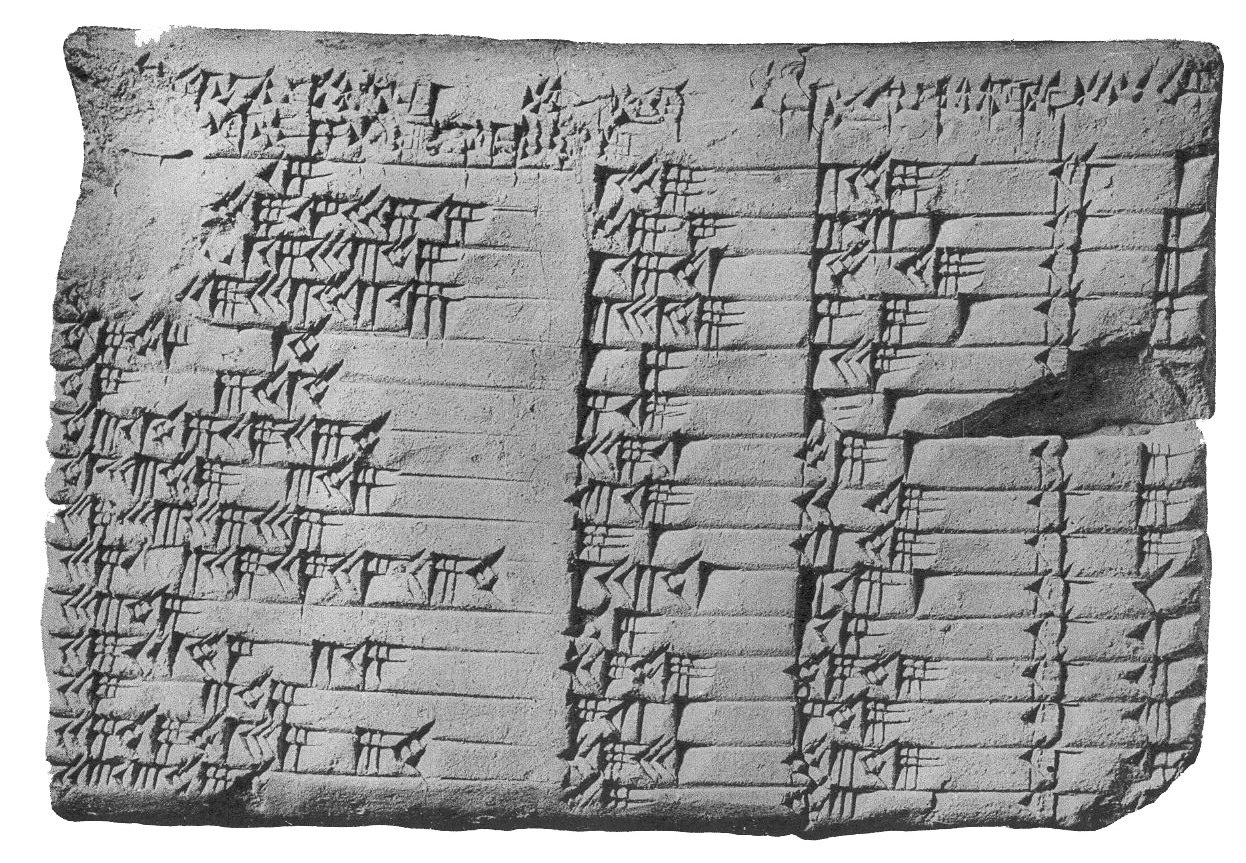
Plimpton 322 is a fragmentary clay tablet about 12.5 by 8.8 centimetres. The surviving portion has four columns and fifteen rows of numbers in base 60. Two columns give the width and diagonal of rectangles. In modern terms, the entries allow us to reconstruct sets of three numbers proportional to the sides of a right triangle. Eleanor Robson interprets the tablet as a list of material for a teacher, while Daniel Mansfield reads it as a study of rectangles. Its exact findspot is unknown and Larsa is a possible provenance. George Plimpton acquired it in 1922 or 1923, and it went to Columbia University in 1936. [21][22][23]
Decline after Hammurabi
Under Hammurabi’s son Samsu-iluna (about 1749–1712 BCE on the Middle Chronology), Babylon’s hold on the south weakened. Tablets from several southern cities carry year names of Rim-Sin II, attesting to his rival rule. Samsu-iluna’s own year names claim victories and the destruction of the walls of Ur and Uruk. Dated documents from these cities become scarce. A later archive excavated at Tell Khaiber near Ur provides evidence for administration under the First Sealand Dynasty in southern Babylonia. [12][13][24]
The end of the dynasty
Hammurabi’s successors, including Ammisaduqa (record 943), ruled a smaller kingdom. The Hittite Proclamation of Telipinu recounts that Mursili I marched against Babylon and sacked it. The raid marks the end of Babylon’s First Dynasty. The conventional date of 1595 BCE follows the Middle Chronology. [10][12][25]
Why it matters
The Old Babylonian period gives us laws, letters, school tablets and mathematical texts alongside records of Babylon’s rise. Royal year names show what kings chose to commemorate, and the Mari archive shows what officials wrote to one another. Each kind of record answers different questions. Converting the order of reigns and events into calendar dates still depends on which chronology is used. [12][16][19][21]
References and notes
- Wikipedia, 'Old Babylonian Empire' (secondary summary) Page read via fetch summary: chronology (middle/short), early Amorite kings, Hammurabi, Mari, decline, fall and eclipse dating; scribal schools and mathematics not covered by the page Return to the text ↑
- Wikipedia, 'Isin-Larsa period' (secondary summary) Page read via fetch summary: dates, Ishbi-Erra, Gungunum, Rim-Sin I, Enlil-bani, end under Hammurabi, debated points Return to the text ↑
- Wikipedia, 'Hammurabi' (secondary summary) First 100,000 of 195,996 characters: reign, year-names, Elam coalition, Larsa, Eshnunna, Mari, governance, code, debates; the final part was not read Return to the text ↑
- Wikipedia, 'Samsu-iluna' (secondary summary) Page read via fetch summary: revolts, Rim-Sin II, abandonment of southern cities, Sealand dynasty, first mention of Kassites Return to the text ↑
- Wikipedia, 'Plimpton 322' (secondary summary) Page read via fetch summary: date, provenance, content, interpretations Return to the text ↑
- Wikipedia, 'Mari, Syria' (secondary summary) First 100,000 of 237,226 characters: Zimri-Lim period, archive, letters, destruction; the rest was not read Return to the text ↑
- Wikipedia, 'Akkadian language' (secondary summary) First 100,000 of 190,325 characters: Old Babylonian dialect, replacement of Sumerian; the rest was not read Return to the text ↑
- Wikipedia, 'Mursili I' (secondary summary) Page read via fetch summary: the sack of Babylon, date, motives, aftermath Return to the text ↑
- Wikimedia Commons file page, 'Plimpton 322.jpg' File page read: licence (Public Domain Mark, published before 1931), description, source, size Return to the text ↑
- The Metropolitan Museum of Art, “The Isin-Larsa and Old Babylonian Periods (2004–1595 B.C.),” Heilbrunn Timeline of Art History. Opening historical overview and “Art and Culture.” Return to the text ↑
- Hermann Gasche, James A. Armstrong, Steven W. Cole and Vahe G. Gurzadyan, Dating the Fall of Babylon: A Reappraisal of Second-Millennium Chronology (Chicago and Ghent, 1998). Chs. 1 and 4, survey of proposed chronologies and discussion of the astronomical data. Return to the text ↑
- Walther Sallaberger and Ingo Schrakamp, “Philological Data for a Historical Chronology of Mesopotamia in the 3rd Millennium,” in History & Philology, ARCANE III (Brepols, 2015). §1.3, p. 6, comparison of chronologies and discussion of astronomical evidence. Return to the text ↑
- Howard Martin Farber, An Examination of Prices and Wages in Babylonia – ca. 2000–1600 B.C.E. (University of Chicago, 2021), PhD dissertation. Part II, discussion of Gungunum, Sumu-la-El and Samsu-iluna. Table 5.1-1 and text on Rim-Sin II and the south. Return to the text ↑
- Rients de Boer, “Beginnings of Old Babylonian Babylon: Sumu-abum and Sumu-la-El,” Journal of Cuneiform Studies 70 (2018). Author’s abstract, early royal succession and proposed overlap. Return to the text ↑
- Ardalan Khwshnaw, “A New Old Babylonian Date List with Hammurapi Year Names,” Journal of Studies in History and Archaeology. Abstract, text and comparisons of the date list SM 038125. Return to the text ↑
- Cuneiform Digital Library Initiative, Mesopotamian Year Names, “Hammu-rabi” (Babylon). Year names 4, 9, 31a–b, 33, 34 and 35a–b. Return to the text ↑
- Musée du Louvre, “Code de Hammurabi,” collection record Sb 8 and AS 6064. Catalogue description of the relief and inscription. Return to the text ↑
- Cuneiform Digital Library Initiative, “Laws of Hammurapi,” composite text P464358. Prologue, opening lines and introduction of Hammurabi’s mandate. Return to the text ↑
- PROCLAC (CNRS and Collège de France), “Archives royales de Mari.” Reigns, conquest, dating of the palace destruction, archival labels and tally of tablets and fragments. Return to the text ↑
- Christopher Woods, “Bilingualism, Scribal Learning, and the Death of Sumerian,” in Seth L. Sanders (ed.), Margins of Writing, Origins of Cultures, OIS 2 (Chicago, corrected printing 2007), pp. 95–124. Discussion of language shift, bilingualism and the continuation of learned Sumerian. Return to the text ↑
- Institute for the Study of the Ancient World, NYU, “Table of whole-number sides of Pythagorean triangles,” Before Pythagoras: The Culture of Old Babylonian Mathematics. Object entry for Columbia University Plimpton 322, dates, possible Larsa provenance, acquisition and transfer. Return to the text ↑
- Eleanor Robson, “Neither Sherlock Holmes nor Babylon: A Reassessment of Plimpton 322,” Historia Mathematica 28 (2001), 167–206. Fig. 1, table I, dimensions, discussion of provenance and interpretation of the tablet as material for teaching. Return to the text ↑
- Daniel F. Mansfield, “Plimpton 322: A Study of Rectangles,” Foundations of Science 26 (2021), 977–1005. Abstract and interpretation of the tablet as a study of rectangles. Return to the text ↑
- Stuart Campbell, Robert Killick, Jane Moon, Dan Calderbank and Eleanor Robson, “Summary report on excavations at Tell Khaiber, an administrative centre of the Sealand period, 2013–2017,” Sumer 65 (2021), 15–46. Historical background, findings and the excavated administrative archive. Return to the text ↑
- “Edict of Telipinu” (CTH 19), English translation excerpt reproduced in University of Massachusetts Lowell, History 213, Lecture 8 (2012). §§8–9, accession of Mursili and account of the expedition to Babylon. Return to the text ↑
Suggest a correction · Suggest a source for this record
Cite this record
IL Archive, «The Old Babylonian period (c. 2000–1595 BCE)», https://ilarchive.com/en/periods/old-babylonian-period