Study
Mary and the palm: accounts, dates and limits of the relationship
An extended study of a topic, with evidence and references.
Surah Maryam, Pseudo-Matthew, Dormition traditions, Leto and Apollo: birth, journey and tree miracle, distinguishing composition, manuscript and episode dates.
Share article
Text
Introduction
Why do Mary, a palm, fruit and water appear both in the QuranQuranCentral text of Islam, used here as evidence of its religious discourse.Glossary · Click to read the explanation and in a Christian infancy narrative? This study compares surah Maryam 19:22–33 with the Gospel of Pseudo-MatthewGospel of Pseudo-MatthewLatin work on Mary and Jesus’ childhood, distinct from canonical Matthew.Glossary · Click to read the explanation 20–21, and reads other Christian and Greek texts to trace the image's history. It asks what each account says and when its surviving form can be documented.
The Quran belongs to the seventh century CE. Scholars place Pseudo-Matthew's composition roughly between 550 and 800 CE, but the date of its palm episode is less certain. The Quranic palm stands at childbirth; Pseudo-Matthew's stands on the journey to Egypt after the birth. Comparing scenes, witnesses and dates raises the question of a relationship without proving direct borrowing. [1] [3] [8]
What does surah Maryam say?
The unit considered here begins with Mary withdrawing from her family. Her LordRabbTitle of lordship, ownership or care by context; applied to God in Lord of worlds.Glossary · Click to read the explanation’s messenger appears and announces a boy; she states that no man has touched her. She becomes pregnant and withdraws to a distant place. Labour then brings her to the palm. The tree belongs to the birth narrative, rather than an explicitly stated journey to Egypt. [1]
Following the instruction to shake the trunk, the account connects fresh dates, eating, drinking and reassurance. Physical relief leads into Mary’s social predicament: she returns to her people carrying the child, encounters their objections and points to him. He speaks, identifying himself as God’s servant and a prophet; further statements explain his relationship to God. [1]
The palm should therefore be read within the whole scene. In the Archive’s interpretation, assistance comes amid a transition from childbirth and fear to facing the community and identifying the child. This is an interpretation of the passage’s structure, not independent evidence for transmission.
Voice and water: distinguish commentary from wording
Verse 24 does not give the caller a personal name. The Quran commentator al-TabariAl-TabariAbbasid-era historian and Qur'anic exegete (c. 839–923 CE). His commentary records competing views on Abraham's son, then favors Isaac.Glossary · Click to read the explanation (839–923 CE) gathers interpretations identifying him as GabrielGabriel / JibrīlName joining El with an element involving man or strength; interpreter in Daniel, messenger in Luke, named Jibrīl in the Qurʾan.Glossary · Click to read the explanation or Jesus and favours the latter. He also discusses sariyyan: a stream, in the interpretation he prefers, or a description of Jesus in other reports. His preference is exegesis, not a name explicitly written in the verse. [2]
The comparison follows the water interpretation while retaining the disagreement. The instruction to eat and drink belongs to the Quranic text; water emerging from the palm’s roots is not stated in these verses. [1] [2]
Verse 25 likewise does not explicitly call the palm dead or dry, or specify a season. Al-Tabari includes reports about a dry trunk and winter dates alongside other interpretations, and discusses variant readings. Such details must be labelled as commentary before they enter a comparison of tree miracles. [5]
In Pseudo-Matthew, the child has already been born
The palm appears in chapter 20 of the Gospel of Pseudo-Matthew after Jesus’ birth, the Magi’s visit and the danger associated with Herod the GreatHerod the GreatLate-first-century-BCE king of Judaea in the journey-to-Egypt story.Glossary · Click to read the explanation, ruler of Judaea in the late first century BCE. Joseph, Mary and the child leave for Egypt. On the third day of their journey, Mary is tired by the heat, rests beside a palm and wishes for its fruit. [3]
Joseph objects that the tree is too tall and raises the need for water. Jesus, sitting in his mother’s lap, commands the palm to bend. It obeys, and the travellers eat its fruit. He then tells it to stand upright again and release a hidden watercourse from its roots. Water springs forth, and people and their animals drink. [3]
Chapter 21 adds a privilege: an angel carries one of the palm’s branches to paradise. The story expands from relief for travellers to the palm’s standing and its associationShirkAssociating others with God in Quranic discourse; not equivalent to denying God’s existence.Glossary · Click to read the explanation with victory. This detail is absent from the Quranic unit compared here. [3]
Compare actions and setting first
| Feature | Maryam 19:22–33 | Pseudo-Matthew 20–21 |
|---|---|---|
| Narrative setting | Labour, birth and return to the community | Journey to Egypt after the birth |
| Joseph | Unmentioned in these verses | Present and speaking with Mary |
| The child | Appears in the birth sequence, then addresses the people | Already born and in Mary’s lap at the palm |
| Tree’s action | Mary is told to shake its trunk; dates fall | It bends at Jesus’ command, then stands upright |
| Water | Sariyyan, understood as a stream; instruction to drink | Springs from the palm’s roots at Jesus’ command |
| Fruit | Fresh ripe dates | Fruit offered to the travellers |
| Branch and paradise | Unmentioned in the passage | An angel carries a branch to paradise |
These differences are demonstrable in the specified passages; they do not prove coincidence. Reusing a story can change its timing, actions and purpose. Difference alone does not exclude a relationship, but it prevents treating the texts as a single version. [1] [3]
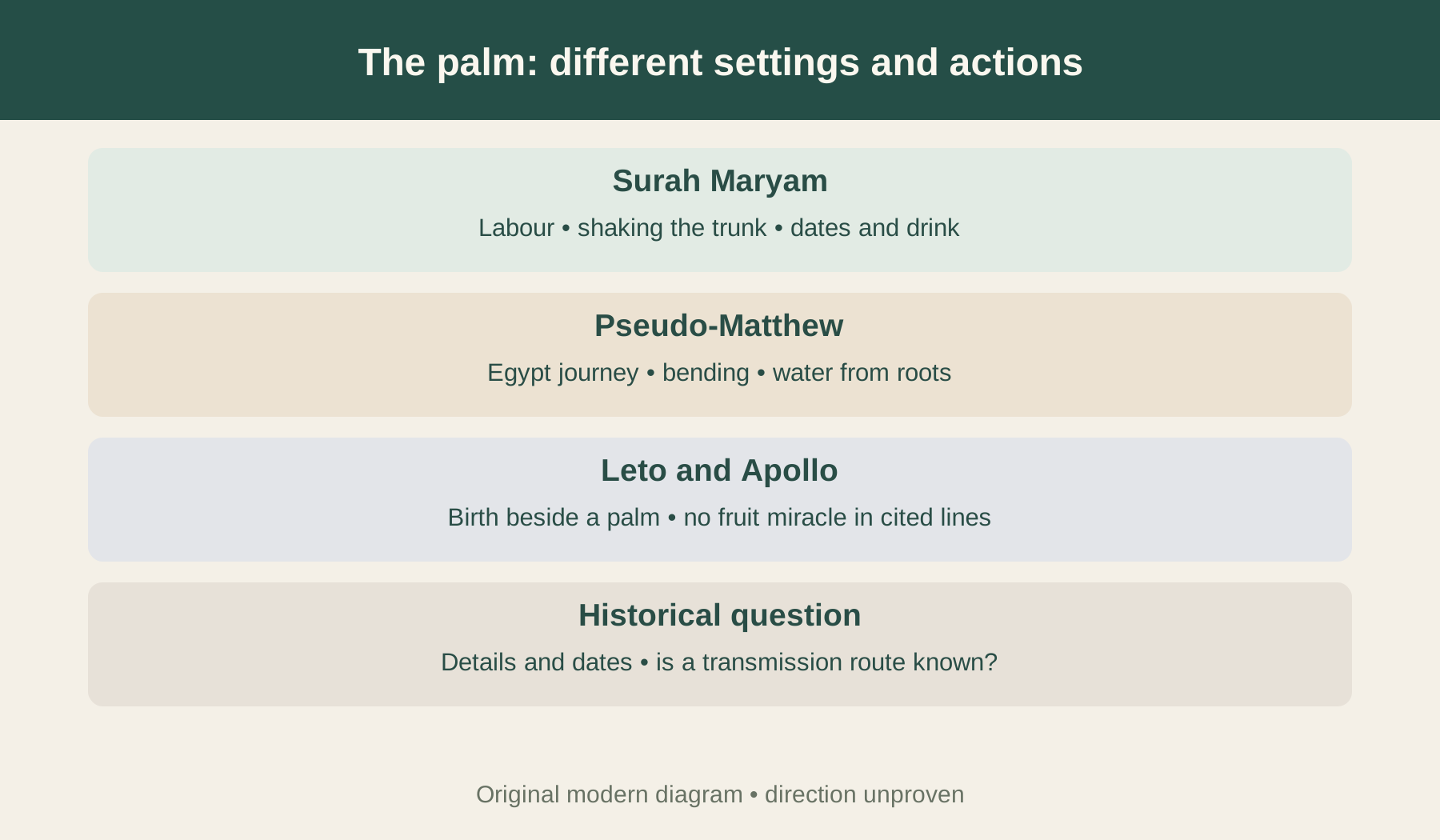
The births also differ
Pseudo-Matthew 13 places the birth in an illuminated cave. It includes a midwife’s declaration that childbirth involved no pain and that Mary remained a virgin. Surah Maryam describes labour and Mary’s distress, including her wish that she had died before the experience. [1] [4]
Here we describe the accounts. The comparison makes no medical judgment about childbirth and does not adjudicate religious belief. It supplies another reason to avoid merging the palm, cave and midwives into one composite story and attributing it to every source.
Pseudo-Matthew is not canonical Matthew
The palm miracle belongs to a Latin work about Mary and Jesus’ childhood, distinct from Matthew in the New Testament. NASSCALNorth American Society for the Study of Christian Apocryphal LiteratureResearch society maintaining a guide to Christian apocryphal texts and witnesses.Glossary · Click to read the explanation’s catalogue describes its substantial dependence on the Protevangelium of James, with expansions and other material. [6]
Prefatory letters do not establish Jerome’s translation of Matthew’s HebrewHebrewA Northwest Semitic language in the Canaanite group, with ancient and modern forms.Glossary · Click to read the explanation book; Hawk examines this purported attribution. [7]
“Apocryphal” does not mean historically ineffectual or used by only one community. Here it identifies the work and limits its attribution, without disparaging its religious reception.
Composition, manuscript and episode are separate questions
Brandon HawkBrandon W. HawkScholar of medieval literature and Christian apocrypha.Glossary · Click to read the explanation places Pseudo-Matthew’s composition approximately between 550 and 800 CE, favouring the seventh century. This scholarly range does not securely date every included story. [8]
His introduction identifies an A-family manuscript copied around 820, while a witness around 800 preserves opening material only. It also presents debate over whether chapters 18–21 belonged to the initial composition. [7]
The practical consequence is caution: the book’s general dating cannot by itself date chapter 20’s miracle. An earlier opening fragment need not preserve the palm. Conversely, a late manuscript does not show that the story originated when that copy was made.
Dormition traditions widen the comparison
In ShoemakerStephen J. ShoemakerScholar of early Christian Mary traditions and late-antique Near Eastern religion.Glossary · Click to read the explanation’s translation of the Book of Mary’s ReposeBook of Mary’s ReposeChristian work within Mary’s Dormition traditions.Glossary · Click to read the explanation, a nursing child commands the palm to bend for his parents; it later goes to paradise. Early SyriacSyriacA literary form of Aramaic, with an extensive Christian heritage and earlier non-Christian attestations.Glossary · Click to read the explanation family witnesses and later complete Ethiopic copies do not date every scene equally. [9]
The scene invites comparison across Christian traditions, beyond a single Latin book. We do not attribute all its details to the oldest Syriac fragment, or make a textual family’s age the direct date of every paragraph.
Leto and Apollo: an earlier birth beside a palm
Greek traditions associate a palm with ApolloApolloGod of music and prophecy in Greek traditions, also participating in the Iliad’s events.Glossary · Click to read the explanation’s birth long before Islam. In the Homeric Hymn to Apollo, LetoLetoGreek goddess and Apollo’s mother in the Iliad, appearing among the gods supporting the Trojans.Glossary · Click to read the explanation, Apollo's mother in the Greek tradition, puts her arms around a palm and kneels as she gives birth; the goddesses subsequently wash the child with water. This is not a command for the tree to bend and feed the mother. [10]
In the third-century-BCE poet CallimachusCallimachus of CyreneThird-century-BCE Greek poet whose Hymn to Delos evokes Apollo's birth.Glossary · Click to read the explanation's Hymn to the Greek island of Delos, Leto sits beside the Inopus stream, rests her shoulders against a palm’s trunk, complains of the child’s weight and asks him to emerge. The passage combines tree, water and difficult labour. These lines do not recount falling dates or a spring emerging from the palm’s roots. [11]
This is a real literary analogue. It cannot alone establish that every later mother-and-palm scene derives directly from that hymn, or that the characters have identical identities across religions.
Mourad’s proposal: a possible route, not a transmission document
Suleiman MouradSuleiman A. MouradIslamic-history scholar who proposed a comparative route for Mary and palm narratives.Glossary · Click to read the explanation proposed that the Leto–Apollo tradition contributed through Christian adaptation and reworking. He acknowledged that no precise shared textual source could be identified, and that the palm miracle was absent from the known Apollo versions he discussed. We present the model as a hypothesis. [12]
The proposed link needs a witness: a Christian account of birth beside the palm that can be dated and connected to both texts. Knowing that an earlier story circulated differs from showing that a particular writer took this scene from it.
How can a transmission route be tested?
Chronological priority is necessary for a direct-source hypothesis but insufficient. The relevant date is that of the version containing the details, not the era of its protagonist.
We then test contact. Communities and languages exchanging stories make transmission possible without identifying a translator or copy. Connected details matter: Mary, the child, miraculously accessible fruit and water are more specific than simply resting under a tree. [1] [3] [9]
Next come structure and purpose, an intermediary, and competing explanations: circulating Christian tradition, a lost common text, oral circulation or fresh development of familiar motifs. These are the Archive’s research procedures, not an established historical chain.
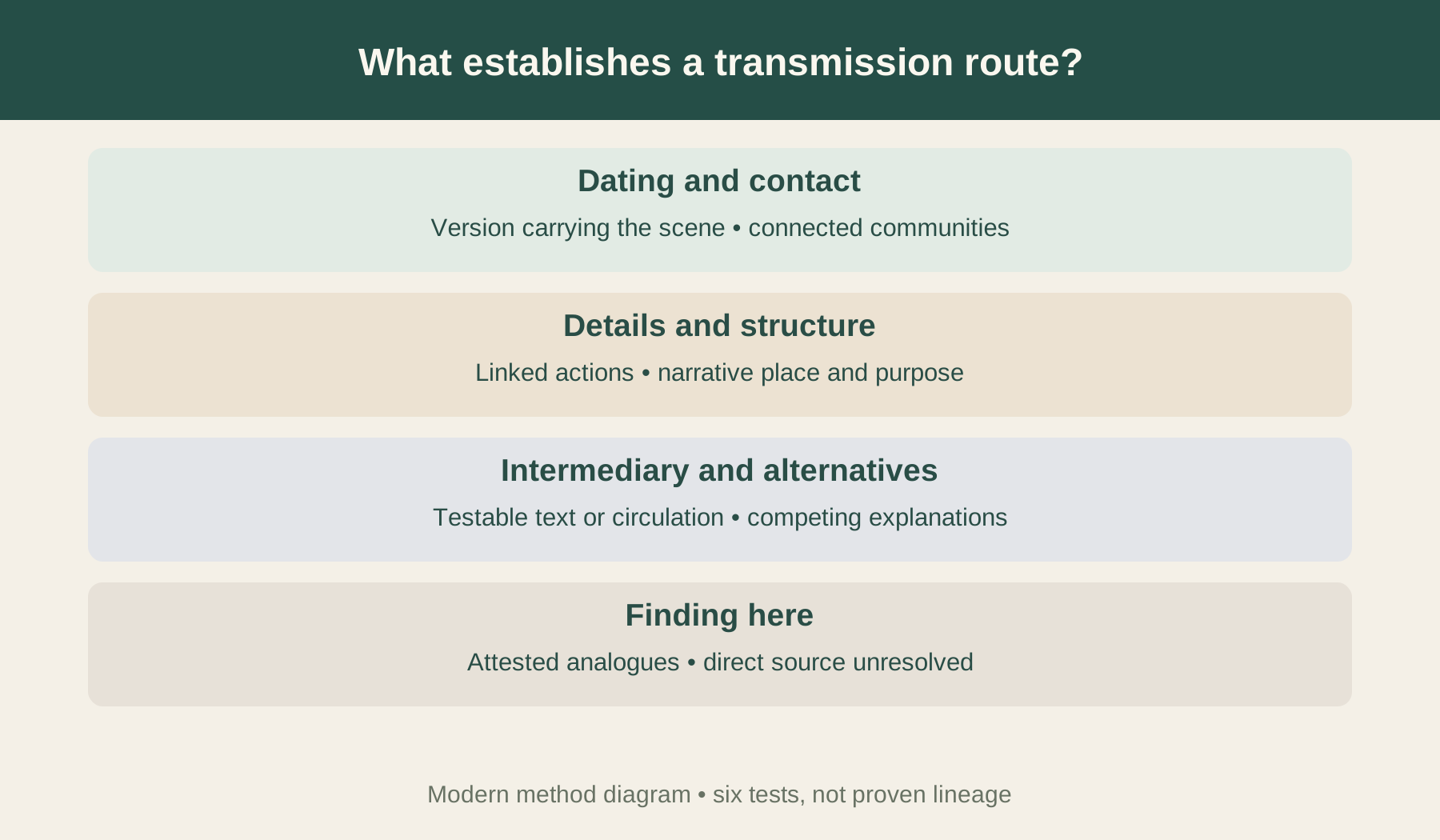
A tree image does not establish doctrinal identity
The verses do not say that Mary worships the palm or that Jesus is Apollo. In Pseudo-Matthew, the tree’s bending is obedience to the child within the account, not a declaration that the tree is God. [1] [3]
The child’s presentation differs: in the Quran he identifies himself as God’s servant and a prophet; in Pseudo-Matthew he commands tree and water within a Christian tradition. Sharing an image or action does not erase its interpretive setting.
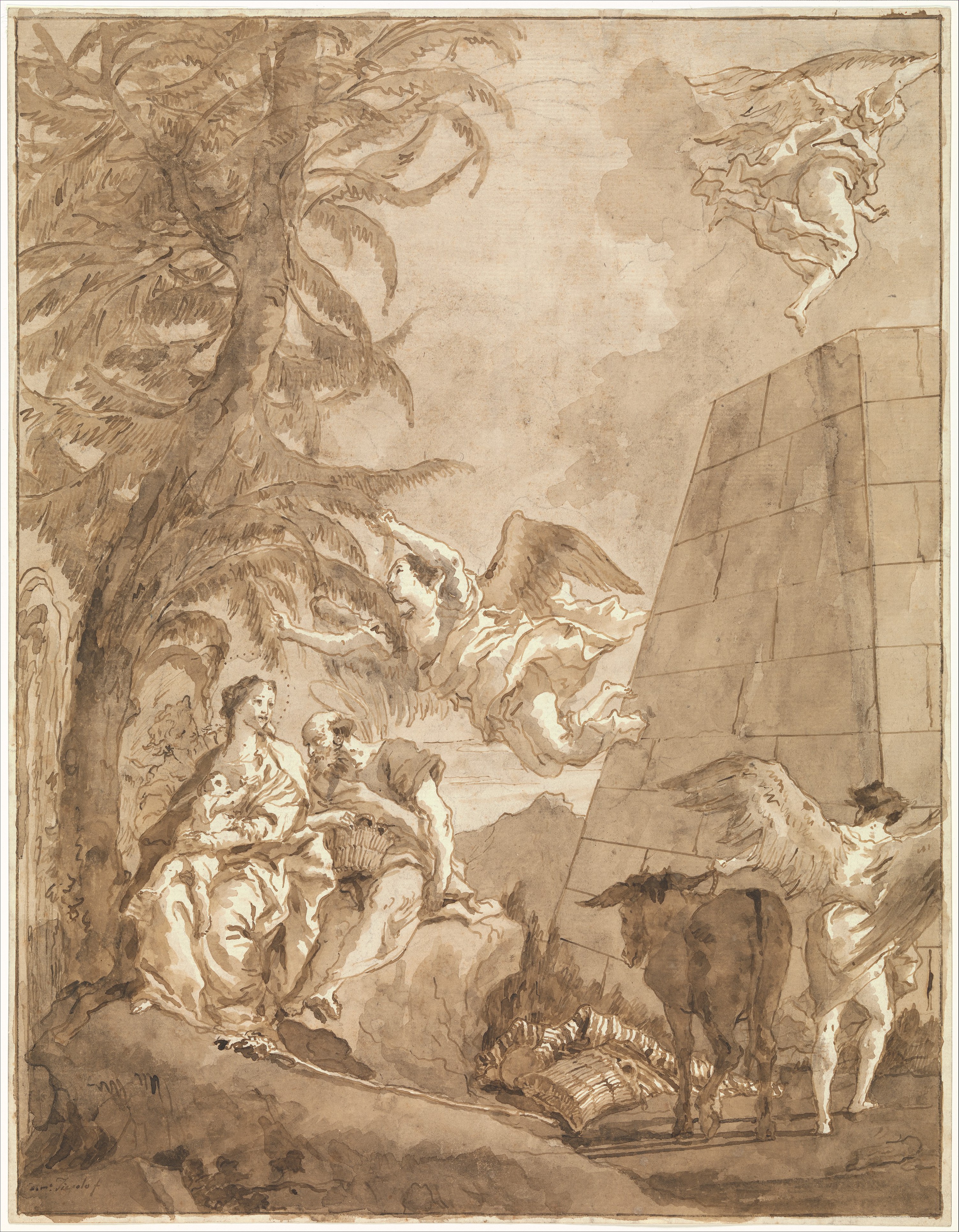
The cover is a drawing by Giovanni Domenico TiepoloGiovanni Domenico TiepoloItalian artist (1727–1804) who depicted the Holy Family resting beside a palm.Glossary · Click to read the explanation, around 1770, held by the Metropolitan Museum. It illustrates much later reception of the journey and palm, not the story’s existence before Islam. [13]
What can be established?
We can establish resemblance between the selected passages, together with the differences between birth and journey, shaking and bending, and Joseph’s presence or absence from the Quranic unit. [1] [3]
We can also identify other Greek and Christian analogues, within the limits of the witnesses and translations read. We cannot establish that the available Latin version directly supplied the Quran, or name a community or individual who transmitted the scene. [9] [10] [11]
The accounts may be connected within a long history of circulation. Determining direction requires clearer dating of versions and closer intermediaries. The palm makes comparison worthwhile; it does not replace the evidence still needed.
References and notes
- Entire specified passage; return to her people, not the Temple. Quran 19:16–36; Arabic primary text Return to the text ↑
- Caller and sariyyan: exegetical readings. Al-Tabari, commentary on Quran 19:24; main verse entry Return to the text ↑
- Complete chapters20–21; third journey day. Gospel of Pseudo-Matthew 20–21; Alexander Walker historical translation Return to the text ↑
- Birth, cave and midwives in specified chapters. Gospel of Pseudo-Matthew 13–14; Alexander Walker historical translation Return to the text ↑
- Trunk and season reports, distinct from verse wording. Al-Tabari, commentary on Quran 19:25; main verse entry Return to the text ↑
- Work identity and selected witnesses. Brandon W. Hawk, e-Clavis: Gospel of Pseudo-Matthew; summary and selected manuscript catalogue Return to the text ↑
- Specified introduction excerpt. Brandon W. Hawk, The Gospel of Pseudo-Matthew and the Nativity of Mary; public publisher introduction excerpt, pp.4–7,10–12,15–18 Return to the text ↑
- Pages59–61; scholarly composition range. Brandon W. Hawk, Biblical Apocrypha as Medieval World Literature, pp.59–61; author-deposited chapter Return to the text ↑
- Dating passages and scene translation. Stephen J. Shoemaker, Ancient Traditions of the Virgin Mary’s Dormition and Assumption, pp.32–35,153–154,290–296; Book of Mary’s Repose §§5–10 Return to the text ↑
- Apollo’s birth and palm; specified lines. Homeric Hymn to Apollo 89–132; H. G. Evelyn-White historical translation Return to the text ↑
- Lines205–214 and stated context. Callimachus, Hymn 4 to Delos 205–214; historical Mair translation Return to the text ↑
- Mourad’s hypothesis; precise source unidentified. Suleiman A. Mourad, From Hellenism to Christianity and Islam: The Origin of the Palm-Tree Story Concerning Mary and Jesus in the Gospel of Pseudo-Matthew and the Quran, Oriens Christianus86 (2002), pp.206–216 Return to the text ↑
- Drawing ca1770; later reception. Metropolitan Museum,1975.1.474, Giovanni Domenico Tiepolo, The Rest on the Flight into Egypt (with a Truncated Pyramid on the Right), ca1770 Return to the text ↑
Research history
Substantive changes are retained here. Minor copy edits remain in the internal operational log.
-
Substantive record update
-
Substantive record update
Suggest a correction · Suggest a source for this record
Cite this record
IL Archive, «Mary and the palm: accounts, dates and limits of the relationship», Edition 3, https://ilarchive.com/en/studies/mary-and-palm-tree-traditions
Continue reading