The Epic of Gilgamesh Chapter 7

The Story of the Flood

Utnapishtim tells Gilgamesh how he built a boat and survived the great flood. When his story is done, he asks Gilgamesh to stay awake for six days and seven nights.

Watch the filmSources

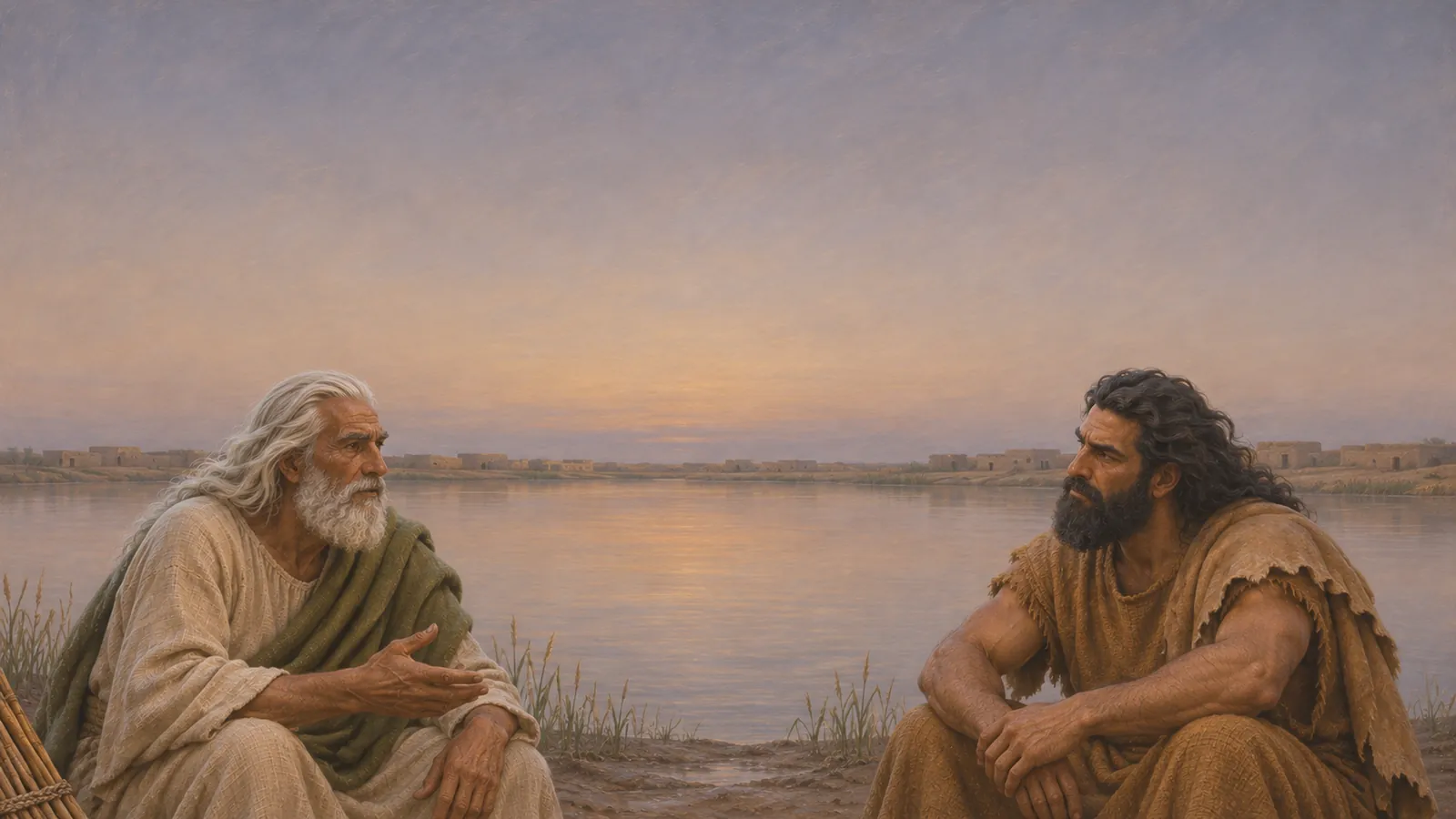
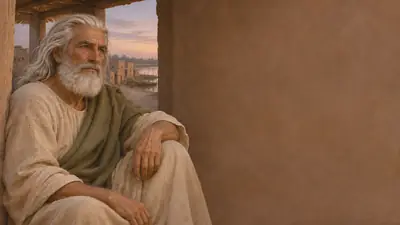
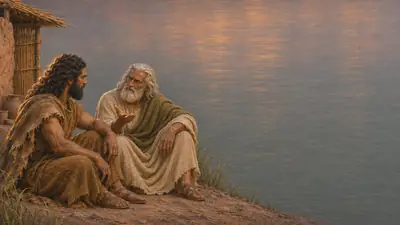
Utnapishtim begins his answer with an open hand, his white hair and olive cloak visible in the last light. Gilgamesh listens opposite him in his travel-worn hide. The river lies still behind them under a wide gray-gold sky.

SECRET

On the far shore, Utnapishtim began his answer. What Gilgamesh wanted to know went back to a secret of the gods, and to a city that stood by a river long ago.
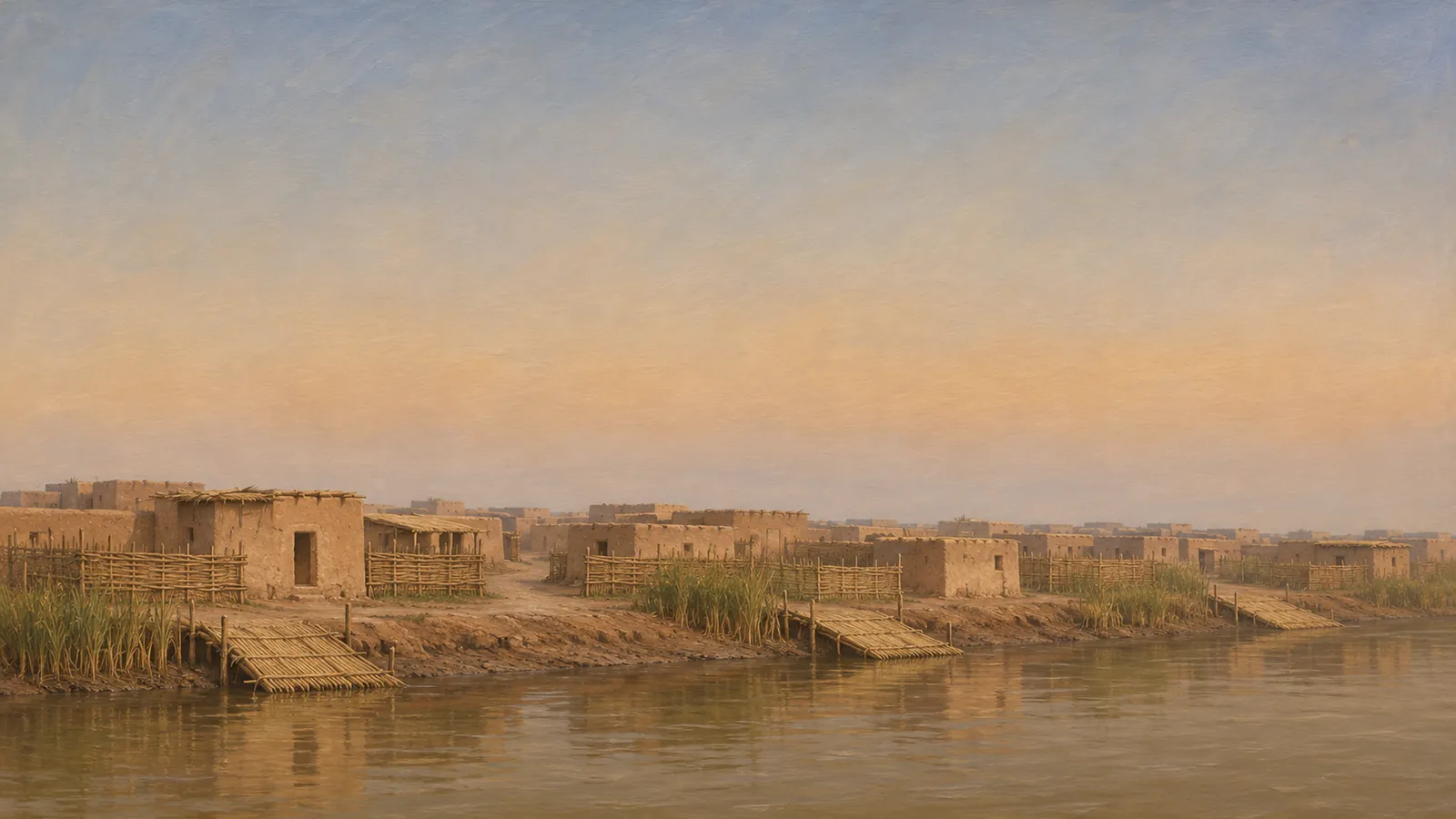
Low earthen houses and reed fences stretch along the Euphrates at old Shuruppak. Woven landings slope from the muddy bank into the quiet river. The settlement sits low under a broad sky tinged with gold.

The city was Shuruppak, on the Euphrates. It was already old when the great gods were said to dwell within it.
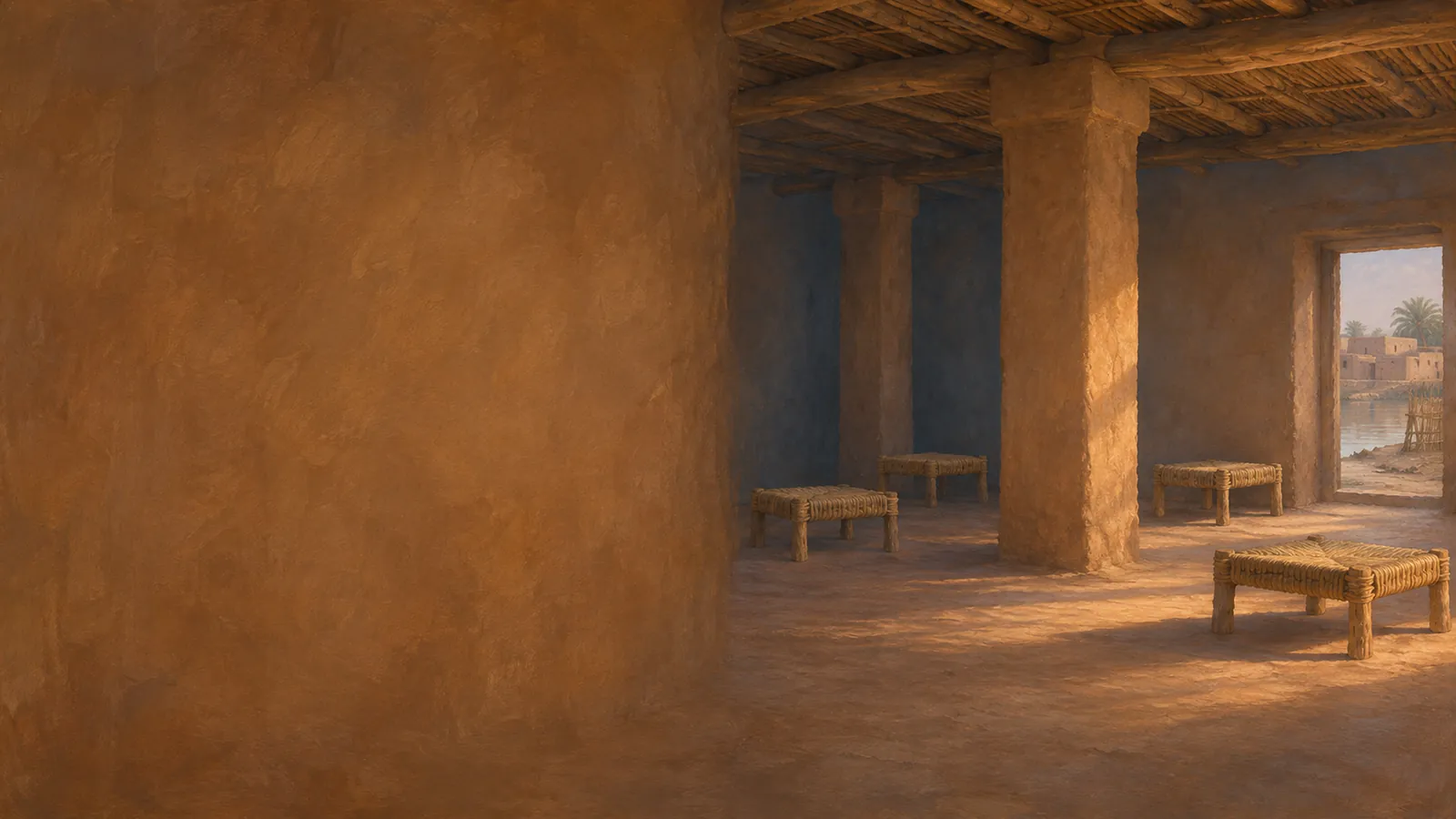
Plain woven stools stand empty between square earthen pillars. A band of warm daylight crosses the floor and fades into the blue shadows behind them. Through the open door, a stretch of water and low houses are just visible.

Utnapishtim told of the great gods and their decision to send a flood. The members of their assembly swore an oath binding them to it.
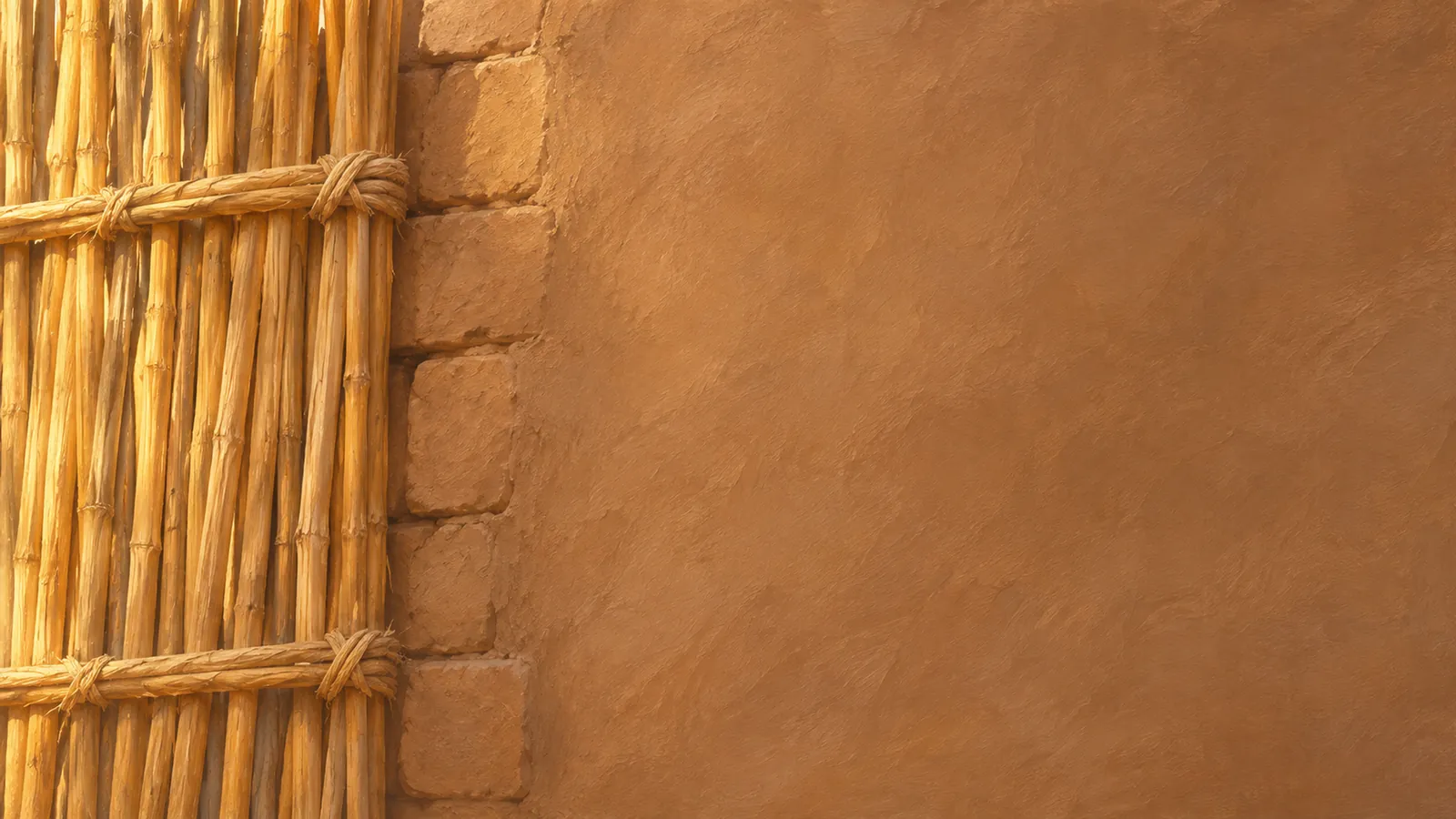
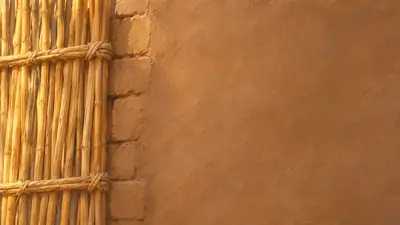
A screen of golden reeds meets the corner of a clay wall. The light brings out the coarse fibers of the ties and the uneven faces of the bricks. It softens into warm shadow across the plaster to the right.

Enlil was part of the council, and Ea had taken the oath with the other gods. What Ea would say next he would say to the reeds.
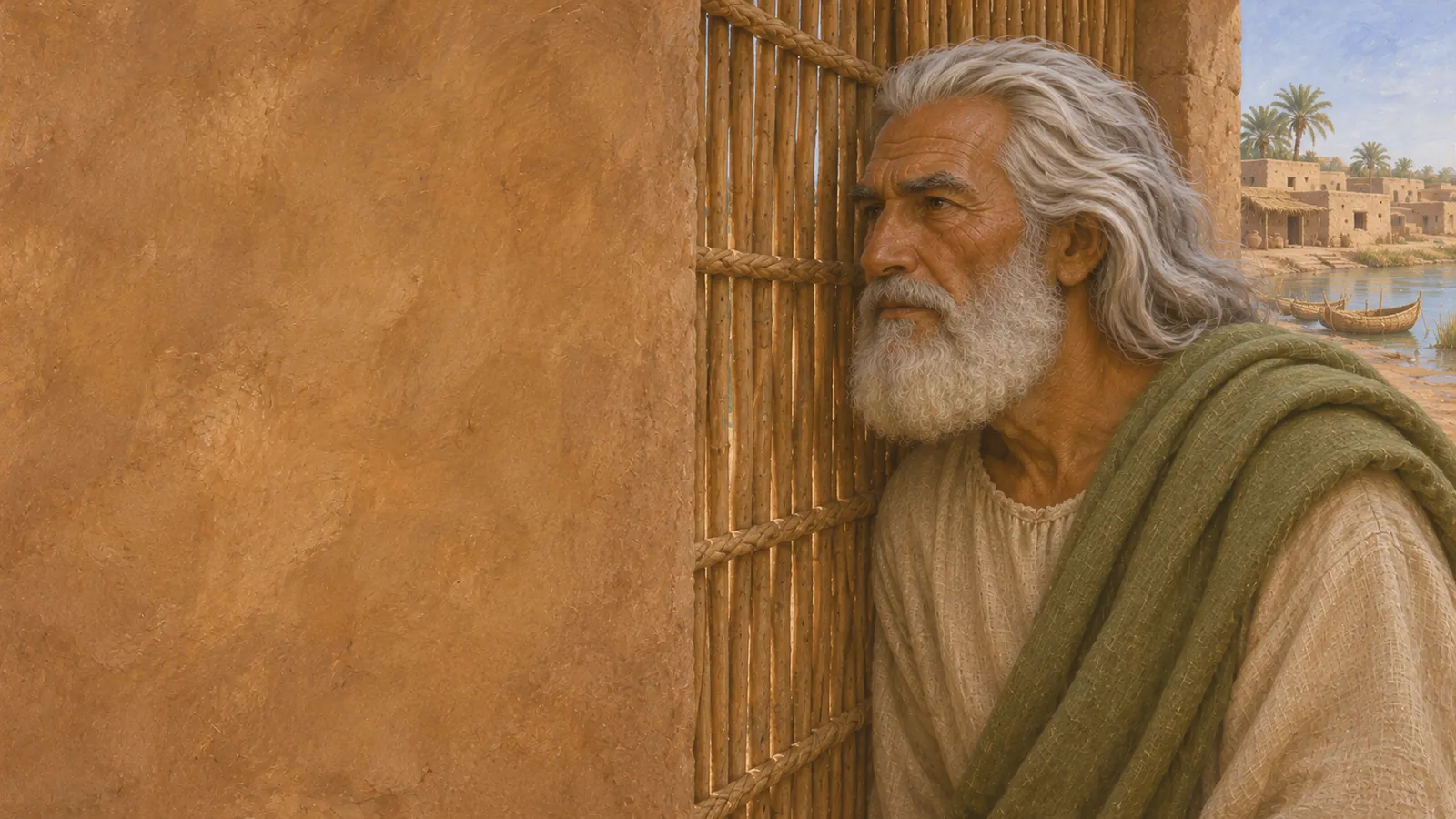
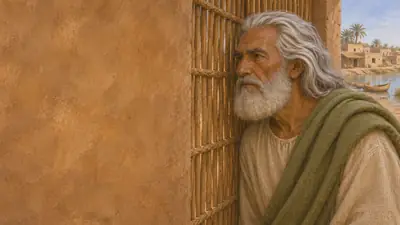
Utnapishtim stands close to the reed fence, his face turned as though listening. His silver-white hair rests over the folds of his muted olive cloak. Beyond the screen, small reed boats lie near the low houses on the riverbank.

The warning went to a reed fence and a wall. Through those words Utnapishtim heard what he needed to do, while the god had addressed the reeds.
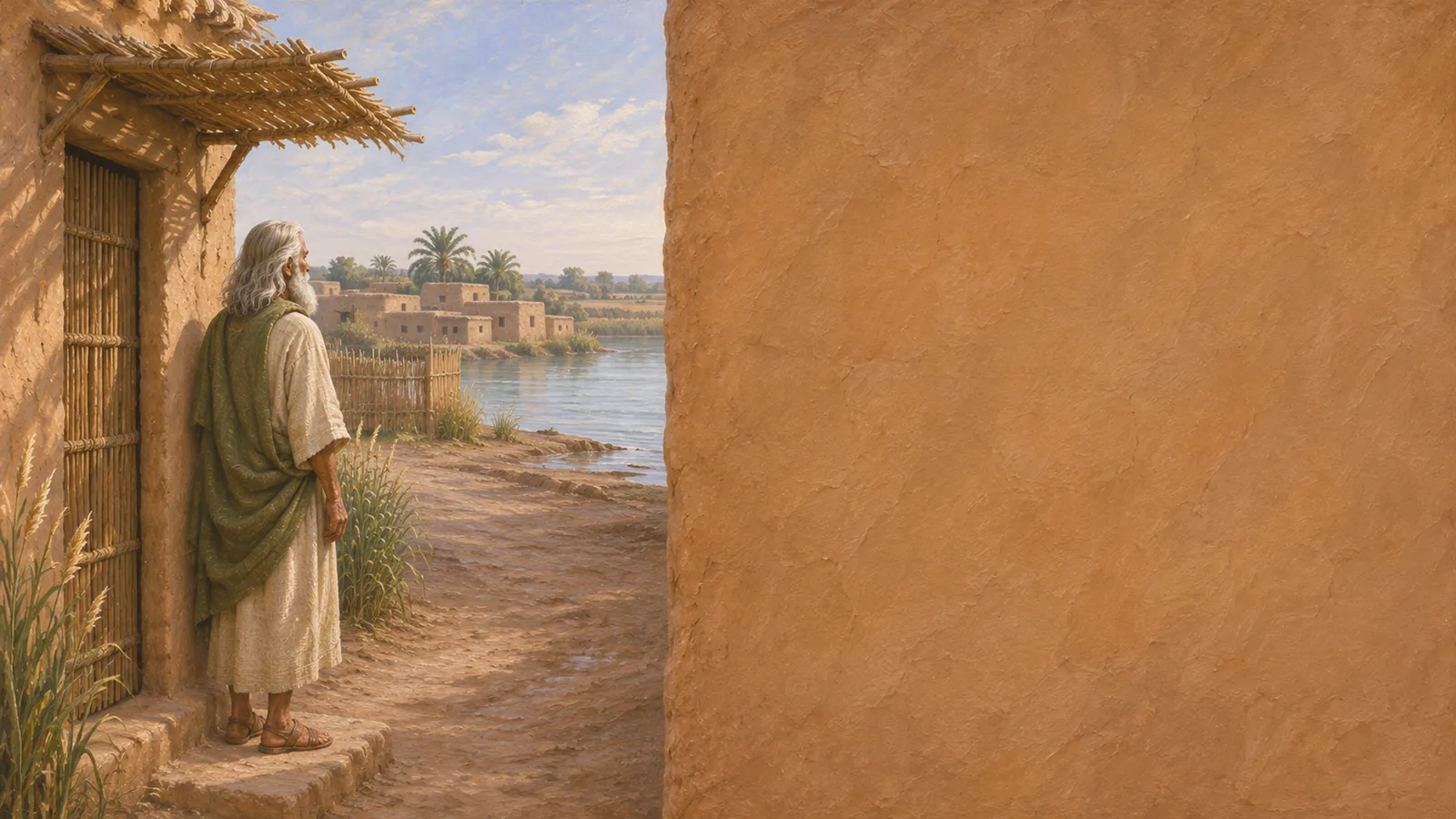
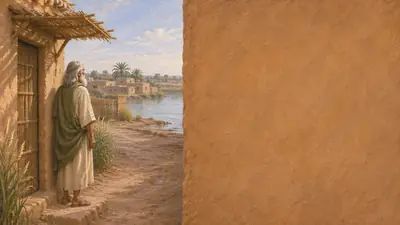
Utnapishtim stands at the doorway of an intact earthen house, looking along the lane toward the river. A woven awning gives the threshold a little shade. Across the water, low houses and palms rise just above the reeds.

Ea told him to take down his house and build a boat. What he could hold on to mattered less now than what he could keep alive.
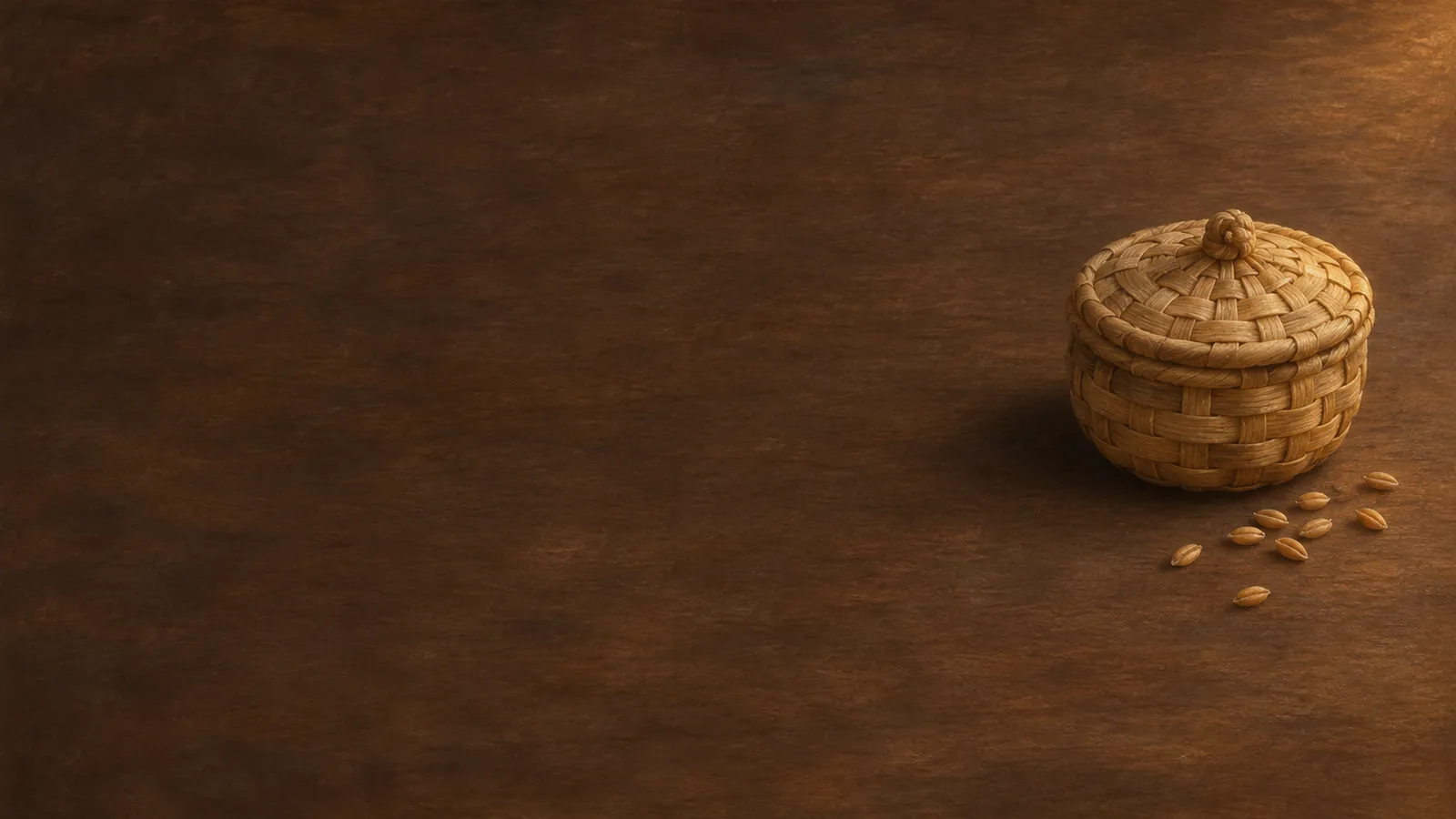
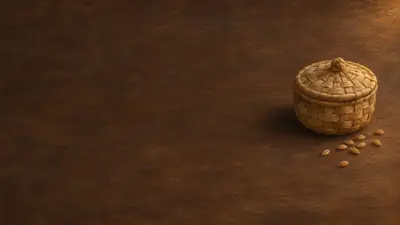
A small lidded reed basket rests on a dark wooden surface. A few whole grains lie scattered beside it, bright in a narrow patch of warm light. Across the left, the wood grain fades into a soft brown shadow.

The boat was to carry the beginnings of living things. Utnapishtim had been told to leave wealth behind and give the things that lived a chance to survive.
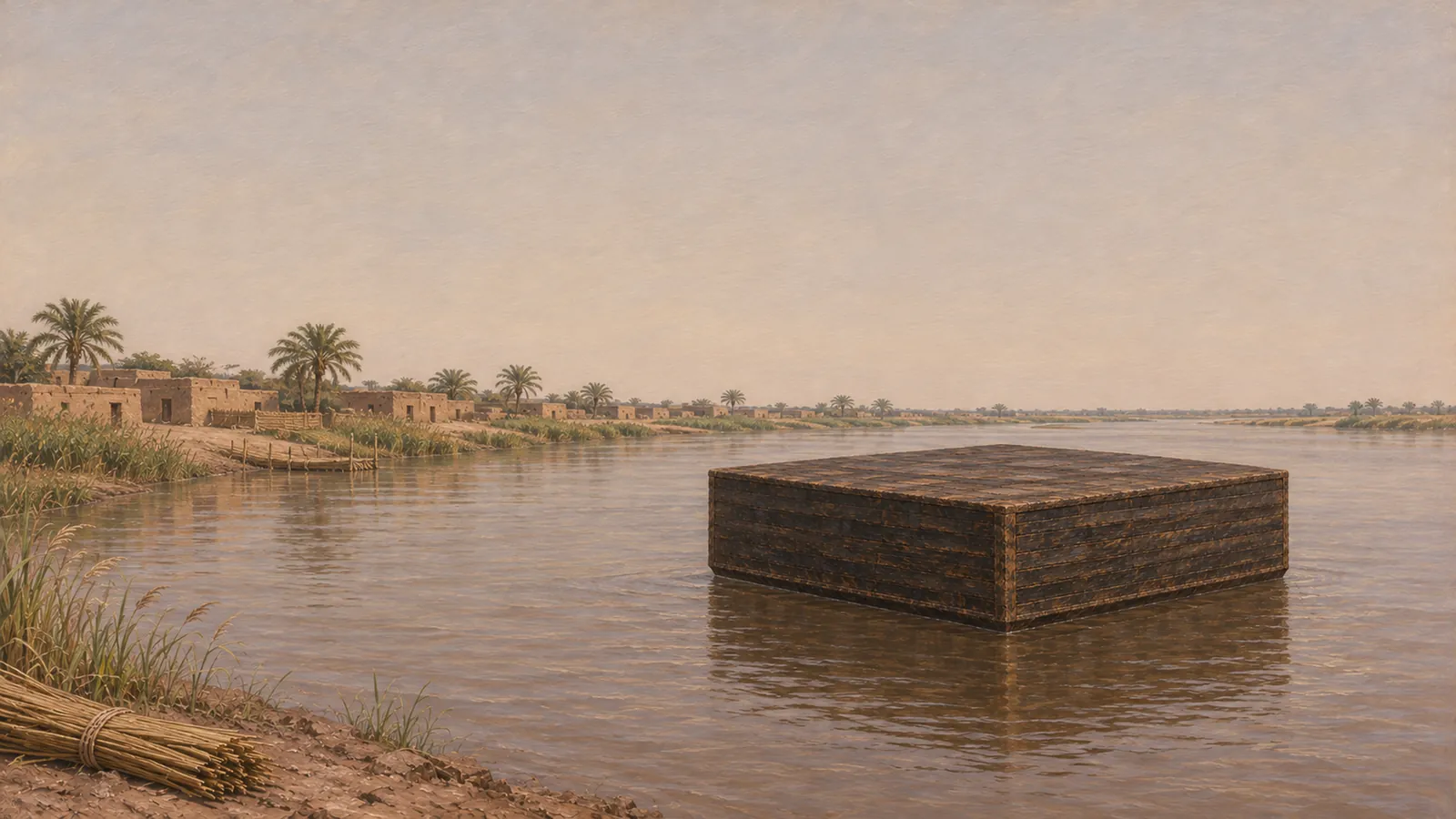
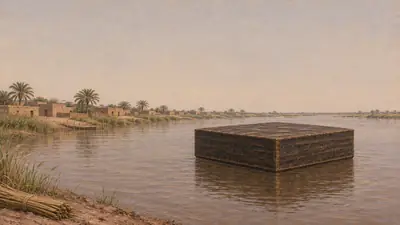
The broad, square roofed boat floats low on the muddy river, with two sides of equal breadth visible. Its dark planks cast a reflection in the slow water. Low houses, palms, and reed landings sit back from the vessel under a pale open sky.

The boat Ea described was to be as wide as it was long. It would have a roof over it, and its shape was unlike the boats of the everyday river.
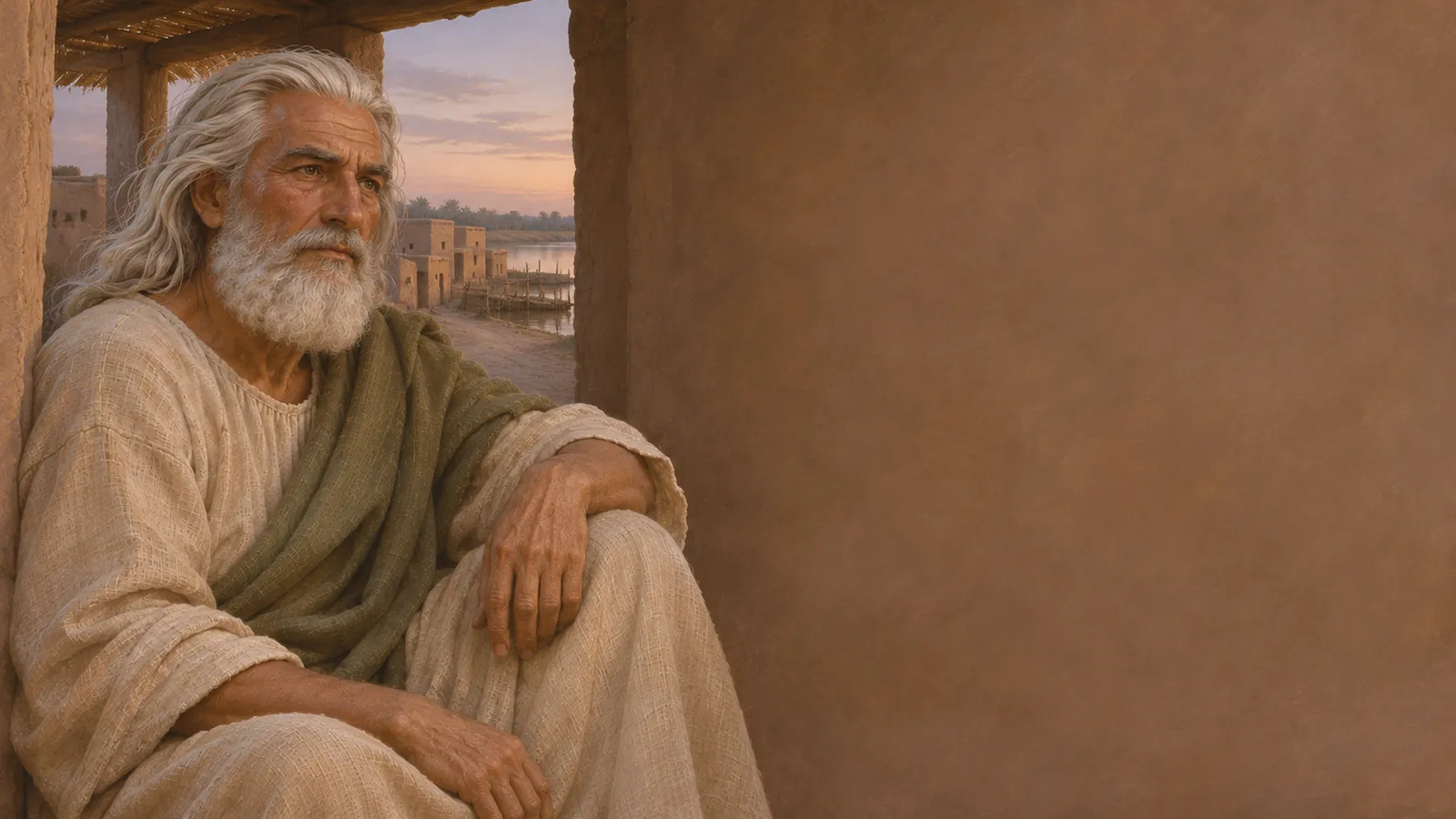
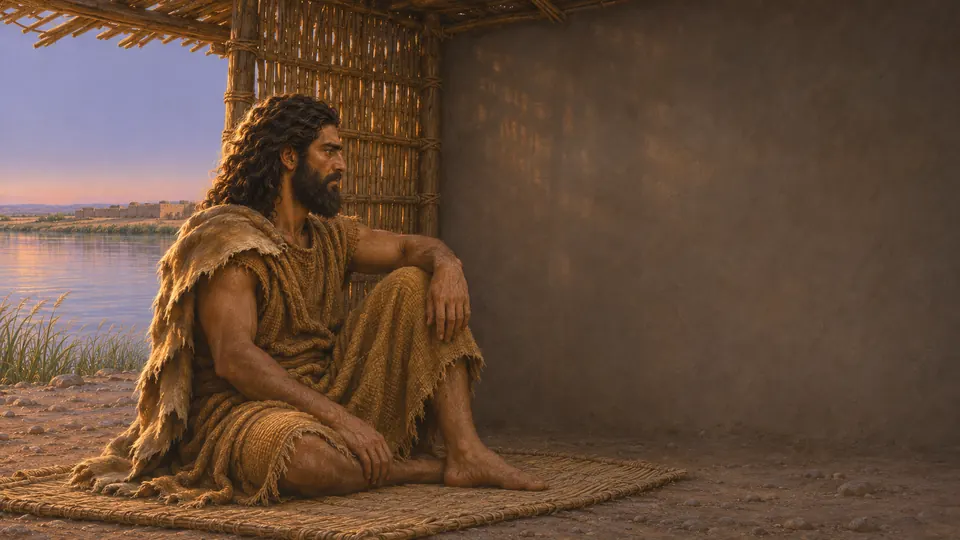
Utnapishtim sits alone at his doorway, his hand resting on his raised knee. Evening light reaches his white hair and the olive folds over his shoulder. The low houses of Shuruppak and a reed landing are visible through the opening.

Utnapishtim said he would do as he had been told. Then he asked what he should say to the townspeople and the elders when they saw what he was doing.
The dark blue river fills the view beside a low bank of wet mud. A clump of reeds leans over the shallows, with a soft reflection below it. Farther out, the last warm color of dusk dissolves into shadow.

Ea told him to say that he had fallen out of Enlil’s favor. That was how he could explain leaving the city to dwell with Ea in the deep.
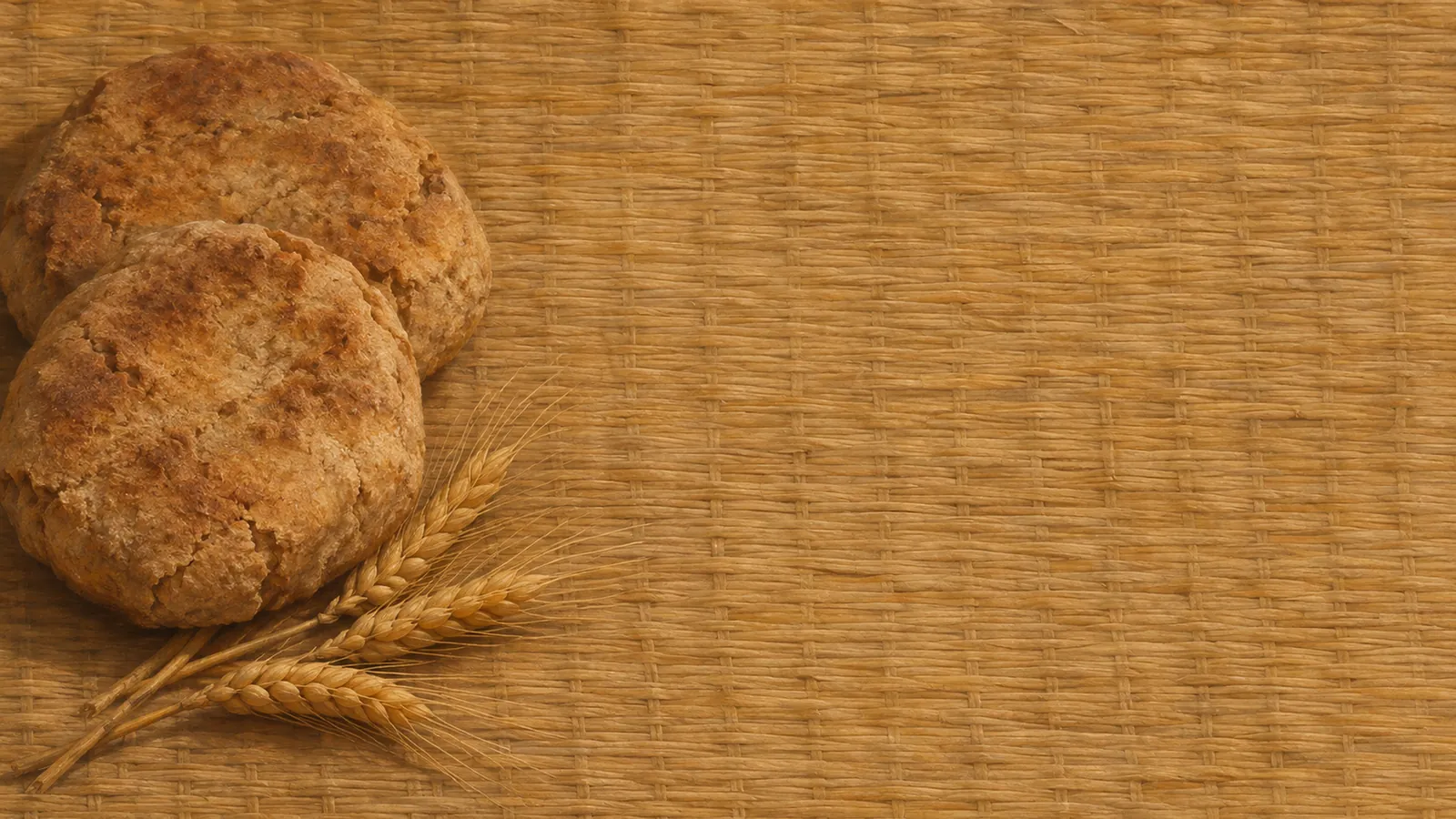
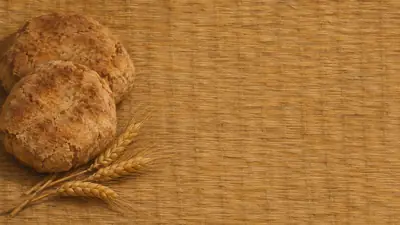
Two rough bread rounds sit beside a few heads of wheat on a woven reed mat. Warm light touches their browned crust and the fine points of the wheat ears. The weave continues quietly across the empty right side.

The message to the city spoke of plenty. Bread and wheat would rain down, it said, words that sounded promising to people who did not know what was coming.
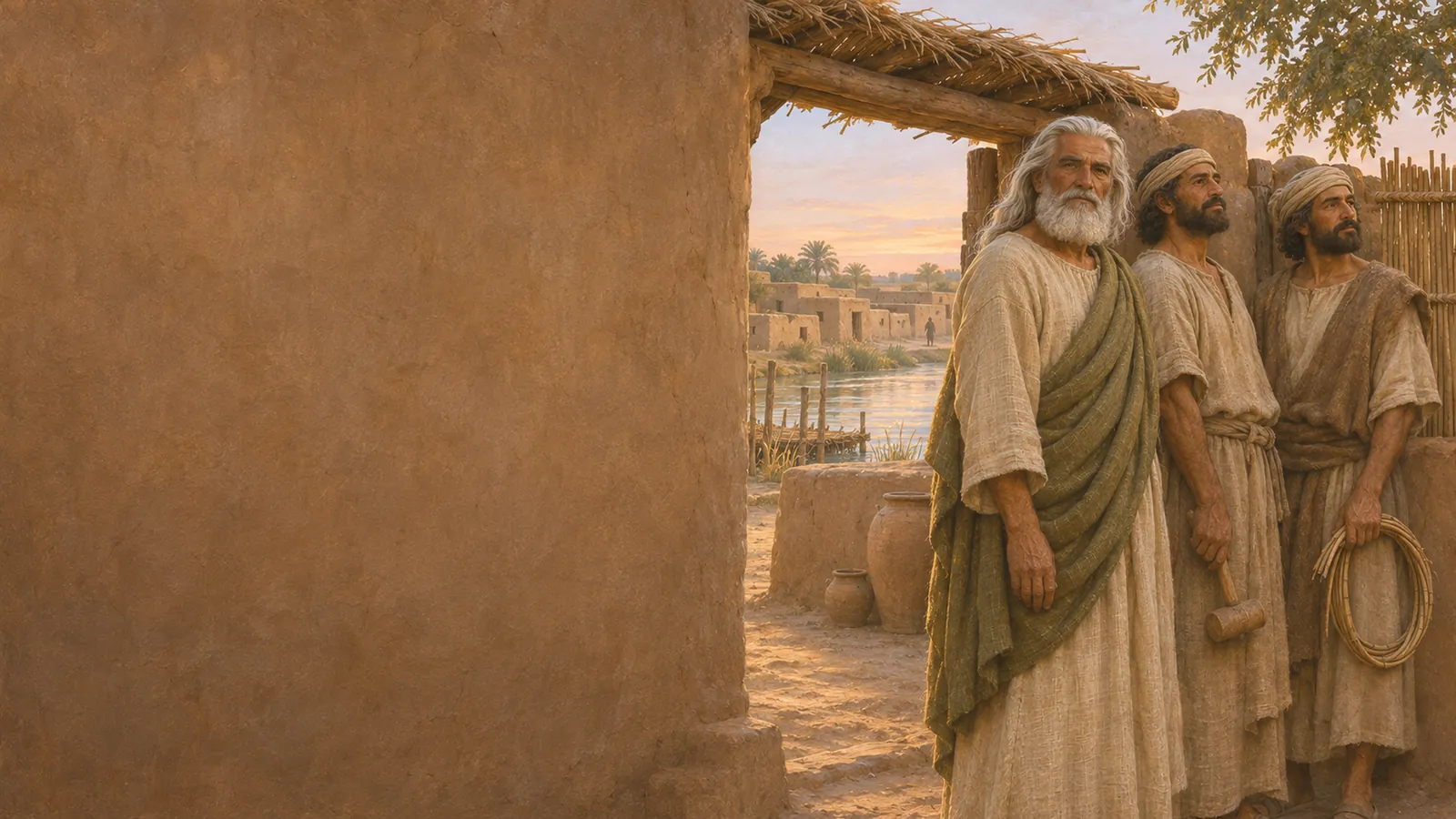
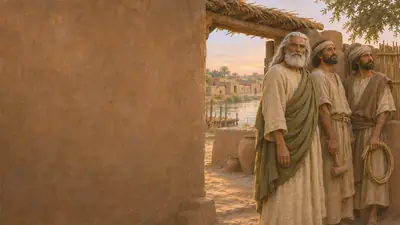
Utnapishtim stands with two workers at the entrance to the yard in the early light. One carries a plain wooden mallet, and the other holds a coiled bundle of reeds. Behind them, the opening looks out toward the river and the low town.

At dawn people gathered at Utnapishtim’s gate. The poem singles out a carpenter and a reed worker among those who came, each with a tool for his work.
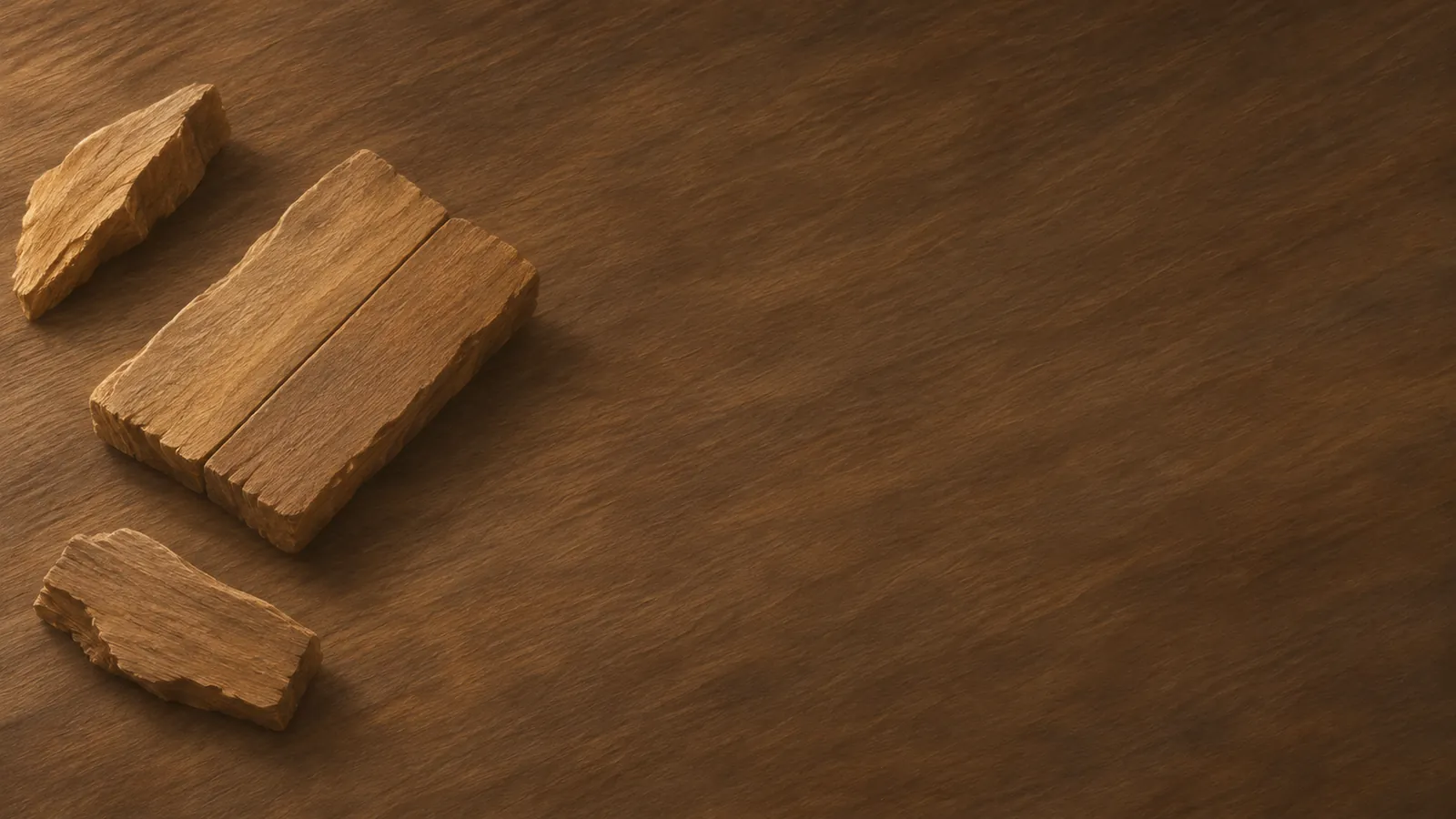
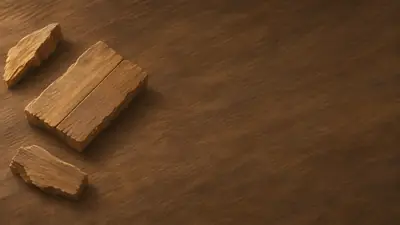
Several rough wood pieces lie beside one fitted joint on an old timber surface. Low light brings out the worn edges and the rough ends of the cut wood. The grain falls into warm shadow across the rest of the frame.

Several lines of the work are broken. We can still see the outline of a shared effort, with different hands bringing what they could to the job.
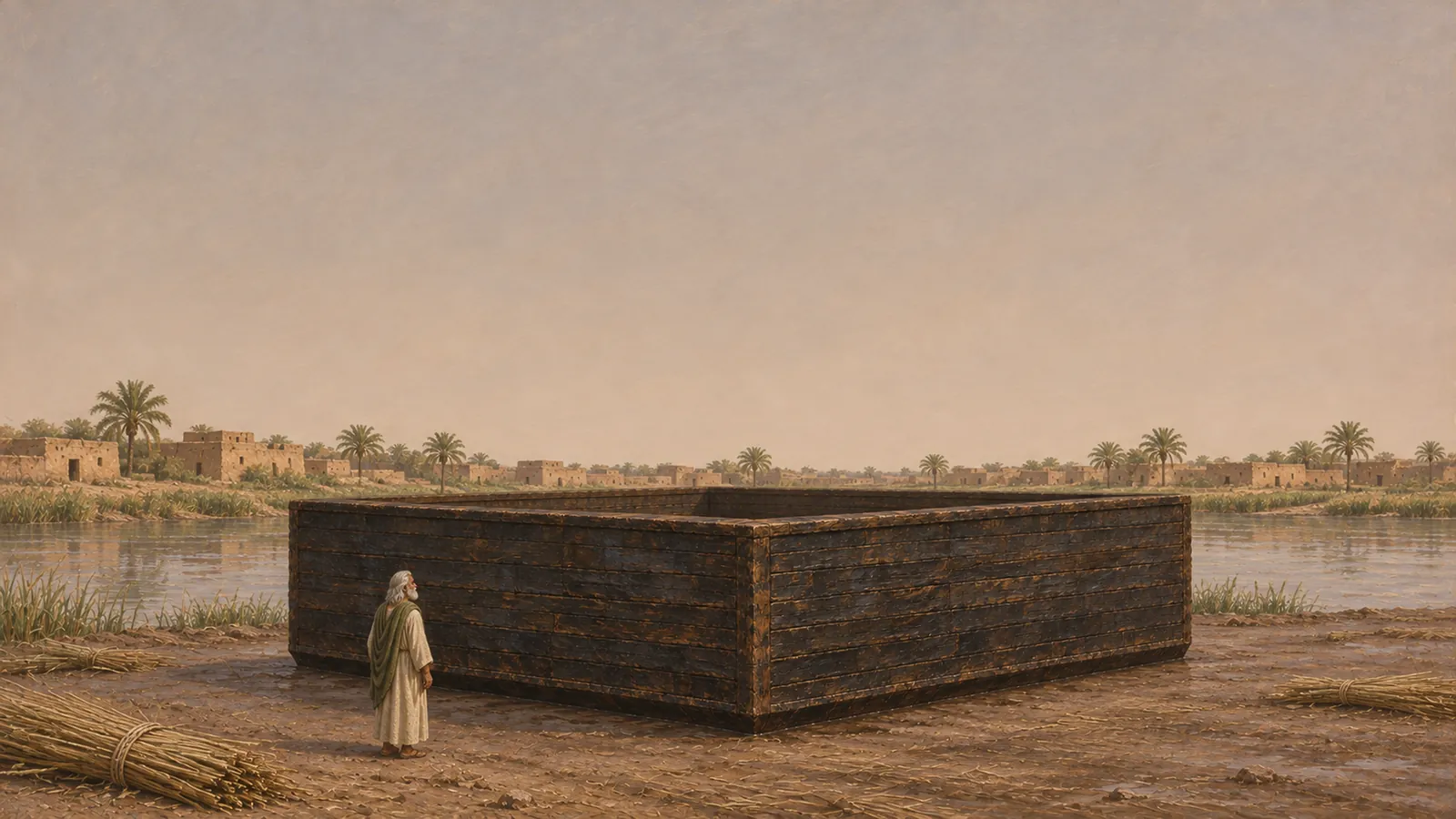
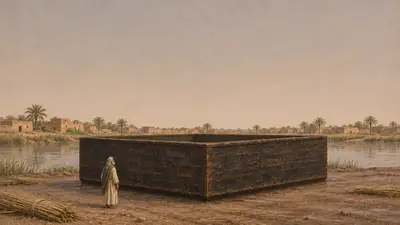
The unfinished square hull rests on the muddy riverbank, its two visible sides broad and dark. A narrow glimpse into the open top shows that the roof is still absent. Utnapishtim stands beside it, small against the high planking.

The story returns to the growing boat. Its high sides and matching edges gave it the breadth it would need to hold so much of the life around it.
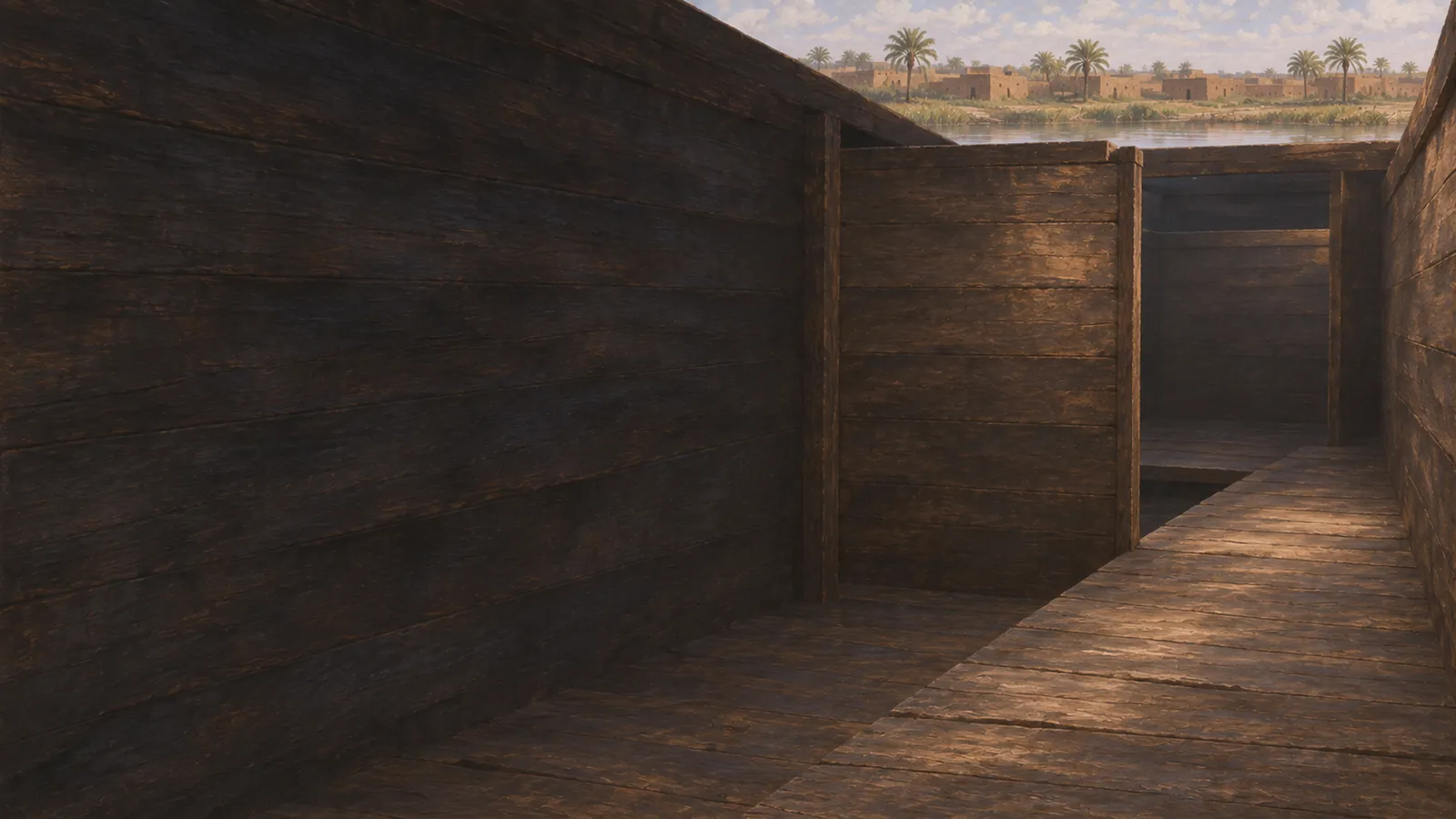
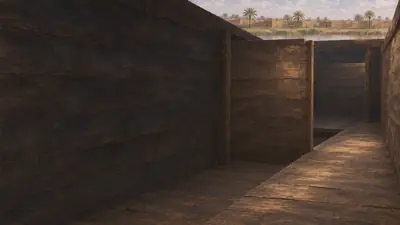
Soft daylight from above catches a lower platform and the worn timber walkway. The near side of the vessel remains in blue shadow.

Utnapishtim describes decks set one above another, with the inside of the boat divided into parts. The old poem pauses over the room made for what would go inside.
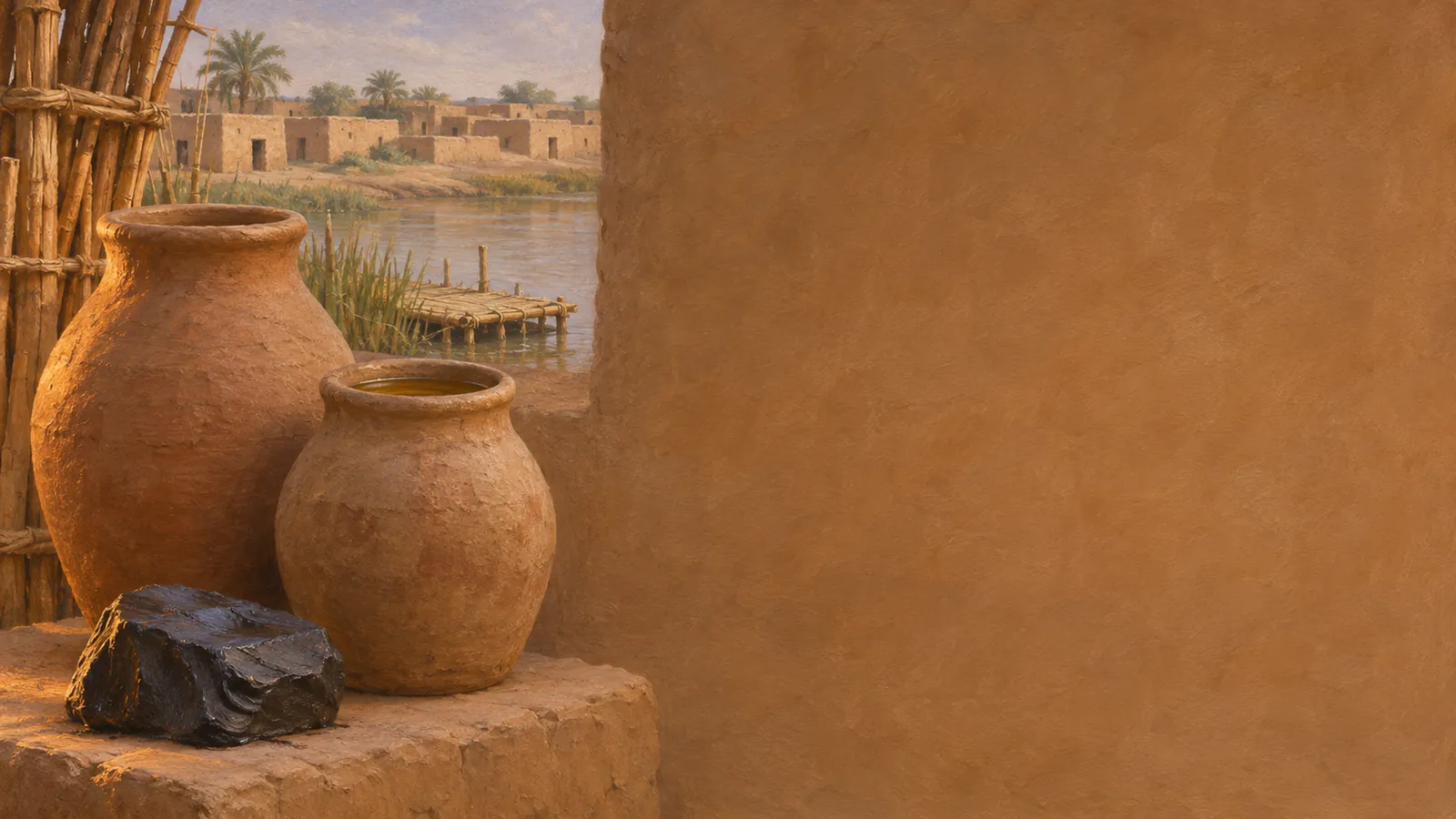
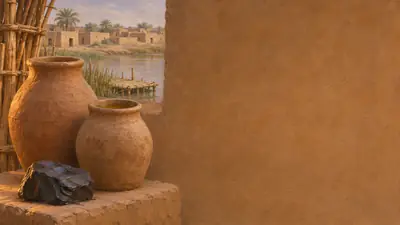
Two plain clay jars sit beside a small block of black pitch. Light catches the oil just inside the smaller jar and the rough contours of the pitch. A reed screen and a glimpse of the river are visible beyond the ledge.

The work used bitumen and great quantities of oil. Part of this account is damaged, but the dark pitch and the loads of oil still stand out in the description.
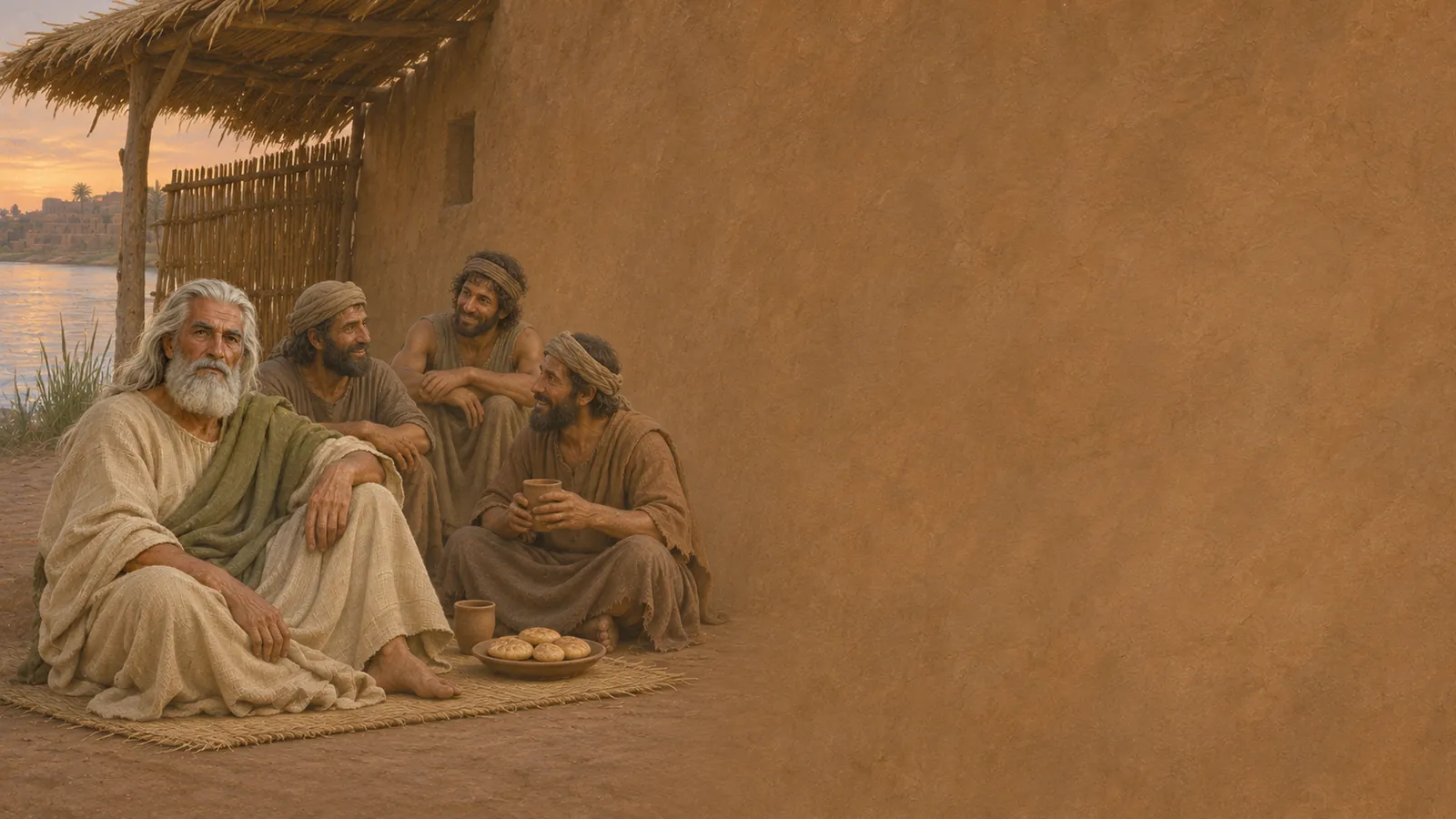
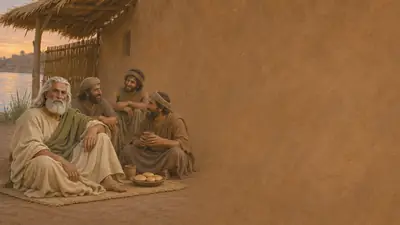
Utnapishtim sits with three workers on a woven mat at the end of the day. They share round loaves and plain clay cups in the shelter of the yard. The warmth of late light softens the wall beside them.

Utnapishtim provided food and drink for the people doing the work. He remembers beer and wine running freely, and says the workers celebrated as they would at the New Year.
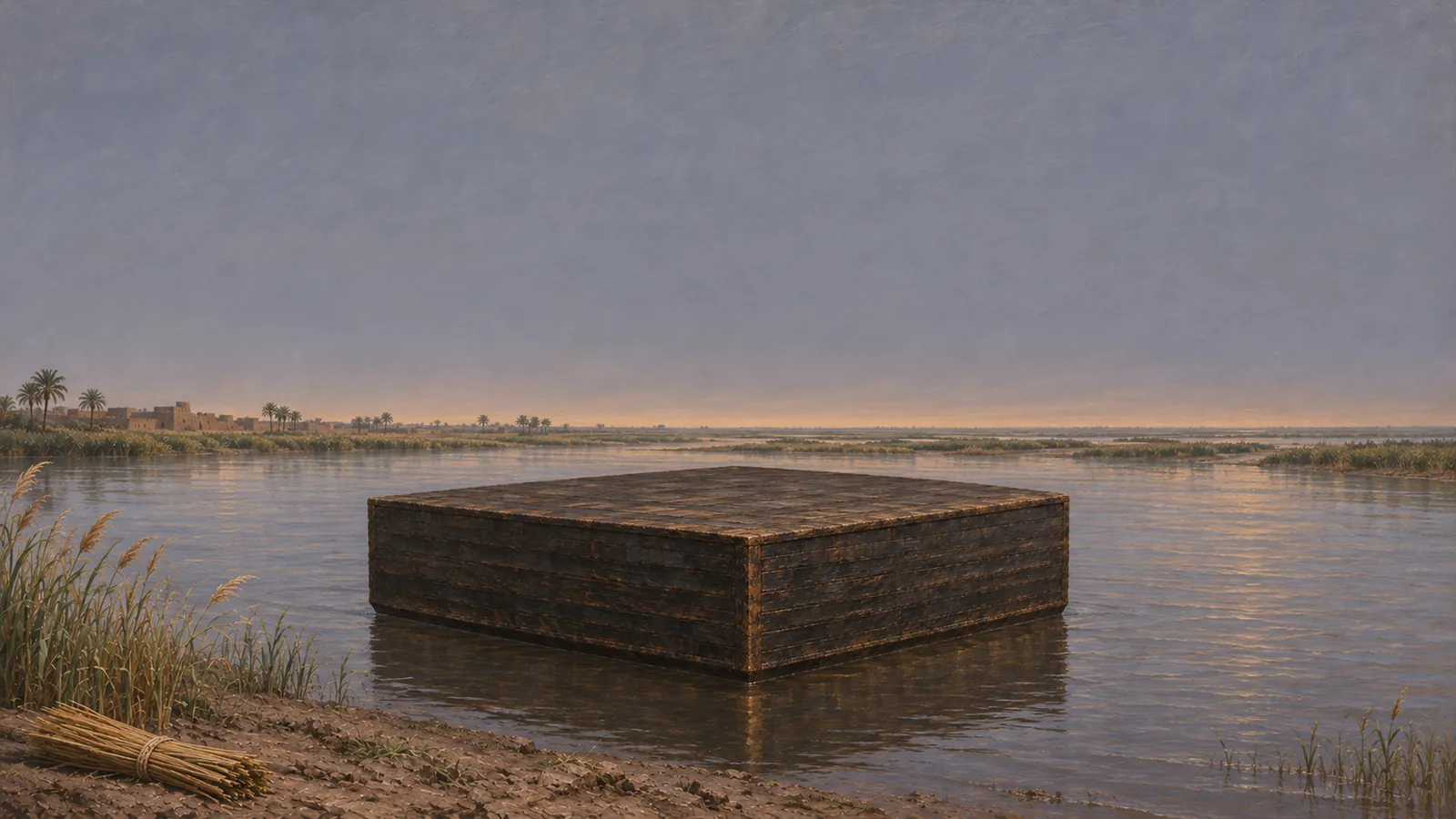
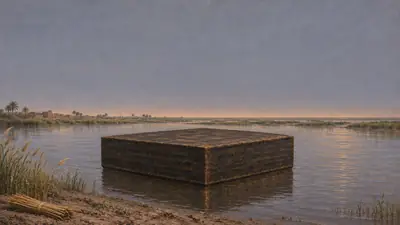
The finished boat lies near the bank in the last evening light. Its continuous flat roof and squared walls make a broad dark shape on the river. A strip of reeds and low mudbrick houses marks the far bank.

Before the sun was gone, the boat was finished. The next lines are damaged, leaving us only pieces of the last work before the loading began.
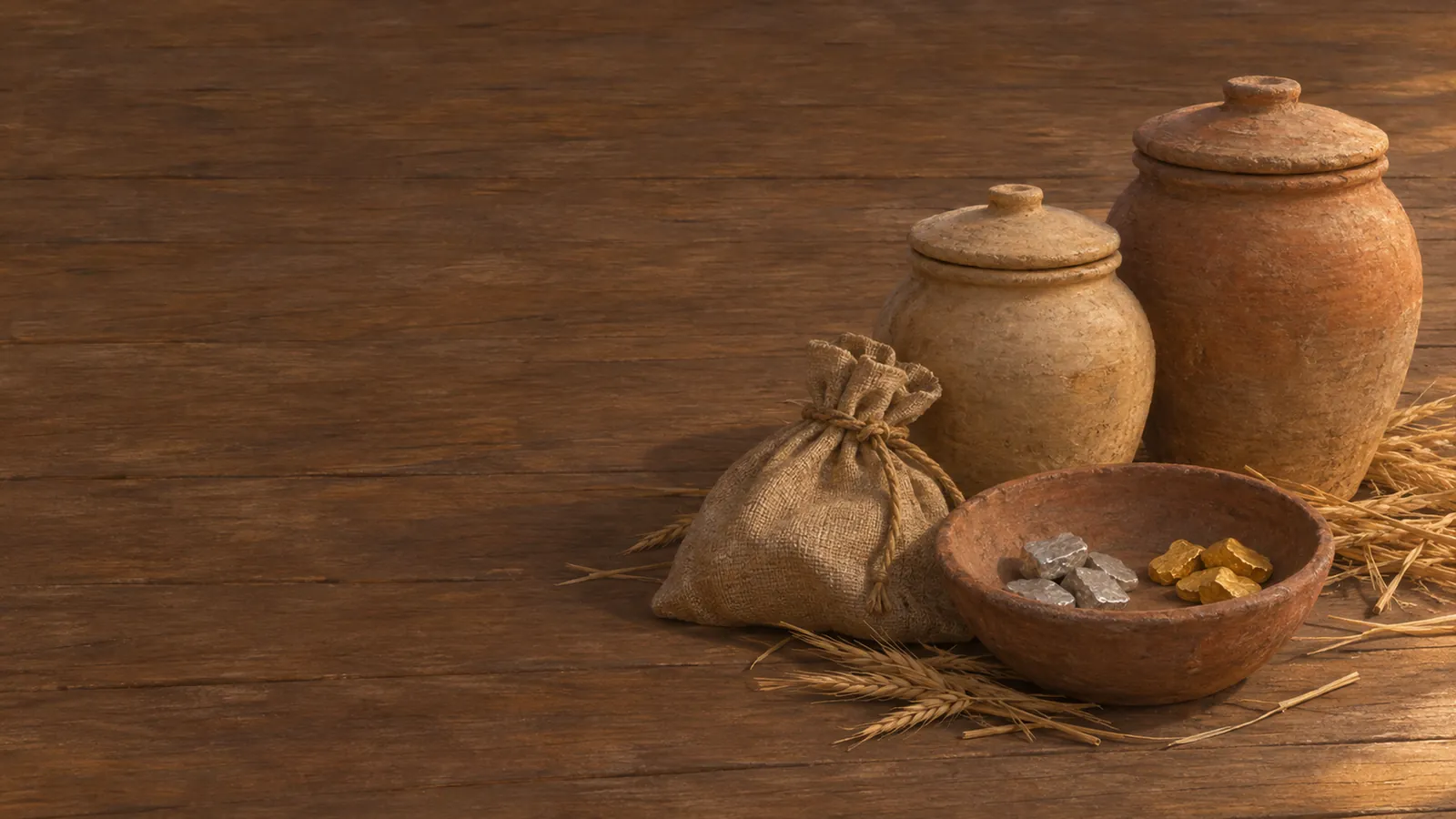
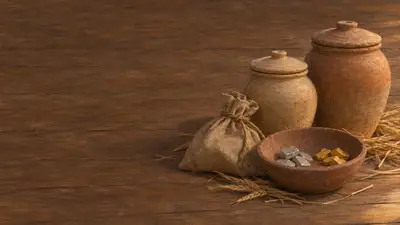
Two lidded clay jars and a tied cloth bag sit at the right on worn wooden planks. A shallow bowl holds separate pieces of dull silver and warm yellow gold, with straw tucked around it. The shaded timber on the left catches only a little of the morning light.

When the loading began, Utnapishtim says he put aboard the silver and gold he had. Among the things he carried was the seed of living things.
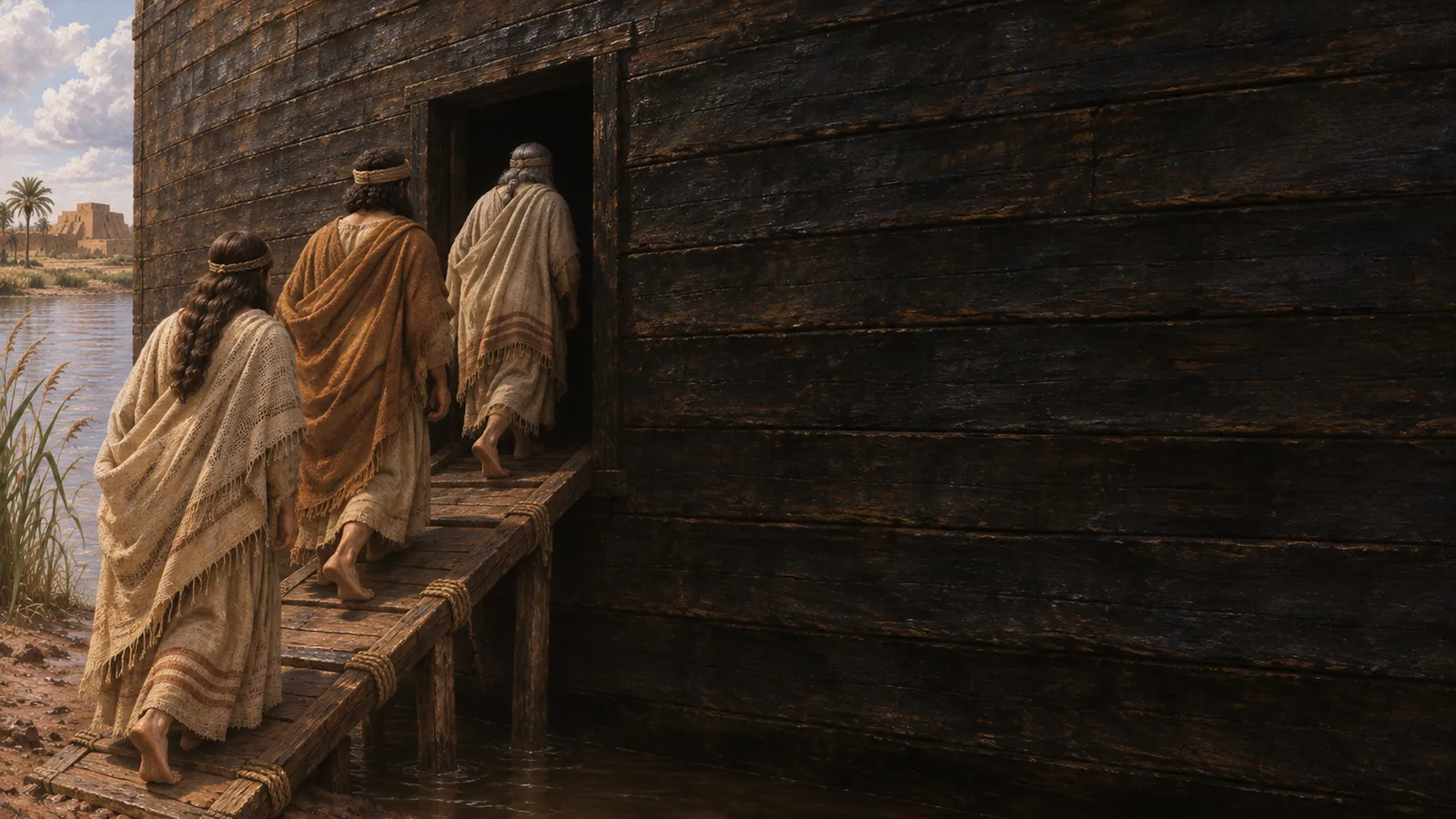
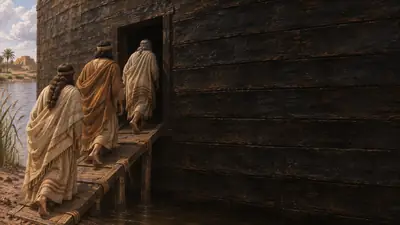
Three relatives in coarse woven garments walk up a short wooden gangplank. Seen from behind, they are just reaching a low opening in the dark side of the boat. A narrow glimpse of the river and its opposite bank remains at far left.

Next he names his family and kin. They went aboard the great boat while it still stood by the land they had known.
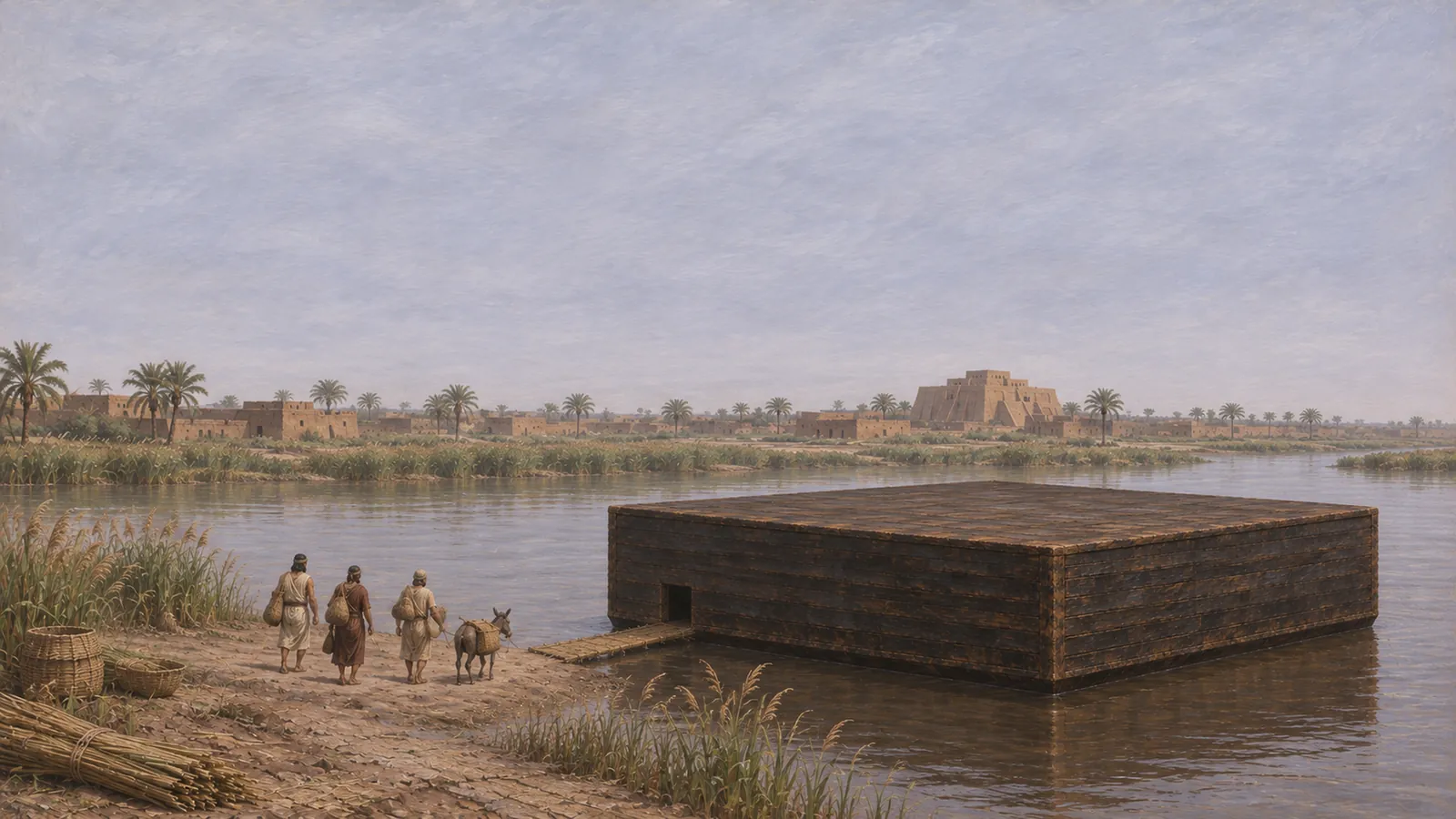
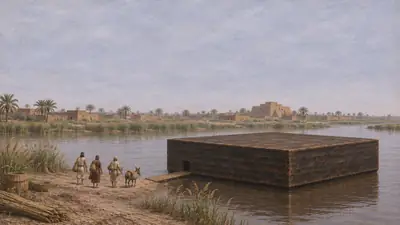
Three people carrying bundles and a small laden donkey approach the gangplank from the left bank. The wide, flat-roofed boat rests at the shallows, with one dark entry near the water. Low mudbrick buildings and reed beds extend along the opposite bank.

He brought animals from the open country, and people who knew many kinds of work. The account names broad groups without telling us how many made it aboard.
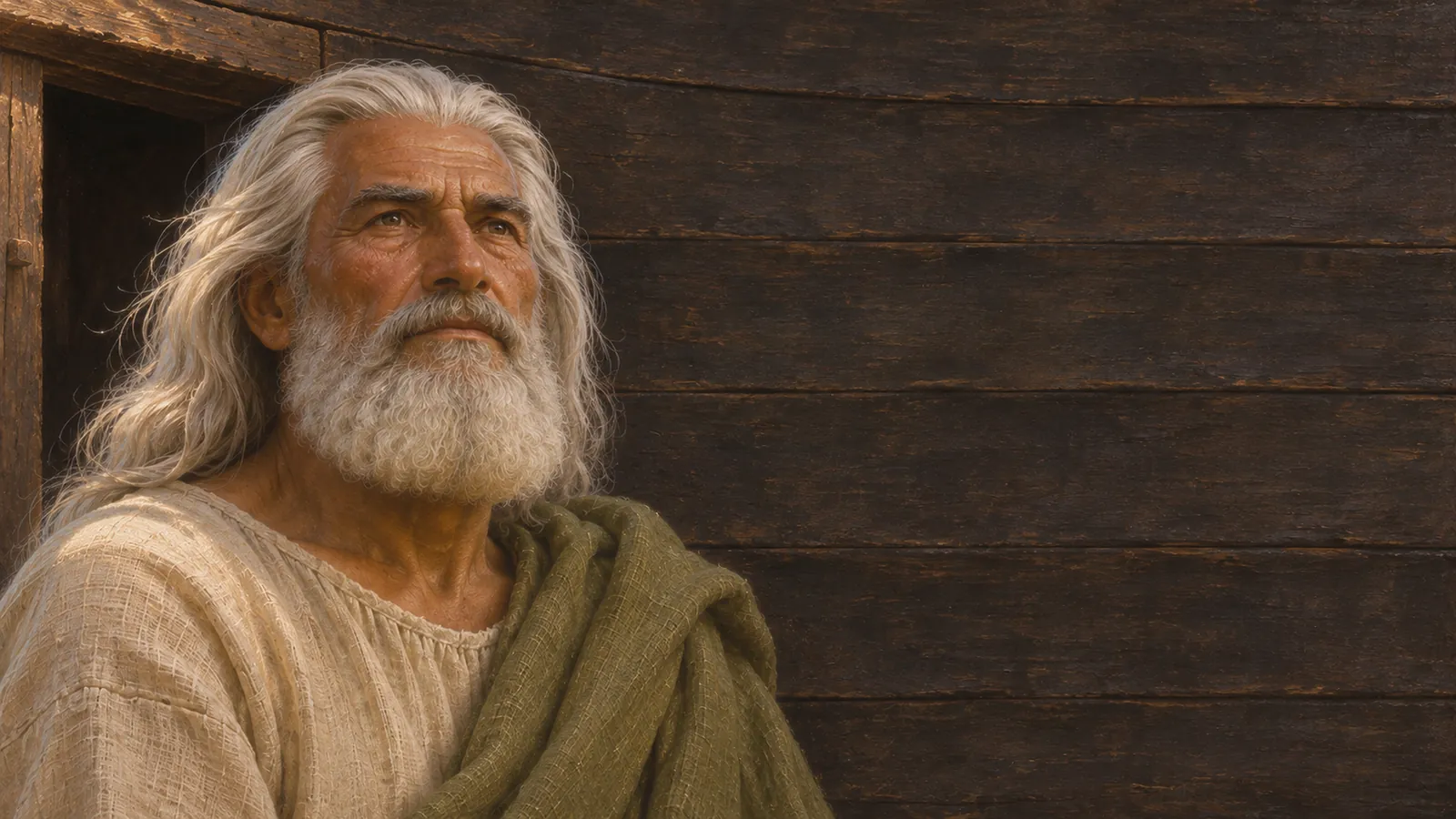
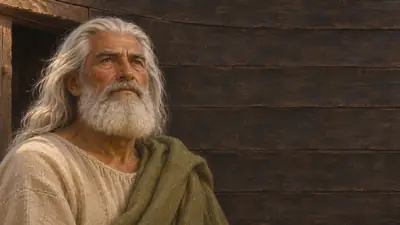
Utnapishtim stands by the open hatch and looks slightly upward. Filtered light rests on his lined face, white hair, and rough olive mantle. The boat’s dark horizontal planks continue across the right side of the frame.

Shamash had given Utnapishtim a time to go inside and shut the hatch. The words about bread and wheat returned, now tied to that hour.
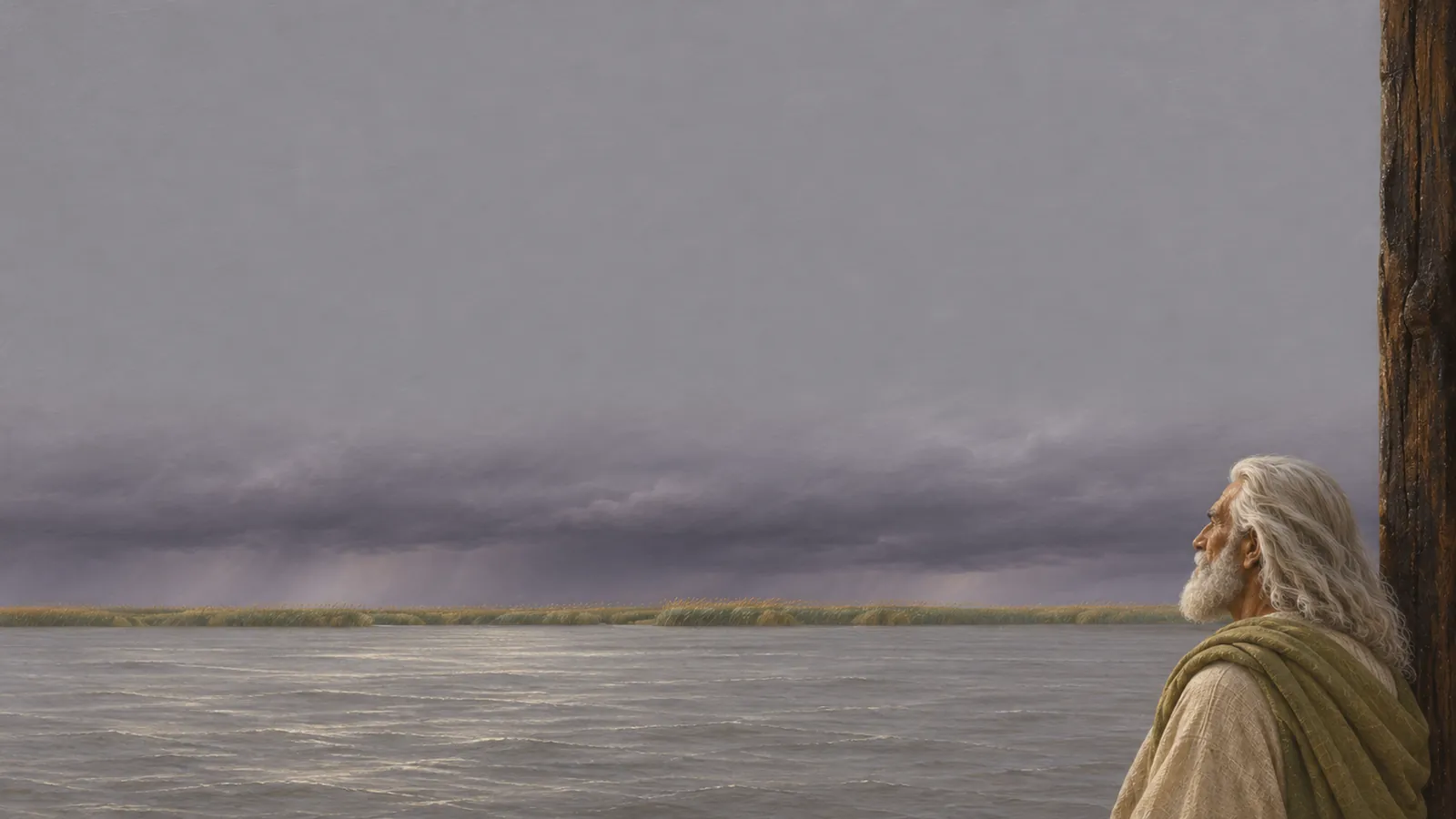
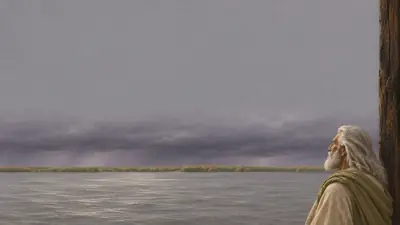
At the far right, Utnapishtim looks out from beside a dark timber post. A band of bruised-gray storm cloud hangs above the reeds across the Euphrates. The changes are still far off, but his face is intent.

The appointed time came. Utnapishtim looked out at the weather, and what he saw made him afraid.
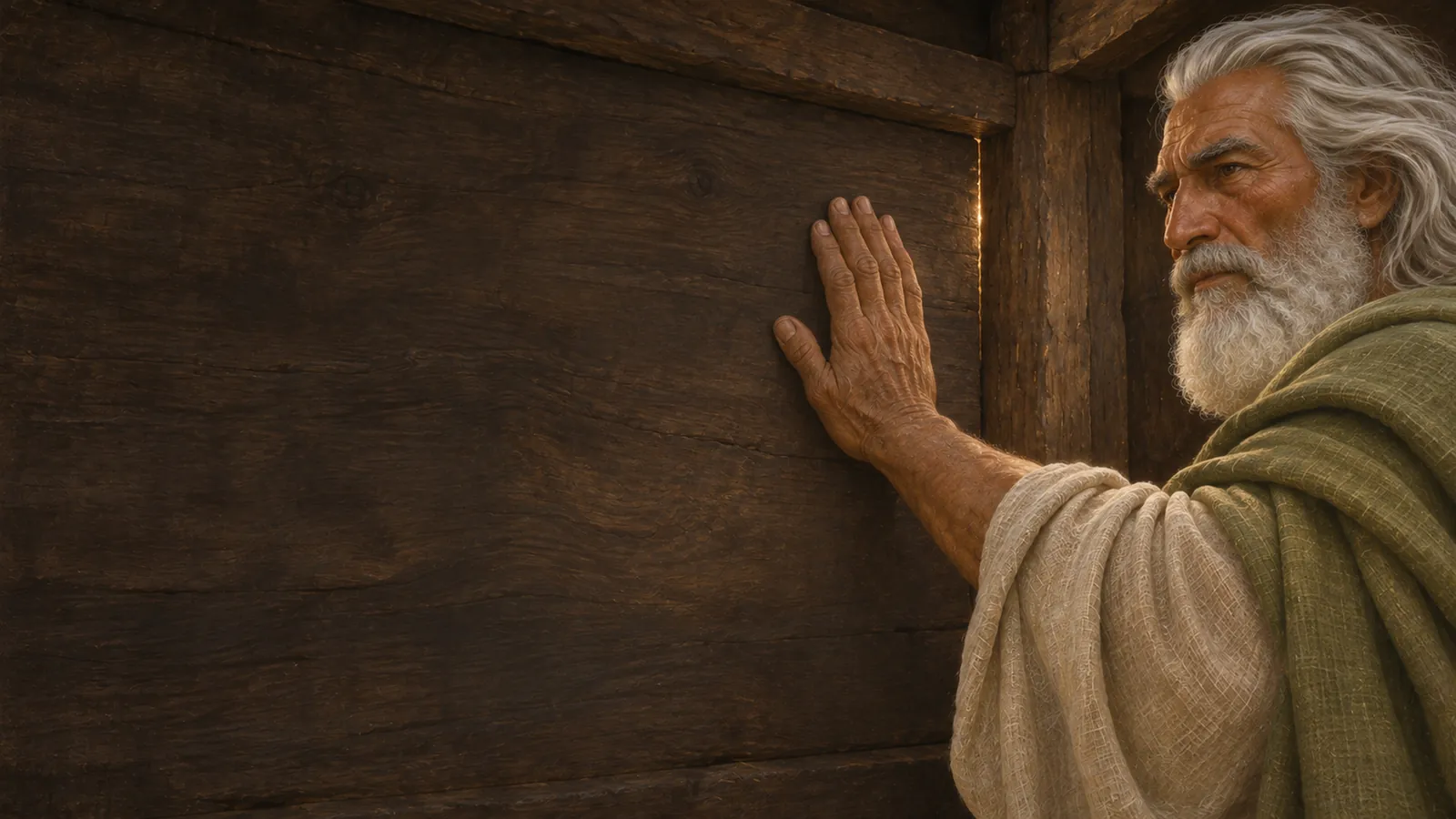
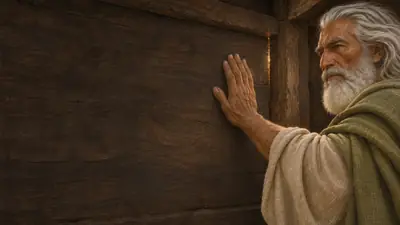
Inside the vessel, Utnapishtim presses a hand flat against the heavy plank hatch. The broad timber boards at left are already in shadow.

Utnapishtim went inside and sealed the hatch. He remembers rewarding Puzur-Enlil, the man who had worked on the boat, with a palace and its goods.
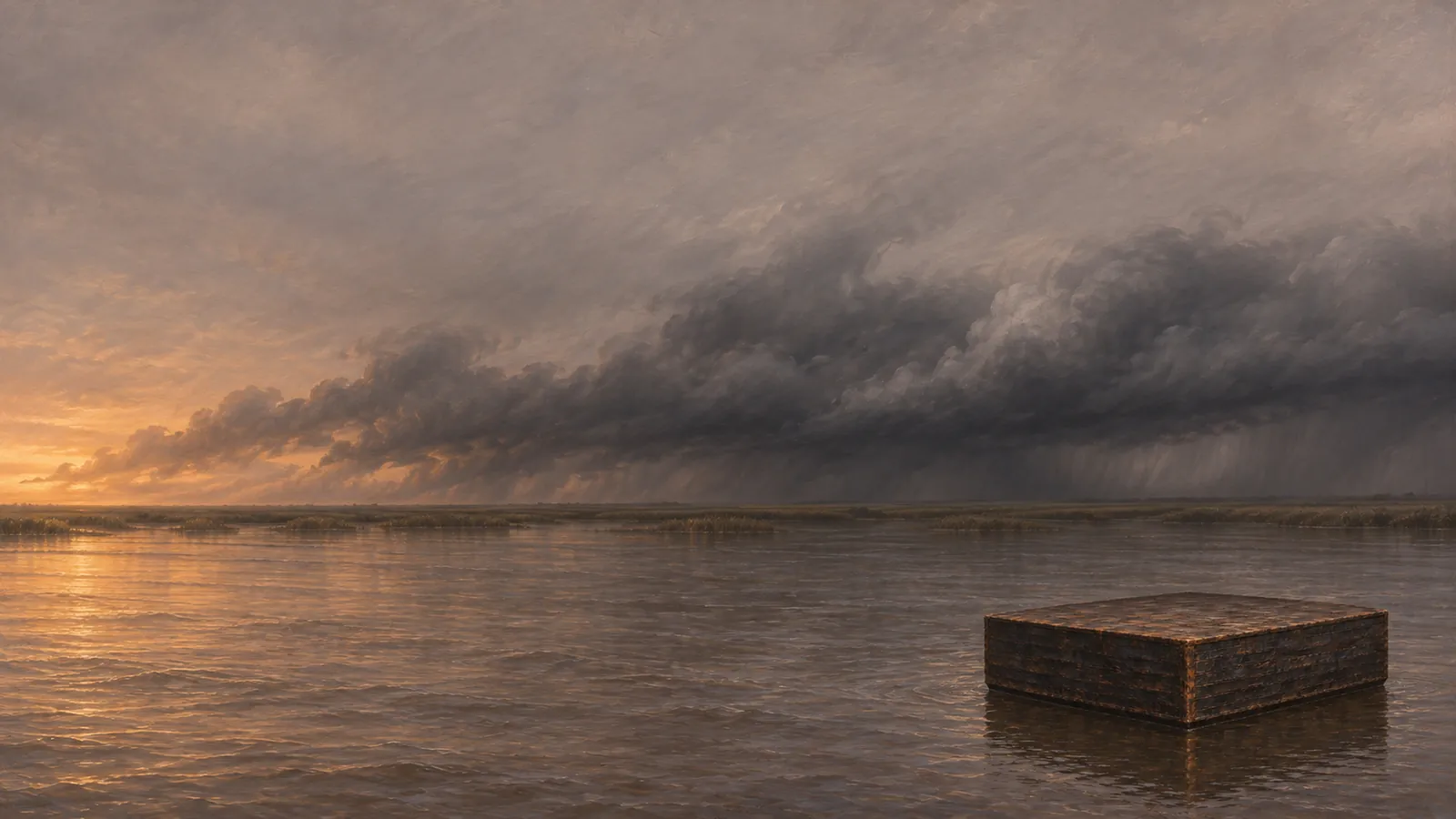
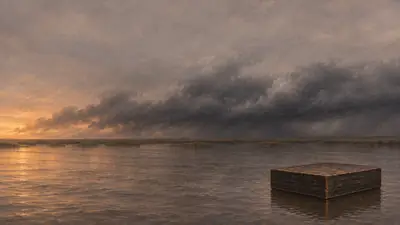
A dark storm bank rises across the horizon as dawn touches the river at far left. Rain gathers under the dark cloud beyond the reed beds. The flat-roofed boat floats alone in the lower right.

STORM

At first light a black cloud rose from the horizon. In Utnapishtim’s story, the roaring within that cloud belonged to Adad, the storm god.
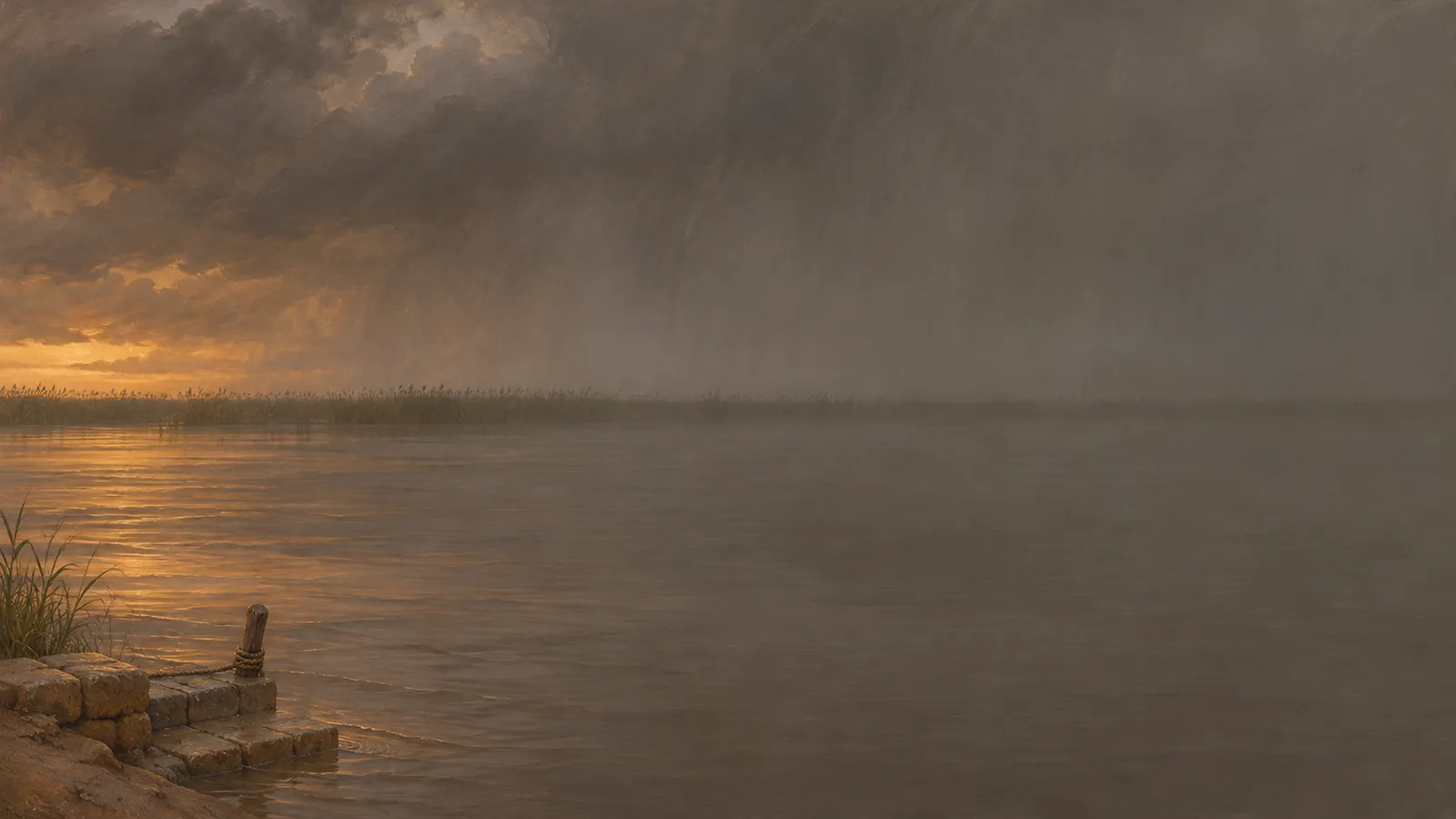
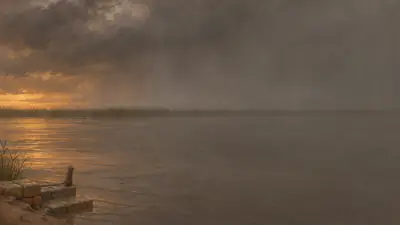
Rising water reaches a stone landing and its mooring post at the far left. A dull amber light clings to the reeds and spreads across a small patch of water. To the right, the flooded river disappears into a gray curtain of rain.

The poem names powers moving ahead of the storm. The river works overflowed, moorings gave way, and the land shone in the light of the gods’ torches.
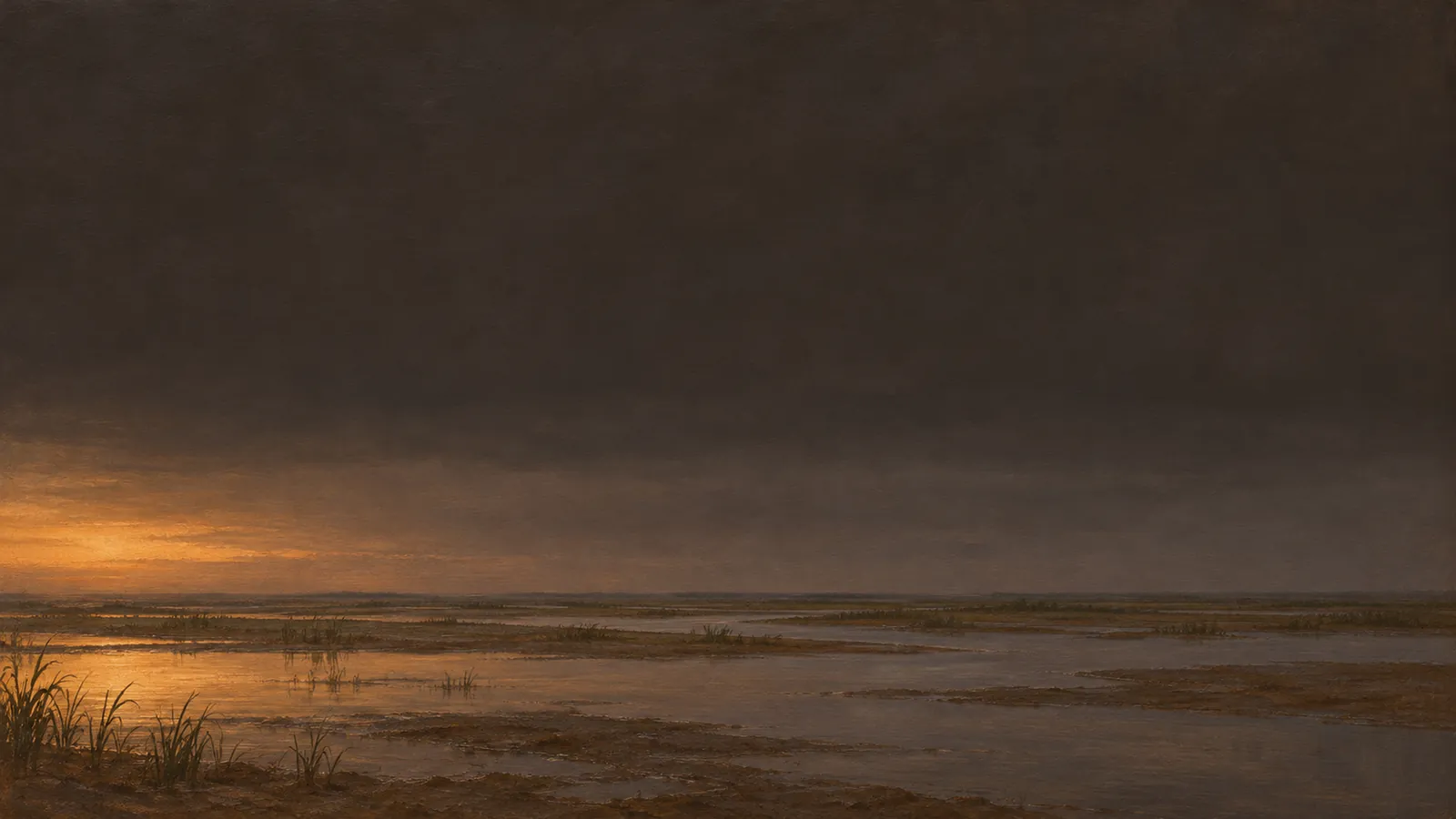
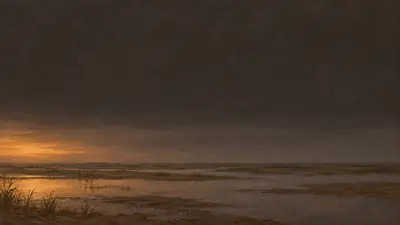
A dark ceiling of cloud covers the old floodplain. A narrow strip of ochre light survives at the far left and glances off shallow water among the reeds. The plain beyond is already hard to make out.

Brightness gave way to darkness as the storm went across the sky. The words are broken in places here, but the growing dark survives in the ancient account.
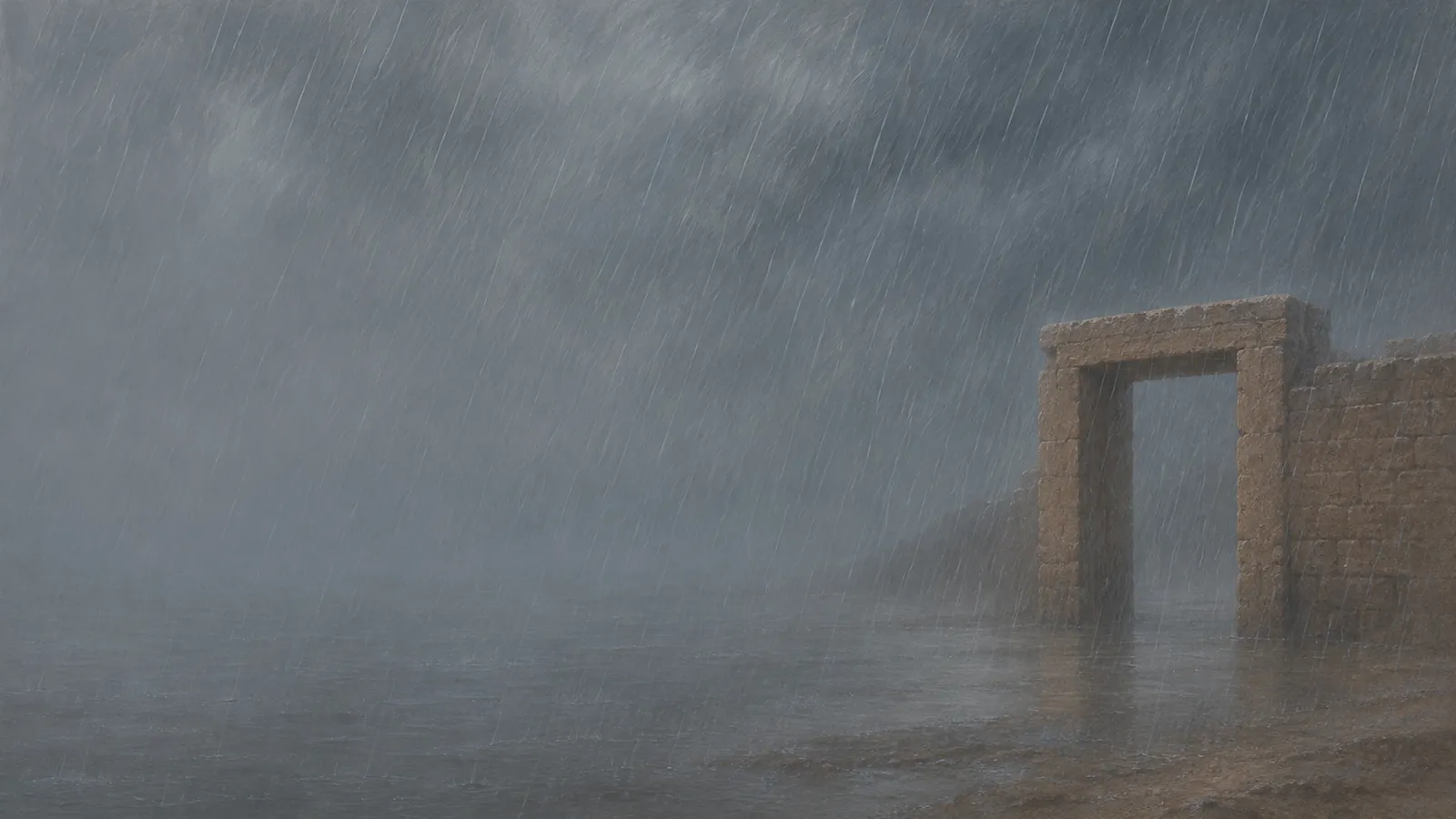
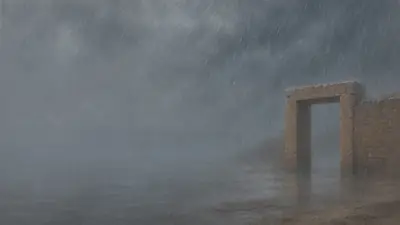
Driving rain hides almost everything beyond an empty mudbrick doorway and a short stretch of wall. Shallow floodwater covers the threshold, and gray mist takes over the left half of the view. Beyond the opening there is only more rain.

In the worst of the storm, one person could no longer see another. Utnapishtim’s account tells us how the world disappeared from sight even before the water grew quiet.
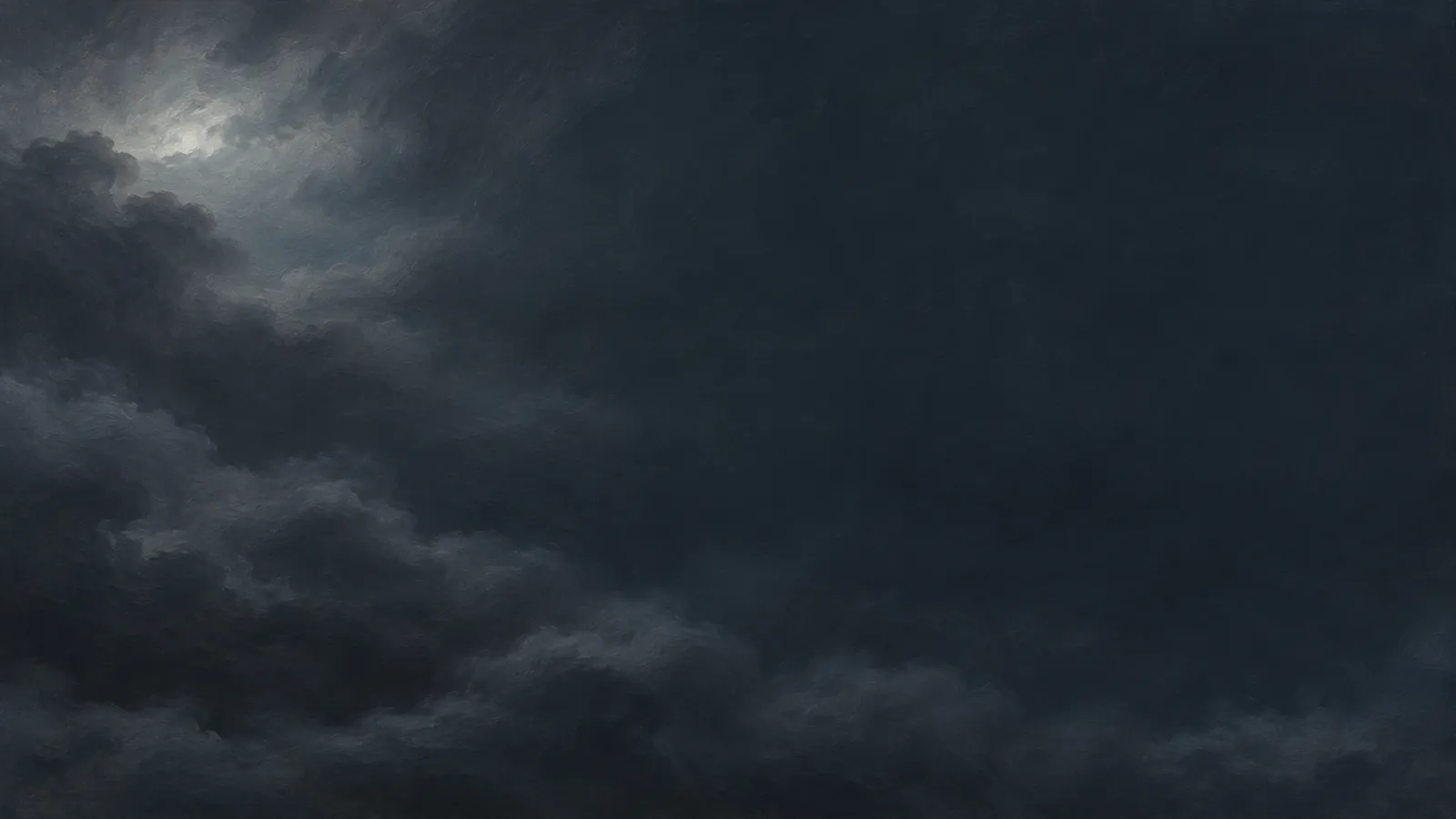
Dark blue-gray clouds lie in banks, one above the other. A small gleam of silver light filters through an opening toward the upper left. The broad cloud bank to the right remains in deep shadow.

Even the gods who had sent the flood were afraid of it. They withdrew to the heaven of Anu while the storm went on below.
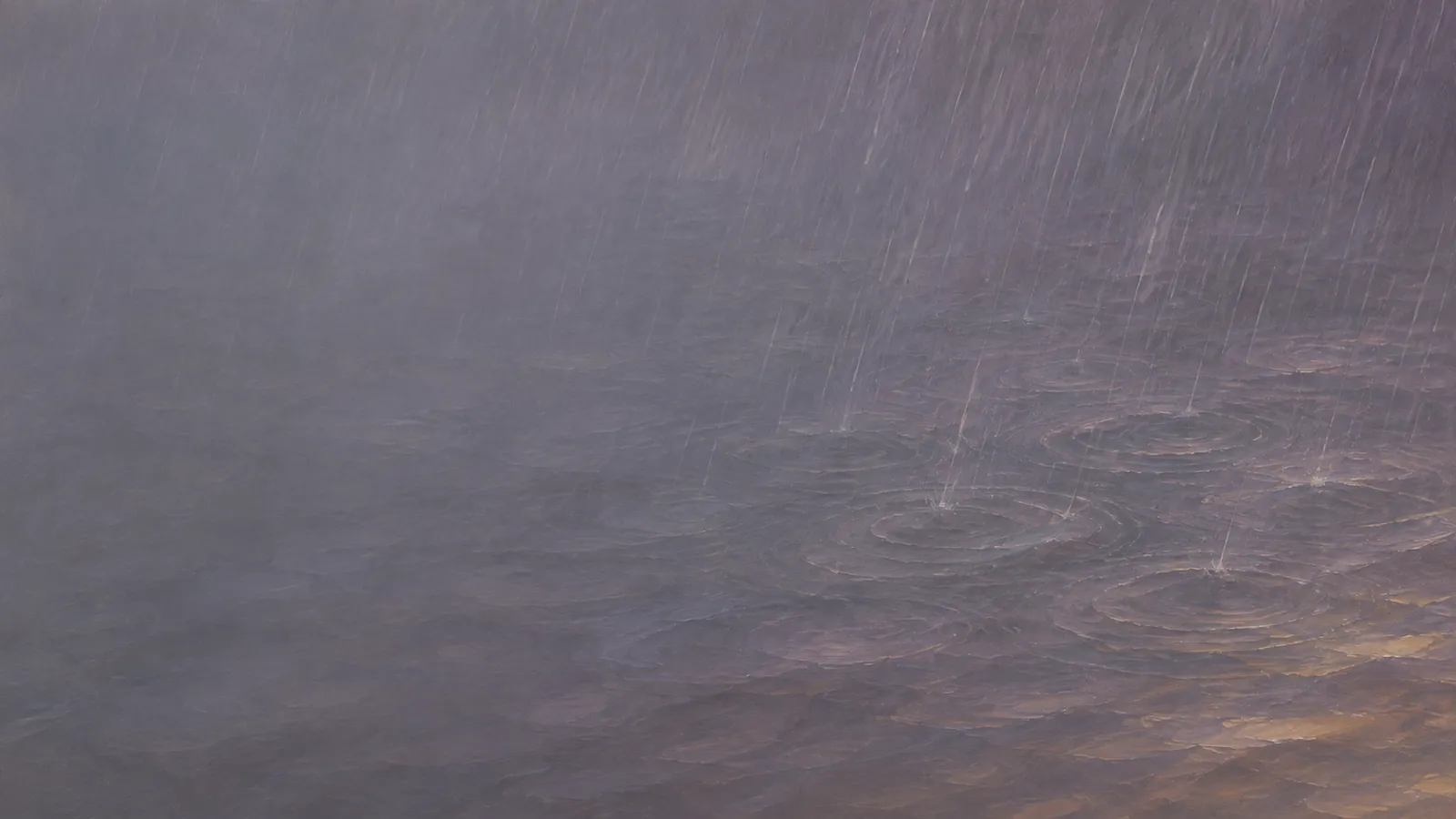
Slanting rain strokes the dark floodwater. Small ripples spread and overlap on the right, where a trace of dull warm light catches them. On the left, the water fades into violet-gray rain haze.

The mother goddess cried out and regretted what she had said in the assembly. The people were hers, she said, and the other gods wept with her.
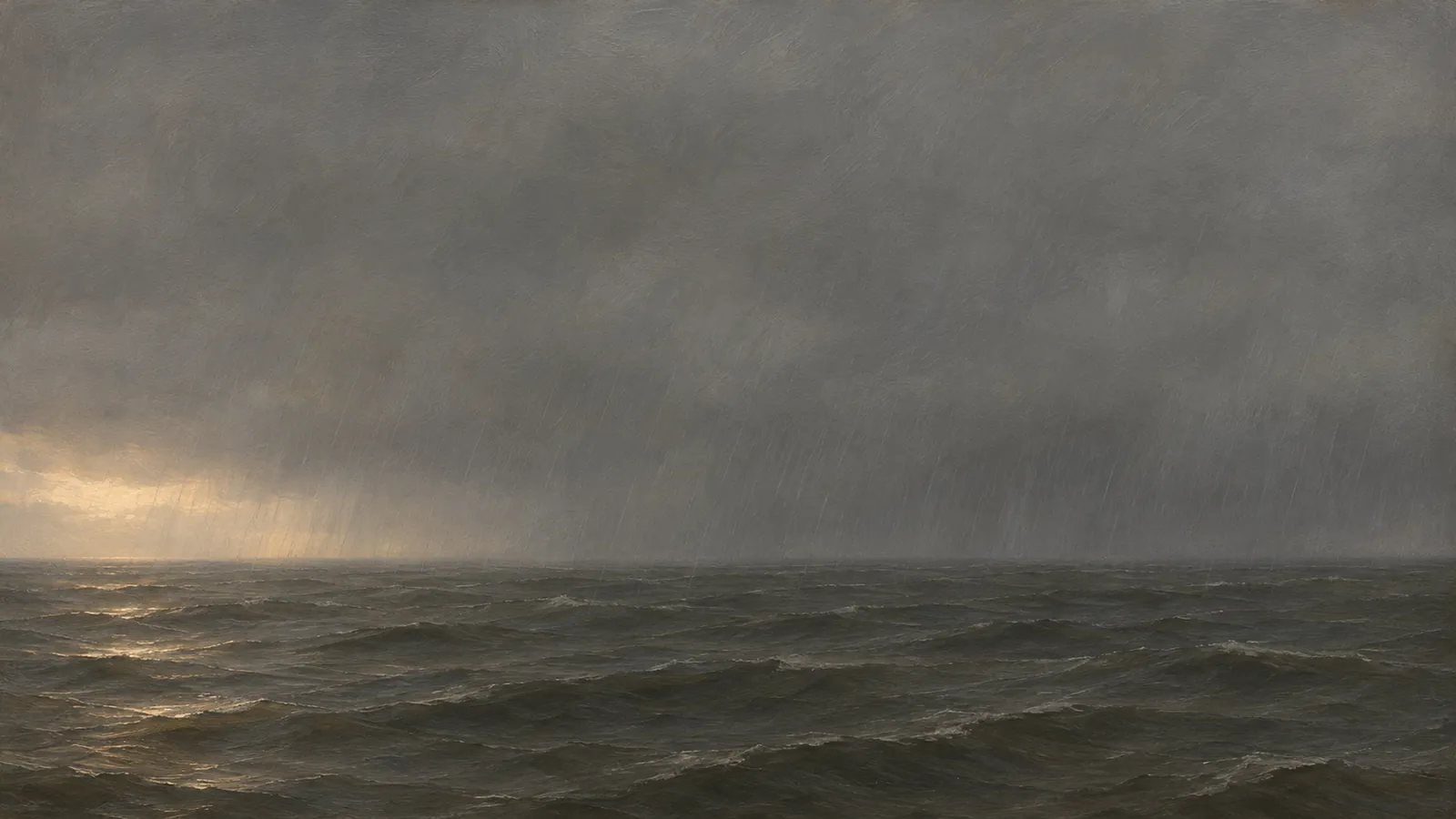
Small ridges still run across the empty floodwater. Rain blurs the horizon, but a low opening at far left lets in a little pale gold. The rest of the gray sky remains closed.

Day after day and night after night, the wind and flood went on. With the seventh day, the strength of the storm finally began to give way.
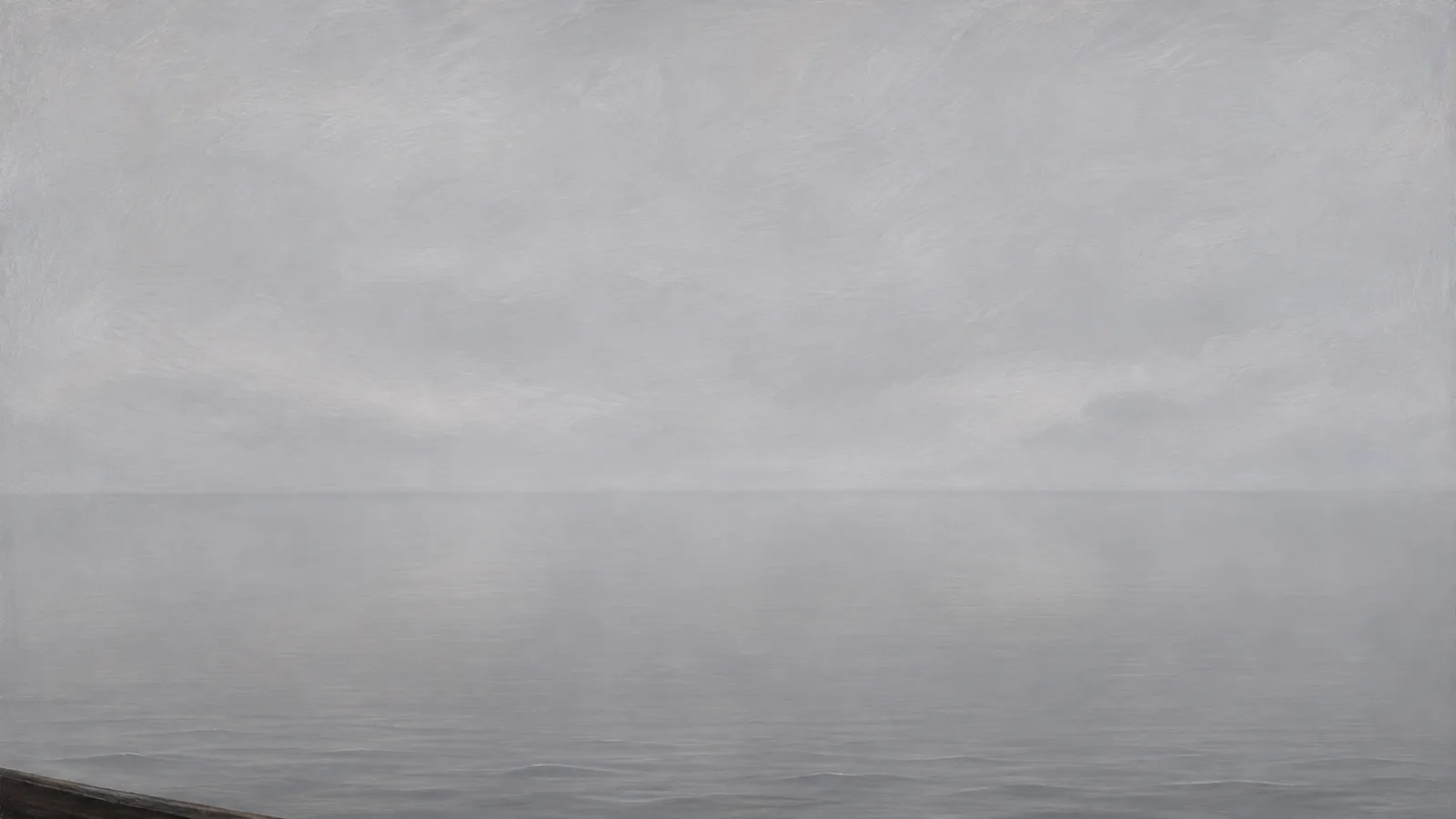
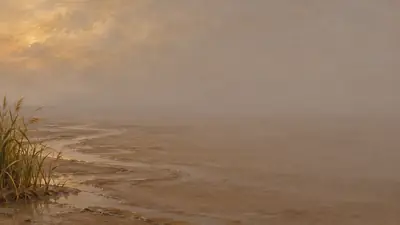
The floodwater has gone almost still under a pale, pearl-gray sky. The horizon dissolves into mist, leaving only a few small ripples close by. A sliver of dark wood at the lower-left edge marks the view from the boat.

SILENCE

On the seventh day the sea grew still. Utnapishtim could finally look out on a world where the water and the sky had stopped fighting.
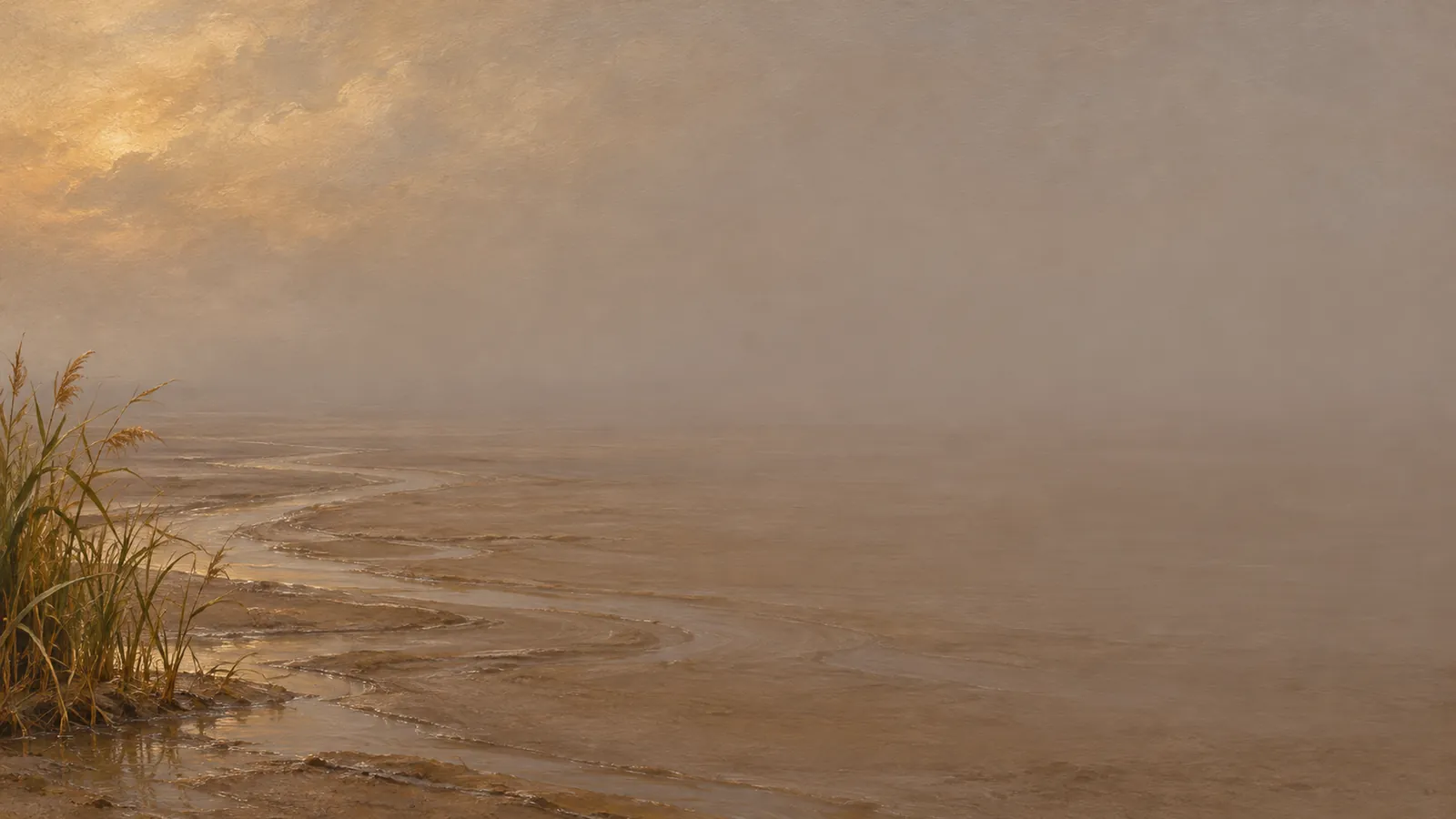
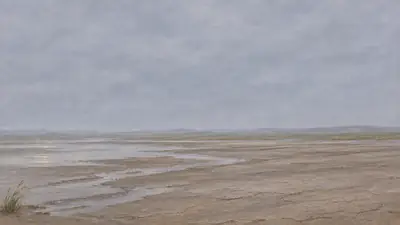
Shallow rivulets wind across exposed brown silt. A handful of reeds stands at the lower left under weak warm light. The now-empty plain blends into haze on the right.

The world outside was silent and flat. Utnapishtim says the people had turned to clay, and where life had been he saw only a level plain.
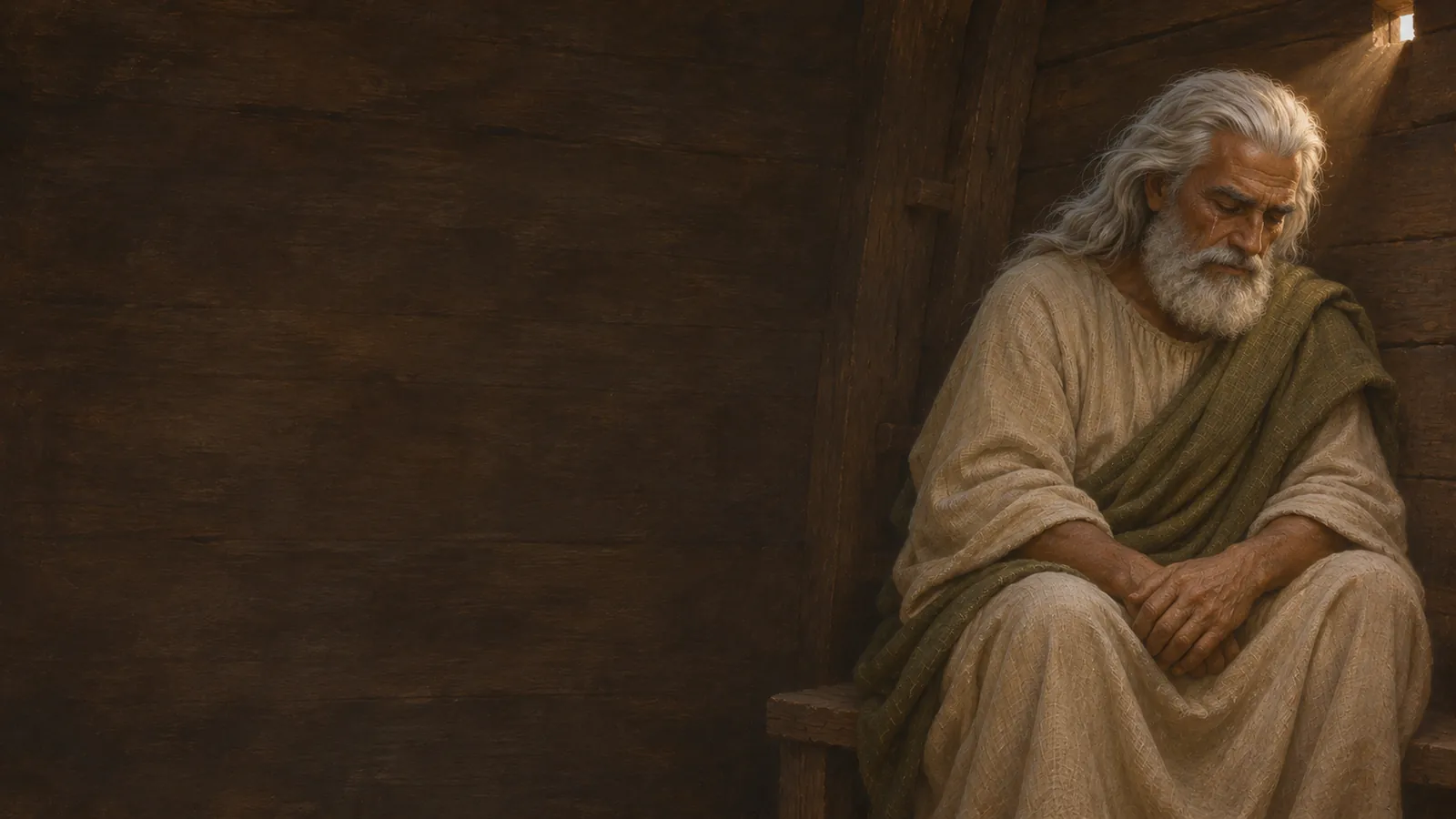
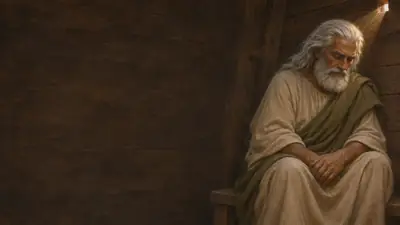
Utnapishtim sits low inside the boat, with his head bowed and hands resting in his lap. A narrow beam from a small opening in the upper-right planks strikes his silver hair and the side of his face. A tear catches the light beside the still-dark timber wall.

Utnapishtim opened a vent and sunlight touched his face. He sank down and wept as the light came in through the opening.
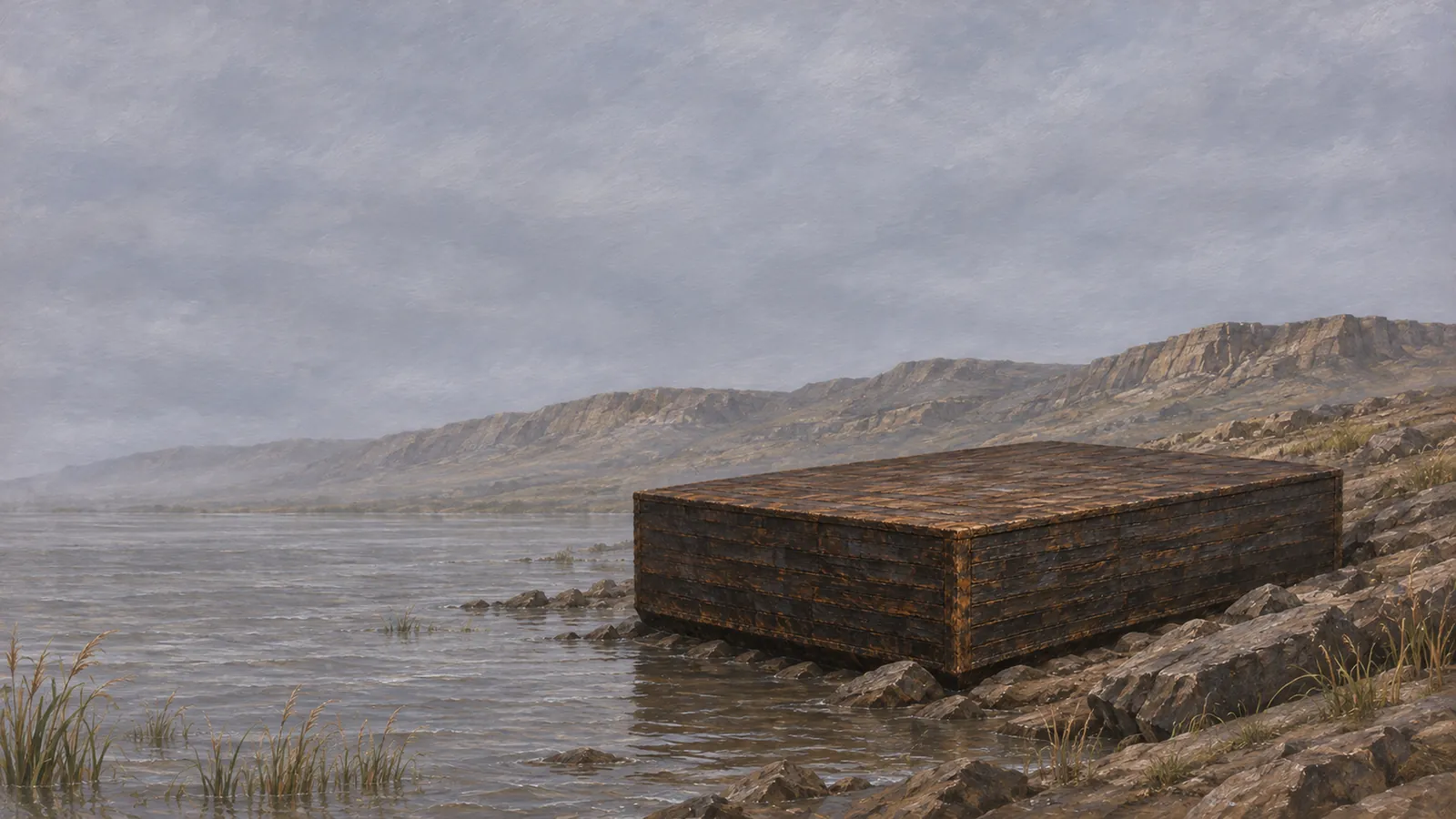
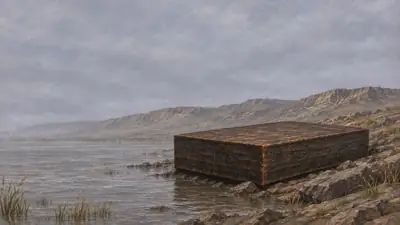
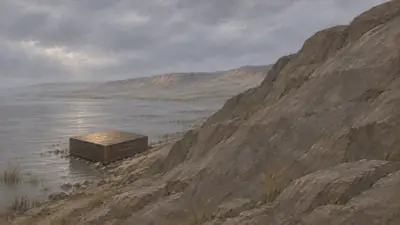
The dark flat-roofed boat has come to rest among the rocks at the foot of Mount Nimush. Water still covers the lower shore, touching the squared hull and scattered reeds. A long ridge rises through the gray haze behind it.

NIMUSH

Land began to appear as Utnapishtim looked out. At Mount Nimush the boat ran aground, and the mountain held it where it was.
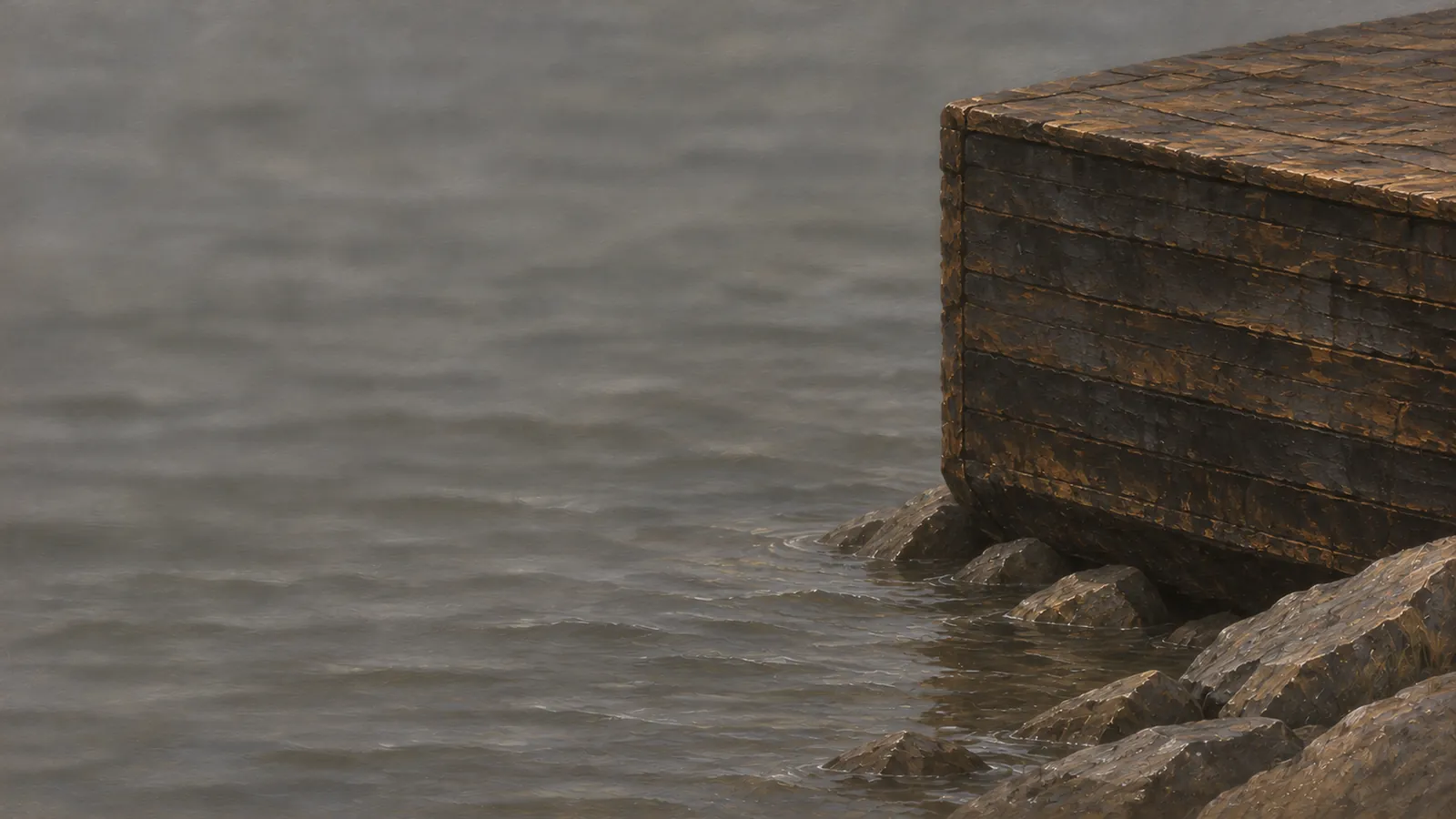
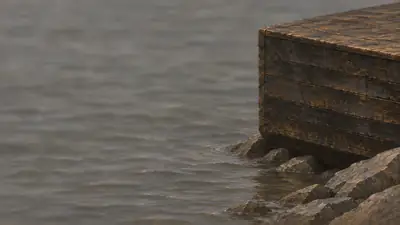
The tar-dark corner of the boat rests firmly among the rocks at Nimush. Soft warm light catches the roof edge and the exposed stone. Small ripples move around the rocks below the motionless hull.

Day after day, the boat could move no farther. The poem counts the waiting while Mount Nimush holds the boat fast against it.
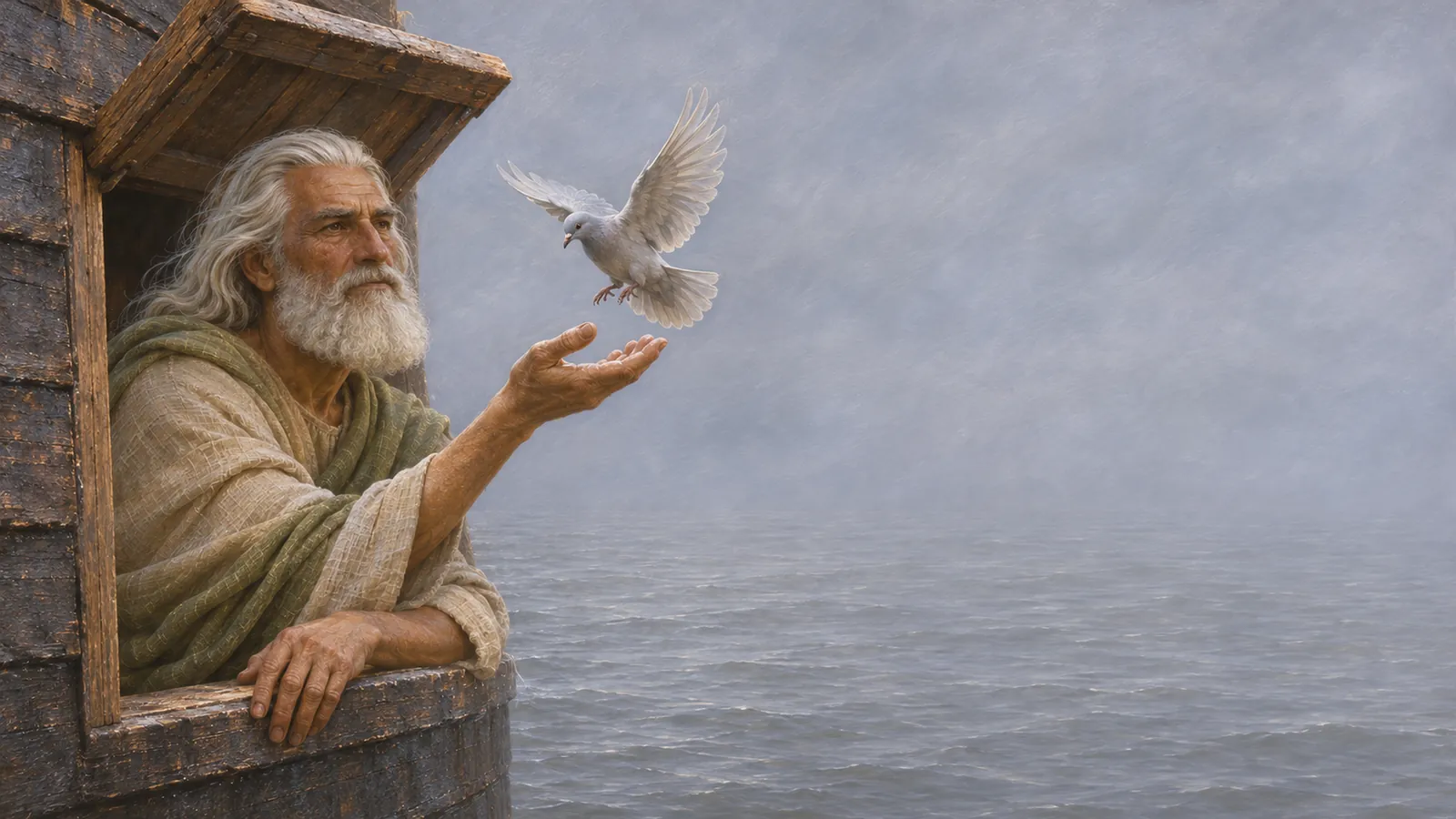
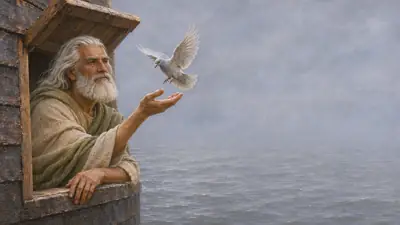
A single pale gray dove drops toward Utnapishtim’s open hand, its wings lifted and feet extended. The old man leans out of a dark plank hatch, watching it come near. Cool haze hangs over the water beyond them.

Utnapishtim set a dove free. It could find nowhere to perch, and so it came back to the boat.
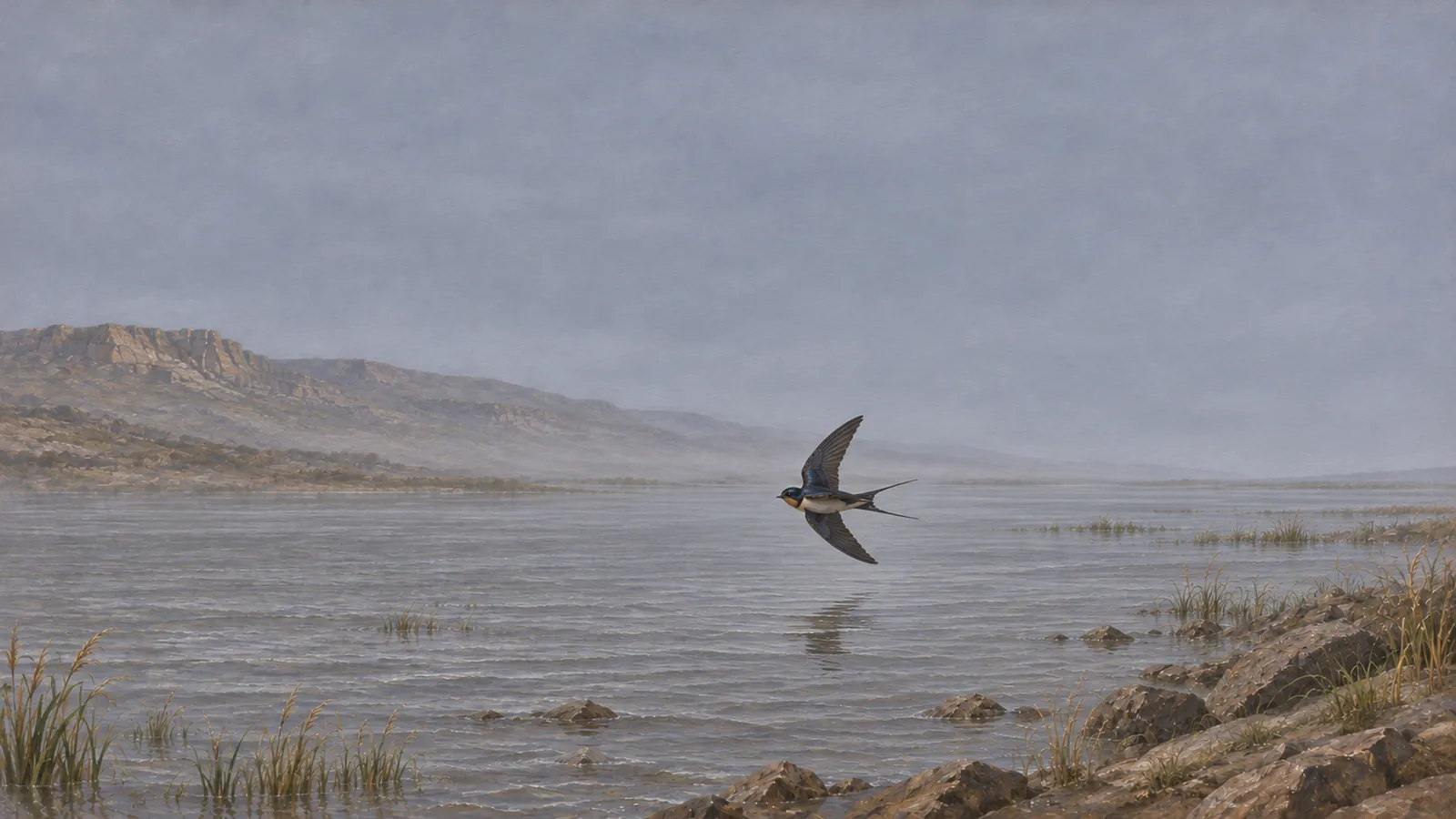
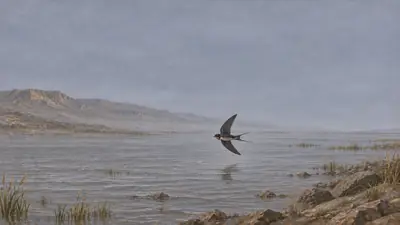
A single swallow skims the gray water with its long wings angled in flight. Its forked tail stands out against the pale floodwater. The rocky slope of Nimush recedes into mist beyond it.

Next he set a swallow free. Like the dove, it found no place to rest, and it came back to him.
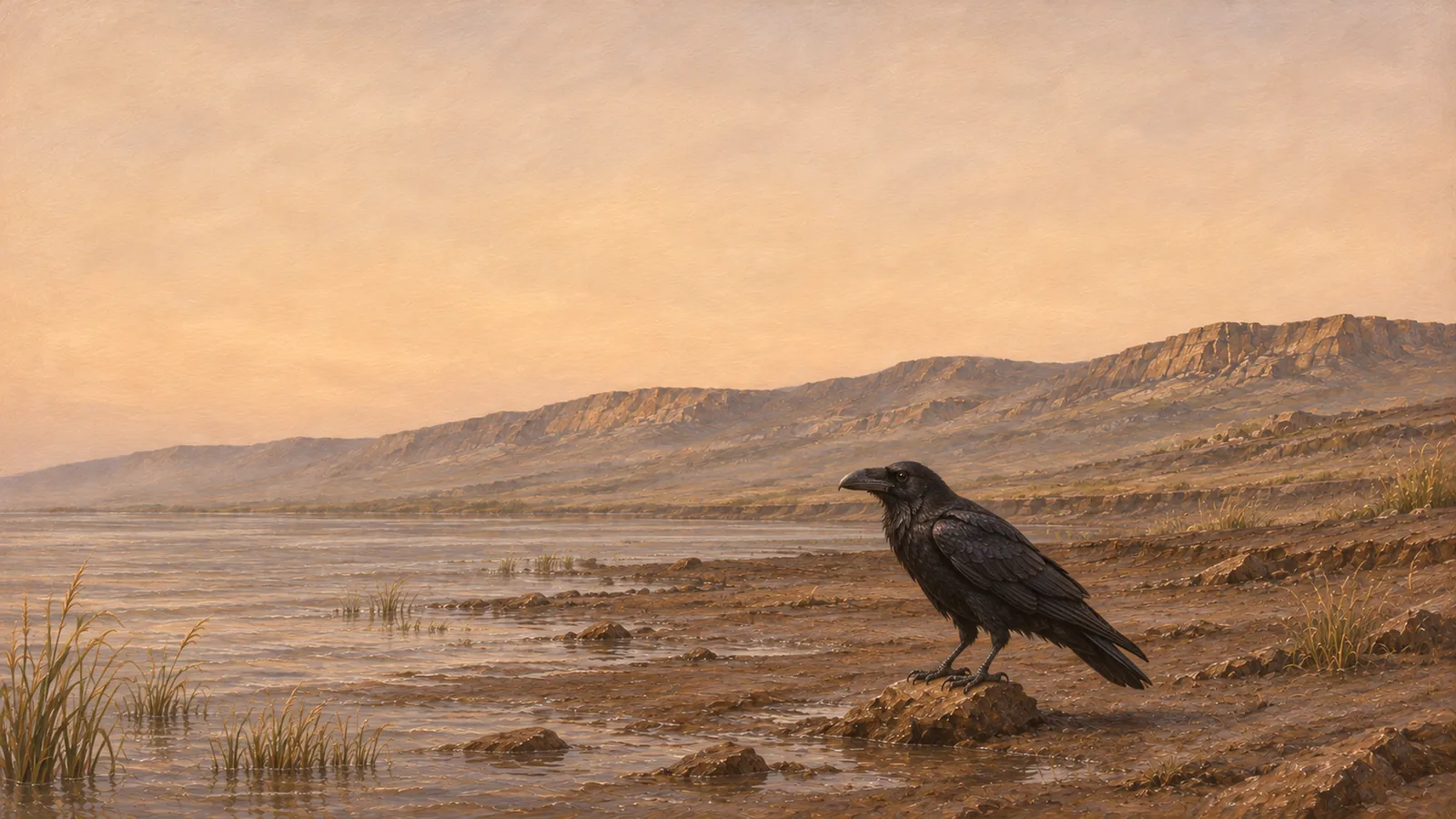
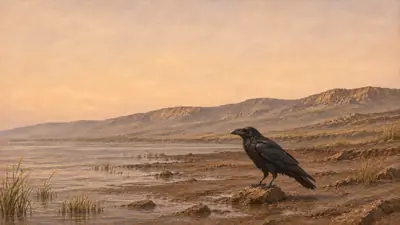
A black raven stands on a stone at the edge of the receding water. Its heavy bill and dark feathers are distinct against the damp brown bank. Warm light reaches the exposed shore under a pale sky.

RAVEN

The raven went out and saw that the waters had receded. It found food, and this time the bird did not come back to the boat.
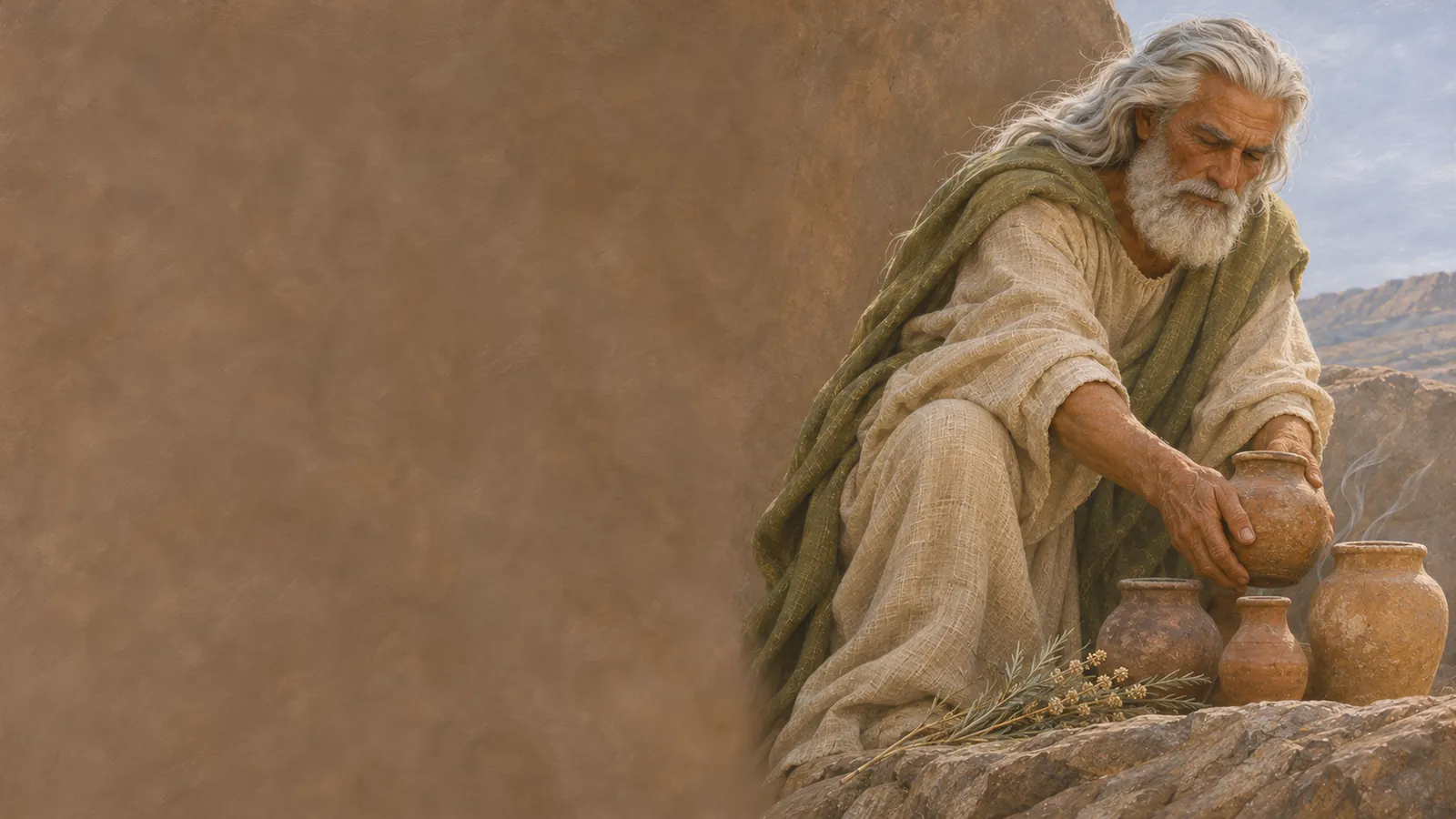
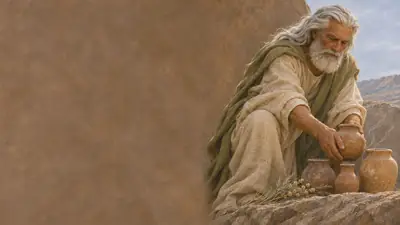
Utnapishtim lowers a rounded clay vessel beside several others on the rock. Dry sprigs lie beside the vessels, and a light wisp rises behind them. The blurred face of a boulder fills the left side.

Then Utnapishtim made an offering toward the four corners of the earth. On the mountain he set out vessels, with reed, cedar and myrtle beneath them.
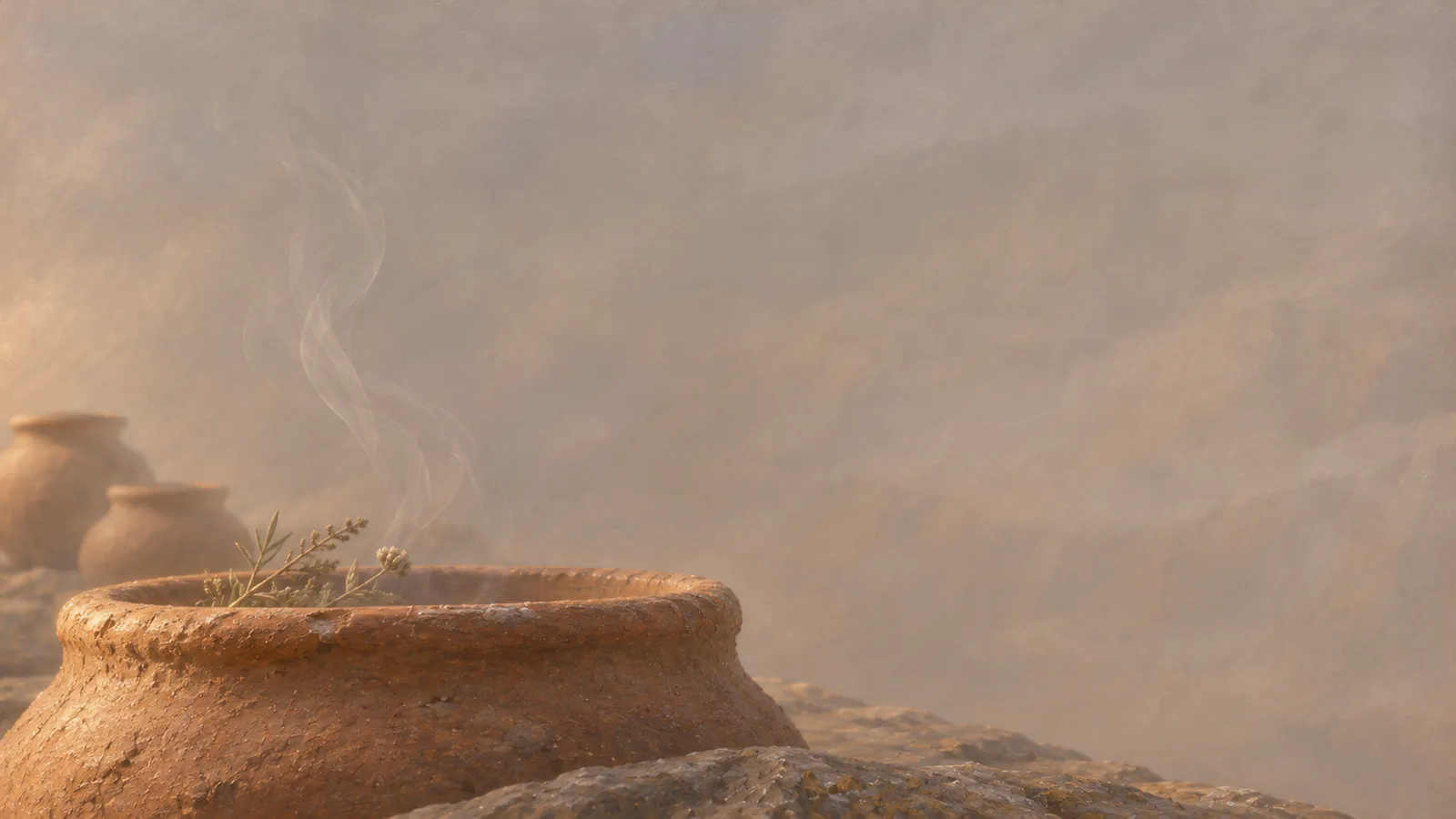
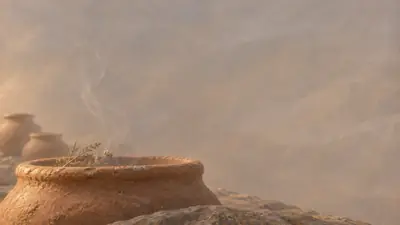
A fine thread of smoke rises above a clay vessel and a few dry sprigs. Two softly blurred pots stand farther back to the left. Warm haze spreads across the stone behind them.

The scent of the offering drifted upward. Utnapishtim says the gods gathered to it as flies gather, a surprising image after so much silence.
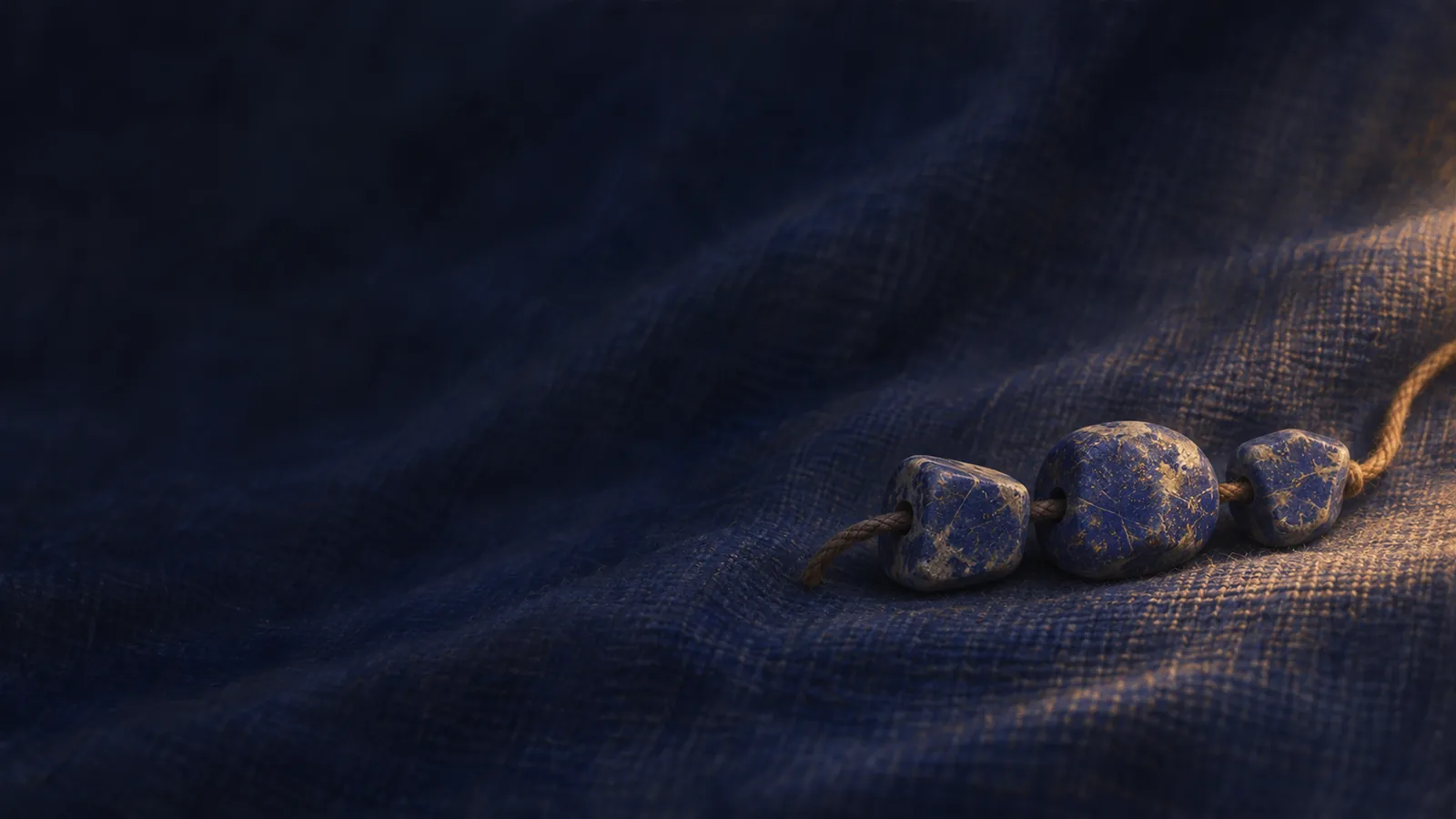
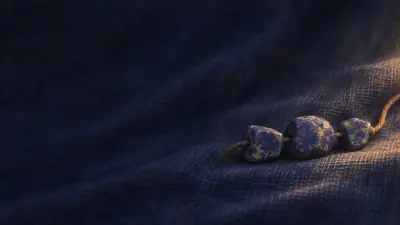
Several lapis beads lie on a simple cord over dark indigo cloth. A little warm light reveals scratches and mineral flecks in the blue stones. The fabric fades to shadow toward the left.

A goddess raised her lapis jewelry and said she would always remember those days. She blamed Enlil for what the flood had done to her people.
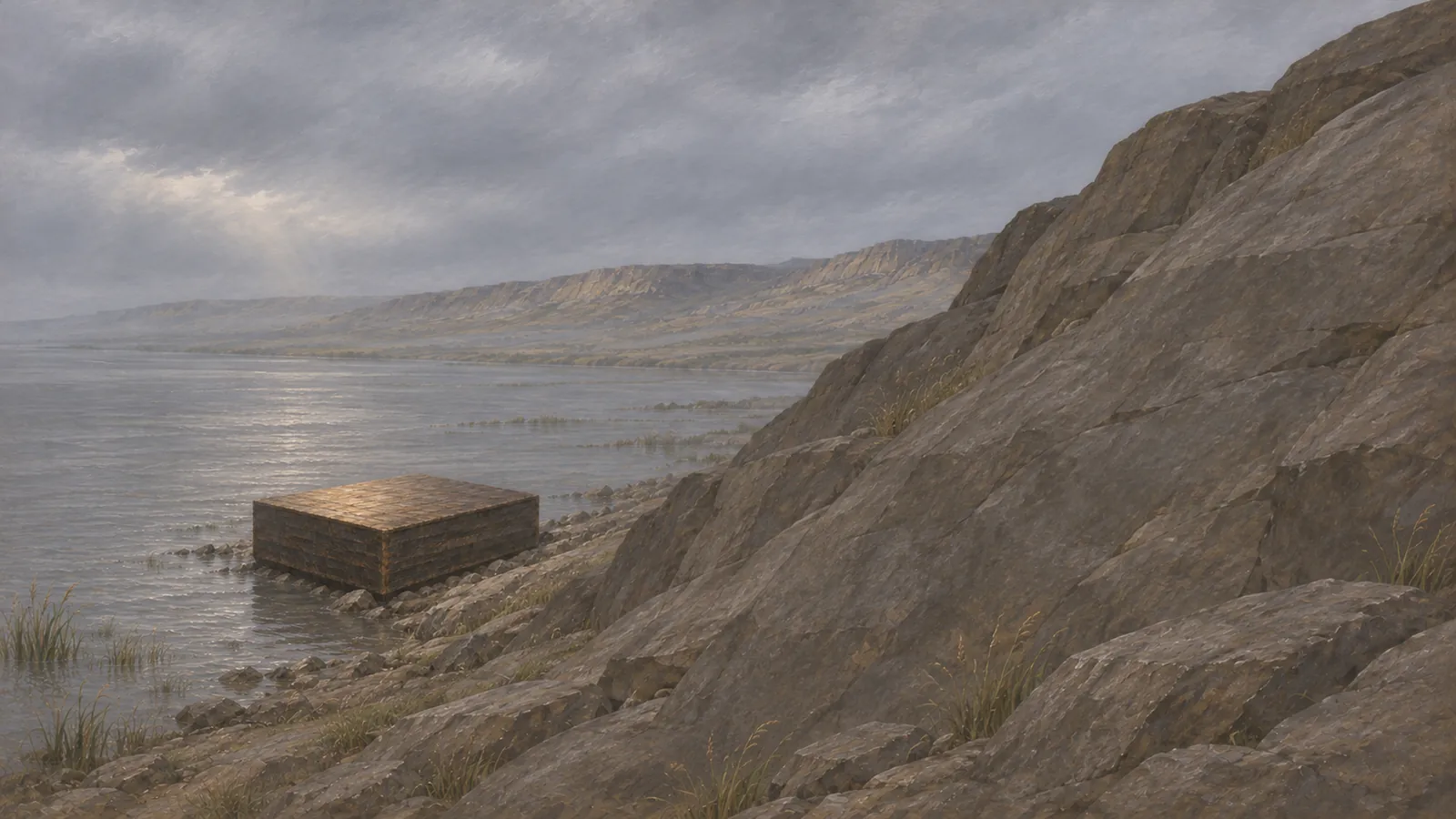
From high on the slope, the squared boat looks small where it rests against the rocks. A break in the clouds casts pale light on the flat roof and the water beside it. A broad shadowed rock face fills the right side.

Enlil saw the boat and grew angry. Someone had come through alive, although he had expected the flood to leave no one alive.
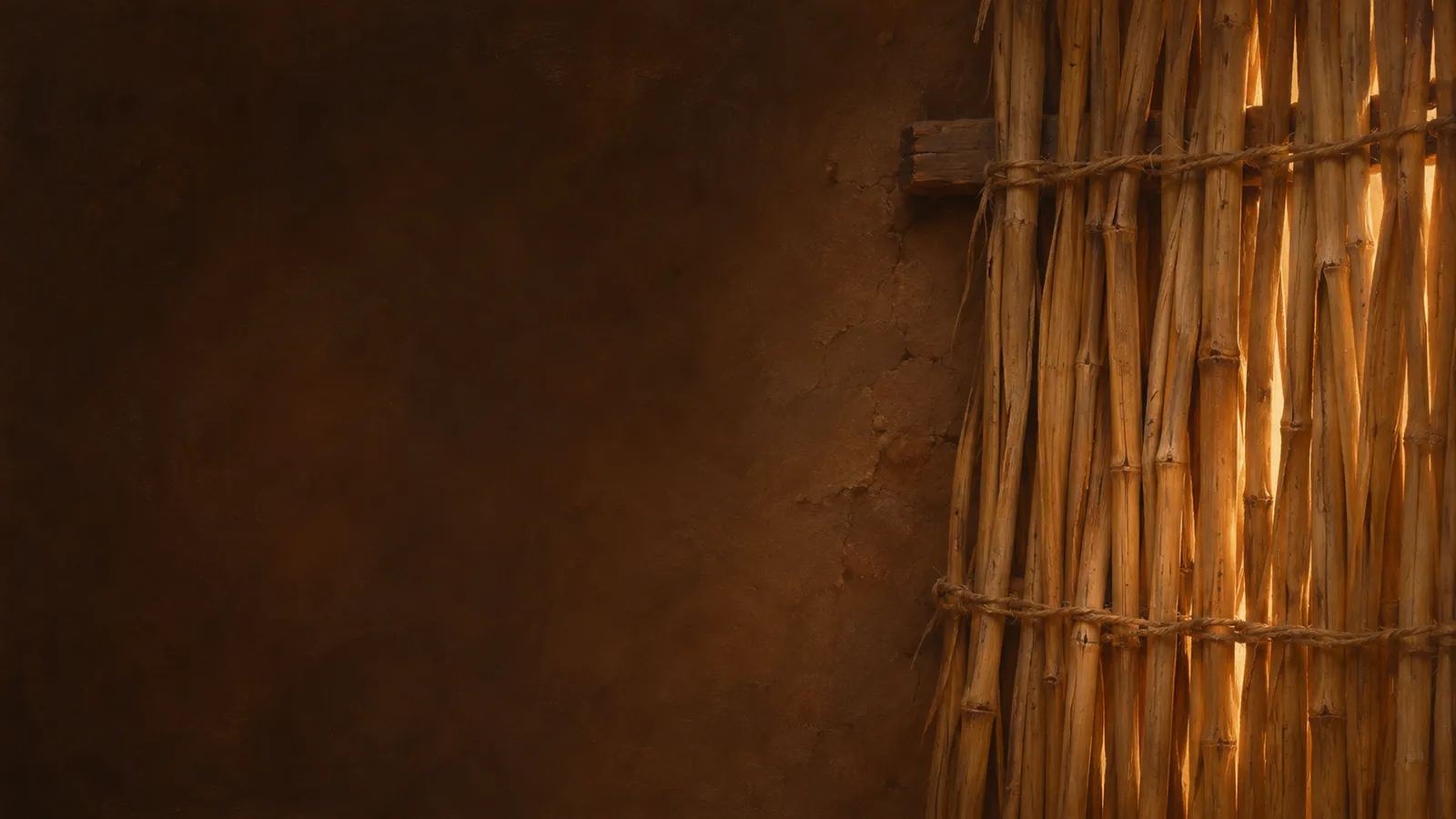
Warm light leaks between the dry stalks of a reed screen. A rough wooden crosspiece and simple ties hold the stalks in place. The clay wall on the left falls into shadow.

Ninurta answered him by pointing to Ea. Who else, he asked, could have brought this about? The story now turns to the one who had warned Utnapishtim.
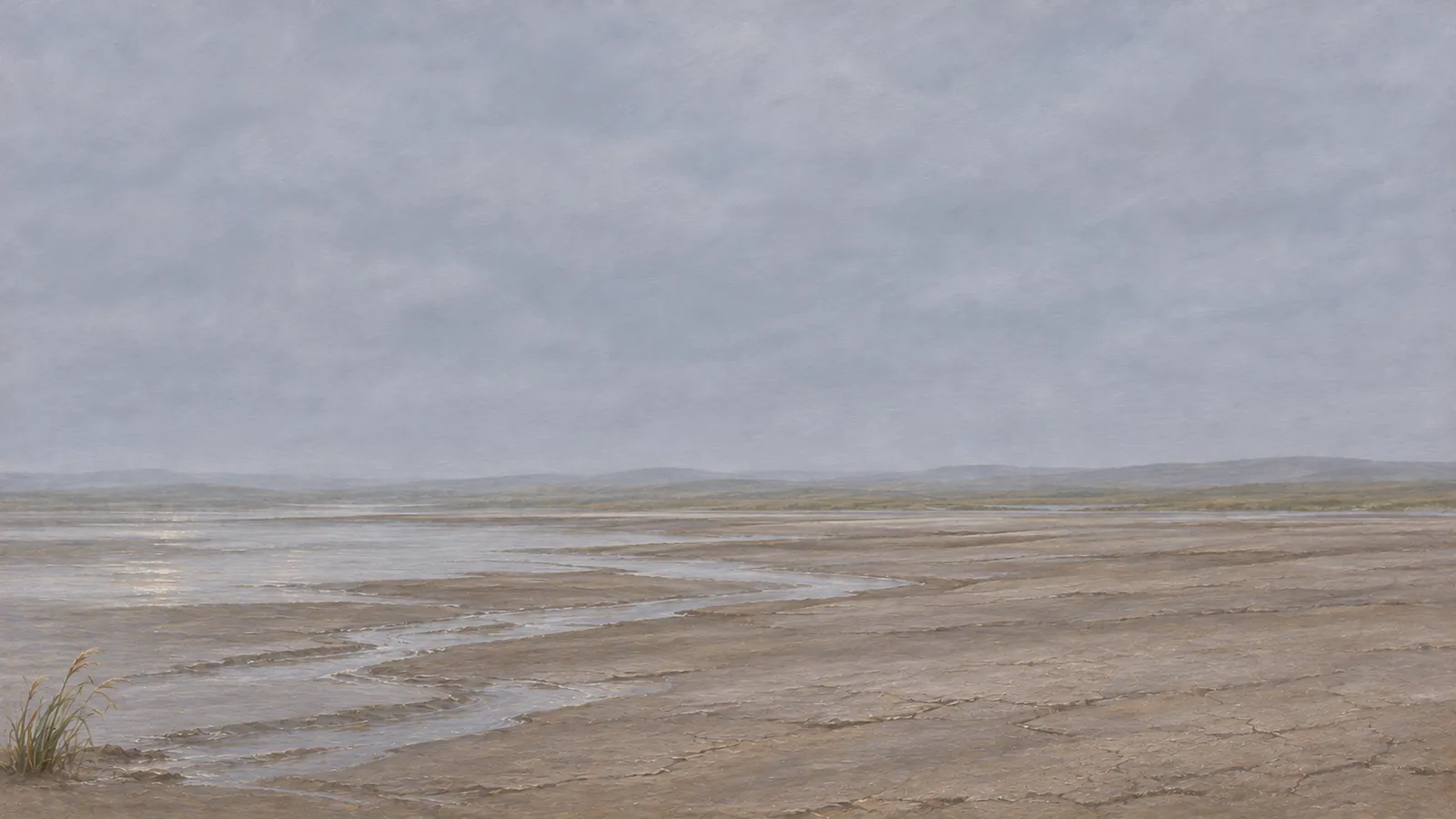
Thin streams wind across the exposed silt where the flood has receded. One tuft of reeds remains at the near edge. Low distant slopes sit beneath a pale, overcast sky.

Ea asked how Enlil could have brought on such a flood without thinking it through. Whoever did wrong should answer for it, he said, rather than everybody paying together.
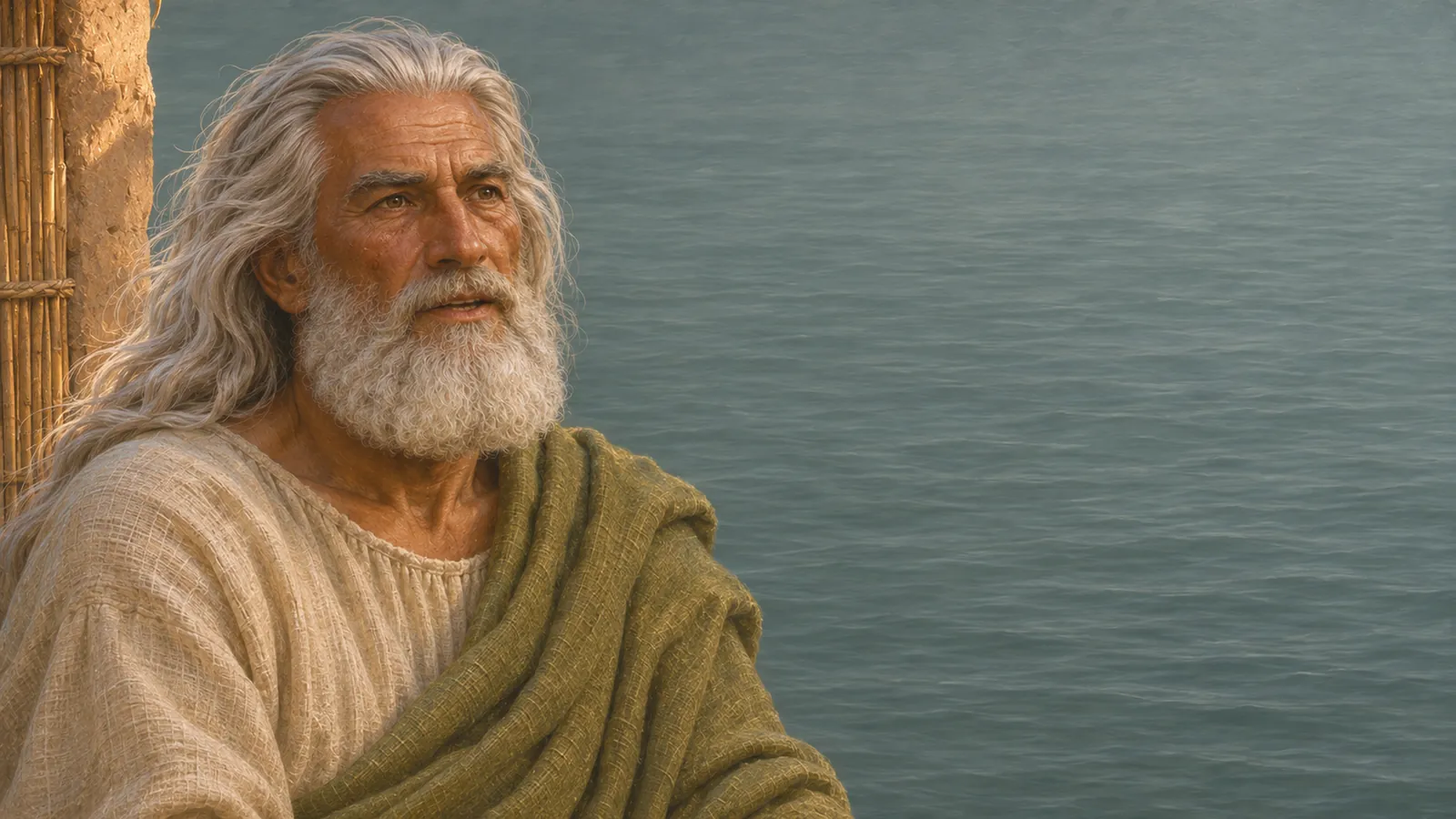
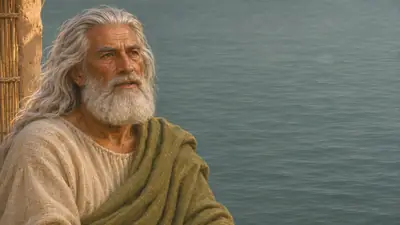
Utnapishtim speaks on the far shore, his silver hair and white beard warmed by the light. A clay wall and a small section of reed screen stand directly behind him. The quiet water fills the right side in muted blue-green.

Ea said he had sent a dream, through which the wise man learned the gods’ secret. He asked the assembly to decide what should happen to him now.
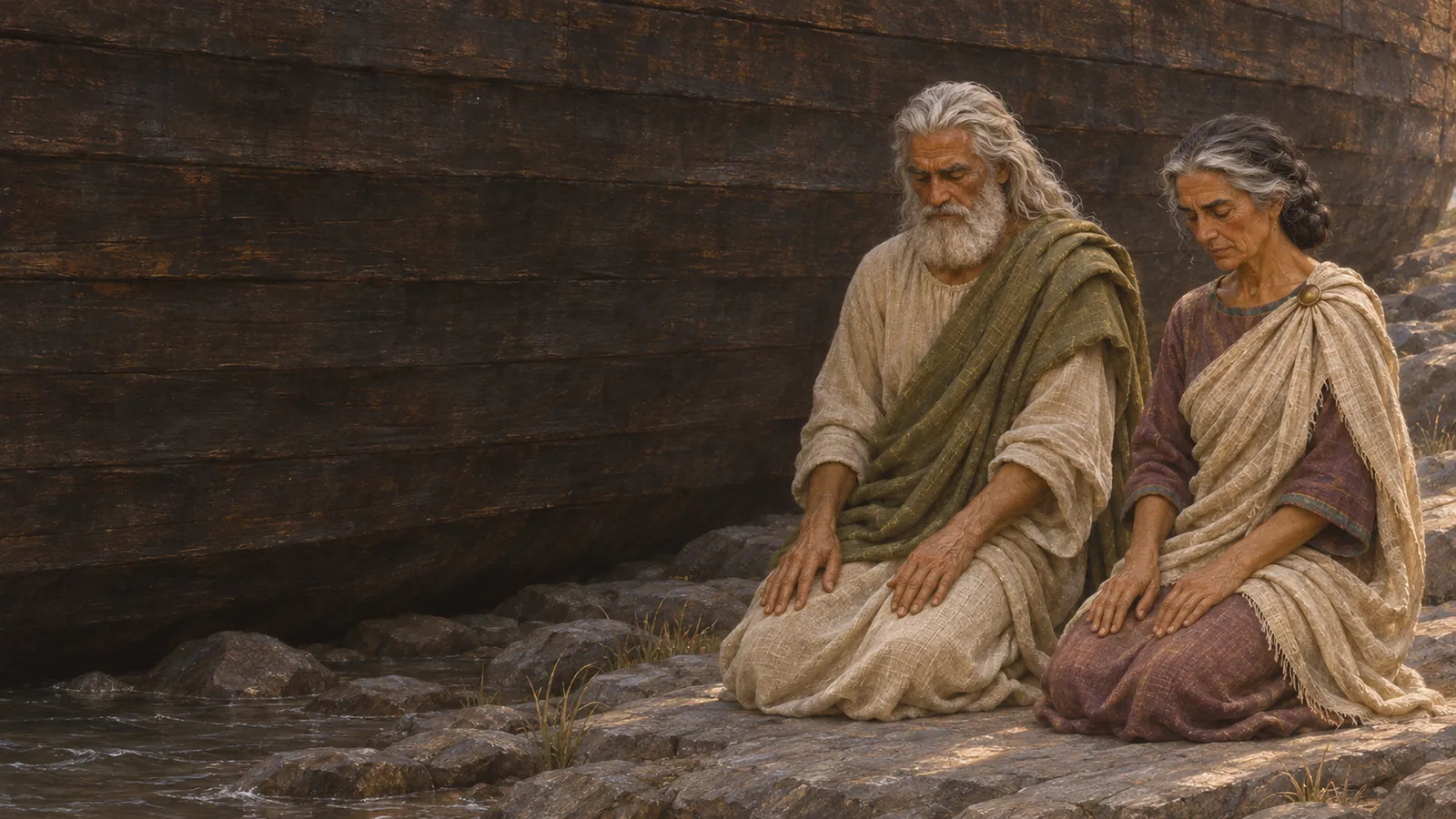
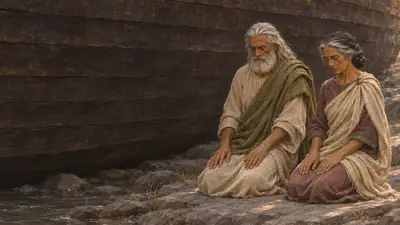
Utnapishtim and his wife kneel side by side on the rock beside the grounded boat. Both lower their eyes and let their hands rest on their knees. Gentle daylight finds the woman’s plum and ivory garments and the man’s olive mantle.

Enlil brought Utnapishtim out from the boat and brought his wife out too. She knelt beside him, and the two received a blessing.
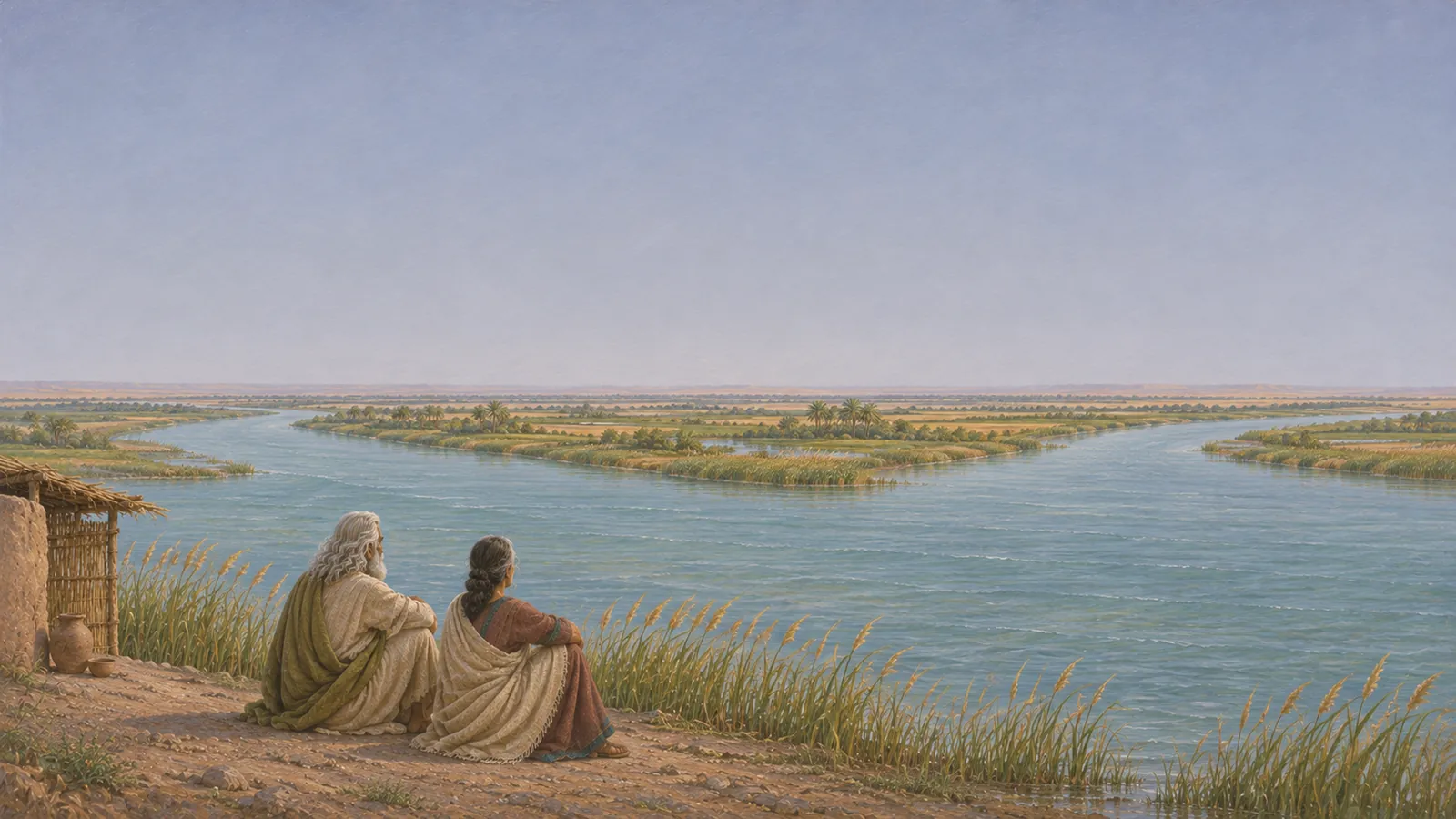
Utnapishtim and his wife sit beside a simple reed shelter, looking out over the water. Two broad channels meet beyond the reeds, parting around low strips of land. A pale blue sky stretches over the river mouths.

Enlil granted Utnapishtim and his wife a life like that of the gods. They were taken far away to dwell at the mouth of the rivers.
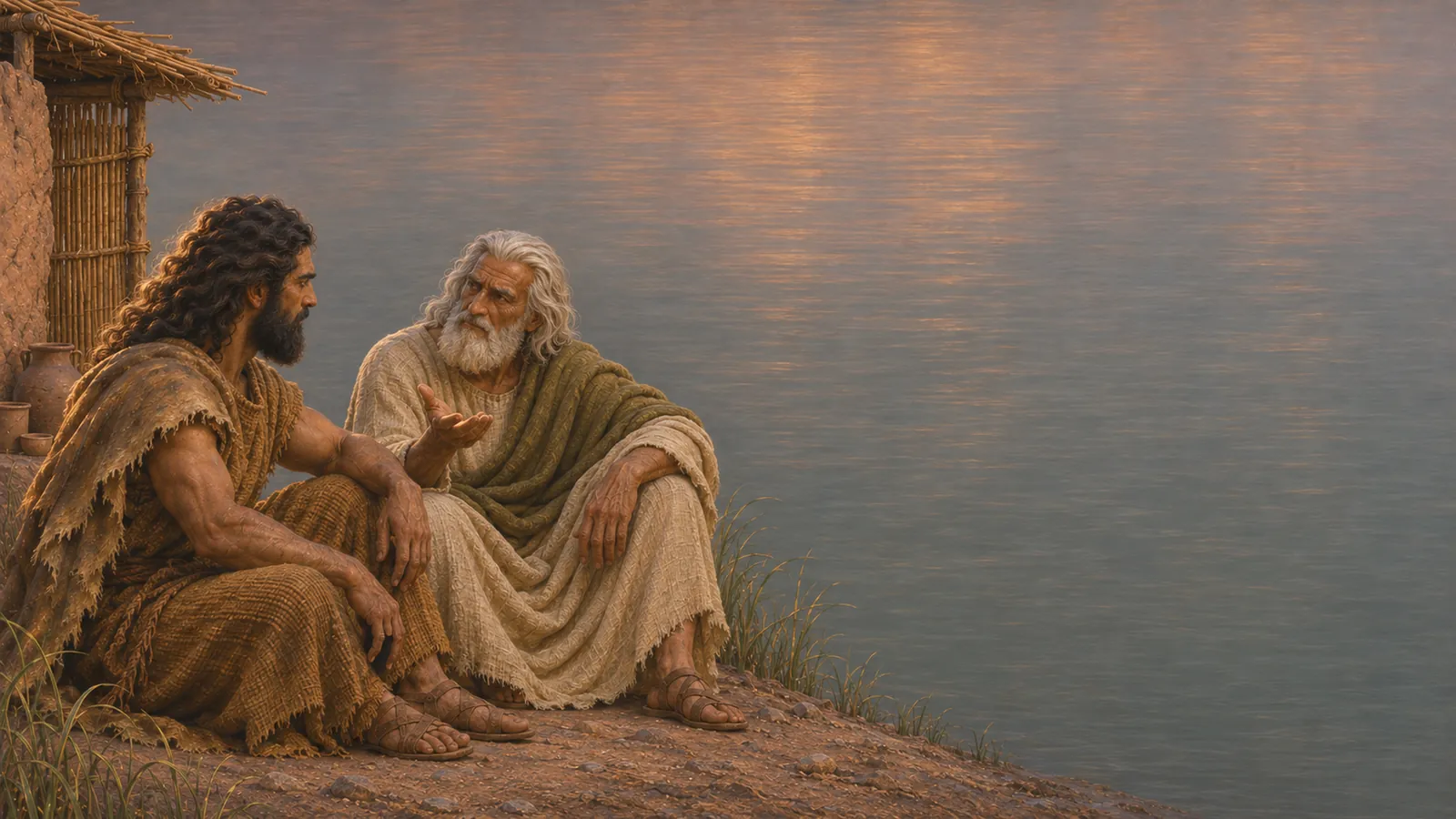
Utnapishtim leans toward Gilgamesh and turns one palm upward as he speaks. Gilgamesh listens in his worn tawny hide, beside the clay and reed shelter. Reflected evening light warms the open water to their right.

Utnapishtim returned to the question Gilgamesh had asked. Who would gather the gods for him, so that he could find the life he was looking for?
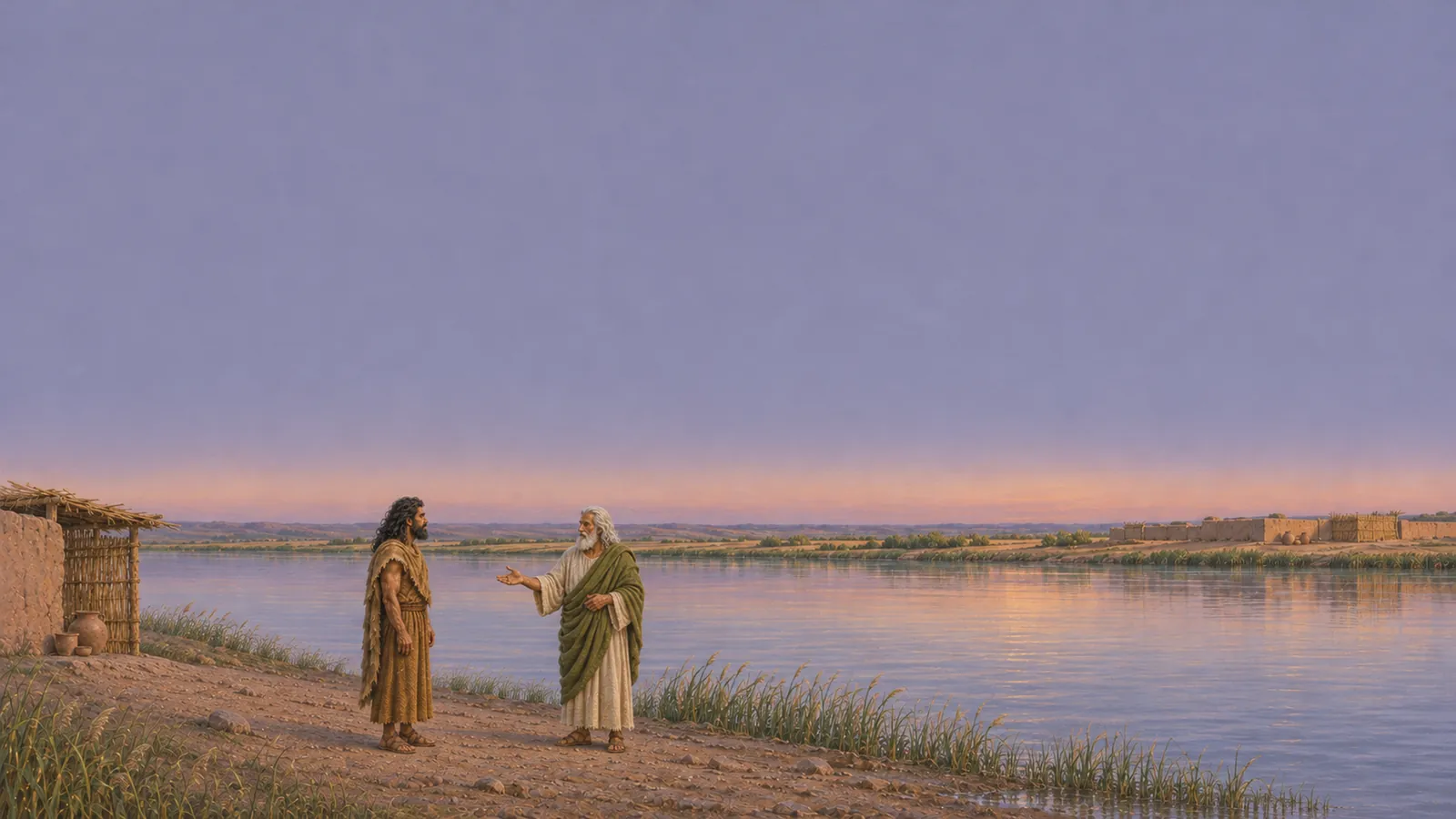
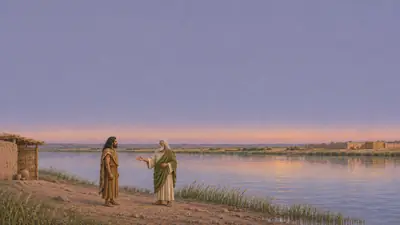
Under the twilight sky, Utnapishtim and Gilgamesh stand facing one another by the river. The older man holds his palm open as he sets the challenge, and Gilgamesh listens with his eyes open. The last warm light lies low across the water.

STAY AWAKE

Utnapishtim offered a test. He asked Gilgamesh to try staying awake for six days and seven nights.

End of chapter 7
Next chapter · Chapter 8What the King Brings Home

Previous chapter All chapters Watch the film

All pages
  1. 1
  2. 2
  3. 3
  4. 4
  5. 5
  6. 6
  7. 7
  8. 8
  9. 9
  10. 10
  11. 11
  12. 12
  13. 13
  14. 14
  15. 15
  16. 16
  17. 17
  18. 18
  19. 19
  20. 20
  21. 21
  22. 22
  23. 23
  24. 24
  25. 25
  26. 26
  27. 27
  28. 28
  29. 29
  30. 30
  31. 31
  32. 32
  33. 33
  34. 34
  35. 35
  36. 36
  37. 37
  38. 38
  39. 39
  40. 40
  41. 41
  42. 42
  43. 43
  44. 44
  45. 45
  46. 46
  47. 47
  48. 48
  49. 49
  50. 50

Sources
Editions consulted
Ancient lines behind each page
  1. Page 1: SB XI 8–12
  2. Page 2: SB XI 11–14
  3. Page 3: SB XI 13–19
  4. Page 4: SB XI 15–22
  5. Page 5: SB XI 19–24
  6. Page 6: SB XI 23–27
    Instructions are attested.
  7. Page 7: SB XI 25–27; cf. XI 82–86
  8. Page 8: SB XI 28–31
    The Apsû simile is in the source.
  9. Page 9: SB XI 32–35
  10. Page 10: SB XI 36–42
  11. Page 11: SB XI 43–47; Andrew George, The Sign of the Flood
    The wording is difficult and possibly ominous.
  12. Page 12: SB XI 48–51; see source note on the epithet Atrahasis
  13. Page 13: SB XI 50–57
  14. Page 14: SB XI 57–60; cf. XI 28–31
  15. Page 15: SB XI 60–65
  16. Page 16: SB XI 64–70
  17. Page 17: SB XI 71–75
  18. Page 18: SB XI 76–81
    The details of the launch and the timing of the last work are partly restored.
  19. Page 19: SB XI 81–84
  20. Page 20: SB XI 85
  21. Page 21: SB XI 84–86
  22. Page 22: SB XI 87–91; Andrew George, The Sign of the Flood
    The recurring wording may carry a hidden warning.
  23. Page 23: SB XI 90–93
  24. Page 24: SB XI 94–96
  25. Page 25: SB XI 97–99
  26. Page 26: SB XI 100–105
  27. Page 27: SB XI 106–111
  28. Page 28: SB XI 111–113
  29. Page 29: SB XI 114–116
  30. Page 30: SB XI 117–127
    Bēlet-ilī in the source.
  31. Page 31: SB XI 128–132
    Witnesses vary between six days and six nights and six days and seven nights.
  32. Page 32: SB XI 130–134
    The last clause paraphrases the poem’s storm simile.
  33. Page 33: SB XI 134–136
  34. Page 34: SB XI 137–139
  35. Page 35: SB XI 140–143
  36. Page 36: SB XI 143–147
  37. Page 37: SB XI 147–150
    Some words describing the flight are uncertain.
  38. Page 38: SB XI 151–153
  39. Page 39: SB XI 154–156
    The poem’s additional verbs of motion have variant translations.
  40. Page 40: SB XI 157–160
  41. Page 41: SB XI 161–163
  42. Page 42: SB XI 164–171
  43. Page 43: SB XI 172–177
  44. Page 44: SB XI 178–182
  45. Page 45: SB XI 181–195
    The speech names several foregone calamities.
  46. Page 46: SB XI 196–198
  47. Page 47: SB XI 199–202
  48. Page 48: SB XI 203–206
  49. Page 49: SB XI 207–208; compare the framing at XI 1–10
  50. Page 50: SB XI 209; no action from XI 210 onward

Illustrations made with AI tools by IL Archive; the text is based on the ancient sources (see the sources at the end of each chapter).