Study
Daniel and Ahiqar: Wisdom and Danger at the Royal Court
An extended study of a topic, with evidence and references.
- Region
- Assyria, Babylonia and Elephantine
The Aramaic Ahiqar papyrus and Daniel’s court tales share the imperiled sage at court, but direct borrowing remains unproven; Tobit offers explicit evidence of Ahiqar’s reception.
Share article
Text
Before Daniel becomes the recipient of visions about kingdoms and the end of days, the first six chapters of his book place him in court scenes: a young exile learns the sages' language, interprets what they cannot, provokes the hostility of officials, and survives when a royal decision seems final. An AramaicAramaicA group of Northwest Semitic language varieties with a long history across the Near East.Glossary · Click to read the explanation papyrus older than the final form of Daniel likewise tells of Ahiqar, a sage at a foreign court whose protégé's betrayal brings a death order before he escapes. Did Daniel inherit Ahiqar's story? A narrower question comes first: what do the surviving witnesses actually say, and what kind of relationship can be demonstrated? [1][2][3]
Three dates that must be kept apart
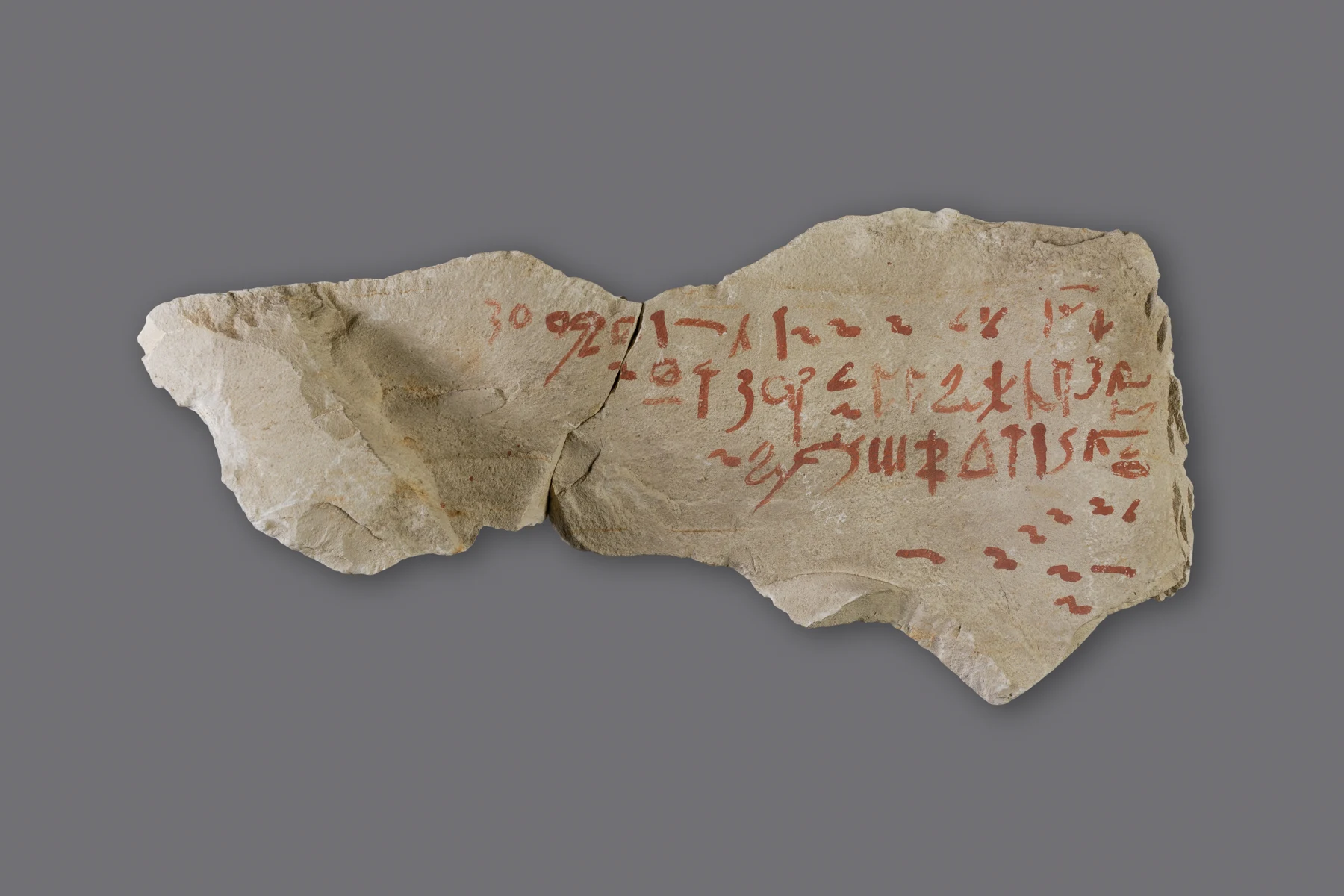
Ahiqar's story is set at the courts of Sennacherib and his son Esarhaddon, Assyrian kings of the late eighth and seventh centuries BCE. Its surviving Aramaic witness, however, comes from ElephantineElephantine / YebIsland near Aswan at the Nile’s first cataract; Persian-period Aramaic papyri document a Jewish community and Yaho’s temple.Glossary · Click to read the explanation in southern Egypt and probably dates to the later fifth century BCE. Its sheets were reused after an earlier customs account had been erased. This helps date *this copy*, not the day the story was first composed. The papyrus is broken, the order of some pieces is disputed, and the translation frequently marks editorial restorations in brackets. Everything found in later SyriacSyriacA literary form of Aramaic, with an extensive Christian heritage and earlier non-Christian attestations.Glossary · Click to read the explanation and Arabic versions cannot be recounted as though it could be read on this sheet. [1][2][4]
Daniel, in turn, sets its court talesCourt TaleA scholarly label for stories of a sage or outsider tested or endangered by a ruler; the label alone does not prove textual borrowing.Glossary · Click to read the explanation under kings of Babylonia and then Media and Persia. That is the time of the plot, not the date of the document available to us. Scholars argue that some court stories circulated before the Daniel collection reached its final form and that the later visions belong to the Seleucid crisis of the second century BCE. Dating each individual tale to a single year is difficult. To call all of Daniel simply a second-century composition, or to treat Daniel 1–6 as an archive of Nebuchadnezzar's court, flattens different historical layers. [3][5]
What does the Ahiqar papyrus preserve?
Ahiqar introduces himself as a wise scribe who served Sennacherib and then Esarhaddon. Having no son, he raises his nephew Nadin and prepares him to succeed him in the king's service. The young man then turns against him. The very lines containing the details of the accusation are damaged, so we cannot describe its mechanism as confidently as later retellings do. What the remaining narrative makes clear is that the king orders Ahiqar killed and the official assigned to the task remembers an earlier kindness: Ahiqar had saved him when a similar order threatened his life. He returns the favor, hides the sage, and lets his death be reported. A long collection of wisdom sayings follows the surviving narrative. [1][2]
The work combines a survival story with instruction in conduct around a court. The sage needs the king to work, yet the king's word can end his life before a full inquiry. Seth Bledsoe reads this combination of obedience and fear in light of the Aramaic-speaking and Judean inhabitants of Persian-ruled Elephantine. That is a historical reading of the work in the place where this copy was made, not proof that its first author wrote Persian propaganda. Crucially, the extant *narrative* does not name a divine intervention that saves Ahiqar: a man repays a past favor. Gods and religious expressions do occur in the sayings, so the distinction does not mean that the entire work is devoid of religion. [1][2]
Later versions also tell of challenges and riddles involving Egypt. The Elephantine papyrus is fragmentary, however, and the later versions cannot automatically fill its gaps. Ahiqar has a history of textual change across languages and settings, rather than one complete, unaltered form preserved since the seventh century. [1][4]
Daniel: wisdom the text attributes to his God
In Daniel 1, Daniel and three other young men from Judah learn the Chaldeans' language and literature to serve the king. The court gives them new names and assigned food, but they negotiate a diet that lets them retain their religious loyalty. They pass the test and the king finds them outstanding in wisdom. The stories thus begin with a skill useful to the state and a boundary the young men will not cross. [6]
In Daniel 2, Nebuchadnezzar demands that the sages tell him both his dream and its meaning, threatening them when they cannot. Daniel and his companions seek mercy from their God; the narrative says the secret is revealed to Daniel in a night vision. Standing before the king, he denies that his knowledge comes from personal wisdom surpassing everyone else's. The interpretation brings him honor and advancement, but the story presents the source of knowledge as divine. It uses the old court-story pattern of a successful sage before a perplexed ruler, yet it is more than a tale of a clever adviser solving a puzzle. [7]
The court tests loyalty again in Daniel 3. Daniel's three companions refuse to bow to the king's image, saying their stance will not change even if their God does not save them from the fire. The text relates their rescue and the king's acknowledgement of their God's power. In Daniel 6, Daniel's rivals cannot find an administrative fault, so they persuade the king to impose a temporary ban on petitioning anyone but himself. Daniel continues to pray, is thrown to the lions, and attributes his survival to an angel sent by his God. The charge here comes from competing officials, not an adopted son; the rescue is narrated as a divine act, not repayment by an old acquaintance. [8][9]
Daniel 4 and 5 return to the figure of the interpreting sage: a huge tree in one king's dream, then writing on the wall at another king's feast. The first interpretation confronts the ruler's pride; the second announces the end of his reign. Neither scene occurs in the surviving narrative portion of the Ahiqar papyrusElephantine Ahiqar PapyrusA fragmentary Aramaic witness, probably from the later fifth century BCE, preserving Ahiqar’s tale and sayings with gaps and editorial restorations.Glossary · Click to read the explanation. Naama Golan's analysis of chapters 1–6 proposes that the tension between earthly kingship and divine sovereignty, and the courtier's divided loyalty, explain the collection better than an account of social success alone. This is a published interpretation, not an agreed rule that excludes other readings. [10][11]
The real resemblance and its limits
Specific shared elements can be named: a sage near the king; work at a court where his safety is never guaranteed; rivals or an informer who turn power against him; danger of death; an unexpected escape; and the sage's continuing standing. These similarities are real. They help explain why Ahiqar and Daniel are studied alongside Joseph and Esther under the scholarly label “court tales.” The label is a literary classification, however, not a document showing that one writer had the other's manuscript open. [1][2][11]
The differences reveal what each text does. In Ahiqar, betrayal pierces the sage's household, and the plot turns on human relationships and an earlier kindness. In Daniel 2, the court sages' shared inability allows the revelation of the secret to be credited to Daniel's God. In Daniel 3 and 6, refusal to comply with imposed worship or petition is the center of the crisis. Ahiqar's surviving narrative and teachings do not depict him refusing to worship the king as the furnace story does. Daniel 6 has no adopted nephew, old favor, and substitute corpse matching the papyrus's sequence. [1][7][8][9]
The Egyptian manuscript's priority to Daniel's final book therefore supplies a necessary chronological possibility for influence; it does not prove influence. Direct borrowing would require more than a date: a plausible contact route and a sequence of uncommon details or shared wording hard to explain through general court-tale conventions. This comparison has identified neither a surviving intermediary nor an explicit citation of Ahiqar in Daniel. The stories may belong to a broad Aramaic narrative world, and a Daniel tale might have drawn on circulating Ahiqar traditions. Both remain research possibilities rather than settled conclusions. [1][2][3][11]
Firmer evidence of Ahiqar's reception: Tobit
There is a useful difference between the possibility that Daniel knew Ahiqar and a text that names Ahiqar. Tobit does the latter. Tobit 1:21–22 presents him as Tobit's relative and an office-holder under Esarhaddon. Tobit 14:10 recalls Nadab's betrayal and Ahiqar's rescue as an ethical example in an exhortation about almsgiving. The betrayer's name and narrative details vary among textual traditions, so this account is limited to the translation checked here; it does not homogenize every ancient version. Naming Ahiqar proves that his character and story could enter Jewish literature and be given new moral emphasis. It does not prove that Daniel's author used the particular Elephantine papyrus. [12][13]
What can be said with confidence?
It is certain that the Aramaic Ahiqar papyrus from Elephantine predates the final form of Daniel, although the date of the story's first composition and of each separate Daniel tale is less precise. It is certain that the texts meet in scenes of a court sage, royal danger, and survival, and that Tobit names Ahiqar explicitly. It is probable that the Daniel stories belong to a wider Near Eastern circulation of such narratives and that this literary form helped shape a tale about a Judean sage at a foreign court. Direct, word-for-word copying of Ahiqar by Daniel, or the claim that the oldest papyrus contains every episode of the later versions, remains unproven. [1][2][3][4][11][12]
The comparison offers more than an answer to “who copied whom?” Both works place a sage uncomfortably close to power that could kill him. Ahiqar asks how experience and mutual loyalty might preserve a person at court; Daniel asks where an exile's loyalty to the king must end when it collides with loyalty to his God. An old narrative form persists as its center of meaning changes. [1][2][6][9][11]
Sources and reading extent
[1] Berlin Museum, Ahiqar papyrus P.13446: record, text and translation, narrative Ai01–Dii14 and selected sayings Ei01–Ji16. The papyrus is fragmentary; bracketed words are editorial restorations.
[2] Seth A. Bledsoe, “Conflicting Loyalties: King and Context in the Aramaic Book of Ahiqar”, in *Political Memory in and after the Persian Empire* (2015), pp. 239–265. Selected parts of the introduction, discussion of the accusation and kingship, and conclusion were read, not the whole chapter.
[3] Carol A. Newsom, “Daniel,” Oxford Bibliographies, accessible introduction only, on stages of the book's formation.
[4] University of Göttingen's digital Ahiqar project, project introduction distinguishing the Elephantine witness from later Syriac and Arabic versions; the individual editions were not all read.
[5] Naama Golan, “The Daniel Narratives (Daniel 1–6): Structure and Meaning”, *Journal of HebrewHebrewA Northwest Semitic language in the Canaanite group, with ancient and modern forms.Glossary · Click to read the explanation Scriptures* 19 (2019); introduction, pp. 1–5, and conclusion, pp. 23–24, inspected, not the entire article.
[6] Daniel 1, Hebrew with facing English translation, verses 1–21.
[7] Daniel 2, verses 1–49, especially 17–30.
[8] Daniel 3, verses 1–30; the later verse placement differs between MT and some Christian editions.
[9] Daniel 6, verses 1–29 in this edition's numbering, especially 4–24.
[10] Daniel 4 and Daniel 5, both chapters inspected in full using MT numbering.
[11] Golan [5] on the court-tale genre and tension between earthly and divine rule; Bledsoe [2] on Ahiqar's reception at Elephantine. The absence of proof of direct copying is our editorial inference from comparing the inspected witnesses, not an ancient statement denying it.
[12] Tobit 1–2, 1:21–22 read in context; the translation edition was not identified on the inspected page.
[13] Tobit 14, whole chapter inspected, especially 14:10; the translation edition was not identified on the inspected page.
References and notes
- Museum record, narrative translation Ai01–Dii14 and selected sayings read; papyrus is incomplete, bracketed reconstructions occur, and not all sayings were read. Berlin Ahiqar papyrus P.13446, narrative Ai01–Dii14, selected sayings Ei01–Ji16 and institutional record Return to the text ↑
- Specified parts of Bledsoe’s chapter on the papyrus date, accusation, kingship and conclusion were read, not the whole chapter or volume. Seth A. Bledsoe, “Conflicting Loyalties,” 2015, selected pp. 239–243, 245–246, 253–255, 263–265 Return to the text ↑
- Only the accessible introduction was read, not the complete bibliography entry; compositional staging is attributed to the scholar. Carol A. Newsom, “Daniel,” Oxford Bibliographies, accessible introduction only Return to the text ↑
- Entire short project homepage read; editions of all later versions were not read. University of Göttingen, Ahiqar digital edition project, entire short homepage Return to the text ↑
- The article’s introduction and conclusion were read, not all 25 pages; the analysis of sovereignty and loyalty is attributed to Golan. Naama Golan, “The Daniel Narratives,” JHS 19 (2019), introduction pp. 1–5 and conclusion pp. 23–24 Return to the text ↑
- Daniel 1:1–21 read in full in Hebrew and facing English. Daniel 1:1–21, Hebrew and facing English Return to the text ↑
- Daniel 2:1–49 read in full in Aramaic and facing English. Daniel 2:1–49, Aramaic and facing English Return to the text ↑
- Daniel 3:1–33 read across sequential views; numbering differences between editions noted. Daniel 3:1–33, Aramaic and facing English, MT numbering Return to the text ↑
- Daniel 6:1–29 read in full in the edition’s MT numbering. Daniel 6:1–29, Aramaic and facing English, MT numbering Return to the text ↑
- Daniel 4 and 5 read in full with MT numbering; the principal linked source here is chapter 4, while the article also links chapter 5. Daniel 4:1–34 and 5:1–30, Aramaic and facing English, MT numbering Return to the text ↑
- Editorial inference after selected pages of Golan and Bledsoe and primary texts; absence of proof of copying is not attributed to an ancient witness. Golan, selected pp. 1–5, 23–24; Bledsoe, selected pp. 239–243, 253–255, 263–265; archive inference Return to the text ↑
- Tobit 1:21–22 read in context; the inspected page did not identify the translation edition. Tobit 1:21–22 in Oxford University Church PDF of chapters 1–2 Return to the text ↑
- All of Tobit 14 read, especially 14:10; the inspected page did not identify the translation edition. Tobit 14:10 in Oxford University Church PDF of chapter 14 Return to the text ↑
Suggest a correction · Suggest a source for this record
Cite this record
IL Archive, «Daniel and Ahiqar: Wisdom and Danger at the Royal Court», Edition 1, https://ilarchive.com/en/studies/daniel-tales-and-court-wisdom
Continue reading