Period
The Akkadian Empire (c. 2334–2154 BCE)
- Timeline
- From 2334 BCE to 2154 BCE
- Region
- Mesopotamia
From Akkad, a city whose site remains unidentified, Sargon brought much of southern Mesopotamia under one dynasty. Inscriptions, archives and excavation finds trace the reach of his successors and the breakup of their rule.
Estimated reading time: 7 min Published Last reviewed:
Share article
Text
Introduction
The AkkadianAkkadianAn ancient East Semitic language written in cuneiform from the third millennium BCE; its varieties include Babylonian and Assyrian, and it served in international diplomacy.Glossary · Click to read the explanation empire is the name modern historians give to the kingdom founded by Sargon of Akkad, who made the city of Akkad (also written Agade) the seat of rulers over southern MesopotamiaMesopotamiaHistorical region associated with the Tigris and Euphrates: Uruk, Ur, Eridu, cuneiform, Sumer, Akkad, Babylon and Assyria, their languages and cults, and the limits of archaeological evidence.Glossary · Click to read the explanation and well beyond it. It is often called the first empire in the region, though some scholars ask whether that word fits a state whose control over distant lands was often thin. This entry gives the usual dates and their uncertainty, the kings in order, what they claimed and what the sources can confirm, and the competing explanations for the end.
Dates and a missing capital
The dates about 2334–2154 BCE are conventional. The Metropolitan Museum of Art also uses a rounded range of about 2350–2150 BCE and places Sargon’s reign at about 2340–2285 BCE. [24][8] Walther Sallaberger and Ingo Schrakamp propose different dates. They distinguish Sargon’s accession from the later establishment of Akkadian rule in southern Mesopotamia. [9]
The site of the capital, Akkad, remains unidentified. Its name is known from texts, and one proposed location is near the confluence of the Adhem and the Tigris. Much of the evidence for the dynasty comes from other cities, such as Nippur, Ur and Susa. [8][9]
Sargon and the first conquests
A Sumerian story makes Sargon cupbearer to Ur-Zababa, king of Kish. Its surviving text breaks off before Sargon takes the throne. [10] A separate Akkadian legend tells of his birth and childhood, and a surviving copy from NinevehNineveh and KuyunjikNineveh is an ancient Assyrian city near Mosul in northern Iraq; Kuyunjik is one of its archaeological moundsGlossary · Click to read the explanation is Neo-Assyrian. [25] The two traditions have entries on this site (records 1005 and 324). They show how later scribes remembered Sargon.
Sargon defeated Lugal-zage-si, king of UrukUrukAncient city at Warka in southern Iraq, a major urban centre around 3200 BCE that preserved early writing and accounting tablets.Glossary · Click to read the explanation, who had extended his power across southern Mesopotamia. One royal inscription claims the destruction of Uruk’s walls and the capture of Lugal-zage-si, who was taken to the gate of EnlilEnlilEnlil/Ellil: a major Mesopotamian god associated with destinies, kingship, and Ekur at Nippur, already prominent in third-millennium god lists. His name’s origin and cult beginnings remain debated.Glossary · Click to read the explanation at Nippur. [11][9] Inscriptions also record expeditions towards Elam in the east and Mari on the Euphrates. The degree and duration of Akkadian control varied by region. [9][12]
One royal inscription says Sargon washed his weapons in the sea after campaigning in the south. Another says ships from Meluhha, Magan and DilmunDilmun: Ancient Gulf Land and Literary SettingDilmun was an ancient Gulf trading land with a major archaeological centre in Bahrain and connections to eastern Arabia and Failaka. This entry separates boats, burials and kings from the literary purity and fresh water of Enki and Ninhursaga, and tests the limits of comparison with Eden.Glossary · Click to read the explanation moored at Akkad’s quay, and names Mari and Yarmuti among lands granted to him by the god DaganDaganA god worshipped in Syria and Mesopotamia, especially at Tuttul and Terqa on the Euphrates, and associated with royal authority. His name appears as Dagon in the Hebrew Bible; no ancient image of him is securely identified.Glossary · Click to read the explanation. [11][12] Several royal inscriptions are known from later copies. They preserve the dynasty’s claims about how far its power reached. [9]
The kings after him
In the sequence used here, Sargon is followed by his sons Rimush and Manishtushu, then by Naram-Sin and Shar-kali-sharri. The later Sumerian King List places Rimush before Manishtushu, as in the Oxford composite. The surviving Ur III copy puts Manishtushu first. [9][22] Their royal inscriptions and the King List are different kinds of evidence, and proposed regnal dates vary. [9]
The Sumerian King List places four brief reigns after Shar-kali-sharri, followed by Dudu and Shu-turul. The last of these kings is attested beyond the capital, including at Adab and Tell Brak, although the extent and character of his power remain difficult to establish. [9][22]
Naram-Sin, king of the four quarters
Naram-Sin was Sargon’s grandson. A coalition of cities rose against him in what is now called the Great Revolt. [9] The inscription on the copper statue base found at Bassetki calls him king of Akkad and credits him with nine victories in one year. It says the inhabitants of Akkad petitioned the gods to make him the god of their city and built him a temple. The text thus presents the revolt as the occasion for the honours granted him at Akkad. [13] The title “king of the four quarters” is attested separately in another inscription. [27]
An inscribed fragment from Tulul al-Baqarat adds to the evidence for Naram-Sin’s campaign against Armanum and EblaEblaAncient city at Tell Mardikh, southwest of Aleppo, Syria. Its Palace G archives illuminate third-millennium BCE administration, language, and cult; the site has later occupation phases.Glossary · Click to read the explanation. A year name commemorates his victory over Armanum, whose location is debated. [14] Akkadian royal inscriptions are also known from Susa and Nagar (Tell Brak). [9]
The Victory Stele
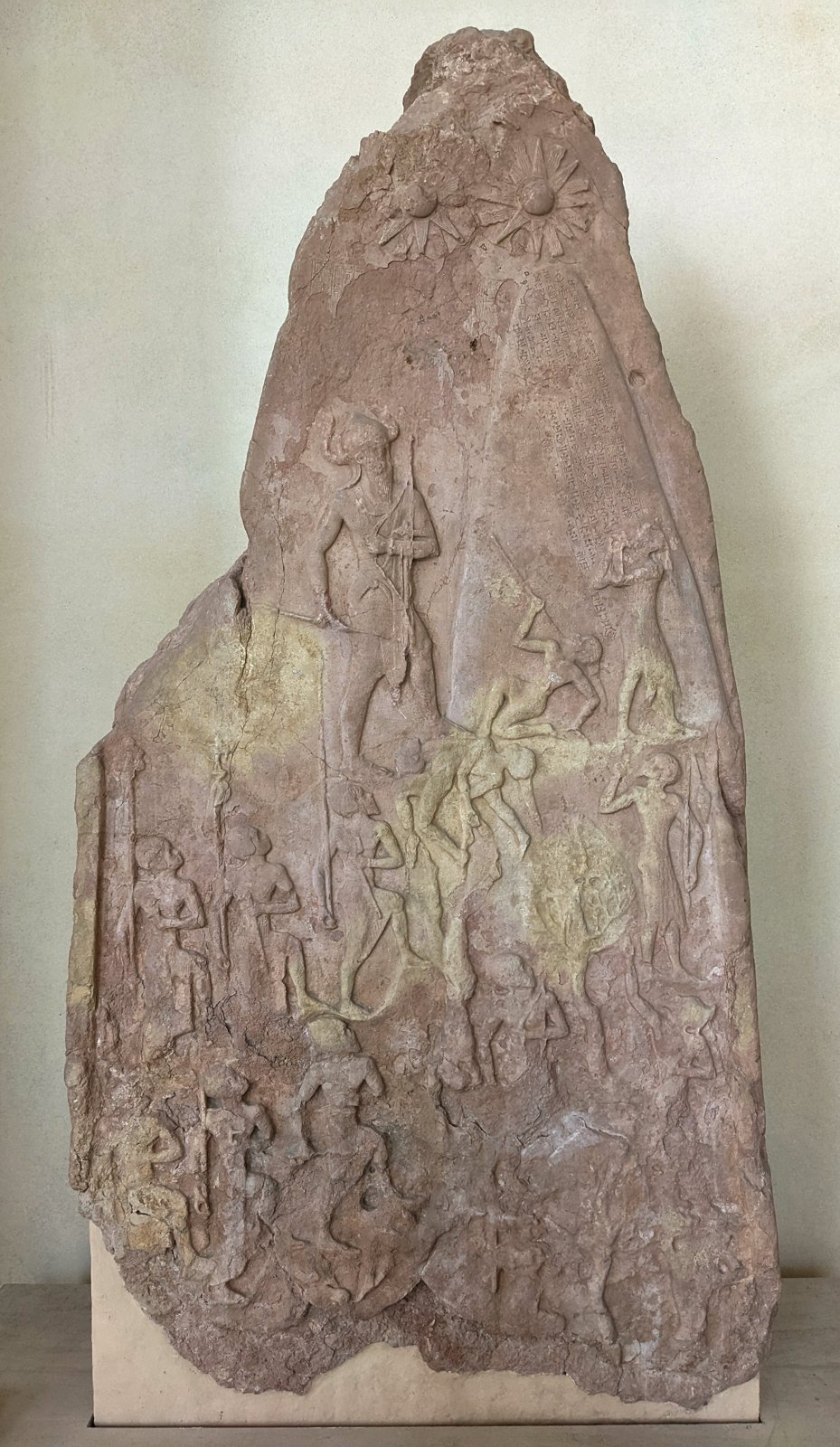
The Victory Stele of Naram-Sin in the Louvre (Sb 4) is a two-metre relief carved in pink and beige limestone. The horned helmet and the king’s greater size set him apart from his soldiers as he climbs a mountain. Star-shaped disks appear above the scene. The Louvre reads the fragmentary Akkadian inscription as recording a victory over the Lullubi and probably a dedication to the sun god ShamashShamashMesopotamian god of the sun and justice, shown before Hammurabi on an eighteenth-century BCE stele preserved in the Louvre.Glossary · Click to read the explanation. [15] This site has a card for Shamash (record 318).
Jacques de Morgan’s excavation at Susa, in present-day IranIranIran is the modern country containing Shush, ancient SusaGlossary · Click to read the explanation, recovered the stele in 1898. A Middle Elamite inscription added by Shutruk-Nahhunte says he took it from Sippar. The Louvre dates the transfer to the twelfth century BCE and lists Sippar as the place of origin. The added inscription attests to the stele’s presence at Sippar before it was taken to Susa. [15]
How the state worked
Governors (ensi) administered cities under Akkadian rule. Seal impressions from Girsu name Lugal-ushumgal, governor of Lagash, as the servant of Shar-kali-sharri. [8][23] The royal house also placed women in important temple offices. Enheduanna, Sargon’s daughter, and Enmenanna, a daughter of Naram-Sin, are both attested as high priestesses at Ur. [9][16]
Scribes used AkkadianAkkadianAn ancient East Semitic language written in cuneiform from the third millennium BCE; its varieties include Babylonian and Assyrian, and it served in international diplomacy.Glossary · Click to read the explanation, a Semitic language, in royal inscriptions and administration. Sumerian also appears in documents from the period, including administrative tablets from Girsu. [9][26] Clay tablets record transactions, and impressions made with a cylinder sealCylinder sealSmall engraved cylinder rolled over soft clay to leave an extended image. Used to secure, document and identify administrative actions; its pictures do not automatically constitute writing.Glossary · Click to read the explanation can name the official who used it. [23][8]
The shift from Early Dynastic to Akkadian rule is difficult to date at some sites. For example, some layers at the InannaInanna / IshtarA prominent Mesopotamian goddess whose Sumerian name Inanna became associated with Akkadian Ishtar across diverse traditions. She was associated with desire, war, royal authority and Venus, while local forms and genealogies varied among texts.Glossary · Click to read the explanation temple in Nippur are dated using tablets bearing Naram-Sin’s year names. Such texts can help place archaeological layers in time. [28][9]
Enheduanna
Sargon’s daughter Enheduanna was high priestess of the moon god Nanna at Ur. The inscription on the back of her calcite disc from Ur, now in the Penn Museum (B16665), names her, gives her titles and identifies her as a child of Sargon. [16][17][19] In The Exaltation of Inanna, a speaker who names herself Enheduanna appeals to the goddess InannaInanna / IshtarA prominent Mesopotamian goddess whose Sumerian name Inanna became associated with Akkadian Ishtar across diverse traditions. She was associated with desire, war, royal authority and Venus, while local forms and genealogies varied among texts.Glossary · Click to read the explanation. [18]
The surviving manuscripts of The Exaltation of Inanna are Old Babylonian, centuries later than Enheduanna. Three tablets published by the Morgan Library & Museum are dated to about 1750 BCE. [18] The attribution remains debated. Annette Zgoll argues for Enheduanna’s authorship and points to the copying of the disc’s inscription into the Old Babylonian period as an example of how a text associated with her could be transmitted for centuries. Other scholars place the poem’s attribution in the Old Babylonian context. [19]
The end, and what the sources say about it
Later Mesopotamians told the fall as a story about the gods. In The Cursing of Agade, Naram-Sin sees in a dream that Enlil will deny Akkad a lasting home. He later attacks the EkurEkur: Enlil’s Temple at NippurEkur (“Mountain House”) was Enlil’s chief sanctuary at Nippur, present-day Iraq; the name may extend to its precinct. Hymns and royal inscriptions attest to its prestige and rebuilding across periods; it is not simply the ziggurat.Glossary · Click to read the explanation, Enlil’s temple at Nippur. Enlil brings the Gutians down from the mountains, famine follows, and the gods curse Akkad. [6] The poem gives a literary account of the disaster. This site has an entry on the Ekur (record 161).
Historians have looked for other causes and none is settled:
- The Gutians. The King List gives Gutium a dynasty, and a few of its kings are attested in contemporary inscriptions. How much territory they controlled and how their reigns overlapped with the last kings of Akkad remain debated. [9]
- Climate. A 2019 study used fossil corals from Oman to infer stronger winter shamal winds around the 4.2-kiloyear event. The authors proposed that the winds contributed to drought and agricultural stress in Mesopotamia. [20] A separate study of carbon and nitrogen isotopes from three northern Mesopotamian sites found limited evidence for change in subsistence. It also notes that Tell Leilan was abandoned, Tell Brak contracted and Tell Hamoukar continued to flourish. [21]
- Inside the state. Royal inscriptions document revolts against Akkadian rulers. The Great Revolt under Naram-Sin shows that subject cities could organise opposition even during a period of Akkadian expansion. [9][13]
- Neighbours. Texts associate Puzur-Inshushinak, a ruler of Susa, with cities in the Diyala region and with Akkad itself. The relation between his campaigns and the reigns of the last Akkadian kings is uncertain. [9]
Political authority became more fragmented. At Lagash, GudeaGudeaRuler of Lagash in the late third millennium BCE, whose inscriptions document temple construction and the name Anunna.Glossary · Click to read the explanation is attested among a line of local rulers, and at Uruk, Utu-hegal claimed victory over the Gutians. The Third Dynasty of Ur later brought much of southern Mesopotamia under one dynasty again. [8][9]
What can be said
The Akkadian dynasty extended its rule across much of southern Mesopotamia, and its inscriptions and administrative records survive from several cities. Akkad itself remains unlocated. Royal inscriptions claim victories and honours, and later literature gives its own account of the empire’s end. The scale of the resulting political changes varied across the region.
References and notes
- Wikipedia, 'Akkadian Empire' (secondary summary) First 100,000 of 275,208 characters: dates in middle and short chronology, kings and reign dates, conquests, administration, army, language, archives, deification, Enheduanna, seals, causes of the collapse, dating debates Return to the text ↑
- Wikipedia, 'Naram-Sin of Akkad' (secondary summary) Page read in main parts: reign, titles and deification, Great Revolt, Bassetki statue, Armanum and Ebla, Elam, Victory Stele, King List order, debated points Return to the text ↑
- Wikipedia, 'Sargon of Akkad' (secondary summary) First 100,000 of 148,754 characters: reign dates and uncertainty, legends of origin, defeat of Lugal-zage-si, campaigns, sea-to-sea claims, Enheduanna, later copies, debated points Return to the text ↑
- Wikipedia, 'Victory Stele of Naram-Sin' (secondary summary) and the Wikimedia Commons file page of the photograph Page read: Louvre Sb 4, height, imagery, Lullubi and Satuni, discovery at Susa 1898, Elamite inscription of Shutruk-Nahhunte, Sippar origin, debated points; Commons file page: author, CC0, size 200 x 105 x 27 cm Return to the text ↑
- Wikipedia, 'Enheduanna' (secondary summary) First 100,000 of 116,212 characters: office at Ur, works attributed, the disc, exile under Naram-Sin, authorship debate and the Old Babylonian copies Return to the text ↑
- Electronic Text Corpus of Sumerian Literature (ETCSL), 'The Curse of Agade' (translation) Translation read through a fetch summary: the rise of Agade, Naram-Suen's dream, the attack on the Ekur, the Gutians, the final curse; earlier Nippur version noted Return to the text ↑
- Wikipedia, '4.2-kiloyear event' (secondary summary) First 100,000 of 118,077 characters: the drought claim for Akkad, Cullen et al. 2000 and Watanabe et al. 2019 as cited, and the criticisms of the 4.2 ka framing Return to the text ↑
- Department of Ancient Near Eastern Art, Metropolitan Museum of Art, “The Akkadian Period (ca. 2350–2150 B.C.).” Heilbrunn Timeline of Art History, October 2004. Overview of Sargon and later rulers, unresolved location of Akkad, royal administration and political fragmentation. Return to the text ↑
- Walther Sallaberger and Ingo Schrakamp, “Philological Data for a Historical Chronology of Mesopotamia in the 3rd Millennium.” In History & Philology, ARCANE III. Turnhout: Brepols, 2015. Table 5 (the King List witnesses), §4 (Nippur), §§6–8 (Sargon, the governors, the revolt and late Akkad) and table 39 (chronology). Return to the text ↑
- Electronic Text Corpus of Sumerian Literature, University of Oxford, “The Sargon Legend,” t.2.1.4. Translation of segments B–C, including Ur-Zababa’s appointment of Sargon and the broken end of the narrative. Return to the text ↑
- Cuneiform Digital Library Initiative, “Text of RIME 2.01.01.01 composite,” P461926 (Sargon). Sumerian-version lines 12–30 on Uruk and Lugalzagesi, and 46–52 on the campaign and washing of weapons. Return to the text ↑
- Cuneiform Digital Library Initiative, “RIME 2.01.01.11 composite,” P461937 (Sargon). Sumerian-version lines 9–28 on the ships at the quay and the royal claims concerning Dagan, Mari and the upper country. Return to the text ↑
- Cuneiform Digital Library Initiative, “Text of RIME 2.01.04.10, ex. 01 (Bassetki statue),” P216558. Columns i–iii: the title king of Akkad, the rebellion of the four quarters, nine reported victories, and the petition and temple at Akkad. Return to the text ↑
- Nashat Alkhafaji and Gianni Marchesi, “Naram-Sin’s War against Armanum and Ebla in a Newly-Discovered Inscription from Tulul al-Baqarat.” Journal of Near Eastern Studies 79, no. 1 (2020), 1–20. Introduction, especially pp. 1–4 and n. 3 on proposed locations for Armanum, and the edition of IM 221139. Return to the text ↑
- Musée du Louvre, “Stèle de Naram-Sin,” Sb 4. Description, dimensions, date and findspot, as well as the Akkadian and Middle Elamite inscriptions. Return to the text ↑
- Penn Museum, “Relief,” B16665 (Disc of Enheduanna). Object description, provenience at Ur and inscription naming Enheduanna and Sargon. Return to the text ↑
- Cuneiform Digital Library Initiative, “RIME 2.01.01.16, ex. 01,” P217330 (B16665). Transliteration, especially lines 1–7 for the titles and parentage. Return to the text ↑
- Morgan Library & Museum, “The Exaltation of Inanna.” English exhibition handout, three-part Old Babylonian manuscript group dated ca. 1750 BCE and translated extracts. Return to the text ↑
- Annette Zgoll, “En-ḫedu-ana: The Birth of Literature through the Goddess.” Iraq 86 (2024), 153–179. Section 5.2.1, including the disc, its later copy and the Old Babylonian manuscripts of the Exaltation, and note 9 on the scholarly debate. Return to the text ↑
- Takaaki K. Watanabe, Tsuyoshi Watanabe, Atsuko Yamazaki and Miriam Pfeiffer, “Oman Corals Suggest That a Stronger Winter Shamal Season Caused the Akkadian Empire (Mesopotamia) Collapse.” Geology 47, no. 12 (2019), 1141–1145. Materials, methods and discussion. The coral geochemistry is the proxy for inferred wind patterns, and the agricultural mechanism is the authors’ interpretation. Return to the text ↑
- Arkadiusz Sołtysiak and Ricardo Fernandes, “Much Ado about Nothing: Assessing the Impact of the 4.2 kya Event on Human Subsistence Patterns in Northern Mesopotamia Using Stable Isotope Analysis.” Antiquity 95 (2021), 1145–1160. Introduction on divergent site trajectories, Materials and methods for the three sites sampled, and Conclusions on the limited isotopic evidence for subsistence change. Return to the text ↑
- Electronic Text Corpus of Sumerian Literature, University of Oxford, “The Sumerian King List,” t.2.1.1. Lines 266–296, the Akkad succession in the composite and its labelled manuscript variants. Return to the text ↑
- Cuneiform Digital Library Initiative, “CDLI Seals 005828 (composite),” P458538. Columns 1–2 and the list of Girsu impressions naming Shar-kali-sharri and Lugal-ushumgal. Return to the text ↑
- Metropolitan Museum of Art, Ancient Near Eastern Art. The Metropolitan Museum of Art Bulletin 41, no. 4 (Spring 1984). Discussion of cylinder seals and the period dates 2334–2154 BCE. Return to the text ↑
- Cuneiform Digital Library Initiative, “CT 13, pl. 42, K 03401 +,” P365306 (K.3401 + Sm.2118). Catalogue of the Neo-Assyrian Akkadian literary witness from Nineveh and link to the eBL fragment edition. Return to the text ↑
- Cuneiform Digital Library Initiative, “RTC 134,” P216913 (Louvre AO 2697). Old Akkadian period administrative tablet from Girsu with Sumerian entries for gold and livestock. Return to the text ↑
- Cuneiform Digital Library Initiative, “Text of RIME 2.01.04.05, ex. 01,” P227519 (Naram-Sin). Obverse column 1′, lines 3′–7′, giving Naram-Sin’s title king of the four quarters. Return to the text ↑
- Maciej Mateusz Wencel, Towards an Absolute Chronology of Early Mesopotamia: A Radiocarbon Perspective. DPhil thesis, University of Oxford. Chapter 2, Early Dynastic–Akkadian transition, on difficulty distinguishing levels, including the Nippur example. Return to the text ↑
Suggest a correction · Suggest a source for this record
Cite this record
IL Archive, «The Akkadian Empire (c. 2334–2154 BCE)», https://ilarchive.com/en/periods/akkadian-empire