Study
The Companions of the Cave and the Sleepers of Ephesus: connected narratives
An extended study of a topic, with evidence and references.
Syriac and Latin witnesses alongside the Qur’an: numbers, money, dog, al-raqim and duration, distinguishing narrative relationship from a proven direct source.
Share article
Text
Introduction
What connects the Qur’an’s Companions of the Cave with Christian accounts of the Sleepers associated with EphesusEphesusAncient city in western Türkiye with major Roman and early Christian phases.Glossary · Click to read the explanation, and where do those accounts differ? This study compares specific passages about refuge in a cave, a long sleep, and a journey to buy food. It asks how the narratives’ relationship can be traced historically without assuming that any surviving version was the direct source of another. [1] [2] [5]
The story places its events under Roman emperors of the third and fifth centuries CE. The texts we can read were composed and copied at other times. We therefore distinguish the story’s setting, the composition of an account, and the date of its surviving copy. [4] [5] [12]
One cave in several narratives
Young men refuse the gods of their community, seek refuge in a cave and awaken after a long interval. Believing their absence short, they send one companion to buy food. Discovery of their story becomes a sign of divine power and resurrectionResurrection of the deadThe dead returning to life, distinguished from soul immortality, with differing scope and form among texts.Glossary · Click to read the explanation. This sequence connects the Qur’an’s Companions of the Cave with the Christian narrative family of the Sleepers of Ephesus. The resemblance extends beyond prolonged sleep: religious refuge, cave, awakening, food, discovery and a purpose concerned with resurrection and the last day occur together. [1] [2] [5]
The accounts differ in the youths’ number and names, the condition of their bodies, the length of their absence, and the roles of emperor and city. We will read each witness in its own context before comparing it with the others.
Three dates to distinguish
Christian narratives set the youths’ persecution under the Roman emperor DeciusEmperor DeciusRoman emperor who ruled in 249–251 CE; the Sleepers narratives set their persecution in his reign.Glossary · Click to read the explanation (249–251 CE) and their awakening under Theodosius IITheodosius IIEastern Roman emperor of 408–450 CE; the Sleepers narratives place their awakening in his reign.Glossary · Click to read the explanation (408–450 CE). These are the reigns chosen as the story’s setting. The date when the story was written is a separate question. [5] [12]
There is also the date of composition. A SyriacSyriacA literary form of Aramaic, with an extensive Christian heritage and earlier non-Christian attestations.Glossary · Click to read the explanation homily on the youths is attributed to Jacob of SerughJacob of SerughSyriac author of the late fifth and early sixth centuries, credited with a homily on the youths of Ephesus.Glossary · Click to read the explanation, who lived around 451–521 CE. Then comes the date of the surviving copy. Ignazio GuidiIgnazio GuidiItalian scholar (1844–1935) who edited Syriac forms of the Sleepers story and translated one into Italian.Glossary · Click to read the explanation published two different manuscript forms of the homily in a work issued separately in 1885, following its academic publication in 1884. An author’s date does not make every later manuscript addition contemporary with him; a modern printing does not date the narrative’s beginnings. [4] [6]
What was read of the Syriac witness?
Our detailed comparison uses Guidi’s Italian translation of the form preserved in Vatican Syriac manuscript 217, printed pages 29–32 of the separate edition. A distinctly Christian invocation opens it, followed by the youths’ refusal to offer incense to the gods, escape to the cave, its closure, awakening and one companion’s journey to Ephesus. [5]
We read Guidi’s Italian translation of this recension, not the Syriac manuscript directly. Guidi distinguishes it from manuscript 115 and discusses additions and the difficulty of recovering the earlier reading. We therefore attribute the youths’ number and the duration to the particular recension in which they occur. [4]
The youths and enforced worship
In that translation, the emperor orders incense offerings and confronts youths from prominent families. An official’s son speaks with seven companions: they reject handmade gods and profess their Christian faith. Before the emperor returns, they hide in a mountain cave and take money supplied by their families. [5]
The Qur’an presents youths believing in their LordRabbTitle of lordship, ownership or care by context; applied to God in Lord of worlds.Glossary · Click to read the explanation, rejecting gods besides him, and choosing withdrawal and refuge. It names no emperor, specifies no fathers’ social rank and does not use the homily’s Christian threefold confession. These differences construct the story’s religious identity. Agreement over resistance to imposed worship does not mean identical statements of belief. [1]
How do the accounts describe sleep and awakening?
In the form Guidi translates, God takes the youths’ spirits to heaven and sends an angel to guard their limbs. Opening the cave awakens them; finally they enter the sleep of rest again, which the translator glosses as death. Sleep language thus accompanies the return of spirits and preservation of bodies. [5]
In the Qur’an, the youths appear awake although they are asleep. They are turned over, and their dog stretches its forelegs at the entrance. They are then raised to question one another about their stay. The scene concerns resurrection, but the verses do not describe their souls ascending to heaven and returning, as the Syriac recension we read does. [2]
Why does one companion visit the city?
After awakening, the youth named GiamblicoGiamblico, one of the SleepersName of a youth in the Christian version translated by Guidi; he returns to the city to buy bread after the long sleep.Glossary · Click to read the explanation in Guidi’s translation visits the city for bread. He finds crosses displayed on the gates, unlike the persecution he remembers. When he offers coins, the sellers suspect a discovered treasure; questioning reveals the temporal distance. Old money makes the past tangible within the narrative’s present. [5]
In Qur’an 18:19, one companion takes silver money to the city to buy food while trying to keep their presence hidden. This is a specific point of resemblance. The seller’s reaction to old coins, suspicion that the youth has found treasure, and crosses on the doors belong to the Christian account we read; they do not appear in the verse. [2]
Seven or eight?
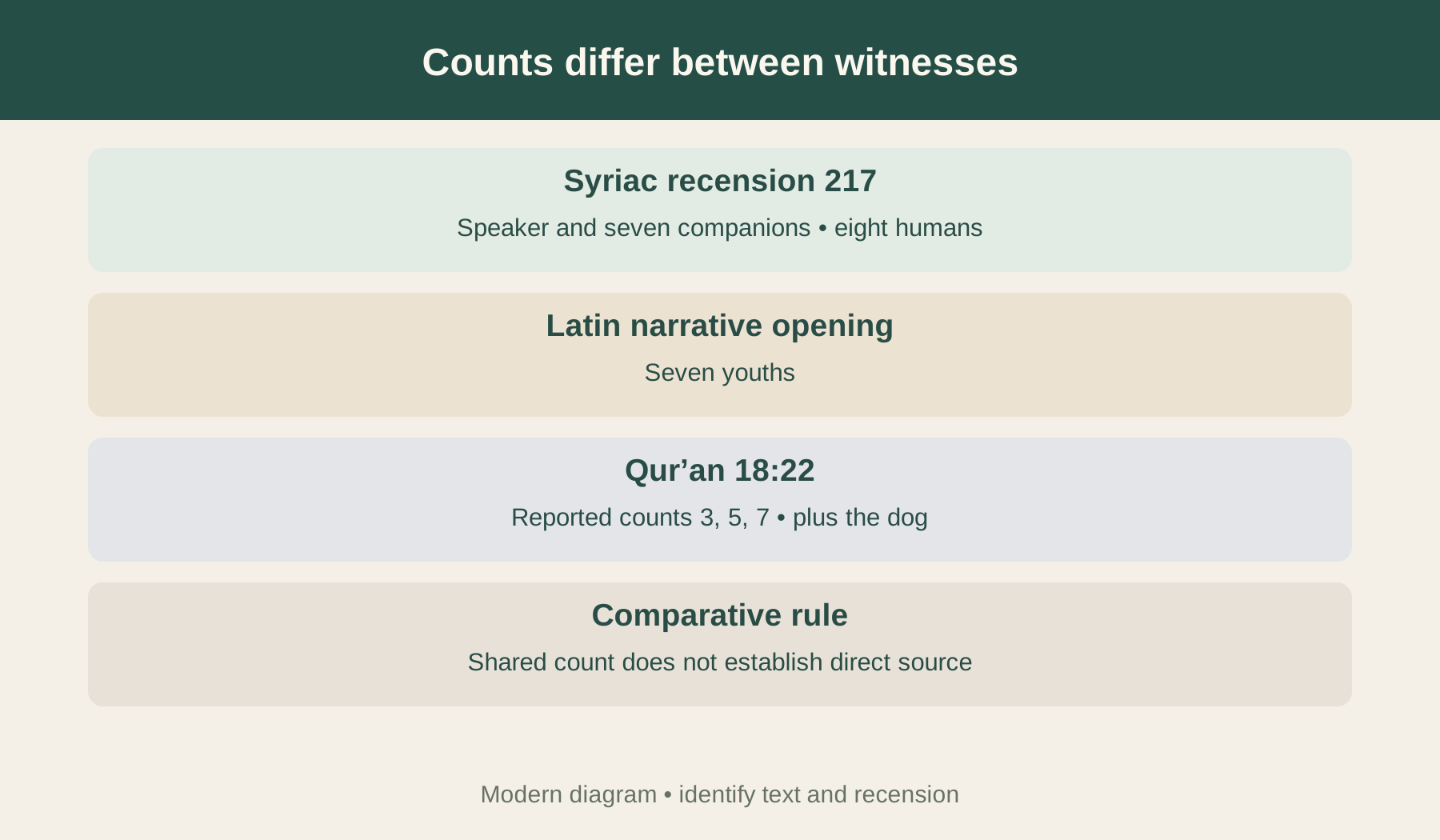
The familiar title Seven Sleepers does not describe every witness. In the Syriac form discussed here, a speaker has seven companions; later the youth describes himself with those seven: eight people. The opening of Gregory of ToursGregory of ToursSixth-century Christian author; the Latin Sleepers narrative’s ending names him and John the Syrian in its translation credit.Glossary · Click to read the explanation’s published Latin narrative gives seven youths. The larger number in the first witness is a human count, not necessarily the addition of the dog. [5] [7]
Nicholas Sims-WilliamsNicholas Sims-WilliamsScholar of Middle Iranian languages, including Sogdian, and of Christian texts translated from Syriac.Glossary · Click to read the explanation, a scholar of Iranian languages, describes a Sogdian version translated from Syriac that also has eight people. Sogdian is an Iranian language used in Central Asia. We rely on his Encyclopaedia Iranica account rather than an inspection of the manuscript itself. The usual name Seven Sleepers therefore does not describe the headcount in every version. [12]
How does the Qur’an handle numbers?
Verse 18:22 reports sayings: three with their dog as fourth; five with the dog as sixth; seven with the dog as eighth. Criticism of conjecture accompanies the passage, which refers knowledge of their number to God and restricts argument and questioning about them. Seven is indeed present, but within reported claims rather than an independent opening enumeration of the characters. [3]
Some commentators prefer the final statement: seven, with the dog as eighth. Understanding that reading requires distinguishing the claims presented in the verse from the commentator’s judgment. We must then examine the other details: agreement on the number alone cannot identify one account as the direct source of another.
How long does the sleep last in each account?
During the questioning in Guidi’s translation of this Syriac recension, 350 years are said to have passed since Decius. This fits neither the historical interval to Theodosius II nor the Qur’anic duration straightforwardly. Keep the number and identify its witness, rather than silently correcting it or assigning it to the entire sixth-century homily. [4] [5]
Verse 18:25 gives three hundred years with nine added. Ibn KathirIbn KathirSyrian Qur'anic exegete and historian (c. 1301–1373 CE) who favors Ishmael in his reading of the sacrifice account.Glossary · Click to read the explanation (c. 1301–1373 CE) explains these as three hundred solar years corresponding to approximately three hundred and nine lunar years. This is a calendrical interpretation; the verse does not explicitly name the two calendars. Numerical proximity settles neither the event’s date nor whether a differently numbered narrative intended the same calculation. [3] [11]
The dog and its later names
The dog is explicit at the cave’s entrance and in the Qur’anic reports of numbers, but remains unnamed there. Qitmir, a name associated with later traditions and art, should not be presented as Qur’anic wording. [2] [3] [13]
To illustrate variation, al-TabariAl-TabariAbbasid-era historian and Qur'anic exegete (c. 839–923 CE). His commentary records competing views on Abraham's son, then favors Isaac.Glossary · Click to read the explanation’s (c. 839–923 CE) commentary on 18:9 includes a report naming the dog Humran. Inclusion in commentary does not establish historical fact, but demonstrates differing reception details. Nor does the guarding angel in the Syriac form prove that the dog developed from that figure: a similar protective role is not a documented chain linking the characters. [5] [10]
Al-raqim and the tablet
Guidi’s translated form includes a lead tablet on which two men record the youths’ names and deeds; bishop and emperor read it when the story is revealed. A record inside the story helps identify the past. [5]
Al-Tabari assembles interpretations of al-raqim as a village, valley, written record or mountain, then prefers an inscribed object, such as a tablet or stone bearing their account. This interpretation can be compared with the Christian narrative’s tablet. The Qur’an specifies neither a tablet’s metal, writers nor storage place. Agreement between one interpretation and another witness’s detail does not eliminate other readings or independently establish a particular source. [1] [10]
A transmission route with a named intermediary
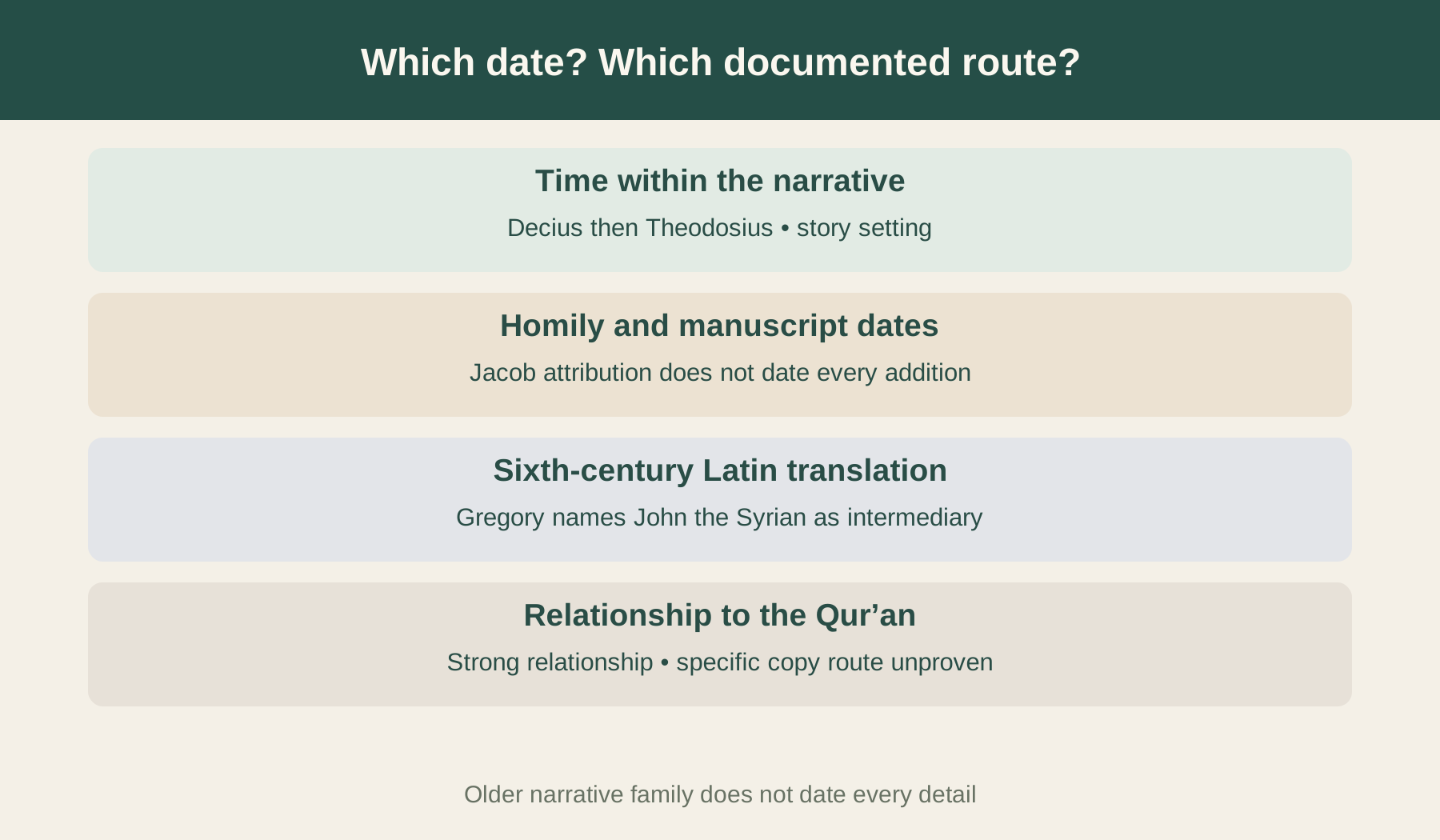
One case offers more than resemblance. The Latin narrative attributed to Gregory of Tours ends by crediting him with its rendering into Latin, assisted by John the SyrianJohn the Syrian, Gregory's interpreterInterpreter named in the ending of the Latin Sleepers of Ephesus account, dated to the sixth century CE.Glossary · Click to read the explanation as interpreter. The Cult of Saints database dates the narrative to 573–587. We therefore have a named intermediary and a particular translation activity in the sixth century. [7] [8]
John’s description as Syrian does not by itself settle his source language: Greek or Syriac may have been involved, and the question remains debated. More significantly, this route into Latin does not establish the same route into Arabic or the Qur’an. The Qur’anic passages name neither a particular Christian book nor a translator identifiable with this intermediary. [3] [8]
Narrative relationship and direct source
Sidney GriffithSidney H. GriffithAmerican scholar (1938–2026) of Syriac and early Arabic Christianity and encounters with Islam.Glossary · Click to read the explanation, a scholar of Syriac and Arabic Christianity, discusses this relationship in a study of Surat al-Kahf. Its published abstract suggests that oral stories circulated before some surviving written versions and that the Qur’an recalled aspects of them for its own purposes. This presents his view from the accessible abstract; the full article was not read for this study. [9]
We have a connected sequence of scenes: refuge in a cave, a long sleep, a return to the city for food, and discovery tied to resurrection. Together they make a narrative relationship more likely than a passing resemblance in one detail. The route by which the story reached each text, and whether it was oral, written or both, requires further evidence. [1] [2] [5] [7]
The image documents reception
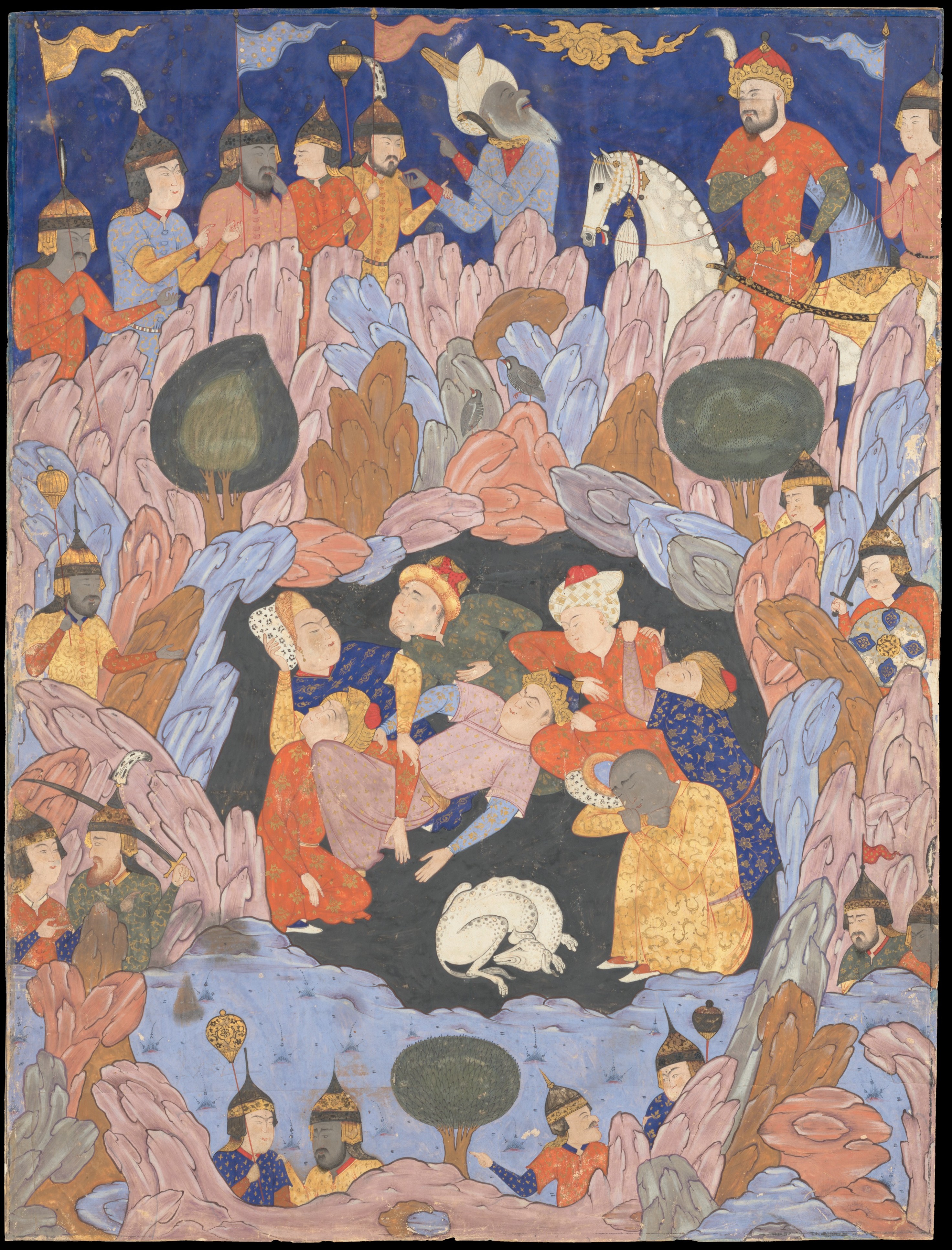
The cover is a leaf from a Falnama, an illustrated book used for divination. It dates to the 1550s; the Metropolitan Museum attributes its production to QazvinQazvinIranian city that served as a Safavid capital in the later sixteenth century and was associated with manuscript arts.Glossary · Click to read the explanation in IranIranIran is the modern country containing Shush, ancient SusaGlossary · Click to read the explanation and holds it as accession 35.64.3. Its youths and dog document later artistic reception, not contemporary testimony to the narrative’s events. [13]
A later image cannot date the earliest narrative form. Likewise, veneration of a place as their cave does not independently prove that the event occurred there. Location requires separate evidence. Neither the sun’s direction in the text nor a painted cave yields certain coordinates.
What remains after comparison?
We have a strong narrative relationship and Christian witnesses predating the Qur’an, alongside differences that should remain visible. In one instance translation is credited to an author and named intermediary. In the examined texts, we have no equivalent route identifying one particular source copy for the Qur’anic narrative. An older narrative family does not independently establish the age of every detail in its surviving versions. [4] [6] [7] [8]
The Qur’an uses the story to discuss God’s oneness, the promise of the Hour, and the limits of human knowledge. The Christian witnesses examined here connect the youths’ awakening with belief in resurrection. Comparison thus reveals what the story does in each text as well as how it circulated, without settling whether the miracle itself occurred. [2] [3] [5] [7]
References and notes
- Arabic text: belief, withdrawal and cave. Quran 18:9–16; Arabic primary text Return to the text ↑
- Sleep, dog, food and discovery; no imperial-coin detail. Quran 18:17–21; Arabic primary text Return to the text ↑
- Reported counts, duration and knowledge limits. Quran 18:22–26; Arabic primary text Return to the text ↑
- Recension introduction and dating limits; no direct Syriac collation. Ignazio Guidi, Testi orientali inediti sopra i Sette Dormienti di Efeso; 1884 journal,1885 offprint; printed16–18 Return to the text ↑
- Full translation of this recension: eight humans,350years and tablet; not every witness. Guidi,1885 offprint, printed29–32; Vatican Syriac217 recension, Italian translation; PDF43–46 Return to the text ↑
- Academic dating and catalogue; complete Brock translation unread. Cult of Saints in Late Antiquity, E02525; Jacob of Serugh, Homily on the Youths of Ephesus Return to the text ↑
- Latin opening, ending and translation credit; middle pages unread. Gregory of Tours, Passio sanctorum martyrum septem dormientium apud Ephesum; MGH SS rer.Merov.1,2,pp398,403 Return to the text ↑
- Dating and source-language debate; intermediary identity does not settle language. Cult of Saints in Late Antiquity, E05364; Passio; dating573–587 and source-language discussion Return to the text ↑
- Abstract only; oral-circulation hypothesis, not a proven route. Sidney Griffith, JIQSA6/1(2021), online15March2022; DOI10.5913/jiqsa.6.2021.a005; abstract Return to the text ↑
- One commentary entry: al-raqim interpretations and Humran; not historical proof. Al-Tabari, commentary on Quran18:9; displayed selected-verse entry Return to the text ↑
- Later calendrical explanation, not calendar names in the verse. Ibn Kathir, commentary on Quran18:25; displayed paragraph Return to the text ↑
- Short entry; Sogdian manuscript not examined here. Nicholas Sims-Williams, Encyclopaedia IranicaVII/5,p474,1998(updated2017) Return to the text ↑
- Image identity and open rights. Metropolitan Museum,35.64.3,The Seven Sleepers of Ephesus,Falnama,1550s,Qazvin Return to the text ↑
Research history
Substantive changes are retained here. Minor copy edits remain in the internal operational log.
-
Substantive record update
Suggest a correction · Suggest a source for this record
Cite this record
IL Archive, «The Companions of the Cave and the Sleepers of Ephesus: connected narratives», Edition 2, https://ilarchive.com/en/studies/seven-sleepers-and-cave
Continue reading