Study
Widow, Orphan, and Resident Outsider: Did the Torah Inherit a Mesopotamian Language of Justice?
An extended study of a topic, with evidence and references.
- Timeline
- From 2500 BCE to 500 BCE
- Region
- Mesopotamia and the Levant
From Urukagina and Ur-Namma to Hammurabi and Deuteronomy: comparing claims of protection and rules on food and justice, while separating rhetoric from practice.
Share article
Text
# Widow, Orphan, and Resident Outsider: Did the TorahTorah / PentateuchGenesis, Exodus, Leviticus, Numbers and Deuteronomy: Mosaic corpus with a compositional history. Torah can also mean teaching or law beyond these five books.Glossary · Click to read the explanation Inherit a Mesopotamian Language of Justice?
When an ancient king says he prevented the powerful from oppressing widows and orphans, and the Torah commands their protection, it is tempting to treat the two texts as expressions of one idea. But who is speaking in each case? A king describing his reign? A goddess praised in a hymn? A rule governing a family's inheritance? Or an instruction that a household leave part of its harvest for people in need? The differences between these voices make the historical comparison worthwhile. [1][2][3][5][8]
There is indeed an ancient Near Eastern tradition, older than the HebrewHebrewA Northwest Semitic language in the Canaanite group, with ancient and modern forms.Glossary · Click to read the explanation Bible, that portrays justice as support for people without strong protection. Yet every mention of a widow and an orphan cannot establish that a Hebrew passage was copied from a particular tablet, or that a ruler's promise reliably became protection for everyone. This study compares what the texts say and treats actual implementation as a separate question. [1][2][4][15]
Who are the widow, orphan, and outsider?
A widow here is a woman whose husband has died, but widows' situations differed. Some had property or relatives; others lacked effective protection or resources. In many ancient uses, an “orphan” is a child whose father has died, even if the mother is alive. Pairing the terms does not mean every widow and orphan was destitute. It points to people whose loss of a household representative or protector could place their rights at risk in a patriarchal family system. Social historians therefore examine varied circumstances instead of assuming one fixed condition. [18]
The Hebrew *gērGēr: the Resident Outsider in Hebrew TextsA person living within an Israelite community; neither every foreigner nor a modern legal refugee category.Glossary · Click to read the explanation*, variously translated “stranger,” “sojourner,” or “resident alien,” is harder than the blanket word “foreigner.” In Deuteronomy this person lives “within your gates” or “among you”: someone in the local community whose family and land position differs from that of inherited landholders. The term should not automatically be equated with every traveler, every member of another people, or everyone whom we would today call a refugee. [7][8][9][15]
Lagash and Ur: justice in the image of a king
In a text attributed to the reforms of Urukagina, ruler of Lagash in the third millennium BCE, the king claims to have freed people from specified burdens. He says he bound himself before the god Ningirsu to prevent the powerful from subordinating the orphan or the widow. What survives is presented in a composite scholarly edition; it is not a court record of every claim successfully brought by such people. It is nevertheless direct evidence that protection of this pair belonged to royal claims of legitimacy long before the Torah. [1]
The prologue to the laws of Ur-NammaNammaA goddess who asks Enki to relieve the gods’ labor in Enki and Ninmah.Glossary · Click to read the explanation, from the late third millennium, restates the image: the orphan is not made subordinate to the rich, the widow to the powerful, or the person with less to the person with more. Where the statement occurs matters. It is in a royal prologue before the conditional legal cases, rather than a specific clause describing the distribution of food or the filing of a complaint. This does not diminish its importance; it identifies the kind of evidence we have. [2]
Nanshe and Hammurabi: more than royal rhetoric
A Sumerian hymn to the goddess Nanshe offers another picture. It praises her for caring for widows and orphans, helping the poor, and protecting people whom the modern translation calls refugees or fugitives. This is religious literature, neither a record of relief payments nor legislation addressed to every household. But it rules out the simple claim that concern for any displaced person first appeared in Hebrew literature. Equally, we cannot silently treat the hymn's translated “refugee” as the same word or legal status as Deuteronomy's *gēr*. [3]
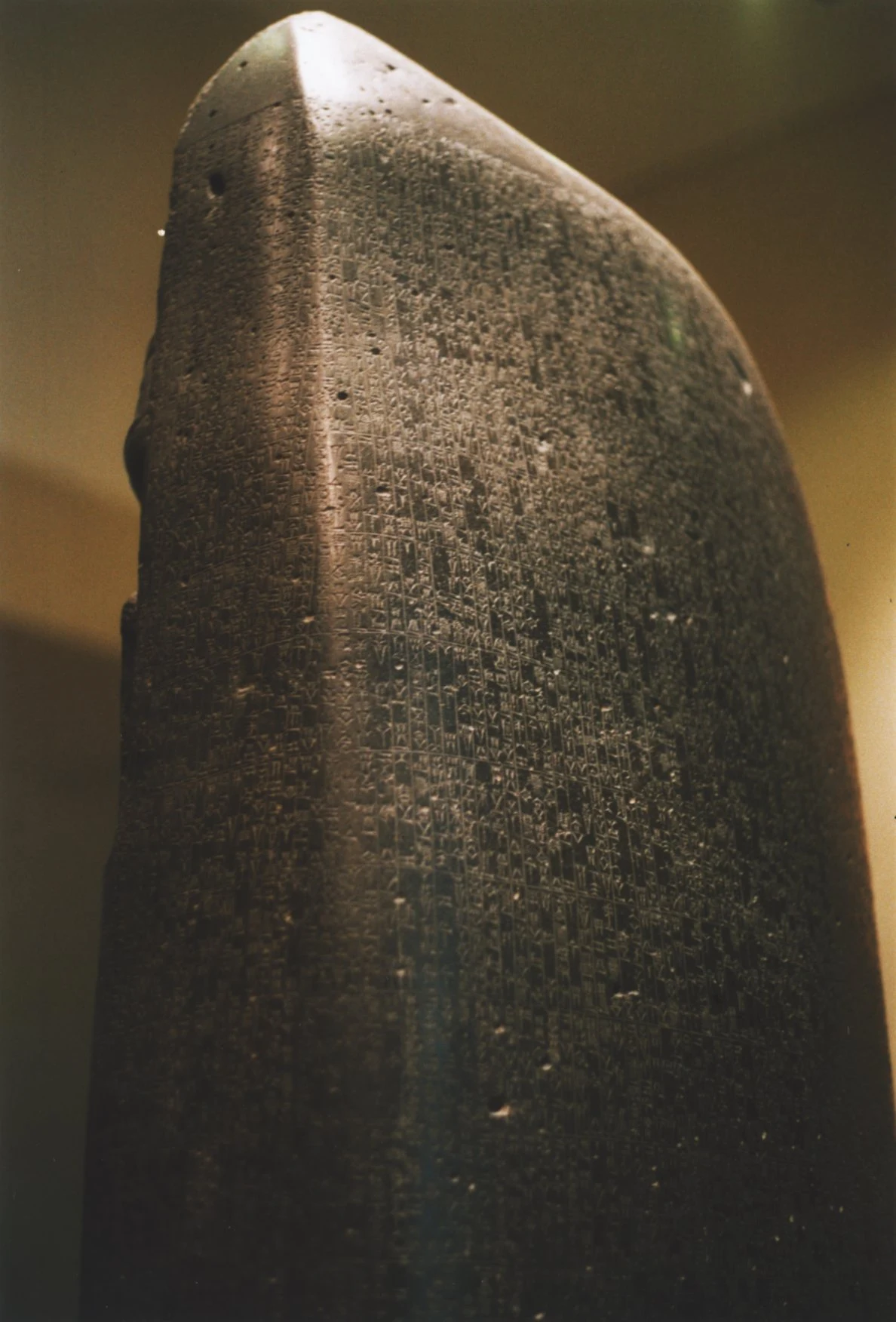
Then comes the Babylonian stela of HammurabiHammurabiKing of Babylon in Mesopotamia, reigning around 1792–1750 BCE. A celebrated legal text preserved on a stele and cuneiform copies bears his name.Glossary · Click to read the explanation in the eighteenth century BCE. In its prologue and epilogue the king presents himself as establishing justice so the strong will not overpower the weak, and so an injured person, including a widow or orphan, may find redress. Between those royal statements stand many conditional rulings. Section 177, for example, regulates the remarriage of a widow with young children through judicial review and arrangements safeguarding their deceased father's estate. This is a specific rule about family and property, not a general guarantee of income to every widow. Nor does the stela alone reveal how courts settled every actual dispute. The older English translation used here is checked for its broad meaning against the Louvre's description and scholarship; it is not presented as a current critical edition of the entire AkkadianAkkadianAn ancient East Semitic language written in cuneiform in Mesopotamia.Glossary · Click to read the explanation text. [4][5]
From royal promises to the community
In Exodus 22, the commands address those who hear the law: do not wrong the *resident outsider*, because the Israelites themselves were outsiders in Egypt; do not afflict a widow or fatherless child, for their cry will reach YHWHYahwehThe divine proper name written YHWH in the Hebrew Bible.Glossary · Click to read the explanation. Instructions on lending to the needy and taking a garment as a pledge follow nearby. Collective memory of Egypt and divine scrutiny of ordinary conduct appear here, rather than only a king's praise of his own just rule. Verse numbers vary between some Hebrew and English Bibles; here the reference is Exodus 22:20–26 in the Hebrew numbering of the cited edition. [6]
But it would be wrong to draw a straight line on which the king disappears. Psalm 72 asks that a king judge the poor justly and rescue those with no helper. Royal justice remained a biblical poetic ideal while legal collections also addressed members of the community. These are overlapping accounts of responsibility, not a royal period replaced overnight by a popular one. [12][17]
What does Deuteronomy add?
Deuteronomy 10 says that YHWH executes justice for the fatherless and widow and loves the *gēr*, giving that person food and clothing. Israel is then instructed to love this resident as it recalls its own stay in Egypt. The text does more than protect the older pair: it places alongside them a person whose relation to the community does not rest on comparable local descent. In the abstract of a scholarly chapter—not the full chapter, which has not been read here—Mark Glanville argues that the stable “stranger, fatherless, and widow” formula emerges clearly in Deuteronomy and concerns weak networks of kinship and protection. That is a claim about a textual formula, not an assertion that older civilizations knew neither displacement nor help for displaced people. [7][15]
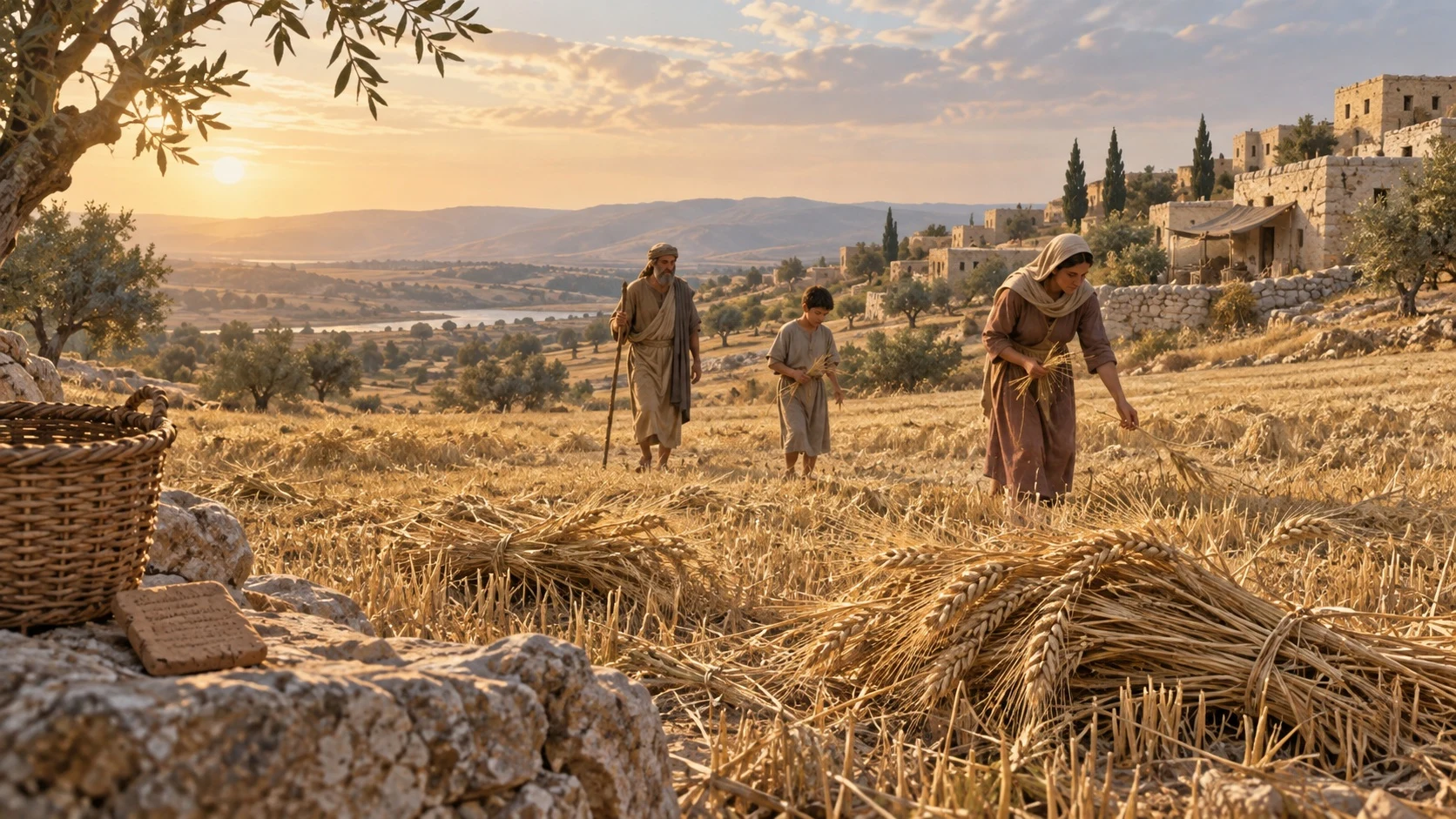
The commands become concrete in Deuteronomy 24. The poor worker's wages must not be withheld, whether the worker is a compatriot or a resident outsider. The case of an outsider or fatherless child must not be perverted, and a widow's garment must not be taken as a pledge. A harvester who forgets a sheaf must not go back for it; one who beats an olive tree or gathers grapes must leave what remains for the outsider, fatherless child, and widow. The passage repeatedly invokes servitude in Egypt as a reason to remember and act. These are instructions concerning wages, justice, pledges, and harvests, rather than a general compliment to compassion. [8]
Deuteronomy adds two more settings. In 14:28–29 the third-year tithe is stored in the towns so that the Levite, resident outsider, fatherless child, and widow may eat their fill. In 26:12–13 the giver declares before YHWH that the tithe has been distributed to them. At Weeks and Booths, 16:11 and 14 invite them to share in celebration with the household, its workers, and the Levite. These rules may be read as an attempt to bring people with weak protection into the local economy of food and feasting, while social differences remain. A prescribed declaration about the tithe is not an archaeological receipt proving that distribution occurred in every village. [9][10][11]
What do the texts say about failure?
Without the prophetic critiques it would be easy to confuse command and reality. Isaiah 1 calls for justice for the fatherless and defense of the widow, then accuses city leaders of taking bribes and keeping their cases from a hearing. In Jeremiah's temple address, the community's future is tied to doing justice and not oppressing the outsider, fatherless, and widow. Confidence in the temple's name cannot excuse continuing harm. These are social and religious accusations within the Hebrew texts themselves. They show that the ideal could fail; neither do they provide neutral statistics for how many cases were actually handled. [13][14]
Was anything directly borrowed?
The sequence of evidence is clear within limits: Lagash and Ur, the Nanshe hymn, and Hammurabi all predate Deuteronomy and contain language of justice for exposed people that its readers would recognize. MesopotamiaMesopotamiaA historical region associated with the Tigris and Euphrates, home to many societies and civilisations.Glossary · Click to read the explanation and the LevantThe LevantThe Levant is a regional name for lands along the eastern MediterraneanGlossary · Click to read the explanation were connected over many centuries. A shared regional tradition is therefore historically plausible. But we have no document showing that the author of Exodus 22 read a particular copy of Urukagina's reforms, or that a compiler of Deuteronomy took the outsider-widow-orphan formula from a particular clause of Hammurabi's stela. The genres also differ: royal inscription, hymn, family-law ruling, communal command, and prophetic protest. Chronology alone does not establish a route of borrowing. [1][2][3][5][6][15][16]
There is a second distinction between formulation and practice. The promise of a Lagash king does not show that all widows were protected. Hammurabi's rule does not establish that every judge preserved children's property. Deuteronomy's commands do not show that every grower left produce behind or every resident outsider ate until satisfied. The texts establish, first of all, that justice toward people liable to lose protection became a measure of the king's, deity's, and community's legitimacy. They then express different rules, accusations, and hopes concerning it. [1][2][5][8][9][13]
What remains after comparison
The Torah did not invent the widow and orphan as a test of justice; surviving Mesopotamian texts attest that language earlier. Nor did it merely repeat an old royal slogan. It frames the protection of the resident outsider, fatherless child, and widow in rules about pay, fields, tithes, and festivals, and connects those duties to the memory of Egypt and the community's relationship with YHWH. Meanwhile, royal poetry and the prophets continue to judge rulers by the same standard. The change concerns where the demand is voiced, how it is justified, and what acts it requires. It is neither a complete break nor a copy of an older monument. [6][7][8][9][10][11][12][13][14]
History allows us to see genuine similarities and genuine differences at once. One old question was whether the strong would protect those lacking a strong household. Another became what each harvester would leave, what each giver of the tithe would declare, and who would sit at the festival meal. To answer what really happened in fields and courts, however, we need evidence from people's lives as well as the promises and commands.
References and notes
- CDLI composite of Urukagina’s reforms, lines 303–318; not all witnesses RIME 1.09.09.01, Urukagina reforms composite, lines 303–318 Return to the text ↑
- CDLI composite of the laws of Ur-Namma, prologue lines 150–181 RIME 3/2.01.01.20, Laws of Ur-Namma composite, prologue lines 162–171 Return to the text ↑
- Oxford ETCSL, Hymn to Nanshe, lines 1–46 and 163–192; translation/edition, no independent collation ETCSL, Hymn to Nanshe (Nanshe A), lines 20–31, 163–192; bibliography https://etcsl.orinst.ox.ac.uk/section4/b4141.htm Return to the text ↑
- Louvre, Hammurabi stela; complete short museum description Louvre museum essay on the Hammurabi stela Return to the text ↑
- Hammurabi collection: prologue, §177, epilogue in older L. W. King translation; not a modern edition of the whole text Hammurabi law collection, L. W. King translation, prologue, §177, epilogue Return to the text ↑
- Exodus 22:20–26, Hebrew verse numbering, Hebrew text and JPS Exodus 22:20–26 in Hebrew and JPS 1917 translation; Hebrew verse numbering Return to the text ↑
- Deuteronomy 10:17–19, Hebrew text and JPS Deuteronomy 10:17–19, Hebrew/JPS Return to the text ↑
- Deuteronomy 24:14–22, Hebrew text and JPS Deuteronomy 24:14–22, Hebrew/JPS Return to the text ↑
- Deuteronomy 14:27–29, third-year tithe Deuteronomy 14:27–29, Hebrew/JPS Return to the text ↑
- Deuteronomy 26:11–15, declaration on tithe distribution Deuteronomy 26:11–15, Hebrew/JPS Return to the text ↑
- Deuteronomy 16:9–17, sharing in Weeks and Booths Deuteronomy 16:9–17, Hebrew/JPS Return to the text ↑
- Psalm 72:1–14, royal justice in poetry Psalm 72:1–14, Hebrew/JPS Return to the text ↑
- Isaiah 1:17, 23; whole short chapter page inspected Isaiah 1:17, 23, Hebrew/JPS Return to the text ↑
- Jeremiah 7:1–15, especially 5–11 Jeremiah 7:1–15, Hebrew/JPS Return to the text ↑
- Mark Glanville, “Stranger, Fatherless, and Widow” chapter; abstract/record only, not the full chapter Mark R. Glanville, The Stranger, Fatherless, and Widow in Deuteronomy, Oxford Handbook of Deuteronomy, 2020, pp. 233–251 Return to the text ↑
- TheTorah.com essay on widow and orphan; substantial comparative sections, not every note TheTorah.com, You Shall Not Ill-Treat Any Widow or Orphan, 2023/2026 Return to the text ↑
- Dylan R. Johnson on judicial wisdom; selected sections, not the whole article Dylan R. Johnson, The Woman from Tekoa and Judicial Wisdom, 2023 Return to the text ↑
- Study on orphans in Mediterranean antiquity; sections 2 and 3.1–3.2, not the entire article Academic article, Orphans in Mediterranean Antiquity and Early Christianity, sections 2 and 3.1–3.2 Return to the text ↑
Suggest a correction · Suggest a source for this record
Cite this record
IL Archive, «Widow, Orphan, and Resident Outsider: Did the Torah Inherit a Mesopotamian Language of Justice?», Edition 1, https://ilarchive.com/en/studies/widow-orphan-and-stranger
Continue reading