Site · City
Palmyra (Tadmor)
- Names
- Palmyra · Tadmar · Tadmor · Tadmur
- Timeline
- From 1800 BCE to 273 CE
- Region
- The Levant
An oasis city in the Syrian desert, called Tadmor by its own people. Caravan trade made it rich under Rome; its temples, tombs and two-language inscriptions survive, though war damaged them badly in 2015.
Estimated reading time: 6 min Published Last reviewed:
Share article
Text
Introduction
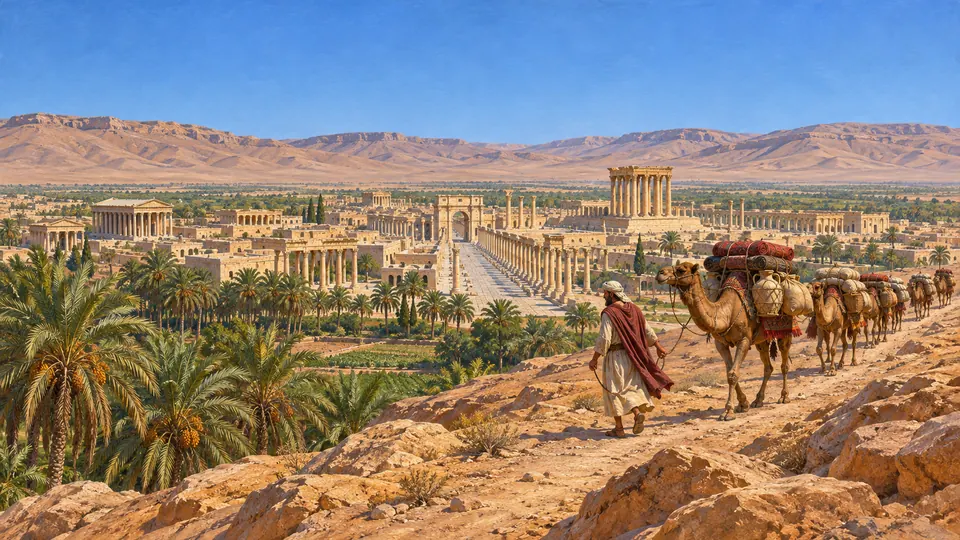
Palmyra is an ancient city in the middle of the Syrian desert, about halfway between the Mediterranean coast and the Euphrates. It grew up around a spring and a wide oasis of palm groves. Its own people called it Tadmor, a name of uncertain meaning; Palmyra, the Greek and Latin name, recalls the word for "palm tree". In the first three centuries CE it became one of the richest cities of the Roman East, because its merchants led camel caravans across the desert between the Roman world and the lands of the Persians. [1][2][3]
Its ruins, temples, tombs and thousands of inscriptions, many in two languages, show how the city lived. This entry follows that evidence from the first clay tablets to the damage of the recent war, and marks where it stops. [1][2]
A name older than the ruins
Tadmor appears in writing long before the buildings that stand today. A tablet from Kanesh in AnatoliaAnatoliaAnatolia is the region occupying the Asian part of present-day TurkeyGlossary · Click to read the explanation, from about 1800 BCE, names a man called "the Tadmorean". Letters from the palace archive of MariMariMari at Tell Hariri on the Syrian Euphrates was founded around 2900 BCE and rebuilt through three major urban phases. Its palace and cuneiform archives illuminate trade, royal government and religious practice, especially in the eighteenth century BCE.Glossary · Click to read the explanation, written shortly before Mari was destroyed (about 1759 BCE), mention envoys from Tadmor and a raid on the oasis by nomads. A tablet from EmarEmar, ancient MeskeneAncient Euphrates city in Syria with Late Bronze Age cuneiform archives and Gilgamesh fragments.Glossary · Click to read the explanation on the Euphrates, of the 13th century BCE, records three visitors from it. Around 1110 BCE the Assyrian king Tiglath-pileser I boasted that he had defeated Aramaeans at "Tadmor in the land of Amurru". [1][3]
The Bible's Second Book of Chronicles says that King SolomonSolomonSolomon is the biblical king, David’s son, associated in Kings with Jerusalem and building the templeGlossary · Click to read the explanation "built Tadmor in the wilderness" (2 Chronicles 8:4). The older parallel passage in the Books of KingsBooks of KingsBiblical books narrating the kingdoms' history, including the campaign against Mesha in 2 Kings 3.Glossary · Click to read the explanation (1 Kings 9:18) is written "Tamar" in the HebrewHebrewA Northwest Semitic language of the Canaanite group, encompassing Iron Age epigraphy, Biblical, Rabbinic, medieval and Modern Hebrew; its scripts and pronunciations changed over time.Glossary · Click to read the explanation text, so many historians think the Chronicler wrote the better-known oasis name in its place. On that reading the verse shows that Tadmor was known in JerusalemJerusalemJerusalem is a city of religious importance in Judaism, Christianity and IslamGlossary · Click to read the explanation when Chronicles was written. [3]
A caravan city between two empires
As the SeleucidSeleucid dynastyHellenistic dynasty arising after Alexander and ruling changing Near Eastern territories into the first century BCE.Glossary · Click to read the explanation kingdom fell apart in the second century BCE and the Parthians took MesopotamiaMesopotamiaHistorical region associated with the Tigris and Euphrates: Uruk, Ur, Eridu, cuneiform, Sumer, Akkad, Babylon and Assyria, their languages and cults, and the limits of archaeological evidence.Glossary · Click to read the explanation, merchants looked for a short desert road. Since camels could cross from the Euphrates to Syria with a single stop, Tadmor was the natural place for it. The oldest monuments that still stand, temple-shaped tombs in the valley west of the city, belong to this time. [3]
In 41 BCE, the Greek historian Appian tells, Mark Antony sent cavalry to plunder the city, claiming that its merchants sided with neither Rome nor Parthia. The Palmyrenes moved their goods across the Euphrates, and the horsemen found nothing. Appian calls them traders who brought goods from Persian lands and sold them in Roman ones. [2][4]
From the reign of Tiberius (14–37 CE) the city came under Roman influence, and by the middle of the first century it belonged to the Roman province of Syria. More than forty inscriptions, dated between 19 and 270 CE, honour the leaders of caravans and their backers. They show Palmyrene merchants settled in cities of Mesopotamia, such as Seleucia on the Tigris, and, it seems, trading down to the Persian Gulf. About 2,000 scraps of silk found in the tombs point to trade with the far East, but how far east the Palmyrenes themselves travelled is debated. [1][2]
In 137 CE the city published a long tax law on a stone slab in its market square, in Palmyrene and Greek. It set the dues on goods entering and leaving, counted by the camel load, donkey load or cart, for goods such as myrrh, bronze statues and slaves. [2][3]
Temples, gods and a colonnaded street
The great temple of Bel, which UNESCO ranks among the most important religious buildings of the first century in the East, was dedicated in 32 CE, in the spring month of Nisan, when the New Year festival was held in Babylonia. Bel means "Lord", the title that the Babylonians gave to MardukMardukBabylon’s leading god, worshipped at Esagil and elevated in the Akkadian Enūma eliš. His symbols include a spade and mušḫuššu dragon. His earliest origins remain obscure; Nibiru is no evidence of a planetary homeland.Glossary · Click to read the explanation. Other sanctuaries honoured BaalshaminBaalshaminCelestial deity attested in the Palmyrene region of Syria; depicted with Aglibol and Malakbel in a Louvre relief.Glossary · Click to read the explanation, "lord of the heavens", the goddess AllatAllatAn ancient Arabian goddess attested by Safaitic and Nabataean inscriptions, monuments in Palmyra, and the Quran; her roles and interpretations vary with period and context.Glossary · Click to read the explanation, Nabu, and local gods such as Yarhibol and Aglibol, with ShamashShamashMesopotamian god of the sun and justice, shown before Hammurabi on an eighteenth-century BCE stele preserved in the Louvre.Glossary · Click to read the explanation also attested. These cults owe more to Babylonian, Phoenician and Greek traditions than to Roman ones. [1][2][3]
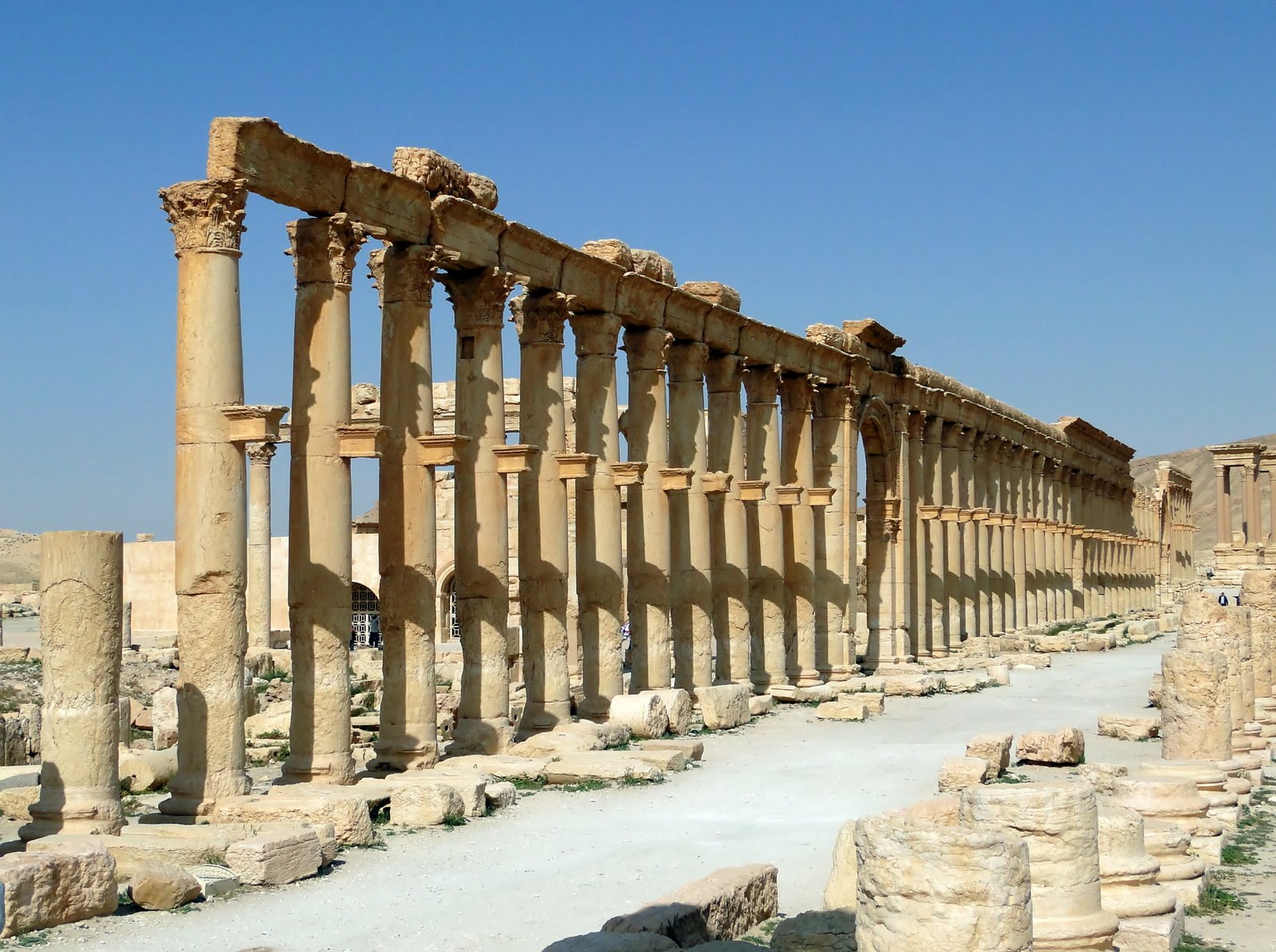
The city's spine was a colonnaded street about 1,100 metres long: a broad road lined on both sides with columns and covered walkways, like a shopping arcade open to the sky. It linked the temple of Bel, the market square, the theatre and other temples. The emperor Hadrian visited around 130 CE, and the emperor Caracalla made Palmyra a Roman colonia, a mark of high status for a provincial city, in 212. [1][3]
Two languages, one city
About 3,000 inscriptions survive in the Palmyrene alphabet, a local form of AramaicAramaicNorthwest Semitic language varieties documented since the early first millennium BCE, including Old and Imperial Aramaic, Syriac, Jewish dialects, and living Neo-Aramaic forms.Glossary · Click to read the explanation, and a few hundred of them are bilingual with Greek; some even add Latin. Palmyrene writing was used from the first century BCE until the later third century CE. [2]
The dead lay in tower tombs several storeys high and in underground family tombs, some built for hundreds of people. A stone portrait of the dead person could close each burial niche. About 3,000 of these portrait busts are now in museums around the world. They mix Greek and Roman portrait style with local dress and jewellery. [2]
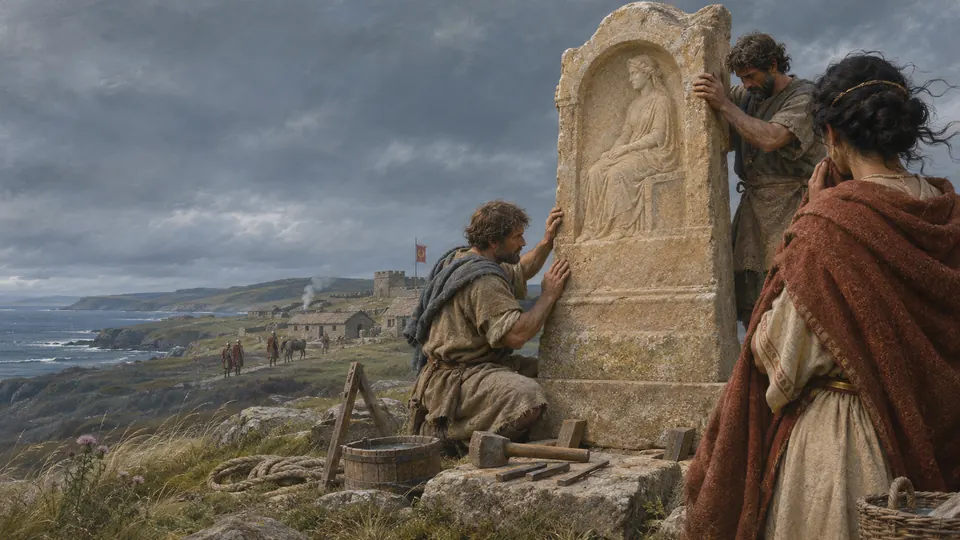
Palmyrenes also travelled far from home. At South Shields in northern England a tombstone of the second century CE was set up by "Barates of Palmyra" for Regina, a British woman of the Catuvellauni tribe, once his slave, whom he had freed and married; she died aged thirty. A line in Palmyrene script below adds: "Regina, the freedwoman of Barates, alas." [5]
Odaenathus, Zenobia and the fall
In the third century the new Sasanian kings of Persia attacked Rome's East. After the emperor Valerian was captured in 260, the Palmyrene leader Odaenathus drove the Persians back and received high Roman titles. After his murder (267 or 268), his widow Zenobia governed for their son; her armies took EgyptEgyptEgypt lies mainly in northeastern Africa and includes the Sinai Peninsula in AsiaGlossary · Click to read the explanation and reached AnatoliaAnatoliaAnatolia is the region occupying the Asian part of present-day TurkeyGlossary · Click to read the explanation. In 272 the emperor Aurelian captured the city and the queen. Palmyra rose again in 273, and Aurelian returned and sacked it, although archaeologists have found few traces of that sack. Palmyrene writing disappears after this; whether Rome suppressed it on purpose is not known. [2][3]
Later centuries and the recent war
The city lived on as a Roman garrison town, and in Late AntiquityLate AntiquityA flexible historians’ framework for transformations around the third to eighth centuries CE across the Mediterranean, Iran and Arabia, with variable boundaries.Glossary · Click to read the explanation it had a bishop and churches. In 634 it passed under Muslim rule, and a mosque inside the temple of Bel helped the building survive. Earthquakes, Timur's sack in 1400 and blowing sand left only a village within the temple walls. Drawings by European travellers of the 17th and 18th centuries influenced classical architecture in the West. UNESCO listed the site as World Heritage in 1980. [1][2][3]
During the Syrian war the site was placed on the List of World Heritage in Danger in 2013. In 2015, while the armed group ISIL (Da'esh) held the area, Khaled al-Asaad, the archaeologist who had looked after the ruins for some forty years, was killed. On 23 August the temple of Baalshamin was blown up, and on 30 August explosives destroyed the temple of Bel, as satellite images confirmed. Work on recording and recovering the site continues. [1][6][7]
Quick answers
Did Solomon build it?
Second Chronicles says so, but the older text in Kings names a different place. [3]
References and notes (7)
- UNESCO World Heritage Centre, “Site of Palmyra” (World Heritage List no. 23), property page Brief synthesis, criteria (i), (ii) and (iv), integrity, authenticity and protection statements (2009), date of inscription 1980, List of World Heritage in Danger 2013 to present, and the list of linked news items on the site's recovery. Return to the text ↑
- Getty Research Institute, “Ancient Palmyra”, in the online exhibition The Legacy of Ancient Palmyra (2017) Whole page: setting and name, Appian on the caravan trade, the tax tariff of 137 CE, the caravan inscriptions of 19–270 CE, the trade routes and the silk finds, the colonia of 212, the about 3,000 Palmyrene inscriptions and the bilingual and trilingual ones, the cults and temples, tower and house tombs and the funerary busts, Odaenathus, Zenobia and Aurelian, and later history to the Ottoman period. Return to the text ↑
- Jona Lendering, “Tadmor (Palmyra)”, Livius.org, history pages 1–5 (created 2015, last modified 2020) Pages 1–5: the Bronze Age and Iron Age mentions (Kanesh, Mari, Emar, Tiglath-pileser I), 2 Chronicles 8:4 and 1 Kings 9:18, the Hellenistic and Parthian background, Antony's raid, the boundary under Tiberius, the temple of Bel dedicated in 32 CE, Hadrian's visit in 130, the colonia of 212, Odaenathus and Zenobia, 272–273, the garrison, the first church and bishop, Justinian's walls and the year 634. Return to the text ↑
- Appian, The Civil Wars 5.9, translated by Horace White, Loeb Classical Library (1913), on LacusCurtius Book 5, section 9: Antony's cavalry raid on Palmyra, his pretext, the merchants who carried goods between the Parthians and the Romans, and the empty city. Return to the text ↑
- The Roman Inscriptions of Britain, RIB 1065: funerary inscription for Regina (South Shields) Whole record: findspot and date, the Latin text and translation, the Palmyrene line and its translation, the museum, and the commentary (RIB 1171, the lettering, the grammar). Return to the text ↑
- UNESCO World Heritage Centre, “Director-General Irina Bokova expresses consternation at the destruction of the Temple of Bel in Palmyra”, news, 1 September 2015 Whole statement: the destruction by explosives on 30 August 2015, the UNOSAT satellite confirmation, and the description of the temple and the monumental arch. Return to the text ↑
- UN News, “Syria: UNESCO chief condemns destruction of Palmyra’s ancient temple”, 24 August 2015 Whole article: the blowing-up of the temple of Baalshamin reported for 23 August 2015, the attacks on the site since May 2015, and the killing of Khaled al-Asaad one week earlier after four decades in charge of the ruins. Return to the text ↑
Suggest a correction · Suggest a source for this record
Cite this record
IL Archive, «Palmyra (Tadmor)», https://ilarchive.com/en/sites/palmyra
Continue reading
Related readings