Study
Manu and the Fish: Did the Flood Story Travel from Mesopotamia to India?
An extended study of a topic, with evidence and references.
- Region
- Ancient India and Mesopotamia
Three distinct Indian layers: fish and offering in the Vedic text, sages and seeds in the epic, Viṣṇu and cosmic cycles in the Purāṇa. A close comparison with Gilgameš and Noah tests the proposed transmission.
Share article
Text
# ManuManu, Survivor in Indian Flood TraditionsA central human figure in several Sanskrit accounts of the flood and human renewal; his position and role differ across the Śatapatha Brāhmaṇa, Mahābhārata and Purāṇas.Glossary · Click to read the explanation and the Fish: Did the Flood Story Travel from MesopotamiaMesopotamiaA historical region associated with the Tigris and Euphrates, home to many societies and civilisations.Glossary · Click to read the explanation to India?
When the Indian story of Manu is placed beside those of AtrahasisAtrahasis: Epic and HeroAkkadian epic: humans created for divine labor, multiplication, noise and flood. Atrahasis, “exceedingly wise,” survives through Enki’s warning; human reproduction is regulated afterward.Glossary · Click to read the explanation, Uta-napishtiUtnapishtimGilgamesh’s flood hero narrates survival to a king seeking immortality. Ea warns him; life is preserved; hero and wife receive exceptional life. Literary character, not an archaeologically established person.Glossary · Click to read the explanation, and NoahNoahNoah is the flood-story figure in Genesis and a prophet in the Qur’anGlossary · Click to read the explanation, familiar elements emerge: a warning, waters that overwhelm the world, a boat, and a survivor through whom a new beginning becomes possible. Yet counting shared elements cannot settle the historical question. “Manu’s flood” is not a single, fixed narrative. The late Vedic text, the Sanskrit epic, and the Purāṇic work give the boat different passengers, identify Manu’s rescuer differently, and imagine the renewal of the world in different ways. Before asking about borrowing, we need to establish what each layer says and when it can be attested. [1][2][3][5]
The fish in the earliest text: no declared divine name
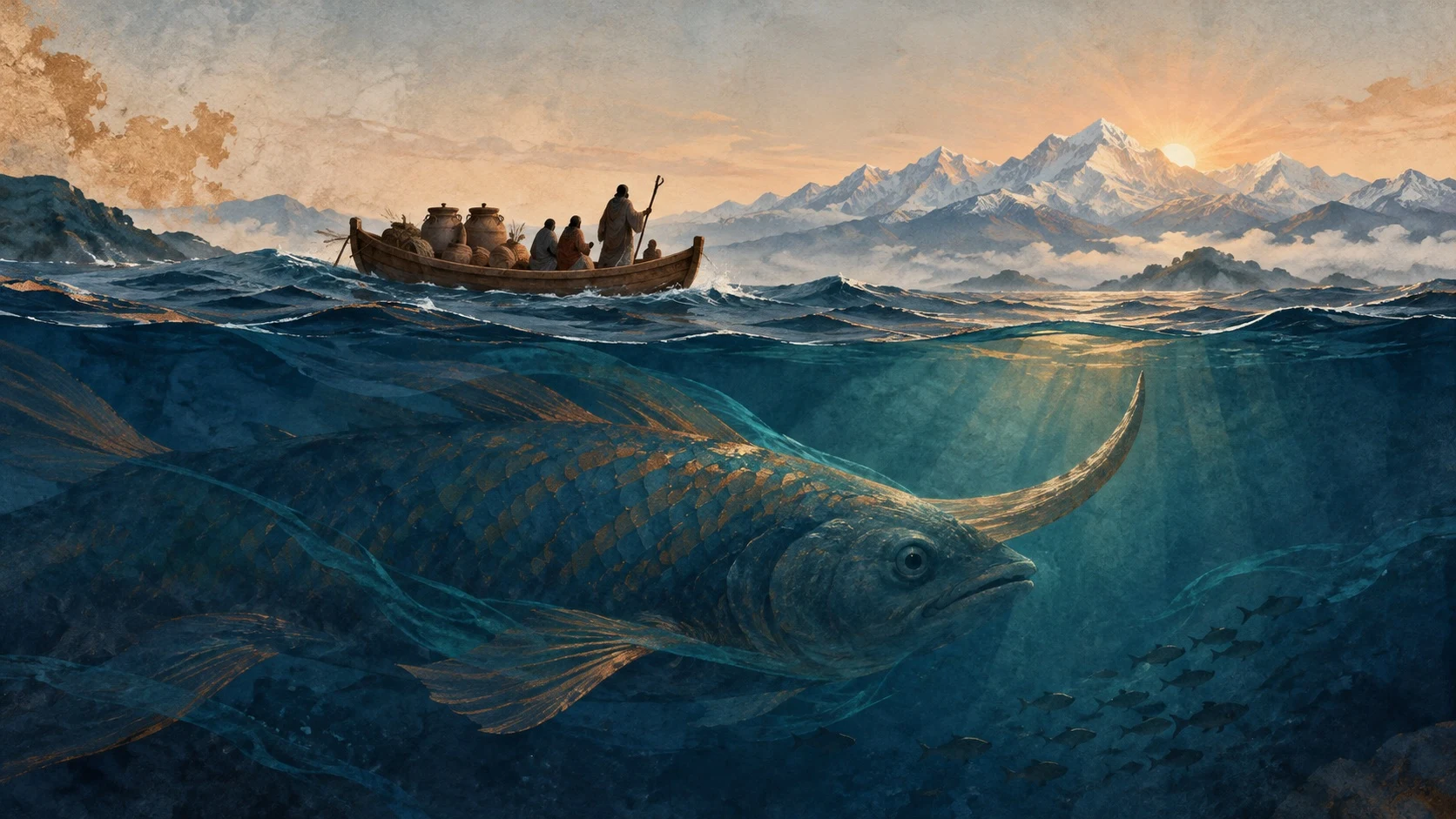
The earliest surviving detailed Indian telling comes from Śatapatha BrāhmaṇaŚatapatha BrāhmaṇaA later Vedic ritual work whose 1.8.1 preserves the earliest surviving detailed Indian account of the fish rescuing Manu.Glossary · Click to read the explanation 1.8.1. This is a ritualRitualAn organised or distinguished practice meaningful to a community; it may leave traces, but its form alone does not reveal an associated doctrine.Glossary · Click to read the explanation text of the later Vedic period, not a dated record of an event at the beginning of humanity. Its textual tradition belongs to the first millennium BCE, but it is not possible to assign this flood passage a precise year of composition. The story opens as a small fish falls into Manu’s hands while he washes them. It asks him to raise it, promising in return to save him from a flood that will sweep away living creatures. As it grows, he keeps it first in a jar, then in a pit, and finally releases it into the sea, because large fish eat small ones. [1][2][10]
The fish warns Manu which year the flood will arrive and tells him to prepare a boat. When the waters rise, he boards it; the fish swims up, and he ties the boat’s rope to its horn. It draws him to a “northern mountain,” where he is instructed to secure the boat to a tree and descend gradually as the waters recede. The account expressly says that the flood swept away the other creatures and Manu alone remained. But this passage does not name a deity who sent the flood, identify the fish as Viṣṇu or Brahmā, or mention seven sages or pairs of animals. These are not details our summary has omitted. They mark the difference between what this text attests and what later tellings add. [1][2]
Why does the account end with an offering?
The passage does not end when the boat reaches safety. Wanting descendants, Manu performs worship and austerities and makes an offering of milk products into the water. After a year a woman arises from it and calls herself his daughter. She then assists him in the sacrificial action; through them Manu’s descendants are generated. The text identifies her with Idā and connects her to the ritual that the wider work explains. She therefore should not be called an “Indian Noah’s wife,” nor should she be removed because she does not fit a comparative template. Here survival introduces an explanation of how people continue and how an offering works. That is not the role played by the post-flood sacrifice in Genesis. [1][2][12]
The Mahābhārata: seven sages and the seeds of life
Mahābhārata 3.185 offers a broader telling. Manu, son of Vivasvat, is an ascetic whose austerities have given him power, and the small fish asks his protection from stronger fish. After he cares for it and it grows, it predicts an approaching dissolution of the world. It orders him to build a strong boat, embark with the Seven Sages, and keep the “seeds” safely aboard. When water fills everything in sight, the boat is tied to the fish’s horn, and it is pulled to a Himalayan peak known in the passage as the “boat-fastening” place. [3][4]
The decisive detail comes after survival: the fish tells the sages that it is Brahmā, lordRabbTitle of lordship, ownership or care by context; applied to God in Lord of worlds.Glossary · Click to read the explanation of creatures, and charges Manu with creating living beings anew. He accomplishes this through austerity and the deity’s favor. We have moved from Manu alone, renewing his lineage through Idā’s sacrificial emergence, to a company of sages, a stock of seeds, and an epic vision of re-creation. The passage does not license us to replace “seeds” automatically with “pairs of animals”: animals are not named as passengers here in the way they are in Genesis. The epic was composed and edited over centuries, so neither its mythical setting nor the date of its final form precisely dates every feature in this passage. [3][4][11]
In the Matsya Purāṇa the fish becomes explicitly Vaiṣṇava
The later MatsyaMatsya: The Saving Fish in Indian TraditionsThe fish that saves Manu from the flood; the earliest surviving account leaves its divine identity unstated, the cited epic identifies Brahmā, and Purāṇic versions link it with Viṣṇu.Glossary · Click to read the explanation Purāṇa gives the story a third frame. Manu is now a king and ascetic, and the fish he rescues grows to a miraculous size. He recognizes it by Vaiṣṇava names including Vāsudeva, Keśava, and Janārdana, and the fish confirms that recognition. It describes a cosmic dissolution preceded by heat and drought and followed by inundation, with divine protection extending to moving and unmoving life. The dialogue between Manu and the fish also becomes the setting for religious instruction. In this telling Manu uses yogic power to bring living beings aboard, and a serpent serves as the rope binding the boat to the fish’s horn. [5]
A later Hindu reader may recognize the fish in all these tellings as Matsya, a form of Viṣṇu. That is an interpretation across the history of the tradition, however; it does not make the Śatapatha Brāhmaṇa explicitly say so. The Vedic passage leaves the fish’s divine identity unnamed; the cited epic passage says Brahmā; the Purāṇic one places it in a Vaiṣṇava and cyclical cosmic setting. The changing identification is part of the story’s history, not an error to be repaired by combining the texts. [1][3][5]
What resembles the Mesopotamian flood?
In the Babylonian Gilgameš account, EaEnkiMesopotamian deity associated with deep fresh water, wisdom and Eridu, known as Ea in Akkadian tradition. The earliest preserved written mention does not date his cult’s origin or identify Ubaid Eridu’s deity.Glossary · Click to read the explanation warns Uta-napishti to make a boat and carry the “seed of all living creatures.” The narrator later lists his kin, animals, and craftsmen among those taken aboard. The AkkadianAkkadianAn ancient East Semitic language written in cuneiform in Mesopotamia.Glossary · Click to read the explanation expression about “seed” thus does not necessarily mean only bags of botanical seed. Another Akkadian witness from Atraḫasīs mentions bringing in barley, relatives, and wild herds. Genesis, meanwhile, tells Noah to take his family and animals into the ark and gives a place in the story’s conclusion to his offering and the covenant with all living things. [6][7][12]
The warning, vessel, and preservation of life resemble one another strongly enough for serious comparison. Yet the fish whom the human first rescues, the relationship between offering and Idā, the Seven Sages, the fish’s changing divine identity, and renewal through ascetic practice or a cosmic cycle are not decorations that can be dropped to make the Indian work match a Mesopotamian or biblical one. Some differences arise within the Indian tradition itself: what is absent from its earliest preserved version appears in the epic and changes again in the Purāṇa. [1][3][5][6][7][12]
Were the “seeds” a mistaken translation?
One focused proposal deserves closer attention than the general claim that “both places have a flood.” In Gilgameš XI the Akkadian text uses an expression that can be rendered “seed of all living creatures”; the Mahābhārata includes *bījāni*, “seeds,” among what Manu must take. Tzvi Abusch and Emily Blanchard West propose that an Indic tradition understood the Mesopotamian phrase too literally and made “seeds” a component of the boat’s cargo. This is an attributed historical and linguistic hypothesis, not a result established by the two words alone. Only the published abstract of their study was available for this research, not the pages setting out its full argument. Moreover, seeds appear in the later epic telling, not in the earliest preserved Vedic account of Manu. They cannot therefore be used directly to identify the source of that Vedic version. [3][6][8]
A more cautious reading also exists. After tracing a long history of comparisons, Guillaume Ducœur points out that proposed paths of transmission from Mesopotamia to Indian texts often lack the intermediate evidence that would show who carried a story, where, and when. He argues for reading each Sanskrit version within its ritual, epic, or Purāṇic setting before proclaiming its origin. This does not rule out contact among ancient cultures. It distinguishes a historical possibility from a demonstrated chain of transmission. The earlier dates of surviving Mesopotamian written witnesses make influence a legitimate question; by themselves they do not identify a tablet supposedly translated by an Indian author. [6][8][9]
What does the evidence establish, and what remains open?
We can say with confidence that three different Indian versions survive. The earliest tells of Manu saved by a horned fish and a boat, then connects human renewal with the offering and Idā. The Mahābhārata introduces the Seven Sages and seeds and identifies the fish as Brahmā. The Matsya Purāṇa brings Viṣṇu’s identity and a cosmic cycle to the foreground. Earlier written Mesopotamian witnesses also contain a warned survivor, a vessel, and the preservation of life. [1][3][5][6][7]
The sources examined here do not, however, demonstrate that the Indian narrative was taken directly from the Gilgameš text now known to us, from Genesis, or from one worldwide flood. Some transfer of traditions across large distances remains worth investigating, and the “seeds” proposal seeks a more precise trace of it. But local recomposition and independent developmentIndependent developmentSimilar elements arising without historical transmission between them.Glossary · Click to read the explanation of some motifs remain alternatives. Most of all, “Which came first?” should not erase another question: what did each community do with the story? In the Śatapatha Brāhmaṇa, sacrifice explains the continuation of life; in the epic, survival opens the way to re-creation; in the Purāṇa, the boat belongs to a cosmic cycle and a Vaiṣṇava vision. Those transformations are the history of the Indian story in their own right, not merely a footnote to a comparison with Noah. [1][3][5][8][9][12]
References and notes
- Śatapatha Brāhmaṇa 1.8.1.1–11, Julius Eggeling’s 1882 translation; whole fish-and-Idā passage Śatapatha Brāhmaṇa 1.8.1.1–11, J. Eggeling translation (1882) Return to the text ↑
- Guillaume Ducœur, Les mythes du déluge de l’Inde ancienne, appendix pp. 331–335: Sanskrit and French Śatapatha text; selected pages Guillaume Ducœur, Les mythes du déluge de l'Inde ancienne (2018), Appendix ŚB 1.8.1.1–11, printed pp. 331–335 / PDF pp. 373–377 Return to the text ↑
- Ducœur, appendix pp. 335–341: Mahābhārata 3.185.1–54 in Sanskrit and French; not the whole epic Ducœur 2018, Appendix Mahābhārata 3.185.1–54, printed pp. 335–341 / PDF pp. 377–383 Return to the text ↑
- Mahābhārata 3.185, critical-edition-based Sanskrit display and English rendering; vv. 26–52 checked against Ducœur Critical-edition-based Mahābhārata Vana Parva 3.185, online Sanskrit display and English rendering, 54 verses Return to the text ↑
- Ducœur, appendix pp. 341–347: Matsya Purāṇa 1.10–34 and 2.1–20 in Sanskrit and French; selected passages only Ducœur 2018, Appendix Matsya Purāṇa 1.10–34 and 2.1–20, printed pp. 341–347 / PDF pp. 383–389 Return to the text ↑
- Gilgameš XI 14–31 and 82–96, Akkadian and Andrew George translation hosted by SOAS; relevant lines Gilgameš XI 1–163, especially 20–27 and 82–86; Akkadian transcription and A. R. George English translation hosted by SOAS Return to the text ↑
- SEAL Atraḫasīs fragment W 1′–17′, Akkadian and translation, especially 5′–10′ SEAL, Atraḫasīs Standard Babylonian flood fragment W 5′–10′, edition/translation by N. Wasserman Return to the text ↑
- Abusch and West 2020, Sowing the Seeds of Uncertainty: published abstract only, not the full article Tzvi Abusch and Emily Blanchard West, Journal of Indo-European Studies 48 (2020), pp. 325–351; accessible abstract Return to the text ↑
- Ducœur, selected introduction and conclusion, pp. 1–12 and 327–330, on comparative limits and missing routes; not full-book reading Ducœur 2018, introduction around printed pp. 1–12 and conclusion pp. 327–330 / PDF pp. 369–372; selected comparison-history paragraphs Return to the text ↑
- Sanskrit Reading Room, grammatical discussion of ŚB 1.8.1.1–4 and approximate dating; posted portion only Sanskrit Reading Room, Oxford-based reading session on ŚB 1.8.1.1–4 and date note Return to the text ↑
- Oxford thesis, §1.4 on the Mahābhārata’s compositional period; relevant passage only Oxford thesis Ends of the Mahābhārata, §1.4, dating discussion Return to the text ↑
- Genesis 6–9, Hebrew and JPS 1917; family, animals, offering and covenant, without manuscript collation Genesis 6–9, Hebrew/JPS 1917, chapter links Return to the text ↑
Suggest a correction · Suggest a source for this record
Cite this record
IL Archive, «Manu and the Fish: Did the Flood Story Travel from Mesopotamia to India?», Edition 1, https://ilarchive.com/en/studies/manu-and-the-fish-flood
Continue reading