Entity
Nergal
A reference page linking a name, group, or concept to the materials that discuss it.
- Names
- Meslamtaea · Nergal · Nerigal
- Timeline
- From 2600 BCE to 300 BCE
- Region
- Mesopotamia
Nergal was the Mesopotamian god of the city of Kutha, of war, plague and sudden death, and in time the king of the underworld beside Ereshkigal. Who he was, and what the texts say about him.
Estimated reading time: 6 min Published Last reviewed:
Share article
Text
Introduction
Nergal is one of the oldest gods of ancient IraqIraqIraq is a modern country encompassing much of ancient MesopotamiaGlossary · Click to read the explanation. He was worshipped for well over two thousand years, and his main home was the city of Kutha in central Babylonia. To the people who prayed to him he stood for death that comes from outside: death in battle, death by plague, the sudden blow. In the later stories he also becomes a king of the dead, ruling the underworld together with the goddess EreshkigalEreshkigalMesopotamian goddess ruling the netherworld; Inanna’s sister in descent texts, with varying accounts of her relationship with Nergal.Glossary · Click to read the explanation.
Over such a long time his picture changed: he took over the names and roles of other gods, and the tablets tell his best-known myth in different ways. This card sets out what the sources say, and which points are still discussed.
A god of Kutha with several names
The oldest form of the god is called Meslamtaea. The name appears in lists of gods of the Early Dynastic period, from about 2600 BCE, and his main cult centre was already Kutha.[1] The name is usually explained as "the one who comes out of the Meslam", the name of his temple.[2] A Sumerian hymn for King Shulgi of Ur (about 2094–2047 BCE) praises the god "when you sit in E-meslam", his temple house, and calls him a "wild bull with thick horns" whose awe fills heaven and earth.[3]
The name Nergal itself first appears in the time of the Third Dynasty of Ur.[1] Its exact reading and meaning are debated. One common explanation takes it from a Sumerian phrase meaning "lord of the great city", where the "great city" is the land of the dead.[2] This is a likely meaning, not a proven one.[1]
Over the centuries Nergal absorbed other gods, a little as a large city absorbs nearby villages that keep their old names as districts. By the Ur III period Meslamtaea and Nergal were treated as one god. Later Meslamtaea was also paired with another god, Lugalirra, as "the divine twins"; in Assyrian times small figures of the pair were buried at doorways to guard houses.[4] From the Old Babylonian period on, Nergal was also identified with Erra, a Semitic god of death and destruction, the hero of the Babylonian poem Erra and Ishum.[1] Whether Nergal and Erra were ever fully the same god, or two sides of one figure, is discussed by scholars; one reading even treats Erra as Nergal's double, the part of him that goes down to the dead.[2]
Family and character
In the Sumerian myth EnlilEnlilEnlil/Ellil: a major Mesopotamian god associated with destinies, kingship, and Ekur at Nippur, already prominent in third-millennium god lists. His name’s origin and cult beginnings remain debated.Glossary · Click to read the explanation and NinlilNinlilMesopotamian goddess and consort of Enlil, associated with Nippur, Tummal, destinies and royal ritual. Identified with Sud in literary tradition and known as Mulliltu/Mullissu in Akkadian and Assyrian contexts; her genealogies and roles vary by text and period.Glossary · Click to read the explanation, Nergal is one of the children of the great god EnlilEnlilEnlil/Ellil: a major Mesopotamian god associated with destinies, kingship, and Ekur at Nippur, already prominent in third-millennium god lists. His name’s origin and cult beginnings remain debated.Glossary · Click to read the explanation and the goddess NinlilNinlilMesopotamian goddess and consort of Enlil, associated with Nippur, Tummal, destinies and royal ritual. Identified with Sud in literary tradition and known as Mulliltu/Mullissu in Akkadian and Assyrian contexts; her genealogies and roles vary by text and period.Glossary · Click to read the explanation, conceived while Ninlil follows Enlil on the road to the underworld.[5] Other sources give his mother as the birth goddess Belet-ili. His wife changes from source to source: the goddesses Laṣ and Mammitum, the messenger goddess NinshuburNinshubur: Divine Messenger of Inanna and AnMesopotamian divine messenger and intermediary associated with Inanna in Sumerian narratives and with An in inscriptions and hymns; identity and gender vary by context and must not be equated automatically with Papsukkal.Glossary · Click to read the explanation, and finally Ereshkigal, which is a later development.[1]
His character is that of a fighter. He is linked with war gods, goes with the king into battle, and commands demons, above all the Seven (the Sebettu) who march with Erra.[1] This dark power had a protective side: a god who rules the bringers of disease can also hold them back. Late Babylonian figurinesFigurineA small shaped object depicting a human, animal or abbreviated form, in clay, stone or another medium. Its form alone does not establish its use; manufacture, handling traces and find context matter.Glossary · Click to read the explanation of Nergal and amulets carrying lines from the Erra poem were used to protect houses.[1]
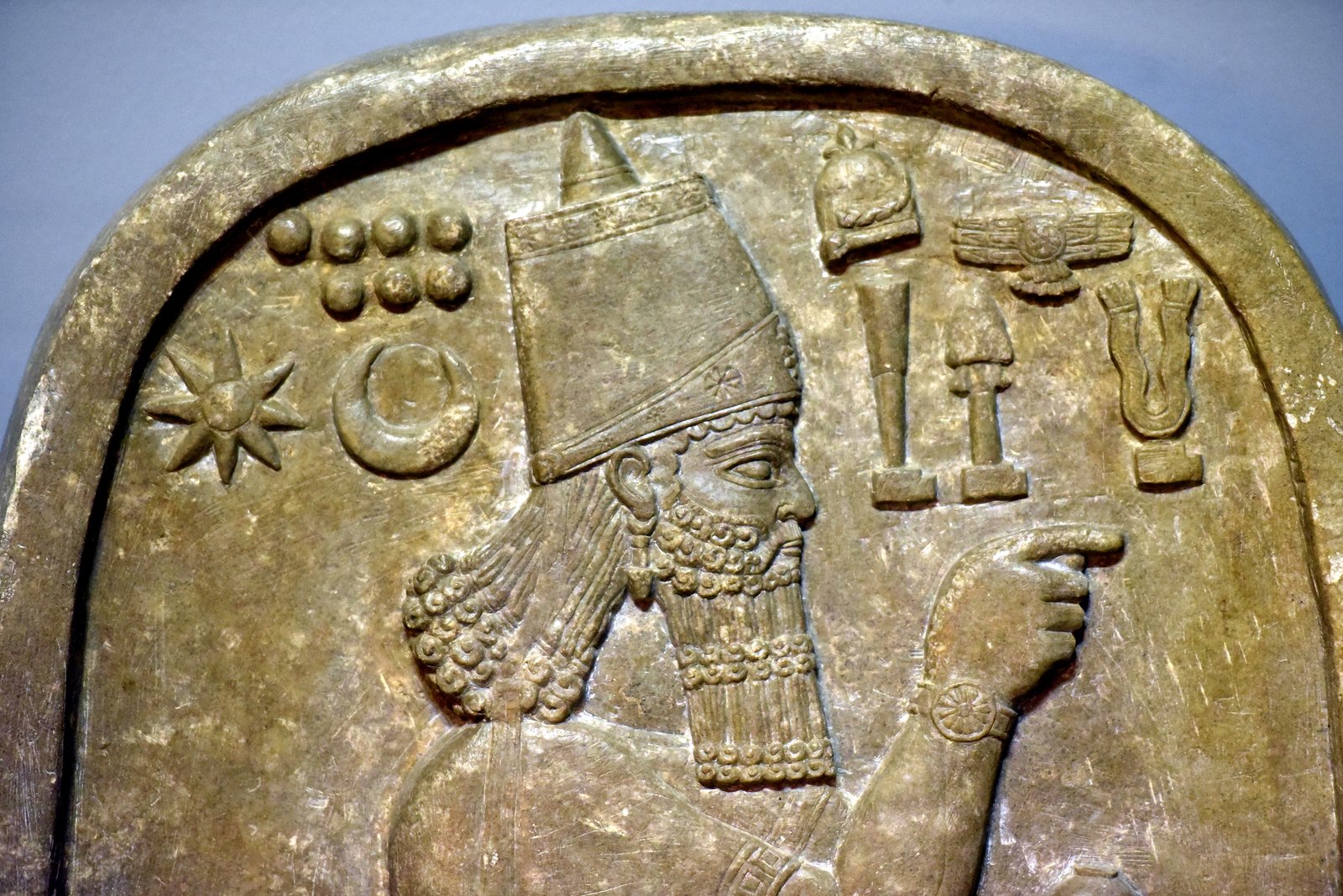
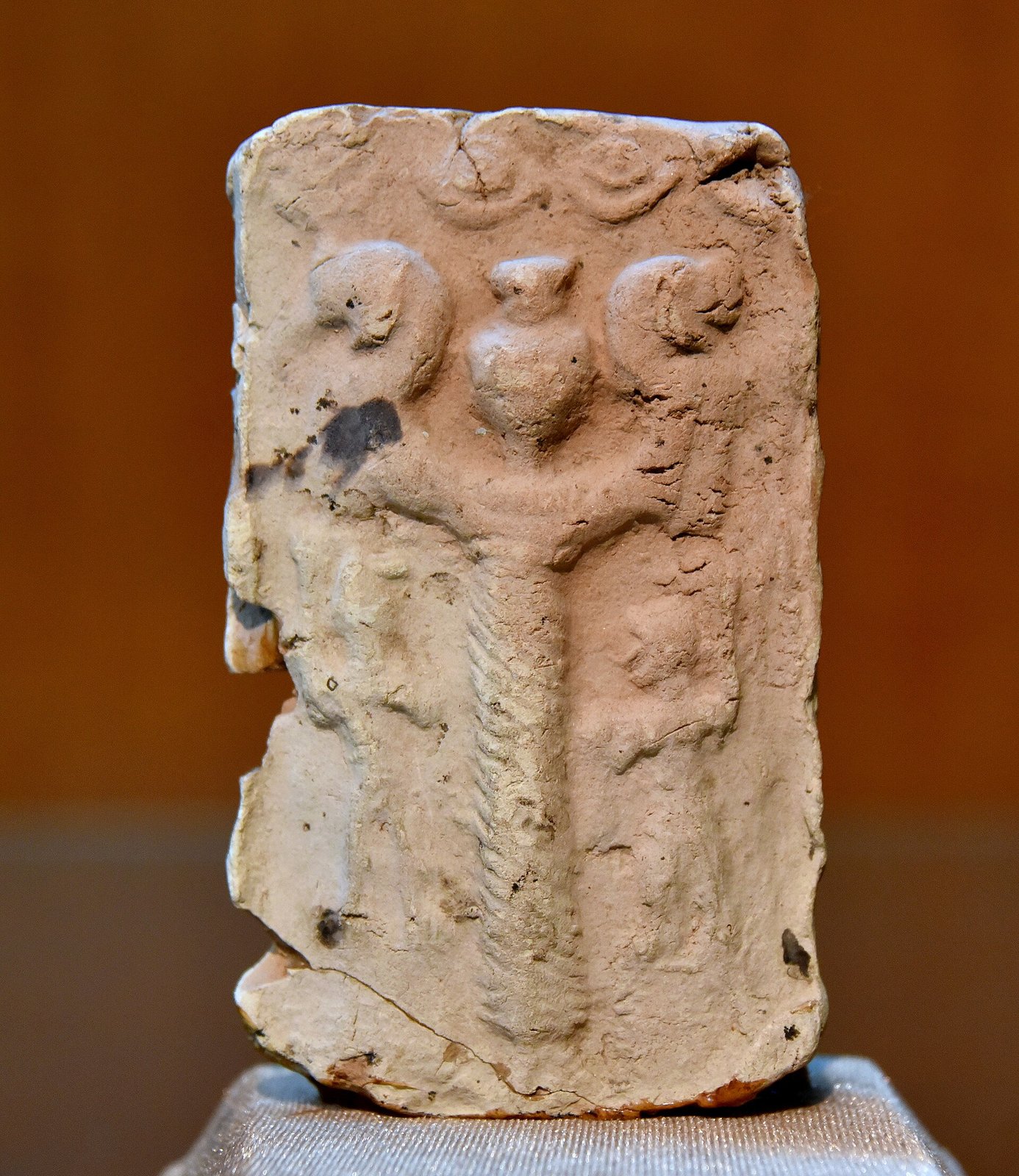
In art he is often shown as a male figure with a curved sword or a mace. The mace is often topped by one or two lion heads, and this lion-headed mace became his sign.[1] The clay plaque on this page shows such a twin-headed mace.
Nergal and Ereshkigal
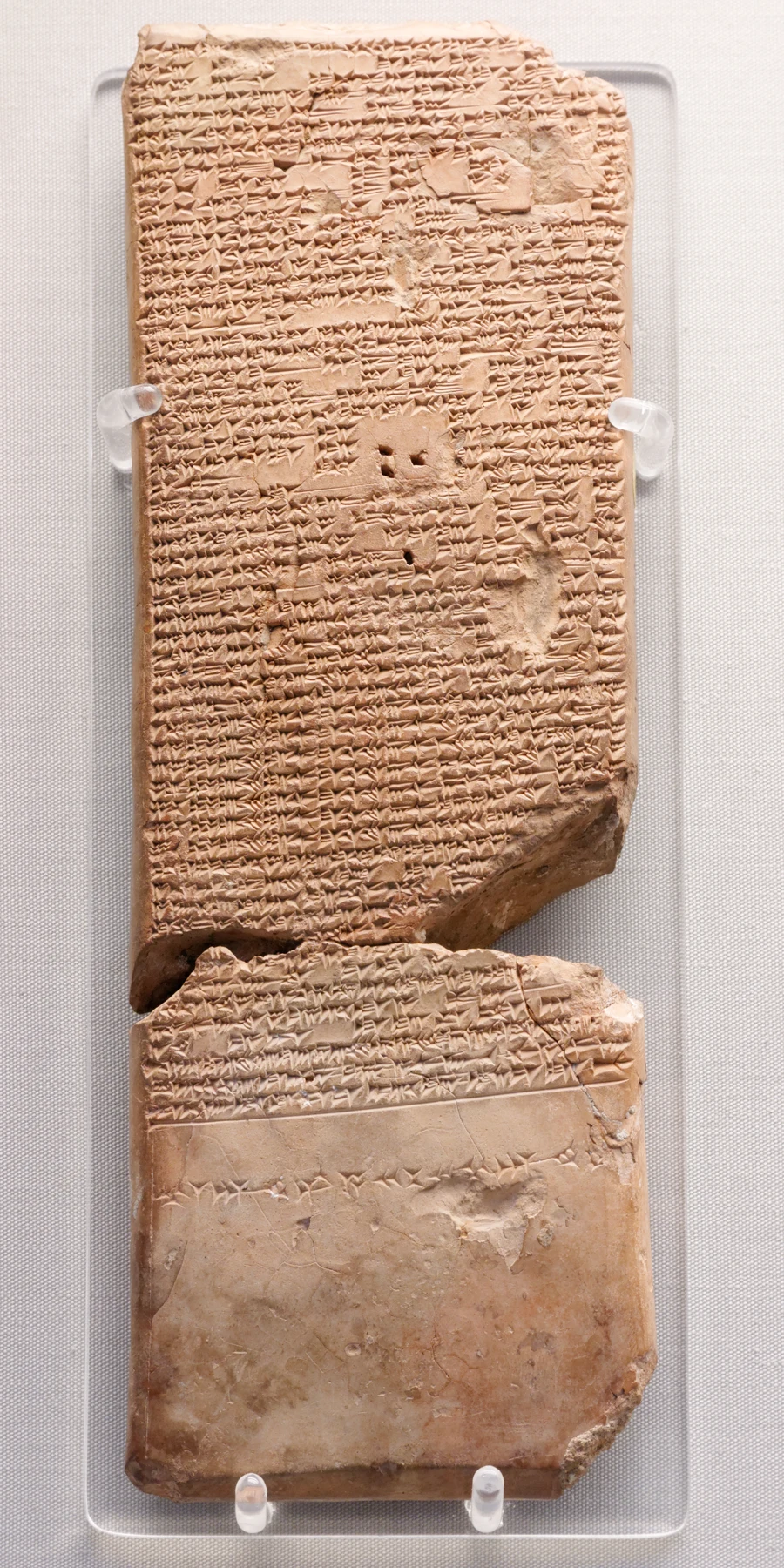
The best-known story about Nergal tells how he came to rule the underworld. It survives in two main versions. The short version is on a tablet from AmarnaAmarna / AkhetatenAmarna is the archaeological site of Akhetaten, Akhenaten’s fourteenth-century BCE capital in Middle Egypt, preserving royal boundary stelae, temples, houses and cemeteries.Glossary · Click to read the explanation in Egypt, written in the 14th century BCE as a training exercise for a scribe. The longer version is known from a library tablet of the 8th century BCE from Sultantepe in modern TürkiyeTurkeyTurkey is a modern country including Anatolia and territory in southeastern EuropeGlossary · Click to read the explanation, from a much later fragment from UrukUrukAncient city at Warka in southern Iraq, a major urban centre around 3200 BCE that preserved early writing and accounting tablets.Glossary · Click to read the explanation, and from a fragment from BabylonBabylonBabylon is an ancient city in central present-day Iraq, south of BaghdadGlossary · Click to read the explanation identified in 2025.[6][7]
In outline, the story begins among the gods of heaven. Nergal fails to show respect to Namtar, the minister of Ereshkigal, and so angers the queen of the dead; he has to go down to her world to make amends.[6][1] In the longer version the wise god EaEnkiMesopotamian deity also known as Ea, linked with Eridu and the Abzu (deep fresh waters), wisdom, incantations, and narratives of creation and cosmic order. Later written attestations do not identify the deity of Eridu’s earliest layers.Glossary · Click to read the explanation (the Sumerian EnkiEnkiMesopotamian deity also known as Ea, linked with Eridu and the Abzu (deep fresh waters), wisdom, incantations, and narratives of creation and cosmic order. Later written attestations do not identify the deity of Eridu’s earliest layers.Glossary · Click to read the explanation) warns him what to refuse below: a chair to sit on, the baker's bread, the butcher's meat, the brewer's beer, water to wash his feet, and above all the queen herself when she steps out of her bath.[7]
The two versions end in different ways. In the Amarna tablet Nergal arrives with fourteen demons given to him by Ea, posts them at the gates, rushes in and drags Ereshkigal from her throne.[6] In the longer version he gives in to her, stays with her six days and nights, slips back up to heaven, and is finally brought down again to stay; the gods then settle his place in the underworld.[2] In both, Nergal ends as king of the dead beside her. One suggestion is that the story joins two older traditions, one in which Ereshkigal ruled the underworld and one in which Nergal did.[1]
The Amarna text speaks of fourteen "gates", while the later versions and the story of IshtarInanna / IshtarA prominent Mesopotamian goddess whose Sumerian name Inanna became associated with Akkadian Ishtar across diverse traditions. She was associated with desire, war, royal authority and Venus, while local forms and genealogies varied among texts.Glossary · Click to read the explanation's descent have seven. Jamie Novotny argued that the fourteen are door leaves, two for each of seven gates, so that both versions describe the same underworld; he presents this as a possible reading, not a proof.[6]
The king on the throne below
Nergal as king of the dead appears vividly in an Assyrian tablet from AshurAshur, Qal’at SherqatAncient Tigris city in Iraq, an Assyrian political and religious centre.Glossary · Click to read the explanation of the 7th century BCE, known as the Underworld Vision of an Assyrian Prince. A prince called Kummâ (Kummaya) sees the underworld in a dream and finds "the valiant Nergal seated on a regal throne", wearing a royal crown and holding two fierce maces, while lightning flashes and the great gods kneel around him.[8] Nergal seizes the prince by the hair and is about to kill him when his counsellor Ishum speaks up for him. Nergal lets him go, but warns him: "Do not forget or neglect me!"[8] The prince wakes and praises "the mighty deeds of Nergal and Ereshkigal" before the people of Assyria.[8]
Nergal's name also reached the HebrewHebrewA Northwest Semitic language of the Canaanite group, encompassing Iron Age epigraphy, Biblical, Rabbinic, medieval and Modern Hebrew; its scripts and pronunciations changed over time.Glossary · Click to read the explanation Bible. The Books of KingsBooks of KingsBiblical books narrating the kingdoms' history, including the campaign against Mesha in 2 Kings 3.Glossary · Click to read the explanation tell that the king of Assyria settled people from Cuthah and other cities in the towns of SamariaSamaria: city and regionAncient city and administrative region; the city’s site is at Sebastia, northwest of Nablus in the West Bank.Glossary · Click to read the explanation, and that "inhabitants from Cuth made Nergal".[9] Far from Babylonia, Nergal was still remembered as the god of Kutha.
What is still open
References and notes (9)
- Yağmur Heffron, “Nergal (god)”, Ancient Mesopotamian Gods and Goddesses, Oracc and the UK Higher Education Academy, 2019 (CC BY-SA 3.0) Whole entry: functions (inflicted death, war, the king in battle, the Seven, apotropaic figurines and Erra amulets), divine genealogy and syncretisms (Meslamtaea, Erra from the Old Babylonian period, parents, spouses Laṣ, Mammitum, Ninšubur, Admu, Ereškigal), the myth of Nergal and Ereškigal, cult places (Kutha, Maškan-šapir and others), time periods, iconography (scimitar, mace with one or two lion heads), name and spellings. Return to the text ↑
- David Marcus (1987) and Giovanni Pettinato (2005, trans. Paul Ellis), “Nergal”, Encyclopedia of Religion, 2nd ed., via Encyclopedia.com Whole entry: the name as a rendering of Sumerian En-irigal(a), Meslamtaea “one who comes out of the Meslam”, Cuthah in central Babylonia, the myth of Nergal and Ereškigal (six days, flight to heaven, return), and S. M. Chiodi's view (1998) of Erra as Nergal's double in the underworld. Return to the text ↑
- The Electronic Text Corpus of Sumerian Literature (ETCSL), “A hymn to Nergal for Šulgi (Šulgi U)”, t.2.4.2.21, English translation (after J. van Dijk, Sumerische Götterlieder II, 1960) Whole translation, especially lines 1–4 (awe filling heaven and earth, the battle-net), 6–12 (wild bull with thick horns, E-meslam), 14–23 (the rebel lands, the god roaming the mountains) and 28–29 (prayer for Šulgi). Return to the text ↑
- Nicole Brisch, “Lugalirra and Meslamtaea (a pair of gods)”, Ancient Mesopotamian Gods and Goddesses, Oracc and the UK Higher Education Academy, 2019 (CC BY-SA 3.0) Whole entry: the Divine Twins, Meslamtaea syncretised with Nergal by the Ur III period (after von Weiher 1971), cult at Kutha, Kisiga and Durum, Neo-Assyrian guardian figurines at doors, Maqlû, periods attested. Return to the text ↑
- The Electronic Text Corpus of Sumerian Literature (ETCSL), “Enlil and Ninlil”, t.1.2.1, English translation Lines 35–142 (the four conceptions; lines 65–90, Enlil as the city gatekeeper and the seed of Nergal-Meslamta-eda). Return to the text ↑
- Jamie R. Novotny, “Were there Seven or Fourteen Gates of the Netherworld?”, Zeitschrift für Assyriologie 89 (1999), pp. 24–28 Whole article read, pp. 24–28 with notes 1–15: the three copies (Amarna, Sultantepe, Uruk), the plot summary (Nergal's disrespect, Namtar, Ea's fourteen demons), EA 357:67–74 with translation, bābu as “door leaf”, the double-gate alternative (G. Wilhelm), Nergal pulling Ereškigal from her throne. Return to the text ↑
- Geraldina Rozzi, “A New Late Babylonian Fragment of Nergal and Ereškigal”, in G. Rozzi, E. Jiménez and E. Bennett, “From the Electronic Babylonian Literature Lab 48–51”, KASKAL n.s. 2 (2025), pp. 1–18, DOI 10.30687/KASKAL/2036-5845/2025/02/002 Note 50, pp. 12–14 (the two main versions: Amarna, Ḫuzirina/Sultantepe and Uruk; BM 39743 from Babylon; edition and translation of Ea's warnings, ll. 125–133, with commentary). Return to the text ↑
- Alasdair Livingstone, Court Poetry and Literary Miscellanea (State Archives of Assyria 3), Helsinki 1989, no. 32, “The Underworld Vision of an Assyrian Prince” (VAT 10057), on State Archives of Assyria Online Reverse lines 1–35 (Namtar and the underworld beings, Nergal on his throne r 11–12, the seizure r 13–15, Ishum's plea r 16–17, Nergal's words r 18–30, the waking and praise r 28–32, the scribe r 33–35). Return to the text ↑
- 2 Kings 17:24 and 17:30, The JPS Tanakh: Gender-Sensitive Edition, via Sefaria Verses 24–30 (the settlers brought from Babylon, Cuthah, Avva, Hamath and Sepharvaim; “inhabitants from Cuth made Nergal”). Return to the text ↑
Suggest a correction · Suggest a source for this record
Cite this record
IL Archive, «Nergal», https://ilarchive.com/en/entities/nergal
Continue reading
Related readings