Entity
Nun: Egyptian Primeval Waters
A reference page linking a name, group, or concept to the materials that discuss it.
In ancient Egypt, Nun names the primeval waters preceding the ordered world and a divine personification linked to them; similarity to the waters of Genesis or to Tiamat does not establish identity or borrowing.
Estimated reading time: 7 min Published Last reviewed:
Share article
Text
Introduction
Nun is a name associated with primeval waters in ancient Egyptian religion. It may designate the realm before the ordered world emerged, or a personified divine being. Was Nun the expanse from which creation arose, a god among gods, or both in different contexts? This entry examines the Pyramid Texts, Coffin Texts, Book of the Dead, and visual evidence, distinguishing the dates and forms of their surviving witnesses.
The Egyptians did not leave a single creation narrative that assembled all these elements. It is more informative to trace the uses of primordial water in creation, the afterlife, and the sun’s renewal, before considering carefully delimited comparisons with Mesopotamian and biblical texts. [1]
The name and the waters before formation
Scholars use forms such as Nu and Nun, and the Egyptian spelling was not identical in every period. The name is associated with an undifferentiated watery expanse, but a text can treat that expanse as a place, a divine power, or an addressed person. Nun is therefore neither simply a god with one fixed biography nor a synonym for philosophical nothingness: the image of water already posits something before land and cosmic order take shape. In a study of the Pyramid Texts, Joanna Popielska-Grzybowska discusses the difference between early written forms and the later designation “Nun”; she emphasizes associations with continuity and renewal that a simple equation with chaos would obscure. [4][7]
In some Egyptian expressions of beginnings, AtumAtumAtum is an Egyptian creator god associated with HeliopolisGlossary · Click to read the explanation, the creator associated with Heliopolis (Iunu)Heliopolis, ancient IunuHeliopolis is the Greek name of Egyptian Iunu, at Matariya in northern present-day CairoGlossary · Click to read the explanation, and ReRe, Egyptian sun godRe is the Egyptian sun god, associated with creation, life and renewal of cosmic orderGlossary · Click to read the explanation, the sun god, emerge or become manifest. Creation can be pictured as high ground rising from water, a lotus flower, or a bird landing on the first dry ground. These are images and configurations of divine relationships attested in different sources and cultic settings, not successive episodes in a single Egyptian storybook. The emergence of muddy land after the Nile flood provided an intelligible model for such imagery, without making Nun geographically identical to the Nile alone. [1][8]
An early witness: Nun and the deceased king
The Pyramid Texts, inscribed in royal tombs from the late Fifth Dynasty in the twenty-fourth century BCE, preserve some of the earliest surviving Egyptian religious expressions. In the pyramid of King UnasUnasUnas was the last king of Egypt’s Fifth Dynasty, in the late third millennium BCEGlossary · Click to read the explanation (Wenis), Utterance 258, paragraph 310, reads approximately as follows in an English translation available as a modernized version of Alexandre Piankoff’s translation: [3]
This places Nun in the nourishment and continued existence of the dead king; it does not by itself provide a complete account of the creation of the earth. In another Unas text, Utterance 301, paragraph 446, the names rendered “Niu and Nenet” receive offerings as sources of the gods, followed by “Amon and Amonet.” Identifying the early “Niu” without qualification with later Nun is problematic, however: scholars discuss early spelling and the possibility of an upper- or under-sky counterpart rather than a wholly stable divine identity. The wording and location of these witnesses are more secure than every proposed equivalence among their divine names. [3][4]
The four pairs: a grouping that changed
In the group of EightThe Eight in Egyptian creation traditionsThe Eight are four divine pairs describing conditions before the ordered world in Egyptian traditionsGlossary · Click to read the explanation conventionally associated with Khemenu (Hermopolis)Hermopolis, KhemenuHermopolis is an ancient Egyptian city at Ashmunein, called Khemenu in EgyptianGlossary · Click to read the explanation, Nun is paired with Nunet or Naunet, and the four pairs express aspects of the condition before creation. Yet the earliest surviving reference to eight pre-creation beings, as presented by UCL Digital Egypt from Coffin Text spell 76, pairs them with Heh and Hehet (unbounded duration), Kek and Keket (darkness), and Tenem and Tenemet (wandering or lack of direction). Later versions commonly substitute Amun and Amunet, associated with hiddenness, for the last pair. [1][5]
Thus the more familiar later roster should not be projected unchanged onto all early evidence. Nor does the appearance of an Amon–Amonet pair in Pyramid Text Utterance 301 establish that the full later Eight was already present there. “Hermopolitan theology” is a convenient scholarly label, but it does not securely locate or date the invention of every element. Nor must this scheme be an opposing creation story to Atum’s solar emergence. [1][3]
Book of the Dead 17: the creator in Nun and the “father of the gods”
Chapter 17 of the Egyptian Book of the DeadEgyptian Book of the DeadA modern name for a variable collection of Egyptian funerary spells and images intended for the afterlife, not a single book with a fixed sequence.Glossary · Click to read the explanation more explicitly connects the water, the creator, and divine parenthood. In its first section, the speaker identifies with Atum when alone in Nun and with Re at his first manifestation and rule. Part a, section 2, is presented in UCL Digital Egypt’s conventional Latin-letter transliteration as follows: [2]
The first line is the editorial transliteration printed on the university website; the English rendering here follows its published translation. This is not a fresh independent reading of a hieroglyphic manuscript. The passage continues with questions equivalent to “What does it mean?” and the text’s own glosses on Re’s creation, Atum, and the sun’s appearance. Calling Nun “father” therefore need not mean that Nun, acting alone instead of the creator, manufactured the cosmos. The spell associates the earlier watery condition, divine generation, and an Egyptian commentator’s exposition of religious language. [2]
Three chronological levels are essential here. The mythic “beginning” is not a datable historical event. A form of this composition already appears in Middle Kingdom Coffin Text spell 335. By contrast, the modern web presentation reproduces a composite Book of the Dead version assembled from several papyri by Édouard Naville, with subdivisions based on Thomas George Allen’s 1974 edition. Its wording should not be assigned wholesale to one papyrus, nor should the date of a surviving later copy be mistaken for the date when the entire composition was created. [2]
Water, the primeval mound, and the renewed sun
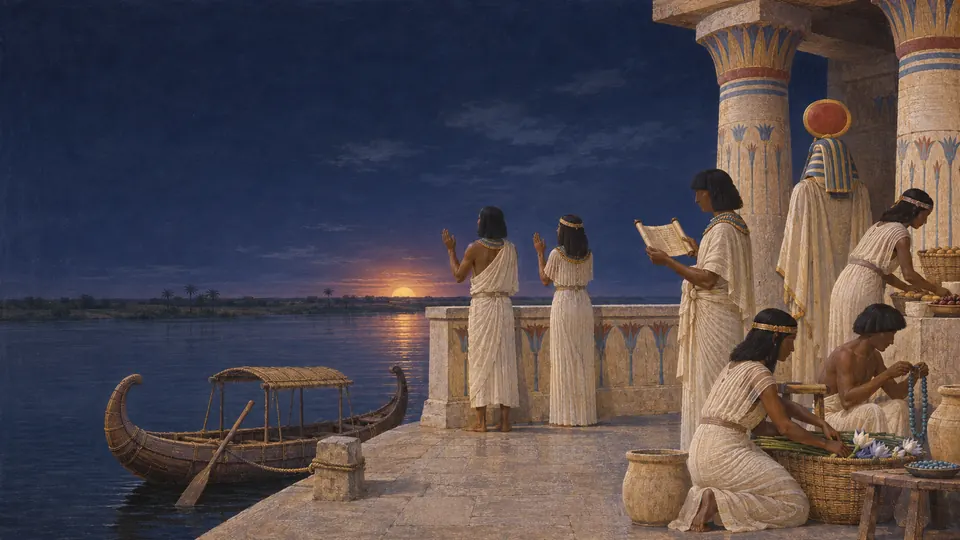
UCL Digital Egypt describes several recurrent images: high ground emerging from water, the benu bird alighting on the first land, and a lotus associated in some traditions with the sun god’s appearance. The Global Egyptian Museum explains that, within the religious cosmology, Nun remains beneath and around the formed world and is associated with earthly waters and inundation rather than vanishing after dry land appears. This is a historical account of religious conceptions, not a measurable claim about geology or a literal subsurface ocean. [1][7]
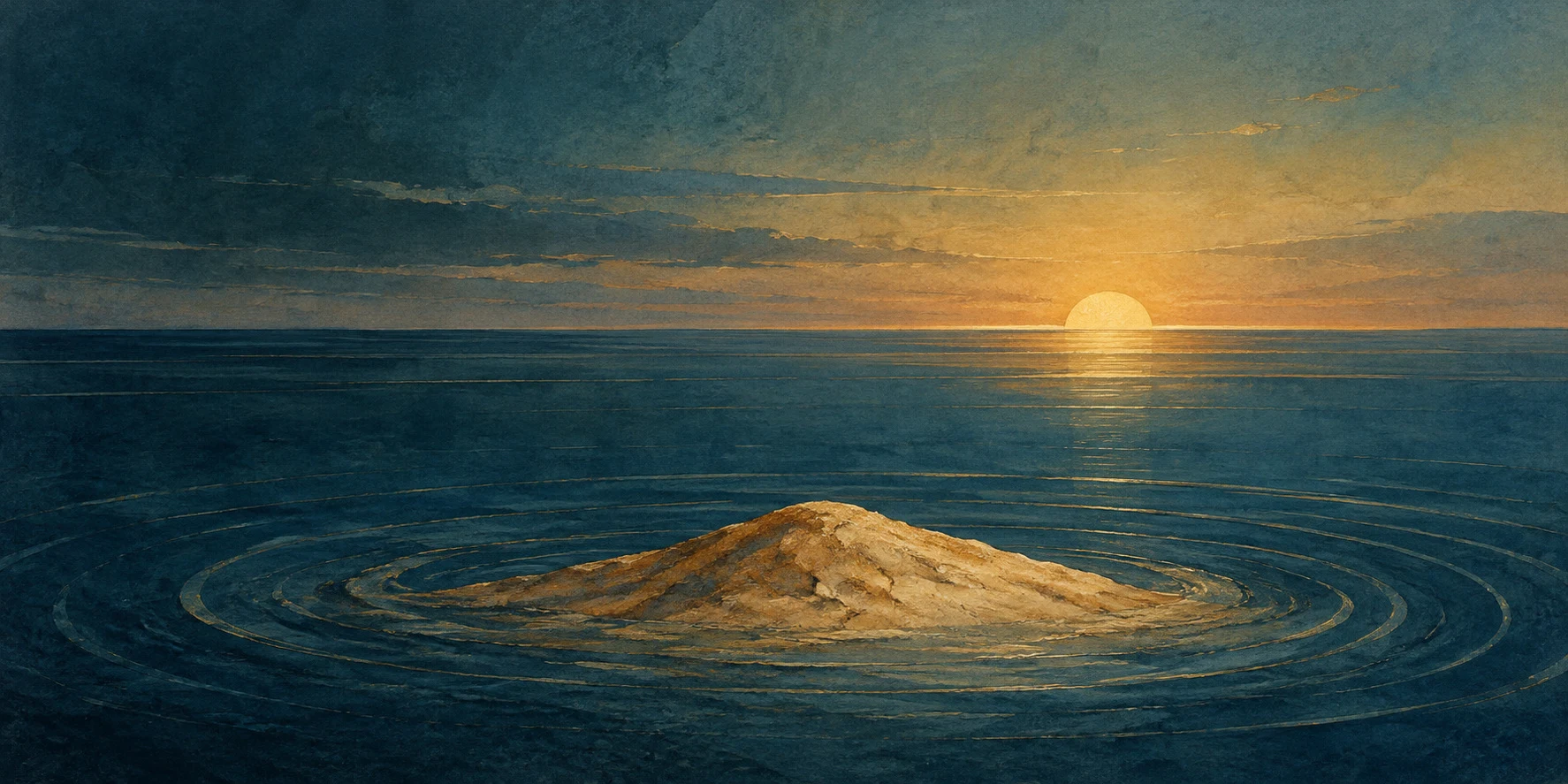
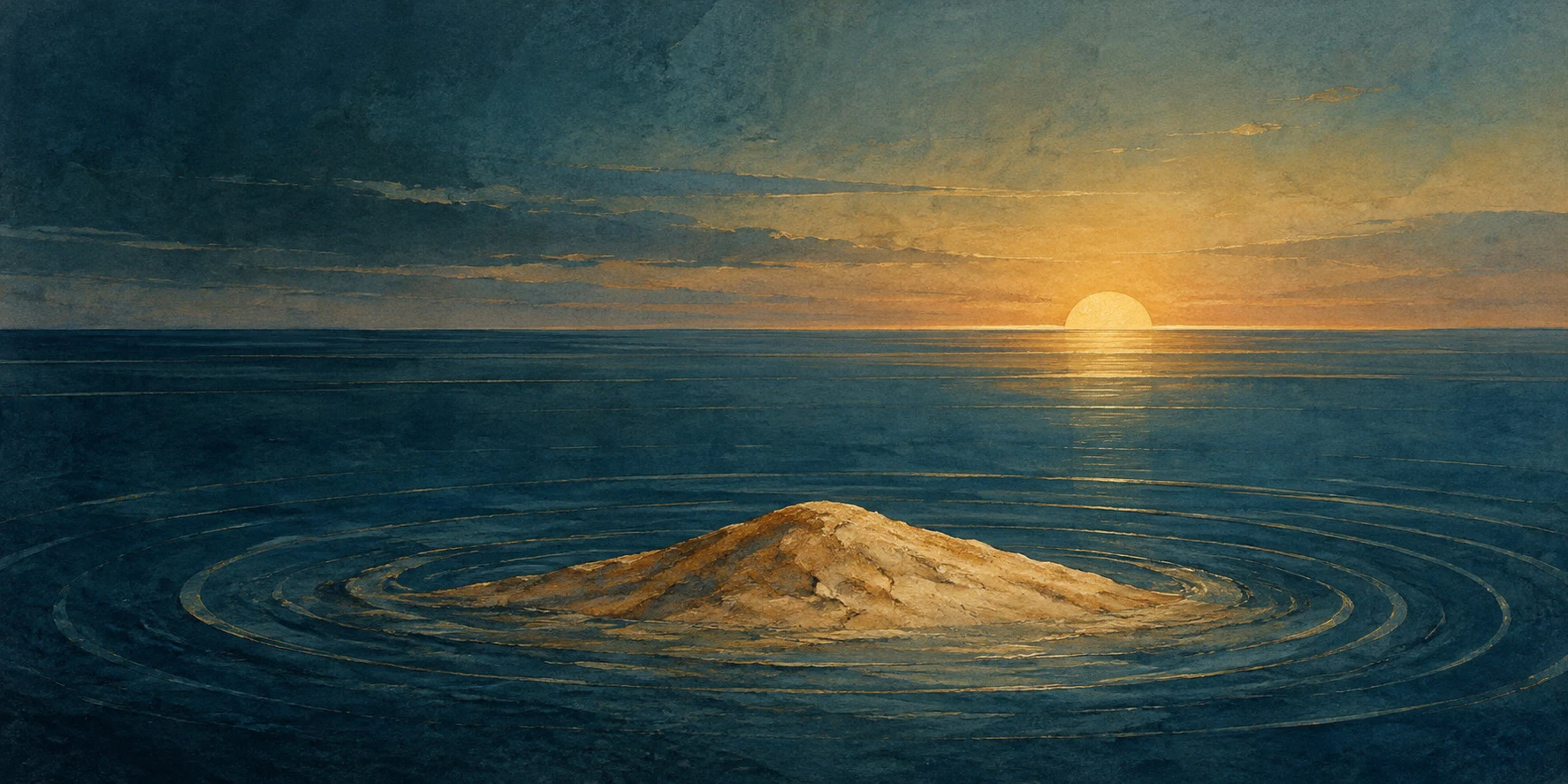
There is also a concrete ancient image. The University of Memphis documents a relief in the passage leading to the Osireion at Abydos, begun under Seti I (approximately 1290–1279 BCE): Nun raises the solar barque of Khepri, the morning sun, in a scene from the Book of Gates. Nun’s role here is to sustain the sun’s appearance and renewal. This identifiable relief is more informative than assigning an unprovenanced modern drawing to an Egyptian object. The cover of this entry is an expressly modern conceptual illustration of waters, mound, and sunrise, not a photograph of that relief or a reconstruction of any particular spell. [6][8]
A brief chronology of the witnesses
- Around the twenty-fourth century BCE: Pyramid Texts were inscribed in late Old Kingdom tombs, including Unas Utterances 258 and 301. An inscription establishes a text’s presence by that date, not its first composition. [3][4]
- Around the early second millennium BCE, in the Middle Kingdom: Coffin Text witnesses include spell 76 on the Eight and spell 335, related to Book of the Dead 17. The date of a coffin copy does not date every earlier idea in its text. [1][2][5]
- From the New Kingdom, beginning around 1550 BCE: Book of the Dead spells circulated in varying papyrus collections; chapter 17 also received vignettes in later periods. [2][8]
- Approximately the thirteenth century BCE: Nun appears with the solar barque in the royal setting at Abydos; dating this depiction does not date the mythical first sunrise to that century. [6]
Comparing other primeval waters
At the beginning of the Babylonian poem Enūma ElišEnuma ElishA seven-tablet Babylonian creation poem in Akkadian, recounting Marduk’s rise, victory over Tiamat, cosmic ordering and human creation, and culminating in praise through fifty names. Its composition date is debated; later manuscripts and recitation traditions preserve it.Glossary · Click to read the explanation, Tablet I, lines 1–9, the waters of ApsûApsûApsû: primordial watery ancestor in Enuma Elish, killed by Ea after plotting against the younger gods. Ea’s sanctuary later bears the same name; distinct in context from the broader cosmic Abzu.Glossary · Click to read the explanation and TiamatTiamatTiamat is a primeval divine mother and watery figure in Enūma eliš who later opposes Marduk; he divides her body in making the cosmos. No Babylonian portrait of her is securely identified.Glossary · Click to read the explanation mingle and give rise to divine generations. Later the narrative develops into a conflict in which MardukMardukBabylon’s leading god, worshipped at Esagil and elevated in the Akkadian Enūma eliš. His symbols include a spade and mušḫuššu dragon. His earliest origins remain obscure; Nibiru is no evidence of a planetary homeland.Glossary · Click to read the explanation kills Tiamat and fashions parts of the cosmos from her body. The Egyptian witnesses discussed here have no necessary counterpart in which Atum must kill Nun to make the world. Water before creation is a meaningful parallel, but neither the divine characters nor the sequence of events are identical. [10][1]
In the Book of GenesisBook of GenesisHebrew book of the Torah containing Noah’s flood, survival offering and covenant with living creatures.Glossary · Click to read the explanation, chapter 1, verse 2, the HebrewHebrewA Northwest Semitic language of the Canaanite group, encompassing Iron Age epigraphy, Biblical, Rabbinic, medieval and Modern Hebrew; its scripts and pronunciations changed over time.Glossary · Click to read the explanation word tehom (תְהוֹם) denotes the deep, alongside darkness and waters. This invites comparison of watery imagery before the ordered world, but neither derives the Hebrew word from Egyptian Nun nor demonstrates textual borrowing by resemblance alone. Etymological relationships between Semitic words and historically demonstrated transmission of a particular narrative are distinct questions, each requiring independent evidence. [9][10]
Taken together, the witnesses portray Nun as a watery realm before differentiation, sometimes personified and called father of the gods, and also associated with life and renewal in funerary and solar contexts. The strongest reading preserves the differences among a Pyramid Text, changing arrangements of the Eight, the glosses of Book of the Dead 17, and temple images, instead of merging them into one hypothetical Egyptian creation account. [1][2][4]
References and notes (10)
- University College London, Digital Egypt, “Gods and Goddesses in Ancient Egypt: Creation”; academic synthesis of Egyptian creation metaphors and changing pairs, not the text of Coffin Text spell 76 itself. Entire webpage; especially “Before creation,” “The creator emerges,” and the identification of the Eight in Coffin Text 76. Return to the text ↑
- University College London, Digital Egypt, “Book of the Dead, Chapter 17”; Egyptian transliteration, English translation, and editor’s notes from Naville’s composite edition, with Allen’s 1974 subdivisions; not the entire chapter read. Introduction and Part a, §§1–3, particularly the Atum/Nun passage and mw pw nwn pw it nTrw in §2. Return to the text ↑
- “Translation of the Pyramid Texts of Unas,” Pyramid Texts Online; modernized English version of Alexandre Piankoff’s translation, not an independent fresh reading of the hieroglyphs. Utterance 258 §310 (antechamber west wall), Utterance 301 §446 (antechamber east wall), with the surrounding relevant lines. Return to the text ↑
- Joanna Popielska-Grzybowska, “Nu, Continuity and Everlastingness in the Pyramid Texts,” in Egypt 2015: Perspectives of Research, Archaeopress Egyptology 18 (2017), pp. 17–30, DOI 10.2307/j.ctv170x4dg.8; selected author-uploaded full-text passages consulted, not the full book. Chapter pp. 17–20 and 23–24, on early spellings, continuity, and Pyramid Text contexts; not the whole book. Return to the text ↑
- Adriaan de Buck, The Egyptian Coffin Texts, vol. II: Texts of Spells 76–163, Oriental Institute Publications 49 (Chicago, 1938). Publisher catalogue and bibliographic identification only: the large facsimile was not opened; identification of the pairs in spell 76 relies on UCL [1]. Publisher catalogue and bibliographic/volume details only; not a reading of the spell 76 facsimile. Return to the text ↑
- University of Memphis, Institute of Egyptian Art and Archaeology, “Relief of the God Nun from Abydos”; institutional identification of a Book of Gates relief near the Osireion associated with Seti I. The website photograph was not reused because its file license was not confirmed. Relief identification and contextual passage on the Osireion and Seti I. Return to the text ↑
- Global Egyptian Museum, “Nun,” concise museum glossary on surrounding/subjacent waters and divine personification; a modern museum synthesis, not one ancient text. Entire glossary entry, especially primordial waters and personification. Return to the text ↑
- Jennifer Houser Wegner (Penn Museum), “Ancient Egyptian Creation Myths: From Watery Chaos to Cosmic Egg,” Glencairn Museum News, 13 July 2021; curatorial synthesis, not full-text publication of primary Egyptian witnesses. Introduction and selected creation-water, solar, and Eight sections; not comprehensive examination of artwork licensing. Return to the text ↑
- Hebrew Genesis 1:2, as displayed with Hebrew textual witnesses by Bible Hub; checked tehom (תְהוֹם) in its immediate verse, not a complete textual or etymological study. Genesis 1:2 only, תְהוֹם and adjacent references to darkness and waters. Return to the text ↑
- Enūma Eliš, English translation attributed to W. G. Lambert reproduced by Joshua J. Mark in World History Encyclopedia (4 May 2018). Consulted the cited Tablet I and IV lines; did not adopt the article introduction’s speculative dating claims. Tablet I, lines 1–9 (Apsû and Tiamat); Tablet IV, lines 99–105 and 129–140 (defeat and division of Tiamat), with adjacent context. Return to the text ↑
Suggest a correction · Suggest a source for this record
Cite this record
IL Archive, «Nun: Egyptian Primeval Waters», https://ilarchive.com/en/entities/nun-egyptian-primeval-waters
Continue reading
Related readings