Study
Resurrection in Daniel: The Jewish Text and Its Ancient Context
An extended study of a topic, with evidence and references.
- Timeline
- From 400 BCE to 900 CE
- Region
- Judaism in the Hellenistic period; Iranian traditions
From sleepers in the dust and dry bones to Iranian texts and Qumran: what can we establish about resurrection hope, and what do parallels or manuscript dates leave unproven?
Share article
Text
The sleepers in the dust
Daniel 12 changes the horizon of death. MichaelMichael / MīkālTheophoric name asking who is like God; borne by humans and a heavenly figure in Daniel. It establishes no former Canaanite deity.Glossary · Click to read the explanation appears as a protector in a time of distress; many sleepers in the earth’s dust then awaken. Their outcomes differ: lasting life on one side, lasting shame and contempt on the other. The wise and those who lead others toward righteousness shine like stars. This is a future for humans associated with deliverance and judgment, rather than a god’s seasonal departure from the underworld. [1]
The passage is brief. It says “many,” without explicitly enumerating all humanity or explaining in detail how new bodies are constituted. The star imagery alone cannot establish that sleepers become bodiless spirits. The text needs to be distinguished from later accounts elaborating the mechanics of resurrectionResurrection of the deadThe dead returning to life, distinguished from soul immortality, with differing scope and form among texts.Glossary · Click to read the explanation. The chapter ends with a personal promise that Daniel will rest and stand in his allotted place at the end of the days: the individual remains visible within a collective destiny. [1]
Narrative time and the book’s formation
Daniel’s stories inhabit the world of Babylonian and Persian kings. A story’s setting, however, need not date every part of its composition. Christine Hayes’s critical account at Yale places the final visions in the crisis under Antiochus IV, around 167–164 BCE, while allowing older court stories. This influential scholarly dating is distinct from an explicit narrator’s record of composition. [3]
That distinction matters for comparison. We cannot automatically place everything in Daniel in the sixth century BCE; nor must we assume all its stories first emerged from nothing in the second. The book combines tales and visions and may preserve older material in later formulations. We therefore begin with the passage under investigation, asking about its date and function rather than assigning one date to every layer. [2][3]
When rescue is insufficient for justice
Daniel 11 describes a desecrated sanctuary, the removal of an offering, and wise teachers falling through sword, fire and captivity. A difficulty emerges within this world: how can divine justice stand when people die for fidelity to the covenant? Rescuing survivors alone does not address those killed. The awakening promised in chapter 12 can therefore be read as an answer within the book’s structure. This interprets the text’s function, without deciding whether the anticipated event will occur. [2][1]
Second Maccabees 7 gives the argument a more explicit bodily form. Brothers refuse to violate their ancestral law and hope that God will restore their lives and the limbs their tormentors remove. Their mother links that hope to the world’s Creator, who can bestow life again. The religious narrative is not an independent verbatim torture transcript, but it attests a textual connection between fidelity, creation and restored life. Its denial of resurrection to life for the persecutor does not, by itself, exclude his rising to any possible destiny. [18]
Ezekiel’s bones and the text’s own explanation
In Ezekiel 37, dry bones move together, acquire flesh and skin, and receive breath. Readers familiar with later resurrection doctrines may immediately identify the scene with them. Verse 11, however, interprets the bones as the house of Israel, whose hope has been lost. Opening graves is linked to bringing the people back to their land. The explicit interpretation here concerns a community’s restoration. [4]
That does not make the imagery insignificant for resurrection’s history. Language in which God restores the dead to life can supply readers with ways of imagining individuals restored as well. Yet possible reuse neither removes the vision’s own interpretation nor independently proves a transmission route to Daniel. Two levels should remain distinct: the bones’ function in this passage, and subsequent readings that redeploy them elsewhere. [4]
Isaiah: strong imagery and uncertain dating
Isaiah 26:19 preserves another striking image: the dead live and dwellers in dust awaken. Nearby are dead rulers who do not rise, an enlarged nation, and pains resembling childbirth. Extracting one line and assuming all later resurrection details are already present would flatten this setting. The relationship between a community’s death and restoration and the language of awakened dead requires interpretation. [5]
Placement in Isaiah does not automatically establish an eighth-century BCE date; revival imagery alone cannot establish a late one either. Christopher Hays cautions against that dating criterion and argues for an earlier reading tied to national deliverance. We have consulted his published chapter summary, not the whole book, and note his position to show that reconstruction is disputed. [6]
We therefore lack a settled sequence beginning with an unquestionably dated verse and ending with Daniel in one step. These texts share language of life, death and dust. Their contexts and functions need comparison before they become fixed stages of a single doctrine.
An Iranian text promises a deathless world
Yašt 19:89–96 in the AvestaAvestaAvestan-language religious corpus with layers and oral transmission, not a book composed in one year.Glossary · Click to read the explanation places the benefactor Saoshyant and his helpers within the world’s renewal. The dead rise, life and immortality arrive, creation becomes free from decay, and evil powers lose their dominion. The parallel with hope beyond death is substantive, rather than a shared generic word such as life: dead people rise and the world’s condition changes. [7]
This makes Iranian comparison serious. The horizon exceeds the rescue of one underworld hero or a deity’s return to an annual festival. Yet the passage is not a linguistic duplicate of Daniel: names, agents, the victory’s structure and renewal’s scope differ. A specific parallel raises the question of contact without independently establishing its direction or date. We use a historical translation of the passage and modern scholarship to delimit textual layers, rather than importing every later Iranian detail into these verses. [7][9]
Three times within the Iranian evidence
Three times need separation: a tradition’s oral composition, a collection’s writing or editing, and the surviving physical copy. Almut Hintze explains that the Yašts belong to an oral compositional culture, whereas their surviving manuscripts are late. A late copy neither dates its contents’ invention nor automatically gives every line an early date. [10]
Shaul Shaked distinguishes disputed resurrection readings in the Gathas, statements in the Younger Avesta, and fuller Pahlavi accounts. Projecting the complete later system into the earliest layer requires evidence. [9]
The Bundahišn has two recognized recensions and a layered editorial history. MacKenzie connects an important final redaction with ninth-century CE priestly circles, alongside older material and an unknown first compilation. We therefore identify recension and chapter, distinguishing a tradition’s proposed antiquity from the formulation actually read. [12]
A Greek report about Magian teachings
There is evidence that should not disappear simply because Pahlavi books are late. In his prologue §9, Diogenes Laertius reports that Theopompus attributed to the Magi the teaching that humans would live again and become immortal. Theopompus was a fourth-century BCE historian; Diogenes’s surviving report was written centuries later, around the third century CE. [8]
We do not possess Theopompus’s complete book or a fourth-century Persian document explaining resurrection verbatim. Nevertheless, the transmitted testimony also complicates dismissing all Iranian resurrection hope as a late invention. Its strength and limitation belong together: a later Greek account attributes a teaching to an earlier source.
The paragraph names neither Daniel’s author nor a Jewish intermediary receiving the teaching. It helps investigate the idea’s antiquity in the Iranian sphere, without independently supplying a route into Judaism. [8]
The Bundahišn: restored bodies and a purified world
Chapter 30 of the Indian Bundahišn gives a fuller account. The Creator is asked how a body dispersed by water and wind can be restored. The reply invokes creation itself: the maker of the world can remake what existed. Humanity rises; people recognize relatives; deeds become visible in the judgment assembly. Everyone passes through molten metal, experienced differently by righteous and wicked, before the world is renewed and lasting immortality bestowed. [11]
This is an explicit example of frashokeretiFrashokereti: final renovationCreation’s completion or renovation in Iranian tradition, linked to incorruptible life and evil’s retreat.Glossary · Click to read the explanation, final renovation, in this Iranian formulation. It does not duplicate Daniel’s ending: Daniel juxtaposes two lasting destinies, whereas this chapter moves toward purification, world renewal and immortality. Comparison does not require every Zoroastrian source to share these details or define exceptions identically.
Creation’s power also grounds the argument in Second Maccabees. Agreement between the arguments does not establish borrowing by itself. Dates of formulation, contact and direction of use still require evidence. [11][18]
What would demonstrate influence?
Comparing Daniel with Iranian traditions is stronger than matching a word or picture. Further tests nevertheless remain. Does the proposed source predate the receiving text in the relevant form? Can communities and settings of contact be identified? Does a distinctive sequence recur, beyond the shared human problem of death? Are there traces of a linguistic, textual or ritualRitualAn organised or distinguished practice meaningful to a community; it may leave traces, but its form alone does not reveal an associated doctrine.Glossary · Click to read the explanation intermediary?
Persian rule in Jewish history makes general contact possible. It does not establish that every later idea came through that rule or that an author read a particular Iranian book. Similarity alone cannot decide between independent developmentIndependent developmentSimilar elements arising without historical transmission between them.Glossary · Click to read the explanation, reconstruction within Jewish tradition, and selective engagement with a wider world. These possibilities may overlap; history need not choose between total isolation and complete copying.
In this study we use “possible influence” when the chain remains incomplete. That describes the evidence’s strength without discounting comparison or pre-emptively defending religious originality.
Scholarly differences and the limits of our reading
Jon Levenson argues for resurrection hope’s continuity with older Israelite resources and challenges an explanation confined to foreign import. We present the book’s thesis as described by its publisher; we have not read it in full and do not attribute to him a denial of every possible influence. [13]
Vicente Dobroruka, whose book compares Iranian and Jewish traditions, explains in his introduction that apparently obvious influence became questions and that much of his investigation concerns parallels. We have read the available introductory passages, not all chapters. [14]
These limits belong within research reporting. A publisher’s abstract is not a complete argument; references to dozens of texts are not their independent examination. Internal Jewish resources do not exclude outside contact, just as Iranian parallels do not remove a Jewish community’s ability to reshape hope within its own crisis.
What do Qumran and the 2025 results add?
In 2025, Mladen Popović and colleagues published manuscript dating research combining radiocarbon and writing-shape analysis. One witness is Daniel manuscript 4Q114, for which they accept a calibrated range around 230–160 BCE. It revises some earlier handwriting estimates and overlaps a literary-historical dating in the 160s BCE. It is not a single year supplied by an instrument. [15]
Appendix S4 reveals a crucial qualification: the accepted range is not the entire raw distribution. An older peak, around 355–285 BCE, is rejected through handwriting comparison with dated AramaicAramaicA group of Northwest Semitic language varieties with a long history across the Near East.Glossary · Click to read the explanation documents. Selecting 230, or computing the interval’s mean, cannot settle composition’s date. Nor should the selected interval alone be called a raw measurement containing the full probability. [16]
The dating also concerns the material carrying the text, without directly dating every idea. This witness does not supply Daniel 12’s resurrection verses; those verses themselves cannot be said to have undergone this measurement. The suggestion that the copy arose near the author’s milieu still requires further validation. The findings illuminate copying and circulation, alongside continuing textual criticismTextual criticismComparing witnesses to explain variation and infer earlier readings or editions, distinguishing preserved from reconstructed text.Glossary · Click to read the explanation and literary history. [15][16]
A hope with a history, conclusions with limits
We can establish that Daniel 12 depicts dead people awakening to destinies beyond present life, and that other Jewish texts use restoration imagery or connect creation with renewed life. Iranian tradition also preserves resurrection and final renovation, with differences between its textual layers. A single demonstrated route from one particular source to one particular author remains unproven here.
Research can compare, propose contact, test internal resources and revise dates when evidence changes. It need not rule on a religious belief’s truth or falsehood. A productive historical question is how restoring the dead became a way to imagine justice beyond kings’ power or the death of the faithful.
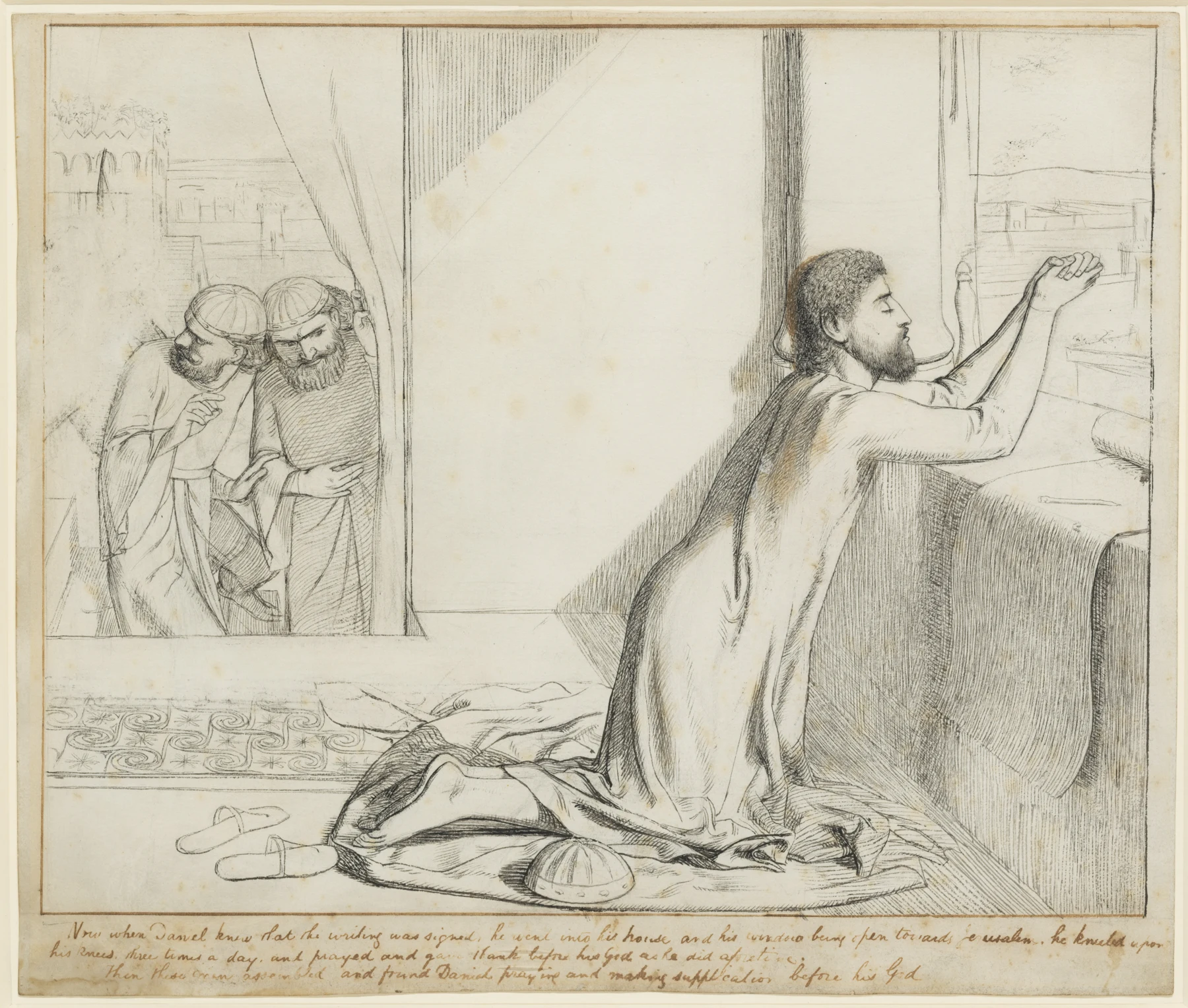
The cover is William Holman Hunt’s 1849 drawing inspired by Daniel’s prayer in chapter 6. Its caption identifies it as later artistic reception, rather than an ancient portrait or the awakening scene of chapter 12. [17]
Continue with Daniel’s tales and court wisdom, Zoroastrianism and Judaism, underworld returns and resurrection, and similarity and the transmission of ideas.
References and notes
- The entire chapter was read; its brief wording does not explain the mechanics of awakening. Daniel 12:1–13; public-domain KJV Return to the text ↑
- Verses 29–45 were read; the king’s historical identification is a critical interpretation, not an explicit name in this passage. Daniel 11:29–45; public-domain KJV Return to the text ↑
- The Daniel discussion in the lecture transcript was read, not the entire lecture or course. Christine Hayes, Open Yale Courses RLST145, lecture23; Daniel discussion, transcript paragraphs on chapters1–6 and7–12 Return to the text ↑
- Verses 1–14 were read; the passage interprets the bones as Israel’s house and return to the land. Ezekiel 37:1–14; public-domain KJV Return to the text ↑
- Verses 14–19 were read; the book’s name alone does not date this textual layer. Isaiah 26:14–19; public-domain KJV Return to the text ↑
- The publisher’s chapter summary and metadata were read, not the full chapter; the author’s position is presented within those limits. Christopher B. Hays, The Origins of Isaiah24–27 (2019), chapter3, pp.68–94; DOI10.1017/9781108582360.004 Return to the text ↑
- Sections 89–96 and nearby context were read in a historical translation; this alone does not date individual verses. Yašt19.89–96; James Darmesteter, The Zend-Avesta PartII, SBE23, historical translation, pp.306–308 Return to the text ↑
- Sections 6–9 were read; Theopompus’s report survives in a later author, not an original fourth-century BCE copy. Diogenes Laertius, Lives1, prologue §§6–9; R.D.Hicks (1925), LacusCurtius, University of Chicago Return to the text ↑
- The discussions of the Gathas, Younger Avesta and Pahlavi material were read, not every work cited in the entry. Shaul Shaked, Eschatology i (1998; updated2014), Encyclopaedia Iranica; Gathas/YoungerAvesta/Pahlavi sections Return to the text ↑
- The transmission and origins passages were read; they distinguish earlier oral composition from late surviving manuscripts. Almut Hintze, Yašts (2014; updated2017), Encyclopaedia Iranica; Transmission and Origins Return to the text ↑
- Chapter 30 of the Indian recension was read in full, not every Bundahišn recension; West’s historical translation appeared in 1880. Indian Bundahišn chapter30, §§1–33; E.W.West, Pahlavi TextsI, SBE5 (1880), pp.120–130 Return to the text ↑
- The manuscript, edition and compilation passages were read; final redaction does not date every component of the work. D.N.MacKenzie, Bundahišn (1989; updated2016), Encyclopaedia Iranica; manuscripts, editions, authorship and compilation Return to the text ↑
- The publisher’s description and metadata were read, not the entire book; the reported claim is its declared thesis. Jon D. Levenson, Resurrection and the Restoration of Israel (2006; paperback2008); Yale publisher description Return to the text ↑
- Selected author’s introductory passages, pages 1–2 and 4, were read in the publisher’s preview; not all chapters were read. Vicente Dobroruka, Persian Influence on Daniel and Jewish Apocalyptic Literature (2022; edition2023); introduction §1 p.1 and §3 p.4 Return to the text ↑
- The Daniel results, abstract and relevant methodological passages were read; the study dates a manuscript, not directly every idea it contains. Mladen Popović et al., Dating ancient manuscripts using radiocarbon and AI-based writing style analysis, PLOSOne20(6), e0323185 (4June2025), §2.1 and discussion Return to the text ↑
- Pages 1–4 and the 4Q114 paragraph on page 7 were read; the accepted range uses handwriting comparison and is not the entire raw distribution. Popović et al. (2025), S4 Appendix, Palaeography and radiocarbon dating; §§4.1–4.1.2, PDFpp.1–4 and7 Return to the text ↑
- Object identity, rights and original image were checked; this is later reception of Daniel 6, not an ancient artifact. Metropolitan Museum, William Holman Hunt, Daniel Praying (1849), accession2023.675 Return to the text ↑
- Verses 1–14 and 20–29 were read in the Greek and Latin display; the ancient text is paraphrased without reproducing the modern English translation. 2 Maccabees7:1–14 and20–29; displayed Greek and Latin primary texts, NewAdvent Return to the text ↑
Suggest a correction · Suggest a source for this record
Cite this record
IL Archive, «Resurrection in Daniel: The Jewish Text and Its Ancient Context», Edition 1, https://ilarchive.com/en/studies/daniel-resurrection-historical-context
Continue reading