Period
The Neo-Babylonian empire (c. 626–539 BCE)
- Timeline
- From 626 BCE to 539 BCE
- Region
- Mesopotamia
For under ninety years Babylon ruled the Near East again, after Assyria fell. Its kings rebuilt the city, took Jerusalem and lost the empire to Cyrus. Much of what we know comes from building inscriptions, short chronicles and the Bible.
Estimated reading time: 8 min Published Last reviewed:
Share article
Text
Introduction
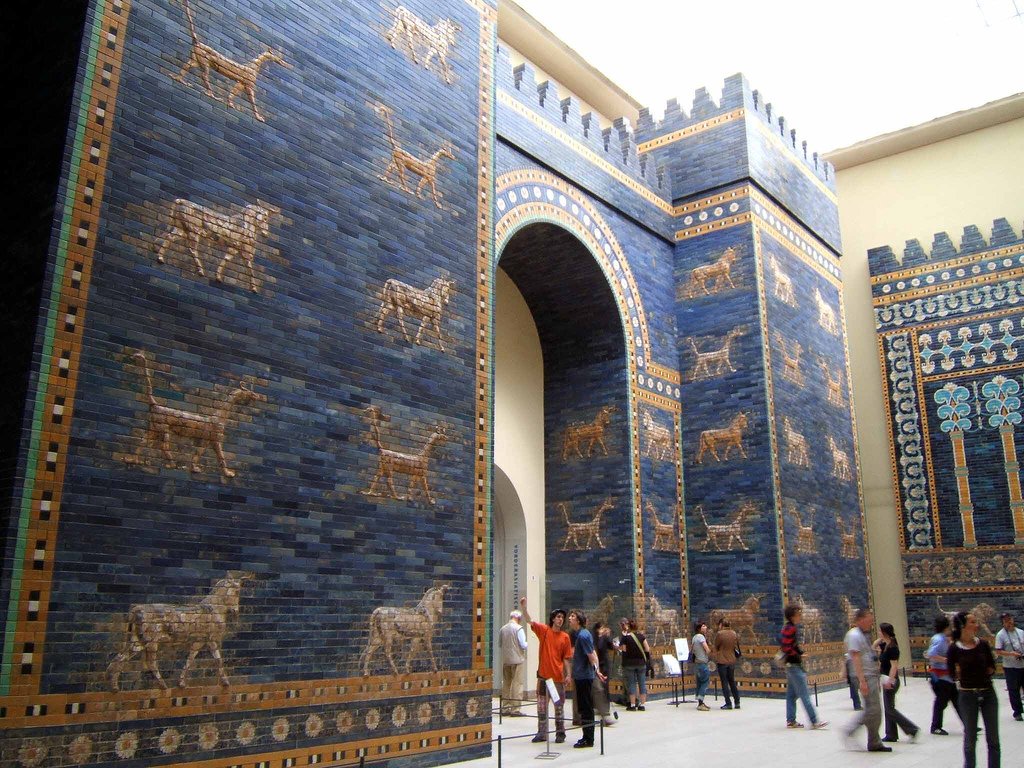
After the Assyrian empire collapsed, the southern land of Babylonia became the centre of a new power, the last in MesopotamiaMesopotamiaHistorical region associated with the Tigris and Euphrates: Uruk, Ur, Eridu, cuneiform, Sumer, Akkad, Babylon and Assyria, their languages and cults, and the limits of archaeological evidence.Glossary · Click to read the explanation ruled by native kings. Historians call it the Neo-Babylonian or Chaldean empire. It lasted only about 87 years, yet it left the IshtarInanna / IshtarA prominent Mesopotamian goddess whose Sumerian name Inanna became associated with Akkadian Ishtar across diverse traditions. She was associated with desire, war, royal authority and Venus, while local forms and genealogies varied among texts.Glossary · Click to read the explanation Gate, the exile of the people of Judah and the memory of a great city. This entry sets out the six kings, what happened to JerusalemJerusalemJerusalem is a city of religious importance in Judaism, Christianity and IslamGlossary · Click to read the explanation, how the empire fell and which sources we have for each point, since they are uneven. [1][2]
Dates and kings
The empire is dated from 626 BCE, when Nabopolassar was crowned king of BabylonBabylonBabylon is an ancient city in central present-day Iraq, south of BaghdadGlossary · Click to read the explanation, to 539 BCE, when Cyrus took the city. These are conventions: Babylon was in fact independent from the 620s, and the conquest took some weeks. [1] Six kings reigned:
- NabopolassarNabopolassarNabopolassar was a late-seventh-century BCE Babylonian king who claimed to rebuild Etemenanki.Glossary · Click to read the explanation (626–605 BCE), founder of the dynasty.
- Nebuchadnezzar IINebuchadnezzar IIBabylonian king, 605–562 BCE, appearing in Daniel and independently attested in inscriptions and building remains.Glossary · Click to read the explanation (605–562 BCE), the longest reign, 43 years.
- Amel-Marduk (562–560 BCE), his son.
- Neriglissar (560–556 BCE).
- Labashi-Marduk (556 BCE), deposed after a few months. Sources give two, three or nine months.
- Nabonidus (556–539 BCE), the last native king of Babylon. [1][3]
From revolt to empire
Nabopolassar took Babylon and Nippur in 626 BCE and was crowned in November that year. By about 620 BCE he held all of Babylonia. In 614 BCE he allied with the Medes, and together they sacked Ashur. NinevehNineveh and KuyunjikNineveh is an ancient Assyrian city near Mosul in northern Iraq; Kuyunjik is one of its archaeological moundsGlossary · Click to read the explanation fell in August 612 BCE, and the last Assyrian force was beaten at HarranHarranHistoric city in southeastern Türkiye, south of Şanlıurfa; Genesis places Abraham’s family there on its journey towards Canaan.Glossary · Click to read the explanation in 609 BCE. [1][2] The Assyrian side of this story is in the entry on the Neo-Assyrian empire on this site. After the fall the old empire was divided: the Medes took the northern Zagros mountains, and Babylon took the lands along the Euphrates and the LevantThe LevantThe Levant is a regional name for lands along the eastern MediterraneanGlossary · Click to read the explanation. [1]
Egypt tried to hold on to Syria. In 605 BCE the crown prince Nebuchadnezzar defeated the Egyptian army at Carchemish. The Babylonian Chronicle reports that the pursuit continued into the district of Hamath, where it claims that none of the fugitives escaped. When his father died, Nebuchadnezzar returned to Babylon to take the throne. The chronicle also records a failed invasion of Egypt four years later. [10][11]
Nebuchadnezzar II and the Levant
Nebuchadnezzar spent many years keeping the former Assyrian vassals in line. He destroyed Ashkelon in 604 BCE. [1] Two events matter for the history of the Bible.
597 BCE. The Babylonian Chronicle (British Museum, BM 21946) dates the capture of Jerusalem to the second day of Addaru in Nebuchadnezzar’s seventh year, in March 597 BCE. It records the capture of the king and the appointment of a successor. [10][12] The Bible names the captive king Jehoiachin (Jeconiah) and the new king Zedekiah. 2 Kings 24:14 gives a total of 10,000 exiles. Verse 16 lists 7,000 warriors and 1,000 artisans and smiths. Jeremiah 52:28 gives 3,023 deportees for Nebuchadnezzar’s seventh year. [12][13]
587 or 586 BCE. After Zedekiah revolted, the Babylonian army besieged Jerusalem again. The date of the city’s fall, in 587 or 586 BCE, is debated. 2 Kings 25:8–12 describes the burning and demolition, and 25:22–26 recounts Gedaliah’s appointment as governor and his killing. The surviving Babylonian chronicle covers the earlier siege in 597 BCE. [6][12][20] In the City of David, archaeologists found the collapsed floor of a monumental building destroyed by fire. The magnetic study of the floor uses August 586 BCE as its historical date. [14] The Lachish letters (see record 1204 on this site) belong to the last months before the fall.
The exile in Babylonia is treated on the page Babylonian exileBabylonian exileJudean deportations to Babylonia and the kingdom’s collapse in the early sixth century BCE; several phases, not everyone removed or returned at once.Glossary · Click to read the explanation. One kind of document gives a glimpse of exiles in Babylon itself: tablets found by Robert Koldewey near the Ishtar Gate, dated about 595–570 BCE, record rations of oil for captives and craftsmen from many lands. One of them names "Ya'u-kīnu, king of the land of Yahudu" and his five sons. The tablets are now in the Pergamon Museum in Berlin (VAT 16378). [7]
Nebuchadnezzar's other campaigns are less certain. Josephus says TyreTyreTyre is a city on the coast of present-day southern Lebanon and an important ancient Phoenician centerGlossary · Click to read the explanation was besieged for 13 years, ending around 573 BCE, but the length is disputed. [1][4] A campaign against Egypt in 568–567 BCE is possible but poorly attested; the fragmentary text BM 33041 may refer to it. [1][4]
Rebuilding Babylon
Most of the written sources for Nebuchadnezzar are building inscriptions, and for a long time he was seen mainly as a builder. The Chronicle later changed that picture, but the buildings remain his best-known mark. He concentrated his building work on BabylonBabylonBabylon is an ancient city in central present-day Iraq, south of BaghdadGlossary · Click to read the explanation, where he restored the temple EsagilEsagil, Marduk’s templeEsagil, also written Esagila, is Marduk’s temple in ancient Babylon, in present-day Iraq, and a central sanctuary of the city’s god.Glossary · Click to read the explanation, completed the zigguratZigguratZiggurat: a monumental stepped or terraced cult structure of ancient Mesopotamia. Not every raised temple platform was a ziggurat, and the form and specific use of lost upper stages often remain uncertain.Glossary · Click to read the explanation EtemenankiEtemenankiStepped ziggurat in Babylon’s Esagil sacred precinct, associated with Marduk. Excavations establish its base, royal texts attest rebuilding, and a later Esagil Tablet supplies idealized dimensions.Glossary · Click to read the explanation and built palaces and defensive walls. [1][4] Bulls and dragons decorated the glazed bricks of the Ishtar GateIshtar Gate at BabylonA gate in Nebuchadnezzar II’s sixth-century BCE Babylonian building program, decorated with glazed-brick animals associated with Mesopotamian deities.Glossary · Click to read the explanation. North of the gate, reliefs of striding lions lined the Processional Way. [15]
Ancient Greek authors counted the Hanging Gardens among the wonders of the world. Their location remains disputed. Traces of the gardens have yet to be identified in Babylon, and Nineveh has been proposed as another location, since royal gardens are documented there. [16]
Marduk, Babylon and its temples
The national god was MardukMardukBabylon’s leading god, worshipped at Esagil and elevated in the Akkadian Enūma eliš. His symbols include a spade and mušḫuššu dragon. His earliest origins remain obscure; Nibiru is no evidence of a planetary homeland.Glossary · Click to read the explanation, whose statue stood in Esagil and was carried out in the New Year festival. [1] Kings also revived old Sumerian and AkkadianAkkadianAn ancient East Semitic language written in cuneiform from the third millennium BCE; its varieties include Babylonian and Assyrian, and it served in international diplomacy.Glossary · Click to read the explanation traditions: Nebuchadnezzar II recovered the foundation deposit of the Akkadian king Naram-Sin at Sippar. The language of administration stayed Akkadian even though most people spoke Aramaic. [1] Temples were large economic institutions with dependents, who worked the land and, in a crisis, could be called up as archers. [1]
Economy and rule
Under Assyria, wealth had flowed out of Babylonia; now tribute flowed in. The number of settlements in the region rose from 134 to 182, and towns grew. [1] The king was the largest landowner. He took the titles "king of Babylon" and "king of Sumer and Akkad", and the Assyrian boasts of universal rule were largely dropped. [1] Local assemblies, called puhru, acted as courts, and most penalties were fines in silver. [1] The Levant was ruled through governors and vassal kings. [1]
Nabonidus and the end
Nabonidus came from Harran, and his mother Adad-guppi was a devotee of the moon god Sîn. He rebuilt Sîn's temple at Harran, destroyed by the Medes in 610 BCE. [3] He appears to have promoted Sîn, and whether he meant to replace Marduk is debated. [3] In 553 BCE he left for Arabia and settled at Tayma for about ten years, while his son Belshazzar acted as regent in Babylon. Why he went is unknown; explanations include conquest, trade and religion, and none has wide support. [1][3] The Nabonidus Chronicle, written after the conquest, criticises his long absence and says the New Year festival was suspended. The Verse Account is also hostile. Both were written under Persian rule, so read them as the winners' view. [3]
An inscription of Nabonidus says that he sought the original foundations of the Ebabbar temple at Sippar and uncovered foundations laid by Naram-Sin. It says that none of his predecessors had found them in 3,200 years, a span far longer than the interval between the two kings in modern chronologies. [17]
The Nabonidus Chronicle places the defeat of Astyages and Cyrus’s occupation of the Median capital Ecbatana in Nabonidus’s sixth year, which Muhammad Dandamayev dates to 550 BCE. For 539 BCE the chronicle reports that the Persians defeated the Babylonian army at Opis, took Sippar and entered Babylon without a battle in the city. Nabonidus was taken prisoner. [18] Sources disagree on his fate: Berossus says he was spared and lived in Carmania, while Xenophon says someone killed him, perhaps meaning Belshazzar. [3] The Cyrus Cylinder (British Museum, BM 90920, record 1154 on this site) presents Cyrus as Marduk's chosen king and says he restored sanctuaries and sent displaced people home. It does not mention Jews or Jerusalem, so the usual link to the book of Ezra is an inference. [8]
After 539 BCE
Babylon never regained its independence. Under the early Persian kings it was a rich province that paid a large share of the empire's tribute, and it rebelled several times, in 522, 521–520, 484 and 482–481 BCE. [1] Babylonian scholarship lasted for centuries. Securely dated cuneiformCuneiformWriting with wedge-shaped signs, developed from Mesopotamian recording traditions and used for several languages from the third millennium BCE.Glossary · Click to read the explanation astronomical almanacs from Babylon extend to 74/75 CE. [19]
Reading the evidence with care
The Babylonian chronicles date some campaigns and accessions, while royal inscriptions describe projects that kings chose to commemorate. Excavation adds evidence for individual buildings and destruction layers. [10][12][14][18] For some years, especially about 594–557 BCE, very few cuneiform sources survive, and historians rely on the Bible and later Greek authors. [4] The Bible, the Babylonian chronicles and the royal inscriptions have different aims, and where they differ we say so. We do not judge beliefs here; the evidence we read supports only what happened and what the sources say.
Why it matters
This short empire links the world of Assyria to that of Persia. It destroyed the kingdom of JudahKingdom of JudahJudah was an ancient southern Levantine kingdom centered on Jerusalem in the Iron AgeGlossary · Click to read the explanation and shaped the HebrewHebrewA Northwest Semitic language of the Canaanite group, encompassing Iron Age epigraphy, Biblical, Rabbinic, medieval and Modern Hebrew; its scripts and pronunciations changed over time.Glossary · Click to read the explanation Bible, it rebuilt the Babylon that later authors remembered, and its astronomers and scribes kept the cuneiform tradition alive for centuries after.
References and notes
- Wikipedia, 'Neo-Babylonian Empire' (secondary summary) First 100,000 of 205,280 characters: dates, kings, Nabopolassar's rise, Nebuchadnezzar II's campaigns and building works, economy, administration, Nabonidus and Tayma, fall to Cyrus, after 539 BCE; the last part was not read Return to the text ↑
- Wikipedia, 'Fall of Nineveh' (secondary summary) and the Neo-Assyrian entry on this site Background on 612-609 BCE only; the fall of Nineveh and Harran as summarised in the Neo-Babylonian article Return to the text ↑
- Wikipedia, 'Nabonidus' (secondary summary) First 100,000 of 163,433 characters: reign, Sin and Harran, Tayma, Belshazzar, Nabonidus Chronicle, Verse Account, Cylinder, fall of Babylon, fate; the last part was not read Return to the text ↑
- Wikipedia, 'Nebuchadnezzar II' (secondary summary) First 100,000 of 201,119 characters: reign, Carchemish, Egypt 601, Jerusalem, Tyre, building works, Hanging Gardens debate, sources; the biblical section was not read Return to the text ↑
- Wikipedia, 'Siege of Jerusalem (597 BC)' (secondary summary) Whole article as returned: Babylonian Chronicle BM 21946, 2 Adar (16 March 597 BCE), Kings and Jeremiah numbers, dating debates Return to the text ↑
- Wikipedia, 'Siege of Jerusalem (587 BC)' (secondary summary) Whole article as returned: dates 587/586 BCE, siege length, Gedaliah, archaeology of destruction, absence of a Babylonian source, province of Yehud Return to the text ↑
- Wikipedia, 'Jehoiachin's Rations Tablets' (secondary summary) Whole article as returned: tablets from Babylon, c. 595-570 BCE, Ya'u-kinu king of Yahudu, VAT 16378 Return to the text ↑
- Wikipedia, 'Cyrus Cylinder' (secondary summary) First 100,000 of 233,195 characters: content, discovery 1879, BM 90920, debates on Ezra and human rights; the last part was not read Return to the text ↑
- Wikipedia, 'Babylonian Chronicles' (secondary summary) and Wikimedia Commons file page 'Ishtar Gate at Berlin Museum.jpg' (Rictor Norton, CC BY 2.0) Chronicles page: what they are, ABC 5 (BM 21946, Wiseman 1956), ABC 7 (BM 25124). Commons file page: description, author, date 17 May 2006, licence CC BY 2.0, 1024 x 768 Return to the text ↑
- Cuneiform Digital Library Initiative, “Wiseman, Chronicles BM 021946,” P555785. Museum number BM 21946 and bibliography for Wiseman’s 1956 edition and Grayson’s Chronicle 5. Return to the text ↑
- D. J. Wiseman, “Some Egyptians in Babylonia,” Iraq 28, no. 2 (1966), pp. 154–158. Open extract, the campaign at Carchemish and pursuit to Hamath, and the Egyptian campaign four years later. See BM 21946 obv. 1–11 and rev. 5–7. Return to the text ↑
- Center for Online Judaic Studies, “The Babylonian Chronicle (Chronicle 5): Nebuchadnezzar Besieges Jerusalem, 597 BCE.” BM 21946, rev. 11–13, quoted English translation of the capture on 2 Addaru. The resource also reproduces 2 Kings 24:10–17 and explains the gap in the Babylonian chronicle. Return to the text ↑
- NET Bible, “Jeremiah,” chapter 52. Verse 28, the deportation count for Nebuchadnezzar’s seventh year. Return to the text ↑
- Yoav Vaknin, Ron Shaar, Yuval Gadot, Yiftah Shalev, Oded Lipschits and Erez Ben-Yosef, “The Earth’s magnetic field in Jerusalem during the Babylonian destruction: A unique reference for field behavior and an anchor for archaeomagnetic dating,” PLOS ONE 15, no. 8 (2020), e0237029. Abstract and the section on the archaeological context of Structure 100, its collapse and the historical date used in the analysis. Return to the text ↑
- The Metropolitan Museum of Art, “Panel with striding lion,” 31.13.1. Object description, the placement of the animals on the Ishtar Gate and the Processional Way. Return to the text ↑
- Archéologie, French Ministry of Culture, “Hanging gardens.” Glossary entry, Greek accounts, the record at Babylon and the proposed location at Nineveh. Return to the text ↑
- Titus Kennedy, “Temple Dedication and Construction Texts of the Ancient Near East with Elapsed Years: Implications for Long Duration Chronologies,” Religions 15, no. 4 (2024), 408. Section II.3(A), the Sippar Cylinder BM 91109, the wording of the claim about Naram-Sin’s foundation, and its place in modern chronologies. Return to the text ↑
- Muhammad A. Dandamayev, “Babylonian Chronicles,” Encyclopædia Iranica. Nabonidus Chronicle, citing Grayson col. II, ll. 1–4 and col. III, ll. 5–15, for the capture of Ecbatana and the conquest of Babylonia. Return to the text ↑
- Alexander Jones, “The Study of Astronomical Papyri from Neugebauer to Today,” in Scientific Traditions in the Ancient Mediterranean and Near East (Institute for the Study of the Ancient World and New York University Press, 2023). Section 6, note 78, the securely dated late Babylonian astronomical texts. Return to the text ↑
- New American Bible, Revised Edition, “2 Kings,” chapter 25, United States Conference of Catholic Bishops. Verses 8–12 on burning and demolition, and verses 22–26 on Gedaliah. Return to the text ↑
Suggest a correction · Suggest a source for this record
Cite this record
IL Archive, «The Neo-Babylonian empire (c. 626–539 BCE)», https://ilarchive.com/en/periods/neo-babylonian-empire