Study
The Tower of Babel: the city, the tower, and the languages
An extended study of a topic, with evidence and references.
- Timeline
- From 2000 BCE to 650 CE
- Region
- Mesopotamia / Babylon
Genesis 11, Etemenanki and Enmerkar: what the text says, what Babylon’s archaeology attests, and where claims of transmission stop.
Share article
Text
# Babel's tower: what do we know about the city, the tower, and the languages?
The familiar version says that humans built a tower reaching heaven, God knocked it down, and their languages were confused. Genesis offers a more precise picture. Its text describes a city and a tower in the land of Shinar. The builders want to make a name for themselves because they fear dispersion. God confuses their speech and scatters them, and they stop building the city. The passage does not describe the tower collapsing, nor does it name Nimrod as its builder. Those details belong to later readings and retellings rather than to all nine verses of Genesis 11:1–9. [1][2]
Outside this narrative stood an actual Babylonian zigguratZigguratElevated temple tower of terraces in historical Mesopotamian architecture. Not every temple platform is a ziggurat; similar elevation does not establish one developmental route for all early structures.Glossary · Click to read the explanation called EtemenankiEtemenankiBabylon’s ziggurat in the Esagil complex, associated with Marduk and attested in royal inscriptions and a later measurement tablet.Glossary · Click to read the explanation. Its foundations, royal inscriptions commemorating repair, and a later clay tablet describing dimensions survive. An older Sumerian poem contains a difficult incantation about human speech. Together these witnesses explain why scholars read Babel against a Mesopotamian background. They do not photograph the biblical event, or furnish a chain of manuscripts proving that a writer copied one particular Sumerian tale. [3][4][5][6][8][9]
What do the nine verses say?
Genesis 11 opens with a world of one language and one speech. People settle on a plain in Shinar. They choose fired bricks in place of stone, and bitumen as mortar. They plan a city and a tower whose top reaches heaven, intending to make themselves a name lest they be scattered. God comes down to inspect the city and tower, then confuses their speech so they cannot understand one another. They disperse and cease building the city. Within the story, the name Babel is explained by a HebrewHebrewA Northwest Semitic language in the Canaanite group, with ancient and modern forms.Glossary · Click to read the explanation verb meaning to mix or confuse. [1]
The city matters as much as the tower. “Its top in heaven” conveys extraordinary height in ancient language; it is not a measurable engineering specification. The narrative tension lies in the builders’ attempt to prevent dispersal and their subsequent scattering. God’s descent to inspect what seems so high to its makers can also be read as literary irony. That is a reading of the story's construction, not archaeological testimony to any precise height. [1]
We also need to separate the written passage from later additions. There is no sentence in these nine verses saying that God demolished the tower; the concluding act concerns abandonment of city building. Nimrod appears in the preceding chapter, Genesis 10, in a genealogy and a notice that his kingdom began with Babel, Erech and Akkad. He does not appear as a builder in Genesis 11:1–9. “Nimrod built the Tower of Babel” combines distinct passages with later interpretive traditions rather than quoting the tower episode. [1][2]
Why does the preceding chapter already have several languages?
Genesis 10 sorts peoples by lands, families and tongues in several places. Read as a minute-by-minute chronological record, the adjoining chapters present a difficulty: the peoples have separate tongues in chapter 10, yet the opening of chapter 11 depicts one language. [1][2]
This observation alone cannot settle how Genesis was composed, but it prevents a simple straight-line timeline. Chapter 10 can be read as a map of the resulting distribution of nations, with chapter 11 looking back to tell one story about that distribution. Other scholars emphasize a critique of political unity organized around an imperial city, though the alteration of speech remains explicit in the text. Neither approach should be turned into a single interpretation supposedly proved by archaeology. What we can say confidently is that the arrangement is literary; it is not by itself a date for the emergence of the world's languages. [1][2]
What were a ziggurat and Etemenanki?
A ziggurat was a high, terraced structure belonging to a Mesopotamian temple complex. It was not merely a public lookout platform; it belonged to a city's sacred architecture and ritualRitualAn organised or distinguished practice meaningful to a community; it may leave traces, but its form alone does not reveal an associated doctrine.Glossary · Click to read the explanation life. In BabylonBabylonBabylon is an ancient city in central present-day Iraq, south of BaghdadGlossary · Click to read the explanation, Etemenanki stood within the complex of Esagil, a centre of MardukMardukBabylon’s god, elevated with the city’s history. Enuma Elish celebrates his rise and cosmic ordering; sources associate him with Nibiru and Jupiter. Earliest origins and functions remain uncertain.Glossary · Click to read the explanation's worship. The French Ministry of Culture explains the Sumerian name in terms close to “the platform of the foundation of heaven and earth.” [5][6][7]
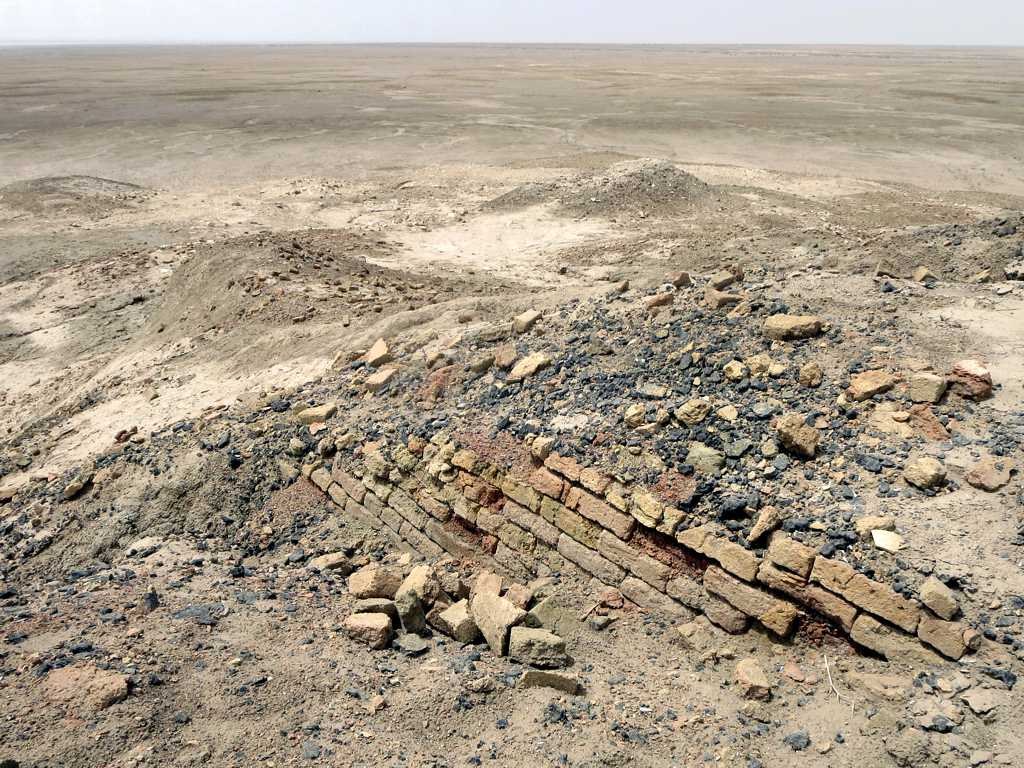
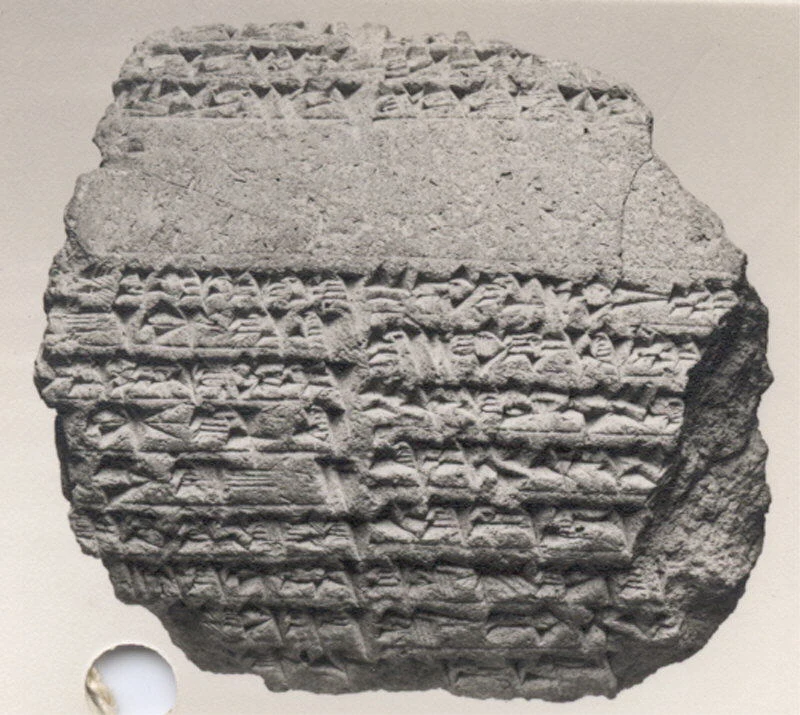
This ziggurat was historical, not a modern invention inferred from Genesis. The Metropolitan Museum holds a clay cylinder from Nebuchadnezzar II's reign commemorating its reconstruction. The Esagil Tablet describes its sections, and a modern archaeological study reports large excavated foundations in Babylon. The monument went through repeated building and repair. The scholarly reconstruction discusses Esarhaddon and, later, Nabopolassar and Nebuchadnezzar II. We should not imagine a structure erected once, left untouched, and finally encountered by a Hebrew narrator. [5][6][7][8][9]
But a different question follows: is this exact building the tower intended by Genesis? The setting in Babylon, a conspicuous tower, fired brick and bitumen make Babylonian monumental architecture a strong possible background. Genesis nevertheless does not name Etemenanki, Marduk, a tier count or any dimensions. Excavated foundations cannot date an episode in which humanity's speech was confused, or demonstrate that the verses report a visit to this precise building. The identification is a reasonable historical interpretation, not an identity certified by an ancient label. [1][5][6][8][9]
The Esagil Tablet: useful measurements and their limits
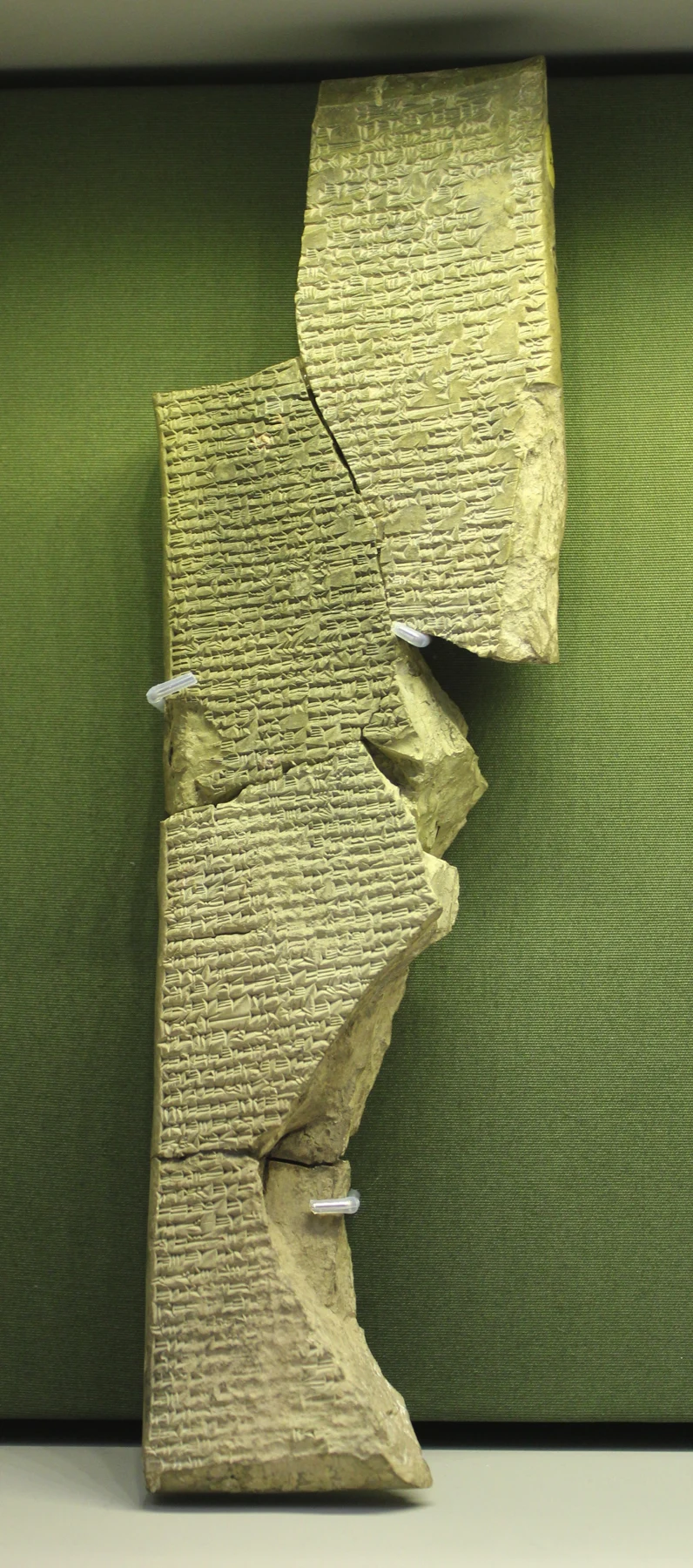
The Louvre's AO 6555 tablet matters because it names Etemenanki and describes its dimensions and levels. But its scribe did not watch the ziggurat's original foundation being laid. The surviving tablet was copied in UrukUrukAncient city at Warka in southern Iraq, a major urban centre around 3200 BCE that preserved early writing and accounting tablets.Glossary · Click to read the explanation in 229 BCE, after an older text associated with Borsippa, according to the museum and the French Ministry of Culture. Its calculations deal with areas in Esagil and the ziggurat. It also belongs to a culture of scribal mathematical instruction. [5][6]
A reconstruction based on it gives a base close to 90 metres on each side, a theoretical height near 90 metres, and seven levels. The height is not a measurement taken from a standing tower today. The Ministry itself cautions that some figures, particularly the height, appear ideal or pedagogical, and that the actual construction may have been lower. Archaeology gives a foundation measurement near 91.5 metres per side; that is a different kind of evidence from a calculation of the model's height. We have a textual vision of the structure and a substantial archaeological location, not one certain height for every period. [6][7][9]
A royal stele also names Nebuchadnezzar and Etemenanki and depicts the monument. Yet the stele's account of discovery, reported after its passage through the antiquities market, is not a completely documented excavation record. Olof Pedersén discusses this limit. We can use the inscription and image to study royal representation while remaining candid about the gaps in its provenance. [9]
“Babel”: gate of god or confusion?
In AkkadianAkkadianAn ancient East Semitic language written in cuneiform in Mesopotamia.Glossary · Click to read the explanation tradition the city's name was understood in a form approximating “gate of god” or “gate of the gods.” Genesis 11 instead gives Babel a Hebrew sound-based explanation from balal, mixing or confusing speech. The wordplay belongs to the biblical story. It does not prove that the original Akkadian city name came from the Hebrew verb. Even the older history of Babylon's name may be more complicated than its familiar Akkadian explanation, which itself may reflect an ancient reinterpretation rather than the name's very first origin. [1][10]
The distinction matters because the Hebrew author does more than mention a known city. The narrative gives that city a function in an argument about speech and dispersal. A city imagined as a centre for holding people together becomes, at the end, a name associated with confusion. This literary and religious function holds whether we identify a particular ziggurat behind the image or leave the tower unspecified. [1][10]
Enmerkar: did the Sumerians tell the same language story?
The Sumerian literary tradition also preserves Enmerkar and the LordRabbTitle of lordship, ownership or care by context; applied to God in Lord of worlds.Glossary · Click to read the explanation of Aratta. Its setting is a rivalry between the ruler of Uruk and the ruler of distant Aratta, including demands for metal, stone and work on Uruk's sanctuaries. Enmerkar sends a messenger whom he instructs to recite the “spell of Nudimmud,” a name for EnkiEnkiMesopotamian deity associated with deep fresh water, wisdom and Eridu, known as Ea in Akkadian tradition. The earliest preserved written mention does not date his cult’s origin or identify Ubaid Eridu’s deity.Glossary · Click to read the explanation. Lines 134–155 envisage lands with multiple tongues addressing EnlilEnlilProminent Mesopotamian god associated with Nippur and Ekur, highly ranked in Early Dynastic texts before the earliest known Anunna attestation.Glossary · Click to read the explanation in a single language, and attribute an alteration of speech to Enki. [3]
Gods, languages, unity and division make the comparison with Babel tempting. But its difficulty must remain visible. Assyriologist W. G. Lambert notes that the spell can be read in two opposed temporal directions: did Enki turn a past single tongue into many, or is he asked to turn future linguistic plurality into unity? Modern translations differ, and the spell's role in the Uruk–Aratta contest is itself obscure. [3][4]
The poem has no city called Babel building a tower to avoid dispersal; it does not narrate Enki demolishing a ziggurat. Even on the reading that describes a primordial division of languages, the resemblance is more thematic than plot-for-plot. Speech and human unity are subjects of a wider Mesopotamian literary world, but this is not a complete Sumerian version of Genesis 11. Respecting the translation dispute is more illuminating than pulling out a phrase and declaring the “original Tower of Babel” discovered. [1][3][4]
Can we trace a route of transmission?
A claim about a specific literary transfer requires more than an older Sumerian text and language imagery in both accounts. It needs chronology for the relevant witnesses, contact among scribal traditions, unusually specific parallels, matching structures, and ideally a trackable intermediary. Jewish communities encountered Babylonian society at several periods, so contact between Babylonian culture and Hebrew literature is not inherently implausible. But we have no copy of Enmerkar demonstrably used by Genesis' author, or an ancient annotation explaining such a borrowing. [1][3][4][5][9]
Etemenanki presents a somewhat different case: the architecture itself was physically present in Babylon, and Babel is named in the narrative. It is therefore reasonable to infer that Babylon's cityscape and ziggurat traditions helped form or receive the story's image. This inference still does not turn every narrative detail into an event excavated at the site. The building cannot prove the first date of human linguistic diversity or the size of the group the text calls “all the earth.” [1][5][6][7][8][9]
What about the Qur'anic tower?
In Sūrat al-Qaṣaṣ, Pharaoh commands Haman to fire clay and build him a lofty structure so he can look toward MosesMosesCentral figure in Exodus, Torah traditions and the Qur’an; childhood accounts differ in detail.Glossary · Click to read the explanation' god. Sūrat Ghāfir again mentions a structure and reaching the paths of the heavens. There is a common image of an ambitious high construction, and al-Qaṣaṣ also mentions fired clay. But the actors, setting and aim differ: this is part of the Moses–Pharaoh story in Egypt, not a narrative of Babylon and its languages. Neither passage recounts confusion of speech or the dispersal of nations after construction. [11][12]
The imagery may be compared within the history of later religious storytelling, and possible intermediary interpretations can be investigated when evidence for them is supplied. Calling Pharaoh's structure simply “the Qur'anic version of the Tower of Babel” suggests a plot that those verses do not contain. A careful comparison sees the common feature and also what does not travel with it. [1][11][12]
How strong is each conclusion?
- Confirmed: Genesis 11 relates the building of a city and tower, followed by confused speech, scattering and the end of city building. It neither narrates the tower's fall nor names Nimrod in this episode. [1][2]
- Confirmed: Etemenanki was a historical Babylonian ziggurat attested by excavated foundations, royal inscriptions and a later measurement tablet. The tablet is not a measurement of surviving full height. [5][6][7][8][9]
- Confirmed: The Nudimmud spell in Enmerkar discusses speech among different peoples, but the translation and temporal direction of Enki's action remain contested. [3][4]
- Probable: Babylon and its famous ziggurat supplied an architectural and cultural background for Genesis' city-and-tower image or later reception of it. This does not identify every literary event in an archaeological record. [1][5][6][9]
- Unproven: Genesis directly copied Enmerkar, Etemenanki was brought down in a historical confusion of all languages, or the Qur'anic Pharaoh's structure was the very same building. [1][3][4][9][11][12]
The historical value of the inquiry is not in announcing that “the very tower” has been found and closing the question. It is in keeping three sorts of witnesses distinct: a Hebrew story explaining language, scattering and Babylon's name; a Babylonian monument with its own cultic, repair and measurement history; and a Sumerian spell whose language imagery remains difficult to interpret. Their connections can be real or plausible while their dates, genres and purposes remain different. Those differences make the comparison more informative.
Further reading: Genesis and Enūma Eliš, Marduk and Babylon, How can resemblance be distinguished from borrowing?.
References and notes
- The entire short chapter was displayed; verses 1–9 read closely. The Hebrew key words Babel and balal were checked against the page and standard lexical reading; not a full textual-critical edition. Genesis 11:1–9, JPS 1917 English translation alongside Hebrew edition Return to the text ↑
- The entire short chapter was displayed; listed verses read closely, especially the repeated division by languages and the separate Nimrod notice. Genesis 10:5, 8–10, 20, 31–32, JPS 1917 English translation Return to the text ↑
- The extant translation was displayed; the specified passages and their narrative setting read closely. The composite translation contains manuscript alternatives and lacunae; the full underlying Sumerian sign edition was not independently collated. Oxford ETCSL translation, Enmerkar and the Lord of Aratta, lines 1–24, 33–133, 134–155, 156–207 Return to the text ↑
- The relevant passage on PDF page 106 and its footnote 17 read; the entire 446-page proceedings volume was not read. Lambert cites opposing Jacobsen and Vanstiphout interpretations, not a settled consensus. W. G. Lambert, 'The Classification of Incantations,' in SAOC 62 (2008), print p. 95, PDF page 106, lines on Nudimmud spell and note 17 Return to the text ↑
- Full object catalogue fields through provenance/dating and relevant bibliography inspected. No claim to read every cuneiform sign or all bibliographic items. The catalogue header's dynastic range conflicts with its explicit circa-229 BCE year; use the latter with the ministry's independent entry. Louvre AO 6555, Esagil Tablet catalogue, description, provenance and dating Return to the text ↑
- Full short explanatory page read, especially copy date, Uruk/Borsippa relationship, genre, and idealised height warning. French Ministry of Culture, Arabic explanation of AO 6555 Return to the text ↑
- Entire short architecture page read; measurements, levels, royal restoration sequence checked. French Ministry of Culture, Architecture of the Ziggurat Return to the text ↑
- Full short catalogue metadata and the museum's public-domain statement read; the Akkadian inscription itself was not translated from signs. Metropolitan Museum of Art 86.11.284, Nebuchadnezzar II cylinder catalogue Return to the text ↑
- Selected pages and footnotes read, not the full 13-page article. The provenance narrative, excavation base, inscriptions and numerical reconstruction were checked; no reliance on an uncorroborated find story as a secure excavated context. Olof Pedersén, 'The Tower of Babylon Stele Found in Babylon,' Iraq (2024), selected pp. 1, 3–7 and 9–10 Return to the text ↑
- Selected three pages only, not the 163-page nomination dossier. Name and historical interpretation checked. UNESCO Babylon World Heritage nomination dossier, selected pp. 63–65 on city name and sacred topography Return to the text ↑
- Arabic verse and the accompanying English rendering read; comparison confined to motif of fired clay and an elevated structure. Qur'an 28:38, Arabic text Return to the text ↑
- Both Arabic verses read. This is a parallel Pharaoh/Haman passage, not a text describing the Genesis 11 city. Qur'an 40:36–37, Arabic text Return to the text ↑
- Catalogue image and original JPEG obtained through the museum's API and visually inspected. Object and rights metadata verified; signs were not transliterated independently. Met 86.11.284 image and public-domain catalogue statement; full-resolution image path from Met Open Access API Return to the text ↑
Suggest a correction · Suggest a source for this record
Cite this record
IL Archive, «The Tower of Babel: the city, the tower, and the languages», Edition 1, https://ilarchive.com/en/studies/babel-and-ancient-ziggurats
Continue reading