Study
Dilmun and Eden: Was the “Sumerian Paradise” the Source of Genesis’s Garden?
An extended study of a topic, with evidence and references.
- Region
- The Near East
A close comparison of Enki and Ninhursaga with Genesis 2–3: water, plants, Ninti and the rib, the name Eden, historic Dilmun and the limits of a borrowing claim.
Share article
Text
The comparison is tempting. An old Sumerian poem describes a land where a lion does not seize its prey and the aged do not announce their old age. A god gives it fresh water and later eats plants that bring him trouble. Genesis describes a watered garden, eating that changes the human condition, and a woman whose story involves a man’s rib or side and the idea of life. Since the cuneiformCuneiformWriting with wedge-shaped signs, developed from Mesopotamian recording traditions and used for several languages from the third millennium BCE.Glossary · Click to read the explanation poem was discovered, DilmunDilmun: Ancient Gulf Land and Literary SettingAn ancient Gulf trading region linked archaeologically to Bahrain and also a Sumerian literary setting whose mythical scenes are not all historical descriptions.Glossary · Click to read the explanation has sometimes been called “the Sumerian Garden of EdenEden: The Setting of Genesis’s GardenThe place in which the garden of Genesis 2–3 is planted; the story describes rivers, trees and a human test, while its archaeological location and name’s derivation remain unsettled.Glossary · Click to read the explanation.” That label, however, answers the historical question before the texts have been read in full. What does each work actually narrate, and do a few shared images demonstrate that one copied the other? [1][2][4][5]
Dilmun in the Sumerian poem
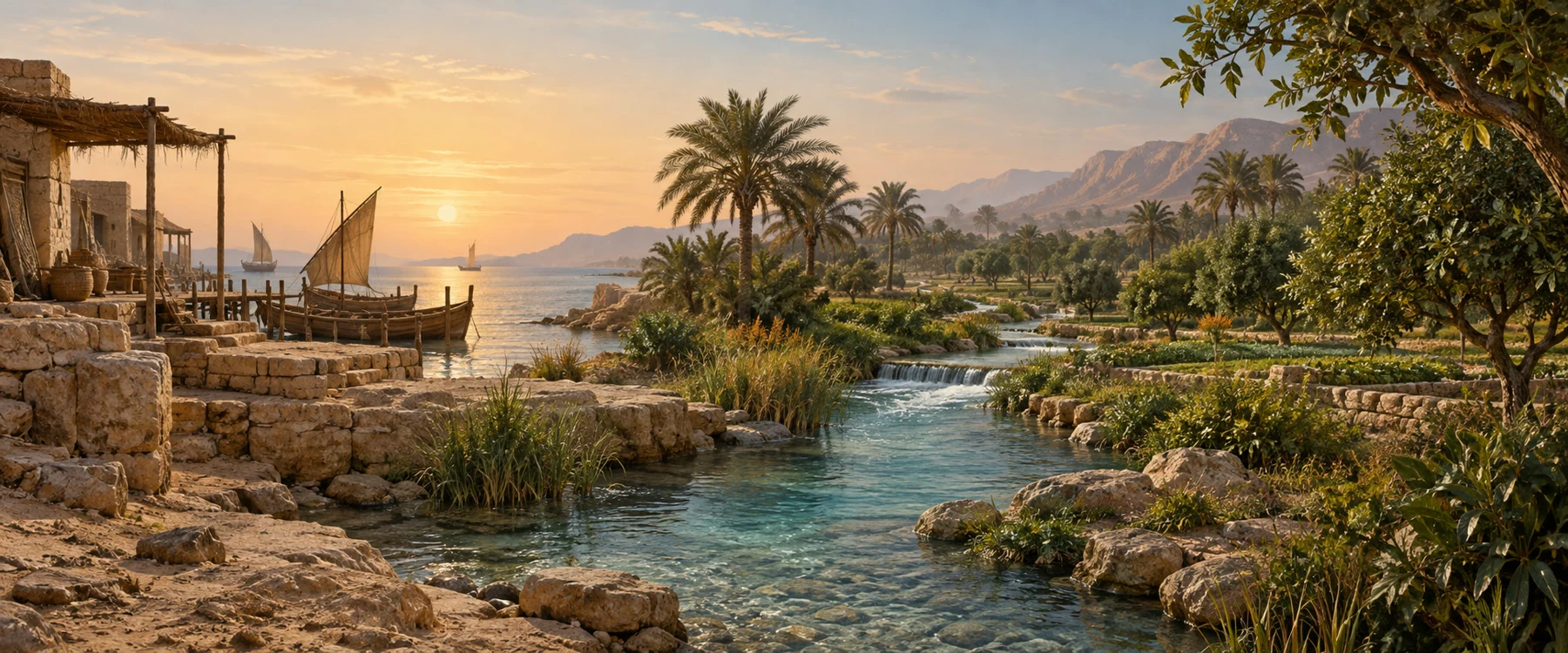
“EnkiEnkiMesopotamian deity associated with deep fresh water, wisdom and Eridu, known as Ea in Akkadian tradition. The earliest preserved written mention does not date his cult’s origin or identify Ubaid Eridu’s deity.Glossary · Click to read the explanation and Ninhursaga” begins by praising Dilmun as virgin and pure or splendid, depending on how its words are read in modern translations. Certain animal predation, illness and complaints of old age are absent. Yet this is not the end of the opening scene. There is no song of celebration or ordinary urban activity either. Ninsikila tells Enki that the place lacks sufficient water and that its canals are empty. Then fresh water appears, brackish wells turn sweet, fields become productive, and Dilmun becomes a place of quays and commerce. Scholars therefore disagree over what the opening represents. Is it a complete, living paradise, or a dormant land whose life has yet to begin? Dina Katz and Keith Dickson favor the latter reading. Markham Geller still finds a comparison with a distant ideal land possible if “paradise” is used broadly, while acknowledging that Dilmun is neither the realm of the dead nor a replica of Eden. [1][2][4][5][6]
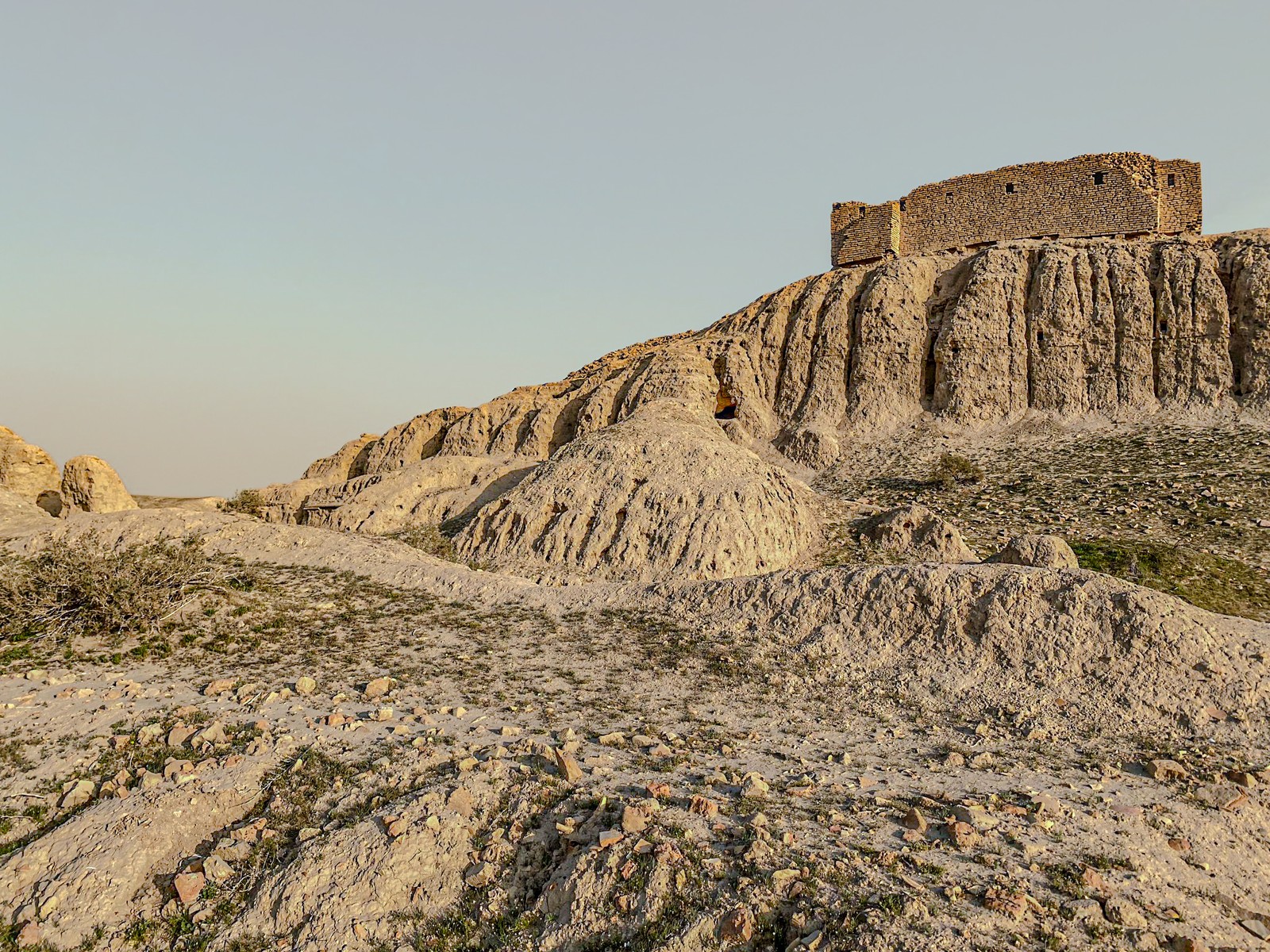
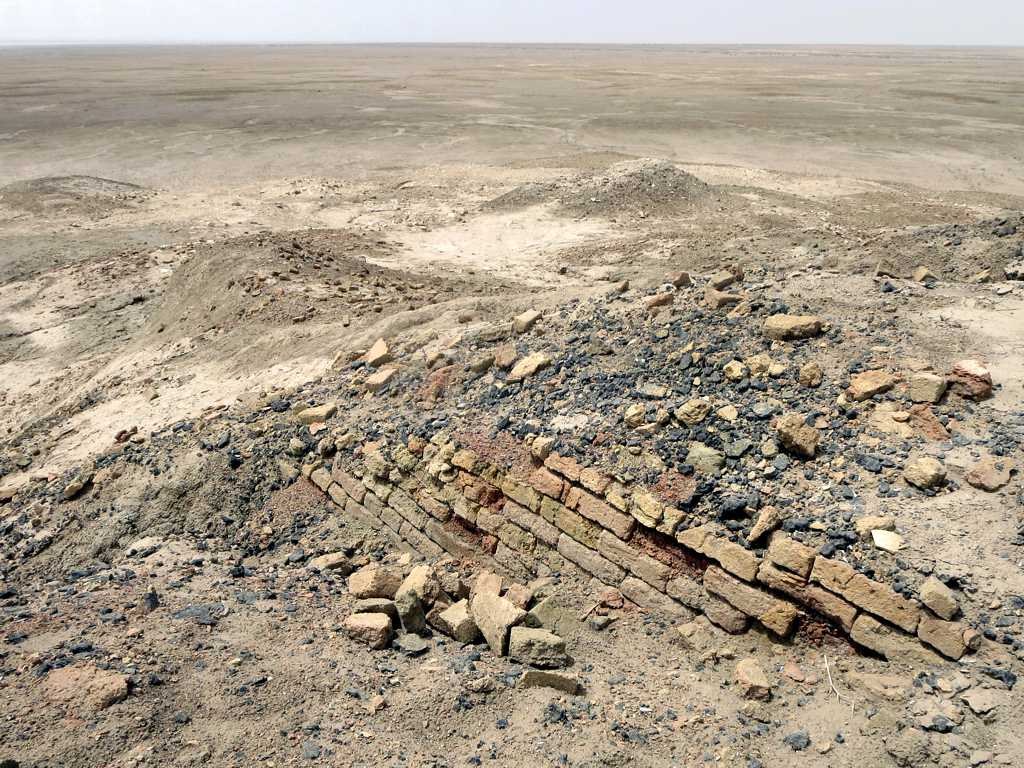
Dilmun was not merely an imaginary name. Documents and archaeology also identify it as a historical Gulf trading center; Qal’at al-Bahrain is associated with its ancient center. But using the name of a historical land in a poem does not make every mythic event an archaeological description of that land. More importantly, locating historical Dilmun in the Bahrain area does not locate biblical Eden. The names belong to different texts, each with its own geographic problem. [1][7]
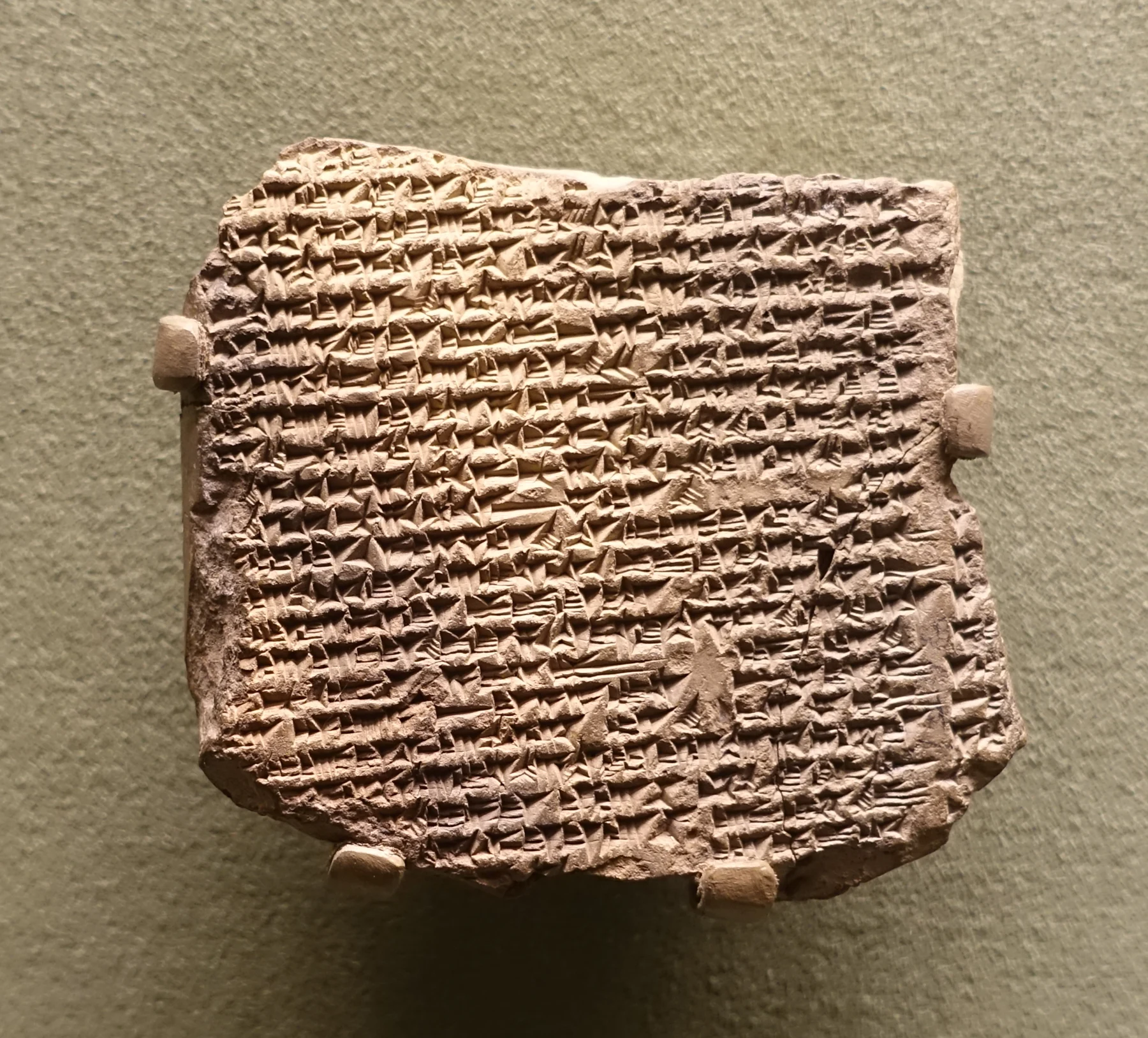
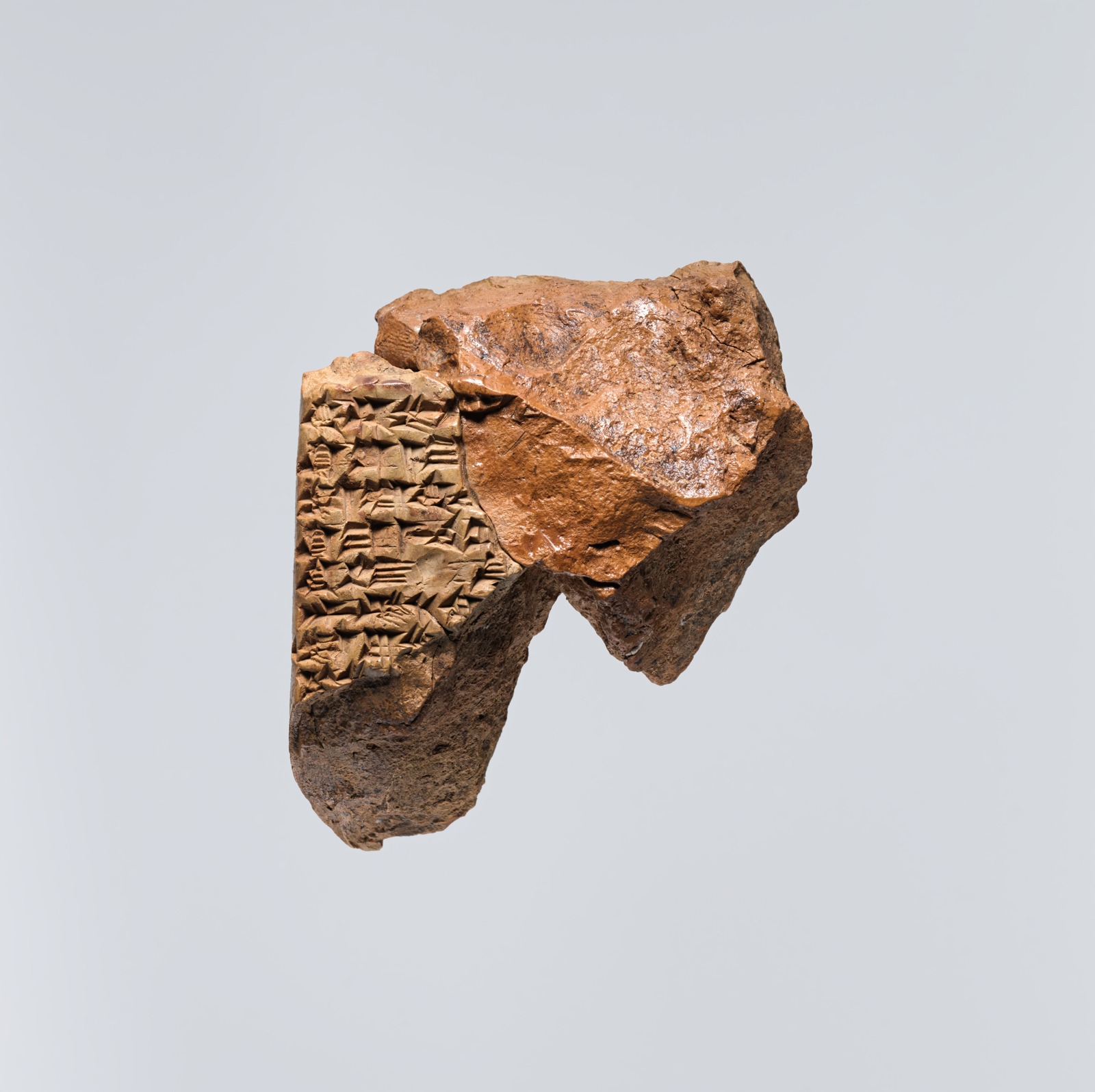
The poem survives in Old Babylonian cuneiform witnesses, including a copy from Ur dated to the reign of Rim-Sîn I, about 1800 BCE. That is a date for an extant witness, not an assured date of composition for every part of the story. Scholars have argued that the initial Dilmun episode and the later account of Enki, the plants and the body do not form a simple, originally unified plot. The copies also differ; the Ur version includes an expanded commercial catalogue. A fair comparison keeps the distance between the composition we read, its surviving copies and its earlier history in view. [2][4]
What happens after the water and plants?
The poem moves through a series of divine births and relationships, followed by the growth of eight plants. Enki asks their names; his attendant brings them, and he eats them. The text places this act in a context of learning their character and determining their destinies. Ninhursaga grows angry and withdraws her life-giving regard, leaving Enki ill. She is brought back and asks which parts of his body hurt. A deity whose name plays on each body part is born until Enki is healed. Whatever one makes of several damaged details, this episode has its own logic of fertility, naming and the body. [1][2][5]
There is no explicit prior command in this poem telling a human being not to eat from one specified tree. There is no serpent conversing with a first human couple, and no human expelled from Dilmun for disobeying such a command. The eater is the god Enki, not Adam and Eve; the consequence is illness followed by healing, not the guarded exclusion from the tree of lifeTree of Life in GenesisA tree distinct from the knowledge tree in Genesis 2–3; after the other tree is eaten, the way to it is guarded lest humans eat and live forever.Glossary · Click to read the explanation. The broad pattern “plant, eating, consequence” merits comparison, but cannot by itself establish that the Genesis plot was copied. [1][2][3][5]
What makes Eden different?
In Genesis 2, YHWHYahwehThe divine proper name written YHWH in the Hebrew Bible.Glossary · Click to read the explanation God plants a garden in Eden and places a human there to work and keep it. That task precedes disobedience, so the text does not say that all work began after eating. A river waters the garden and then divides into four branches, two of which are identified as the Tigris and Euphrates. God permits eating from the garden’s trees but prohibits the tree of the knowledge of good and evilTree of the Knowledge of Good and EvilThe tree forbidden in Genesis 2:17 and discussed by the serpent before the eating in Genesis 3; it is not the tree of life.Glossary · Click to read the explanation. In Genesis 3 the serpent speaks with the woman, the humans eat, and their knowledge and circumstances change. The judgments that follow describe painful labor on the land and in childbirth; finally the humans are barred from the tree of life. At the center of this sequence stand the human relationship to a divine command and the limits of knowledge and life, rather than the founding of a commercial harbor or the allocation of domains among deities. [3][9]
Eden’s rivers do not furnish an agreed archaeological coordinate. Mention of the Tigris and Euphrates places MesopotamiaMesopotamiaA historical region associated with the Tigris and Euphrates, home to many societies and civilisations.Glossary · Click to read the explanation in the geographic horizon of the story, but the identity of all four rivers and their common source has not been fixed on one accepted map. Genesis therefore supplies no address for a garden in Bahrain. [3][8]
The “rib” and Ninti: a comparison across two languages
The best-known parallel appears near the end of the Sumerian poem. Ninhursaga asks Enki what hurts; when he identifies his ribs, *ti* in Sumerian, the goddess Ninti is born. The Sumerian wordplay can suggest both “Lady of the Rib” and “Lady of Life.” Pascal Attinger’s reading shows that this is one of an entire series of sound associations between body parts and divine names; at the end, Ninti’s name is also associated with months. She is one of eight deities in a healing scene, not a solitary human woman made from the first man’s rib. [1][2][5]
In Genesis 2 the woman is built from Adam’s *ṣēlāʿ*, translated “rib” or “side.” In Genesis 3 she is named Eve because the text calls her the mother of all living. “Rib” and “life” make this a serious comparison of unusual images, but they do not establish a documented chain of translation. The *ti* pun works in Sumerian; the HebrewHebrewA Northwest Semitic language in the Canaanite group, with ancient and modern forms.Glossary · Click to read the explanation terms for rib or side and for Eve do not form the same pun. The characters and their narrative functions also differ. An influence through wider regional traditions remains a question one can investigate. Calling Ninti “the original Eve,” however, removes more evidence than it explains. [2][3][5]
Does “Eden” come from Sumerian *edin*?
Sumerian *edin* means “steppe” or “plain,” and its resemblance to Hebrew Eden has long attracted attention. An etymology cannot be established simply because two Latin-letter spellings look similar. The Hebrew name begins with the consonant ʿayin, and the Sumerian form alone does not explain its arrival. Alan Millard also notes that the AkkadianAkkadianAn ancient East Semitic language written in cuneiform in Mesopotamia.Glossary · Click to read the explanation *edinu* invoked as a bridge is attested in a lexical list rather than as an ordinary word widely used in Akkadian texts. He considers a West Semitic root ʿdn, associated with abundance or delight, supported by an early AramaicAramaicA group of Northwest Semitic language varieties with a long history across the Near East.Glossary · Click to read the explanation witness. Millard favors that route, while explicitly saying that neither derivation can be established conclusively. [8]
There is therefore a real linguistic problem, not a ready-made proof that the place-name Eden was taken from the Sumerian word for steppe. Nor is Sumerian *edin* simply another name for Dilmun in the poem under discussion. Collapsing *edin*, Dilmun and Eden turns three different things—a common nounCommon nounA word naming a class of things, such as “god”, rather than one particular individual.Glossary · Click to read the explanation, a literary and historical country, and a biblical place-name—into one location without an argument. [1][3][8]
What kind of connection can the evidence support?
The surviving cuneiform witnesses of the poem are earlier than the biblical manuscripts available to us. Priority of a copy does not reveal when every oral or literary tradition took shape. The composition date of the Eden story is itself debated. Walter Bührer argues that it predates the Priestly material in Genesis, whereas other scholars have preferred a later dating. It is reasonable to investigate how literary images could have circulated between Mesopotamia and the LevantThe LevantThe Levant is a regional name for lands along the eastern MediterraneanGlossary · Click to read the explanation across centuries of contact, through writing or speech. That possibility does not establish that the writer of Genesis 2–3 read the particular version of “Enki and Ninhursaga” known to us. [2][4][10][11]
Tryggve Mettinger makes a useful distinction: ancient Near Eastern texts may share themes of wisdom, immortality and plants without a preceding work that matches Eden’s extended plot closely enough to identify it as its direct literary model. This assessment comes from the publicly displayed description and chapter openings of his book, not from a claim that we have read the whole volume. More specifically, Katz and Dickson put water, commerce, the body and naming back into the Sumerian poem, revealing a narrative purpose unlike the human test in Genesis. [4][5][9]
We can establish genuine thematic comparisons, Dilmun’s historical and literary roles, and a Sumerian wordplay connecting Ninti to “rib” and “life.” Direct borrowing, the derivation of “Eden” from *edin*, and a garden in Bahrain remain unproved. This neither denies all cultural contact nor treats every similarity as descent. It places the historical question at its proper level: how do ancient images move between texts, and when can we actually trace their route? [1][2][3][4][5][8][9]
References and notes
- Oxford ETCSL, Enki and Ninhursaga 1.1.1, lines 1–281; full composite translation, with close reading of opening, plants and ending. Oxford ETCSL c.1.1.1, Enki and Ninhursanga, translation, lines 1–281 Return to the text ↑
- Pascal Attinger, Enki et Ninḫursaĝa (2011, updated 2015), French translation and manuscript notes; especially pp. 1–3, 5, 9–12, not all notes continuously read. Pascal Attinger, 'Enki et Ninḫursaĝa (1.1.1),' 2011, updated 2015; translation and philological notes, 12 pp. Return to the text ↑
- Genesis 2–3, Hebrew and JPS 1917 read, then a combined NRSVUE display checked; both chapters, without manuscript collation. Genesis 2–3, NRSVUE English display, compared with Hebrew and JPS 1917 in D02–D03 Return to the text ↑
- Dina Katz, Enki and Ninhursaga, Part One: The Story of Dilmun (2007), introduction and selected pages on Dilmun, water and trade; not the whole article. Dina Katz, 'Enki and Ninhursaga, Part One: The Story of Dilmun,' Bibliotheca Orientalis 64 (2007), pp. 567–590 Return to the text ↑
- Keith Dickson, Enki and Ninhursag: The Trickster in Paradise (2007), synopsis, Eden comparison and ending; selected passages, not a full continuous reading. Keith Dickson, 'Enki and Ninhursag: The Trickster in Paradise,' Journal of Near Eastern Studies 66/1 (2007), pp. 1–32; author-uploaded full-text transcription Return to the text ↑
- M. J. Geller, Sumerian Paradise Lost, pp. 1–3 only on Dilmun and Eden; the later afterlife-geography argument was not read here. M. J. Geller, 'Sumerian Paradise Lost,' UCL repository, pp. 1–3 Return to the text ↑
- UNESCO, Qal’at al-Bahrain site description and Outstanding Universal Value on Dilmun’s historic center, occupation and trade; not the full excavation dossier. UNESCO World Heritage Centre, Qal'at al-Bahrain, description and Outstanding Universal Value Return to the text ↑
- A. R. Millard, The Etymology of Eden (1984), main argument pp. 103–105 in damaged online OCR, cross-checked with Richard Hess’s public note; publisher scan unavailable. A. R. Millard, 'The Etymology of Eden,' Vetus Testamentum 34/1 (1984), pp. 103–106; DOI https://doi.org/10.2307/1518211; online OCR reproduction linked here Return to the text ↑
- Tryggve N. D. Mettinger, The Eden Narrative (2007), publisher description and chapter 6 opening only; full book unread. Tryggve N. D. Mettinger, The Eden Narrative (2007), publisher description and displayed chapter introductions, especially ch. 6 Return to the text ↑
- Walter Bührer, The Relative Dating of the Eden Narrative (2015), publisher abstract only; full article unread. Walter Bührer, 'The Relative Dating of the Eden Narrative Gen *2-3,' Vetus Testamentum 65/3 (2015), pp. 365–376 Return to the text ↑
- David M. Carr, The Emergence of Scribal Education in Ancient Israel (2019), publisher abstract on Late Bronze cuneiform schooling in the southern Levant only; chapter unread. David M. Carr, The Finger of the Scribe, chapter 'The Emergence of Scribal Education in Ancient Israel' (2019), publisher abstract Return to the text ↑
Suggest a correction · Suggest a source for this record
Cite this record
IL Archive, «Dilmun and Eden: Was the “Sumerian Paradise” the Source of Genesis’s Garden?», Edition 1, https://ilarchive.com/en/studies/dilmun-and-eden
Continue reading