Study
An Eye for an Eye: Retaliation, Compensation, and Social Status
An extended study of a topic, with evidence and references.
- Region
- The Levant
From Hammurabi and Hazor through three Torah contexts to Philo, Josephus, the Mishnah, Matthew and the Quran: when did equivalence mean injury, payment or remission?
Share article

Text
# An Eye for an EyeLex talionisA formula linking a penalty to a harm, such as “eye for eye”; its setting and application vary across texts.Glossary · Click to read the explanation: Retaliation, Compensation, and Social Status
The phrase “an eye for an eye” appears in Hammurabi’s lawsLaws of HammurabiAn eighteenth-century BCE Babylonian legal text in Akkadian, presenting property, family, labor and injury provisions within Hammurabi’s account of justice.Glossary · Click to read the explanation and in three passages of the TorahTorah / PentateuchGenesis, Exodus, Leviticus, Numbers and Deuteronomy: Mosaic corpus with a compositional history. Torah can also mean teaching or law beyond these five books.Glossary · Click to read the explanation. Jewish, Christian, and Quranic authors then read it anew. Yet the phrase does not do the same work in every text. It can concern bodily injury, a false witness, a conception of just equivalence, or an injured person’s choice to forgo a claim. Matching words are therefore insufficient to establish a single law transmitted unchanged from BabylonBabylonBabylon is an ancient city in central present-day Iraq, south of BaghdadGlossary · Click to read the explanation into later religions.
Our earlier study, Hammurabi and the Covenant Code, compares a wider range of provisions. This inquiry is narrower and deeper: when does equivalence mean bodily punishment, when does compensation enter, who falls within the rule’s claim of equality, and how did readings change after the texts were written?
What do Hammurabi’s laws say?
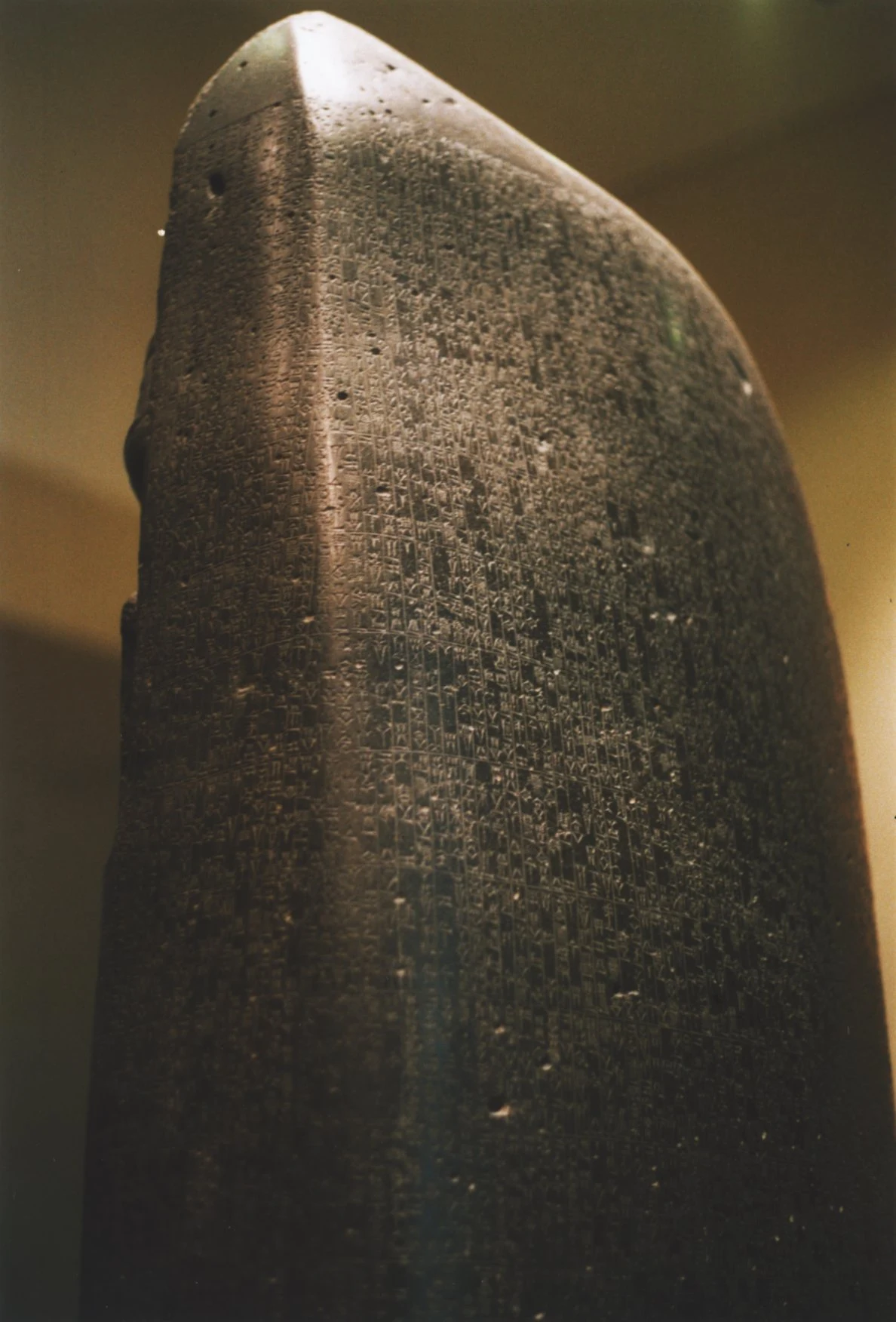
HammurabiHammurabiKing of Babylon in Mesopotamia, reigning around 1792–1750 BCE. A celebrated legal text preserved on a stele and cuneiform copies bears his name.Glossary · Click to read the explanation’s collection was set down in Babylonia around the eighteenth century BCE. Sections 196 and 197 respond to the destruction of the eye, or the breaking of a bone, of a man of the awīlum category by inflicting the corresponding injury on the wrongdoer. The following provisions do not impose the same result for every injured person: an injury to a muškēnum brings a silver payment, while an injury to an enslaved person brings compensation calculated from that person’s value within a relationship of ownership. The distinction recurs in the provisions on teeth. [1][5]
It is therefore wrong to summarize the system as “Babylon applied eye for eye to everyone.” Nor is it enough to translate the three categories as simply “rich, poor, and slave.” Awīlum, muškēnum, and wardum are AkkadianAkkadianAn ancient East Semitic language written in cuneiform in Mesopotamia.Glossary · Click to read the explanation legal and social categories, and the precise position of the first two remains a matter of scholarly discussion. The difference in penalties according to the injured person’s status is clear; replacing each term with a modern economic class obscures that precision. [1][5]
The stele establishes that these legal formulations existed. By itself, it does not tell us how many eyes judges actually ordered destroyed. Conversely, the lack of a complete record of practice does not allow us to declare every provision “merely symbolic.” The text, judicial action, and interpretation are different bodies of evidence.
Hazor: evidence against a simple direct route
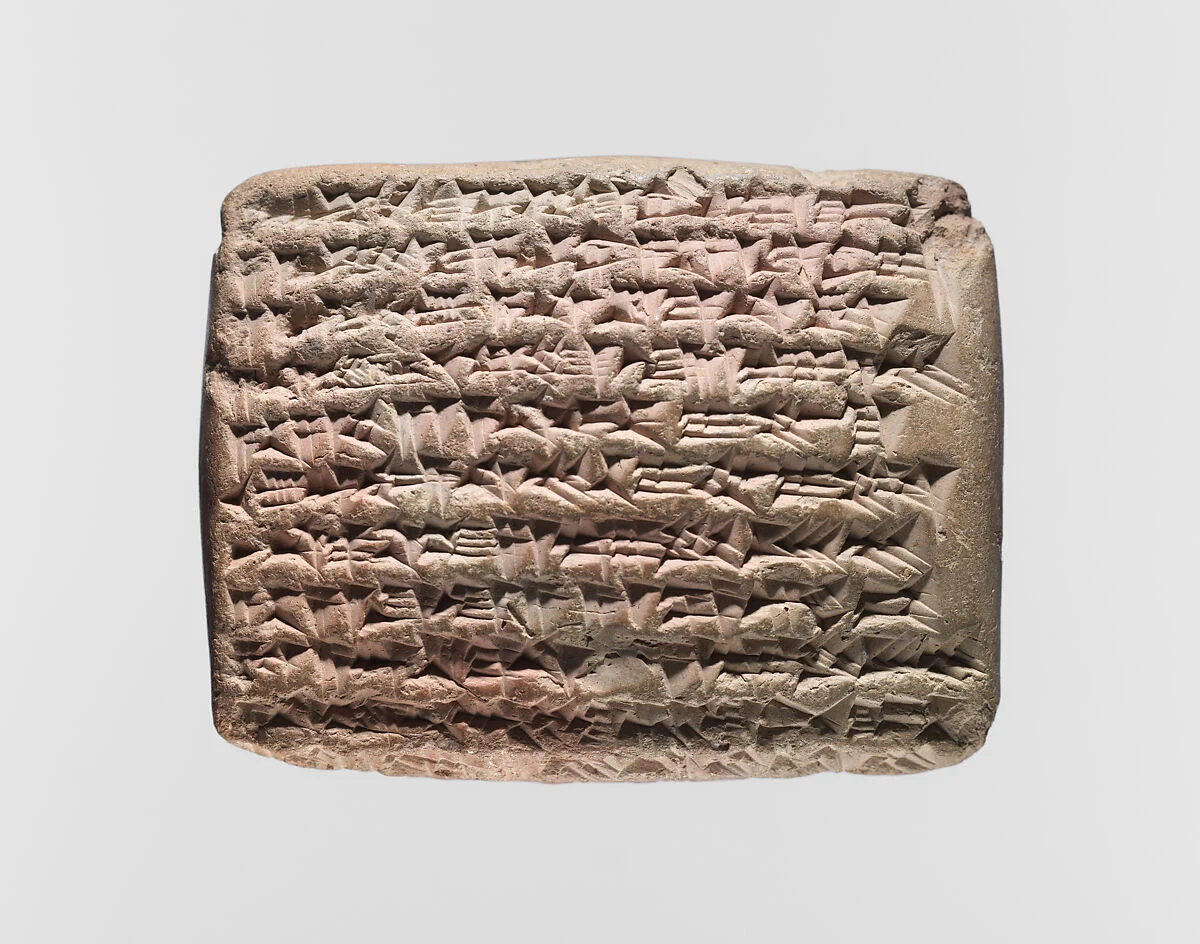
In 2010 excavators at Canaanite Hazor found two small fragments of a cuneiformCuneiformWriting with wedge-shaped signs, developed from Mesopotamian recording traditions and used for several languages from the third millennium BCE.Glossary · Click to read the explanation legal tablet from the Middle Bronze Age. They preserve parts of seven provisions. Some lines concern injury to an enslaved person who had been hired out to someone else, and a silver payment to the owner. Eye, nose, tooth, and ear occur in the broken lines, although some words and penalties are restored. Wayne Horowitz and his colleagues published the tablet; Horowitz later explained his reading to a wider audience. [5][6]
This is valuable evidence that Akkadian legal writing of this kind existed in Canaan centuries before the Torah texts. But it is not an extant copy of an “eye for eye” rule between two free men, nor evidence that any particular biblical writer saw this tablet. The preserved fragment is chiefly about compensation to the owner of an enslaved person. It supports the possibility of a regional legal inheritance and weakens a model in which every resemblance must travel directly from the surviving Babylonian stele to the received text of Exodus. It does not settle a specific transmission route. [5][6]
Exodus 21: injury is not the only case on the page
In Exodus 21:22–25 the sequence “life for life, eye for eye, tooth for tooth” follows a fight between men that injures a pregnant woman. The provision begins with a fine if her children come out and what the HebrewHebrewA Northwest Semitic language in the Canaanite group, with ancient and modern forms.Glossary · Click to read the explanation calls ʾāsôn—grave harm or disaster in this setting—does not occur. If it does, the text moves to the formula of equivalence. Exactly what the children’s emergence means, and to whom the harm refers, have long been debated. We cannot use these verses alone to pronounce a certain ruling for every pregnancy case. [2]
Two other kinds of remedy surround this sequence. In verses 18–19, the assailant must pay for the injured person’s medical care and lost work. In verses 26–27, when an owner destroys the eye or tooth of an enslaved man or woman, the injured person is released. That treatment does not erase the institution of slavery presupposed by the passage, but it differs from the compensation to an owner in Hammurabi §199. In another case, an enslaved person killed by a dangerous ox leads to a fixed sum paid to the owner in Exodus 21:32. We cannot extract a claim of absolute social equality from “eye for eye” while ignoring distinctions elsewhere in the same chapter. [1][2]
Leviticus 24: human beings, animals, and resident foreigners
Leviticus 24:17–22 places killing a person, restitution for a killed animal, maiming a person, and “fracture for fracture, eye for eye, tooth for tooth” in one sequence. A statement of “one law” for the resident foreigner and the native follows. This arrangement differs from the pregnancy case in Exodus: it places the replacement of an animal, the penalty for harm to a person, and one rule for two groups side by side. [3]
A reader may reasonably see in “one law” a serious requirement to avoid differentiating between resident foreigner and native in the matter at hand. Without specifying its scope, however, we cannot turn it into a declaration of modern citizenship or an abolition of every legal distinction involving slavery throughout the Torah. Nor does it tell us directly whether bodily equivalence was always carried out or sometimes understood as a standard for compensation. That is a separate question about practice and interpretation. [2][3]
Deuteronomy 19: the eye in a false-witness trial
Deuteronomy 19:15–21 is not about a man who gouges out another man’s eye during a fight. It requires two or three witnesses and tells judges to investigate a fabricated accusation. If a witness is found to have lied deliberately, the court is to do to him what he intended to bring upon the accused. “Life for life, eye for eye” closes this procedure. Here equivalence serves a rule against false testimony and its deterrence. [4]
Putting the formulations of Exodus, Leviticus, and Deuteronomy in one undifferentiated line hides the difference between their subjects. Their closing language may resemble one another, but the legal question each passage answers is not the same.
Did the formula make revenge less severe?
“Eye for eye” can be read as a ceiling: it disallows taking two eyes in return for one. John J. Collins presents this as a value of proportionality, a correspondence between offense and response that stands against excessive retaliation. [17]
Yet we must distinguish a value we can draw from the formula from a historical narrative in which all neighboring societies supposedly punished more harshly until the Torah reduced the penalty. The comparative texts do not establish such a general story. Some ancient laws also offered monetary compensation rather than bodily harm, and Joel Marcus has criticized a simple narrative of linear improvement. In his reading, the formula in the pregnant-woman case in Exodus 21 may actually intensify, rather than lessen, the earlier monetary response within that case. This is an attributed modern interpretation, not a settled conclusion about every talion passage. [5][12][17]
The more precise observation is that different texts employ a standard of equivalence whose function and limits vary with the case, status, and social setting.
From text to Jewish interpretation: more than one answer
Writing in the first century CE, Philo of AlexandriaPhilo of AlexandriaFirst-century CE Alexandrian Jewish author. In Life of Moses he presents Greek translation as inspired; the passage does not explicitly assign a separate room to each translator.Glossary · Click to read the explanation defended comparable bodily punishment when a free person injured another, while explaining the release of an enslaved person whose owner destroyed an eye in different terms. Josephus, also from the first century, speaks of matching bodily injury but allows the victim to accept money instead. Neither author offers a statistical report of what every Jewish court did. Together, however, they rule out a picture in which “ancient Jewish interpretation” uniformly meant either money alone or bodily punishment alone. [7][8]
The Mishnah, compiled around 200 CE, sets out five categories of compensation for personal injury in Bava Kamma 8:1: damage, pain, healing, time away from work, and humiliation. When a person’s eye is destroyed, its example assesses the material loss by comparing values before and after injury; it does not describe putting out the wrongdoer’s eye. Later rabbinic discussions explain why they read the Torah’s expression in financial terms. We cannot take the Mishnah’s compilation date and project this procedure automatically onto every court of MosesMosesCentral figure in Exodus, Torah traditions and the Qur’an; childhood accounts differ in detail.Glossary · Click to read the explanation’ putative period or the kingdom of Israel. Nor should it erase the different testimony of Philo and Josephus. [9][11]
Matthew 5: from judicial penalty to an addressee’s response?
Matthew 5:38–42 quotes “an eye for an eye and a tooth for a tooth,” then has Jesus give examples of offering the other cheek, yielding a garment, going another mile, and giving. This is a first-century Jewish text engaging an inherited Jewish text. It is not a historical record saying that “Judaism was revenge until mercy arrived from outside.” Philo, Josephus, and later the Mishnah show that questions of punishment, forbearance, and compensation were debated within Jewish settings. [7][8][9][13]
Modern readings differ. Is Matthew directing an individual’s response to mistreatment, restricting the sphere of a judicial rule, or revising the rule itself? Joel Marcus argues that the Gospel’s formulation is closer to a revision of a quoted biblical law and criticizes the claim that it merely corrected an earlier misunderstanding. We present that as his interpretation. We do not derive from these verses alone the history of later Christian courts or a comprehensive civil code. [12][13]
The Quran: retaliation and remission together
QuranQuranCentral text of Islam, used here as evidence of its religious discourse.Glossary · Click to read the explanation 5:45 recalls what was prescribed “for them therein”; the setting speaks of the Torah. It gives “life for life, eye for eye,” then nose, ear, tooth, and retaliation for wounds, immediately adding a clause about forgoing the claim. Quoting its opening to say that only punishment is present would cut away the remission; quoting only the remission would remove the retaliation. Both belong to the same verse. [14]
Quran 2:178, by contrast, explicitly concerns retaliation “in cases of the slain”: homicide, not the destruction of an eye. It mentions the free person, the enslaved person, and the woman, then speaks of remission, appropriate follow-through, and payment in good faith. Muslim jurists developed extensive distinctions about retaliation, financial compensation, and rights from these and other texts. Their varied doctrines deserve a separate study; two verses cannot supply a single Islamic law for every century and place. Nor does the biblical wording in the Quran establish a direct line from Hammurabi’s text to a Quranic passage more than two thousand years later. Between them lie long histories of textual circulation and interpretation. [14][15]
Testing historical connection
Hammurabi’s collection and the Hazor fragments precede the Torah texts in their earliest preserved layers. The resemblance in bodily injury, penalty, and legal wording is real. Cuneiform writing and legal traditions circulated in the LevantThe LevantThe Levant is a regional name for lands along the eastern MediterraneanGlossary · Click to read the explanation; Hazor proves that a legal text of this kind existed locally. But the broken Hazor tablet concerns compensation for injury to an enslaved person and supplies no chain of copies leading to Exodus, Leviticus, or Deuteronomy. The three Torah passages themselves put the expression to work in different disputes. [1][2][3][4][5][6]
A shared ancient Near Eastern legal inheritance is therefore strongly supported. The hypothesis that particular scribes consulted Hammurabi’s collection remains researchable, but requires evidence more precise than a short shared maxim. Philo, Josephus, the Mishnah, Matthew, and the Quran are later witnesses to interpretation and redeployment; they are not transparent windows onto the formula’s first Bronze Age use. [7][8][9][12][13][14]
What can we say, and with what degree of confidence?
- Certain: Hammurabi §§196–201 vary the result according to the injured person’s legal status; some prescribe matching physical injury, others a payment. [1][5]
- Certain: The Hazor fragments preserve an old local provision on compensation for injury to an enslaved person. They do not preserve a complete free-person “eye for eye” rule matching the Torah. [5][6]
- Certain: The formula appears in three distinct Torah contexts: an injury linked to a fight and pregnancy in Exodus, a human impairment in Leviticus, and false testimony in Deuteronomy. [2][3][4]
- Certain: Jewish sources from the first century onward preserve different possibilities—physical retribution, acceptance of money, and a fivefold compensation scheme. They cannot be reduced to one practice. [7][8][9][11]
- Certain: Matthew quotes the phrase and directs a different response to harm. The Quran mentions both retaliation and remission in passages with different settings. [13][14][15]
- Unproved: The phrase alone tells us how often any ancient court carried out physical retaliation, or proves that the Torah copied Hammurabi’s stele directly. [5][6][12]
The phrase is remarkably short, but its history is not. Beneath the eye matched to an eye are questions about who was injured, who assesses the loss, and what the judge, legal text, or later interpreter expects of the offender. A careful comparison asks more than “does the same sentence occur twice?” It also asks: “in which case, for which people, and read by whom afterwards?”
References and notes
- Only §§196–214 read. The English translation is old; class terms were checked against Horowitz. The full collection was not read. Hammurabi §§196–214, Robert Francis Harper translation Return to the text ↑
- Specified verses read in Hebrew/JPS within the chapter, checking wages, healing, pregnancy, manumission and the goring ox. Exodus 21:18–27, 29–32, Hebrew/JPS 1917 Return to the text ↑
- The whole short chapter read, especially vv. 17–22 and the blasphemy setting. Leviticus 24:17–22, Hebrew/JPS 1917 Return to the text ↑
- The whole short chapter read; equivalence checked in the false-witness trial, not a direct bodily-injury case. Deuteronomy 19:15–21, Hebrew/JPS 1917 Return to the text ↑
- Public essay and notes read, especially extant Hazor lines and Hammurabi comparison; no tablet-to-Torah identity presumed. Wayne Horowitz, “An Eye for an Eye or for Shekels,” 2024 Return to the text ↑
- University bibliographic record and abstract only; the full 19-page article was not read. Horowitz, Oshima & Vukosavović, IEJ 62 (2012), 158–176 Return to the text ↑
- Selected §§181–204 read in the posted translation, not a critical Greek edition or the entire work. Philo, Special Laws III §§181–204, older English translation Return to the text ↑
- Only specified paragraphs read from the long book page; Josephus’s account distinguished from court practice. Josephus, Antiquities IV.279–283, Whiston translation Return to the text ↑
- Opening Mishnah and immediate discussion read in Hebrew, cross-checked against an indexed English explanation; not the entire tractate. Mishnah Bava Kamma 8:1 in Jerusalem Talmud, Hebrew Return to the text ↑
- Published introduction excerpt read for c. 200 CE compilation; the book was not read. Cambridge, Transmitting Mishnah, Introduction, publisher excerpt Return to the text ↑
- Abstract and selected PDF pp. 0, 3–4 read for his critique of automatic moderation; not all 17 pages read. Joel Marcus, “The Enigma of the Antitheses,” NTS (2023), selected pp. 121–125 Return to the text ↑
- Specified five verses read, not the whole sermon; claims about their function are attributed interpretation. Matthew 5:38–42, public-domain KJV Return to the text ↑
- Arabic verse and immediate context read; Quranic wording separated from site commentary and checked against Quranic Arabic Corpus translations. Quran 5:44–45, Arabic text and immediate context Return to the text ↑
- Both verses read in Arabic; Quranic text separated from commentary; English renderings cross-checked in Quranic Arabic Corpus. Quran 2:178–179, Arabic text and immediate context Return to the text ↑
- Relevant sections on proportionality read, with opening and selected notes inspected; his position is an interpretation, not proved court history. John J. Collins, “An Eye for an Eye—The Biblical Principle of Proportionality,” 2024/2026 Return to the text ↑
Suggest a correction · Suggest a source for this record
Cite this record
IL Archive, «An Eye for an Eye: Retaliation, Compensation, and Social Status», Edition 1, https://ilarchive.com/en/studies/eye-for-eye-ancient-laws
Continue reading