Entity · Concept
Alaha
A reference page linking a name, group, or concept to the materials that discuss it.
Alāhā (ܐܠܗܐ) is a Syriac masculine singular common noun meaning “a god” or “God” by context. This entry traces its spelling, pronunciation, biblical uses and Semitic cognates.
Estimated reading time: 6 min Published Last reviewed:
Share article

Text
Introduction
What does Alāhā mean in SyriacSyriacAn Aramaic literary language rooted in Edessa, first attested in non-Christian inscriptions and later prominent in Christian writing, scholarship, translation and liturgy.Glossary · Click to read the explanation: is it the proper nameProper nameA name that identifies a particular person, place, group, or entity in context, unlike a common noun denoting a class. Spelling alone may not settle the distinction.Glossary · Click to read the explanation of a particular deity, or a word for “a god” and “God,” depending on the sentence? This entry examines its writing, grammar and occurrences in the Syriac Bible, then compares cognate Semitic words without treating shared vocabulary as proof of identical religious beliefs.
Reading the word in context helps us distinguish a common nounCommon nounA noun referring to a member of a class, such as “city” or “god”, unlike a proper name designating a particular entity. Semitic il/El may fulfill either function in context.Glossary · Click to read the explanation, a divine name and the theological interpretation supplied by the community using it.
The word and its meaning
ܐܠܗܐ (ʾalāhā, represented here as “Alaha”) is a masculine singular common noun meaning “god,” “deity,” or “God” according to context. A writer may mean one deity among several or the God worshipped by that writer’s community. Its frequent use for God in Christian texts does not turn its lexical origin into the proper name of a distinct god. The Comprehensive Aramaic Lexicon (CAL) records both “god” and “God” and examples from diverse religious settings. [1]
Script and transliteration
The word is ordinarily written with four Syriac letters, from right to left: ܐܠܗܐ. In scholarly romanization ʾ denotes the initial glottal consonant, while ā indicates a long vowel in that system. The following modern graphic supplies the romanized pronunciation only; it is neither a photograph of a manuscript nor the sole acceptable pronunciation across traditions.
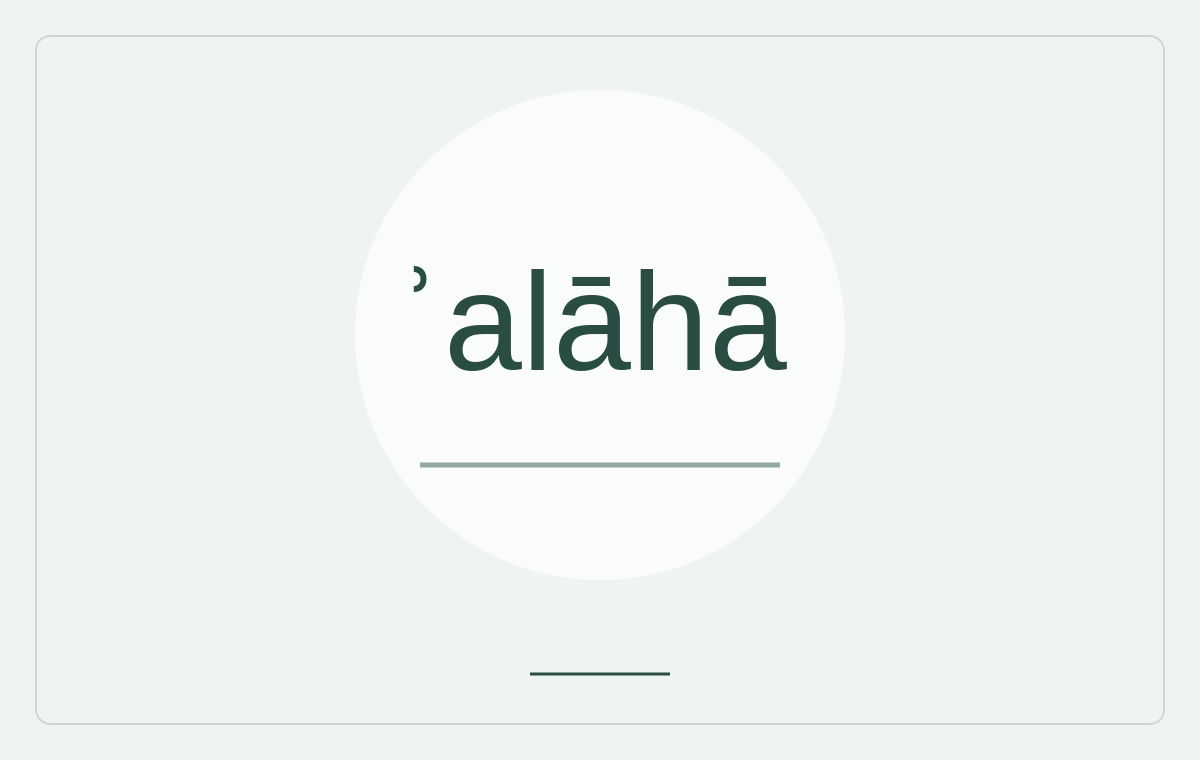
Scholars encounter vocalized and unvocalized spellings, and the letter shapes differ between the Estrangela, Serṭo and East Syriac scripts. The consonantal sequence and a particular written or spoken vocalization should therefore be considered separately. [2]
A singular in the emphatic state
The final aleph in ܐܠܗܐ belongs to what grammars call the emphatic state of a singular noun in SyriacSyriacAn Aramaic literary language rooted in Edessa, first attested in non-Christian inscriptions and later prominent in Christian writing, scholarship, translation and liturgy.Glossary · Click to read the explanation. Historically this Aramaic state was associated with definiteness, but in literary Syriac it became the usual citation form of many nouns. The last letter must not simply be equated with the Arabic definite article. Other inflected forms, including ܐܠܗ (ʾalāh), occur where grammar requires them. [3]
The noun has plural forms as well; in unvocalized writing, singular and plural spellings can resemble each other, while their vocalization and marks differ. In an ambiguous isolated excerpt, syntax and context matter more than a bare set of characters. Structurally, singular Alāhā is not the same type of form as the HebrewHebrewA Northwest Semitic language of the Canaanite group, encompassing Iron Age epigraphy, Biblical, Rabbinic, medieval and Modern Hebrew; its scripts and pronunciations changed over time.Glossary · Click to read the explanation plural ElohimElohimA Hebrew word with plural morphology, used for “gods” or for a singular deity according to context.Glossary · Click to read the explanation. [1]
Eastern and Western pronunciations
The form Alāhā approximates the Eastern pronunciation commonly represented in academic transliteration. Western Syriac religious traditions also use Aloho, reflecting phonological developments including the shift of older long ā toward o. Differences of pronunciation do not create separate deities. Conversely, the historical pronunciation of a specific ancient manuscript cannot be established from the modern transliteration alone; its period, script and reading tradition must be considered. [4]
From Aramaic to a literary language
Syriac is a historically literary variety of AramaicAramaicNorthwest Semitic language varieties documented since the early first millennium BCE, including Old and Imperial Aramaic, Syriac, Jewish dialects, and living Neo-Aramaic forms.Glossary · Click to read the explanation, especially associated with Edessa in northern MesopotamiaMesopotamiaHistorical region associated with the Tigris and Euphrates: Uruk, Ur, Eridu, cuneiform, Sumer, Akkad, Babylon and Assyria, their languages and cults, and the limits of archaeological evidence.Glossary · Click to read the explanation. Early inscriptions attest its writing in the region before the production of the large Christian corpus; Syriac later became a major language of Christian books, liturgy, poetry and translation. It would be misleading to treat every Syriac word as though it originated with Christian literature. Alāhā belongs to older shared vocabulary, whereas the specific sense of an occurrence depends on the text in which it appears. [5]
Cognates across Semitic languages
Alāhā belongs to a larger family of religious terms in the Semitic languagesSemitic languagesA branch of the Afroasiatic language family, including Akkadian, Ugaritic, Hebrew, Aramaic, Arabic, Ethio-Semitic and South Arabian languages; a linguistic, not racial or religious, classification.Glossary · Click to read the explanation. Compare Hebrew EloahEloahEloah (אֱלוֹהַּ) is a singular Hebrew noun meaning “a god” or “God,” common in Job but also used for other gods. It is not the proper name of a separate deity.Glossary · Click to read the explanation and the plural-shaped ElohimElohimA Hebrew word with plural morphology, used for “gods” or for a singular deity according to context.Glossary · Click to read the explanation, Arabic ilāhArabic ilahʾIlāh: Arabic common noun for a god or deity, with the broken plural āliha; distinct from the specific designation Allāh and understood from context.Glossary · Click to read the explanation (“deity”), and the religious use of AllāhAllahAllāh: the Arabic designation of the one God in Islam, also used in other Arabic-speaking traditions. Its pre-Islamic attestations vary in context and historical meaning.Glossary · Click to read the explanation. Linguistic kinshipLinguistic relatednessCommon linguistic descent demonstrated by systematic sound and morphological correspondences, unlike borrowing or accidental resemblance.Glossary · Click to read the explanation concerns historical forms and meanings; it neither makes these words morphologically interchangeable nor demonstrates that their users held identical doctrines. Similar spelling or sound is likewise insufficient evidence for a direct loan from Syriac into Arabic, or the reverse. Benjamin D. Suchard (2025) has proposed a historical morphological account of the broader word family. David Kiltz (2012) argues that Arabic Allāh can be explained by an internal Arabic development, while leaving the more specific Syriac form open to competing explanations, including internal development and possible Arabic influence. The contact history is not reducible to a one-way borrowing. [6]
Alāhā in the opening of John
One clear textual witness is John 1:1 in the Syriac version conventionally known as the Peshitta. In the clause rendered “the Word was with God,” the word for God is ܐܠܗܐ; it appears again in the declaration “the Word was God.” This is a theological statement in a literary context concerning the Word or LogosLogosGreek term for speech, explanation or reason, also used for cosmic rationality. Philo uses it in accounts of creation, while John’s prologue speaks of the Word becoming flesh; its function varies with context.Glossary · Click to read the explanation: its interpretation requires the passage as a whole rather than a dictionary gloss alone. The observation is based on a published Syriac text of this verse, not on a new collation of surviving manuscripts. [7]
Nor was the entire Syriac Bible translated in a single operation at one moment. The history of the Syriac Old Testament translation differs from that of the New Testament versions and the eventual standard text. A reference to the “original Syriac Bible” is therefore insufficiently precise unless the book and textual form are specified. [8]
“My God” in Thomas’s reply
In John 20:28, Thomas says ܡܪܝ ܘܐܠܗܝ, “My Lord and my God.” The second element, ܐܠܗܝ (ʾalāhī), includes a first-person possessive suffix. It is not graphically identical to the dictionary form ܐܠܗܐ, though it belongs to the same noun. The example shows why recognizing a word’s inflection matters when comparing passages or counting its attestations. [9]
Alāhā and Māryā
Syriac biblical and religious texts also employ ܡܪܝܐ (Māryā, “the Lord”), an important designation in traditions of rendering the biblical TetragrammatonTetragrammatonTerm for the four Hebrew letters יהוה (YHWH), the name of Israel’s deity in the Hebrew Bible; it does not establish an exact ancient pronunciation or agreed etymology.Glossary · Click to read the explanation. Māryā is not an alternative spelling of Alāhā: the words have different linguistic histories and functions, even when both refer to God within the same religious tradition. An occurrence of either “Lord” or “God” does not, by itself, prove that the original Hebrew name YHWHYahwehThe proper name of Israel’s deity, written יהוה (YHWH), the Tetragrammaton. Its exact ancient pronunciation is not directly preserved; texts and inscriptions witness its history.Glossary · Click to read the explanation was explicitly written at that point in the Syriac manuscript. [10]
In liturgy and living practice
Western Syriac worship uses expressions such as Qadishat Aloho (“Holy are you, O God”) in the Trisagion tradition. This shows the word as part of living prayer rather than merely a historical dictionary entry, while also illustrating pronunciation differences. The meaning of the surrounding prayer must be understood within its particular church’s liturgical and theological context, rather than inferred from the isolated noun. [11]
Beyond one Christian usage
No single tradition owns the root ʾ-l-h or all of its Aramaic forms. CAL cites examples from Jewish documents at ElephantineElephantine / YebElephantine / Yeb, near Aswan at the Nile’s First Cataract, preserves a long-lived Egyptian town, temples of Khnum and Satet, and Persian-period garrisons. Aramaic papyri document several communities, including Judeans and Yaho’s temple, whose rebuilding was sought in 407 BCE; claims and archaeological interpretations must be distinguished.Glossary · Click to read the explanation and a range of Aramaic writings, in which related words refer to Israel’s God or to other deities according to speaker and document. Such cases attest varied use of the vocabulary, but they should not all be called “Syriac” in the narrower sense of that specific literary variety. [12]
Syriac letters and Arabic texts
At later dates, Arabic-speaking Christian communities sometimes wrote Arabic in Syriac script, a practice known as Garshuni. In such material language and script must be identified separately: Syriac letters do not ensure that the words being read belong to the Syriac language. This scribal practice witnesses contact between cultures of writing, but it does not, on its own, establish the direct derivation of Arabic Allāh from Syriac Alāhā. [13]
A method for interpreting occurrences
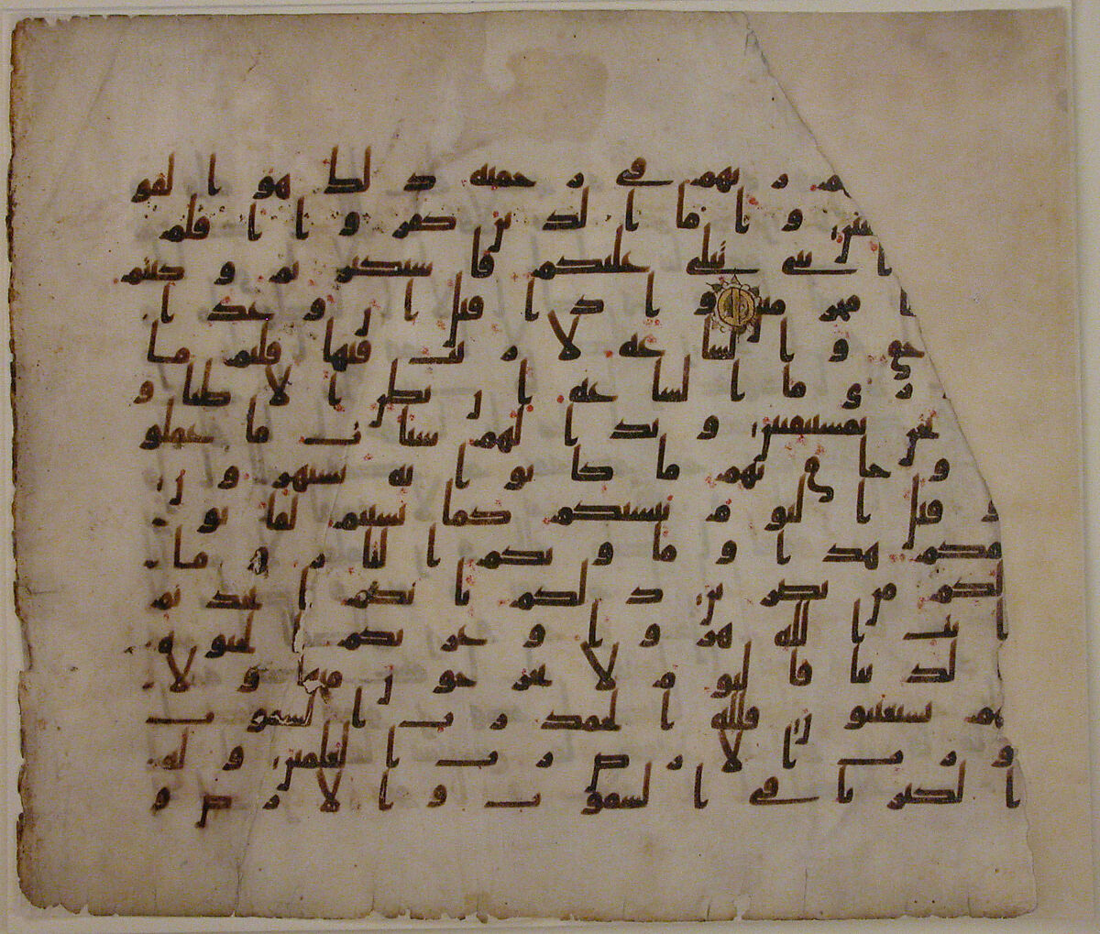
A sound identification starts by establishing the language and variety, reading the full expression and its inflection, and identifying the date and content of the actual witness. A Gospel, a hymn, a commentary and a social document may use related wording in different ways. Three shortcuts should be avoided: turning a common noun into a proper name; equating cognate sounds with a shared doctrine; and dating the origin of a word by the age of one photographed manuscript. The history of Alāhā intersects language, worship and textual transmission, without reducing one to another. [14]
References and notes (14)
- Comprehensive Aramaic Lexicon (CAL), Hebrew Union College, “ʾlh / ʾlhʾ,” accessed 18 October 2026. Lexical entry, senses “god/God,” and examples across Jewish and other Aramaic contexts; entry and its accessible attestations inspected. Return to the text ↑
- John F. Healey, “Script, Syriac,” Gorgias Encyclopedic Dictionary of the Syriac Heritage, electronic edition. Passages on the Aramaic ancestry of the script and Estrangela, Serṭo and East Syriac; online entry read. Return to the text ↑
- Theodor Nöldeke, Compendious Syriac Grammar, trans. J. A. Crichton (1904), digitized at Wikisource. Section on nominal states, especially “The Emphatic State,” digital scan page 86; not the complete book. Return to the text ↑
- Aaron M. Butts, “Syriac Language,” Gorgias Encyclopedic Dictionary of the Syriac Heritage. Discussion of East/West Syriac phonology, including the shift of ā to o; online entry read. Return to the text ↑
- Aaron M. Butts, “Syriac Language,” Gorgias Encyclopedic Dictionary of the Syriac Heritage; John F. Healey, “The Edessan Milieu and the Birth of Syriac,” Hugoye (2007). Opening of Butts’s language entry and early inscription discussion; Healey paragraphs 1–7, not the whole essay. Return to the text ↑
- David Kiltz, “The relationship between Arabic Allāh and Syriac Allāhā,” Der Islam 88/1 (2012), 33–50; compare Benjamin D. Suchard, Journal for the Study of the Old Testament (2025). Kiltz: abstract, introduction pp. 33–34, discussion pp. 45–46 and conclusion pp. 46–48 in accessible full-text transcription; Suchard: abstract and opening morphological sections, not both entire works. Return to the text ↑
- Syriac Peshitta, Gospel of John 1:1, Syriac text presented at Peshitta.eu. Syriac verse 1, both uses of ܐܠܗܐ, and neighbouring verses 1–3; no new critical collation of manuscripts. Return to the text ↑
- “Peshitta,” Gorgias Encyclopedic Dictionary of the Syriac Heritage, electronic edition. Definition, origins and dating of the Old Testament translation, and the introduction to New Testament textual history; not the entire entry. Return to the text ↑
- Syriac Peshitta, John 20:28, as displayed in BibleHub’s textual comparison. Read the specific Syriac line ܡܪܝ ܘܐܠܗܝ alongside the Greek; site devotional commentary not used as linguistic evidence. Return to the text ↑
- Comprehensive Aramaic Lexicon (CAL), entry mry / mryʾ, “lord/master”. Lexical distinction between ordinary lord/master and Syriac divine ܡܵܪܝܵܐ; summary entry consulted. Return to the text ↑
- Syriac Maronite Hymns, “Start Here: Learning the Hymns,” educational guide. Passages naming Qadishat Aloho and explaining Western versus Eastern pronunciation; liturgical teaching site, not a historical linguistic monograph. Return to the text ↑
- Comprehensive Aramaic Lexicon (CAL), entry ʾlh / ʾlhʾ with examples from Elephantine and other Aramaic sources. Lexical excerpts citing TAD, Ezra and related corpora; individual source documents were not read in full. Return to the text ↑
- Alessandro Mengozzi, “Garshuni,” Gorgias Encyclopedic Dictionary of the Syriac Heritage. Definition of Arabic written in Syriac script and the outline of its history; online entry read. Return to the text ↑
- Benjamin D. Suchard, “Semitic *ʾilāh- and Hebrew אלהים: From plural ‘gods’ to singular ‘God’,” Journal for the Study of the Old Testament (2025). Abstract and opening sections on Semitic cognates and proposed morphology of ʾilāh-; not the entire article. Return to the text ↑
Suggest a correction · Suggest a source for this record
Cite this record
IL Archive, «Alaha», https://ilarchive.com/en/entities/alaha
Continue reading