Entity · Concept
Semitic il
A reference page linking a name, group, or concept to the materials that discuss it.
A study of Semitic cognates for “god” from Akkadian to Arabic; it distinguishes the common noun from Ugaritic El and considers Elohim, compound names, and the limits of etymological hypotheses.
Estimated reading time: 6 min Published Last reviewed:
Share article

Video
The Name No One Owns | The Road of El
More than four thousand years ago a palace burned at Ebla, and one small word waited in its clay: ʾl, El. We follow it through names and inscriptions, from Ebla, Mari and Ugarit to the kings of Samʾal, Karatepe and Saba and the stones of the basalt desert, then set the Torah's names and the Arabic question side by side. Some scenes are AI-generated illustrations.
The YouTube player loads only when you press play. Watch on YouTube
Text
Introduction
How can a word related to “El” mean a deity in general in one context but name a particular deity in another? This entry examines the Semitic word and its attested cognates, not the biography of El in UgaritElEl is a senior deity in Late Bronze Age Ugaritic texts, portrayed as father of the divine family and a council authority, alongside his consort Athirat. This entry does not cover every linguistic use of El.Glossary · Click to read the explanation. It compares evidence from inscriptions, lexicons, HebrewHebrewA Northwest Semitic language of the Canaanite group, encompassing Iron Age epigraphy, Biblical, Rabbinic, medieval and Modern Hebrew; its scripts and pronunciations changed over time.Glossary · Click to read the explanation texts, and the Qur'an while keeping three questions separate: the form of a word, its role in a passage, and modern explanations of its origin.
A common noun and a proper name
Words related to El belong to the history of the Semitic languagesSemitic languagesA branch of the Afroasiatic language family, including Akkadian, Ugaritic, Hebrew, Aramaic, Arabic, Ethio-Semitic and South Arabian languages; a linguistic, not racial or religious, classification.Glossary · Click to read the explanation, a family that includes AkkadianAkkadianAn ancient East Semitic language written in cuneiform from the third millennium BCE; its varieties include Babylonian and Assyrian, and it served in international diplomacy.Glossary · Click to read the explanation, Ugaritic, Hebrew, Aramaic, and Arabic. A term can denote any god, serve as a proper nameProper nameA name that identifies a particular person, place, group, or entity in context, unlike a common noun denoting a class. Spelling alone may not settle the distinction.Glossary · Click to read the explanation, or form part of a title. In Ugaritic literature El often names a particular divine figure, whereas a cognate in a Hebrew passage may describe Israel's God. Sound resemblance alone does not settle the referent; syntax, genre, and setting matter. [1]
The distinction also affects translation: capitalizing El in English is an interpretative choice favoring a proper name, whereas god is a common nounCommon nounA noun referring to a member of a class, such as “city” or “god”, unlike a proper name designating a particular entity. Semitic il/El may fulfill either function in context.Glossary · Click to read the explanation. Ancient writing systems do not always mark the distinction in the way modern languages do. Consequently, cognate expressions need not all refer to the same Ugaritic figure.
Reconstructing a Semitic word
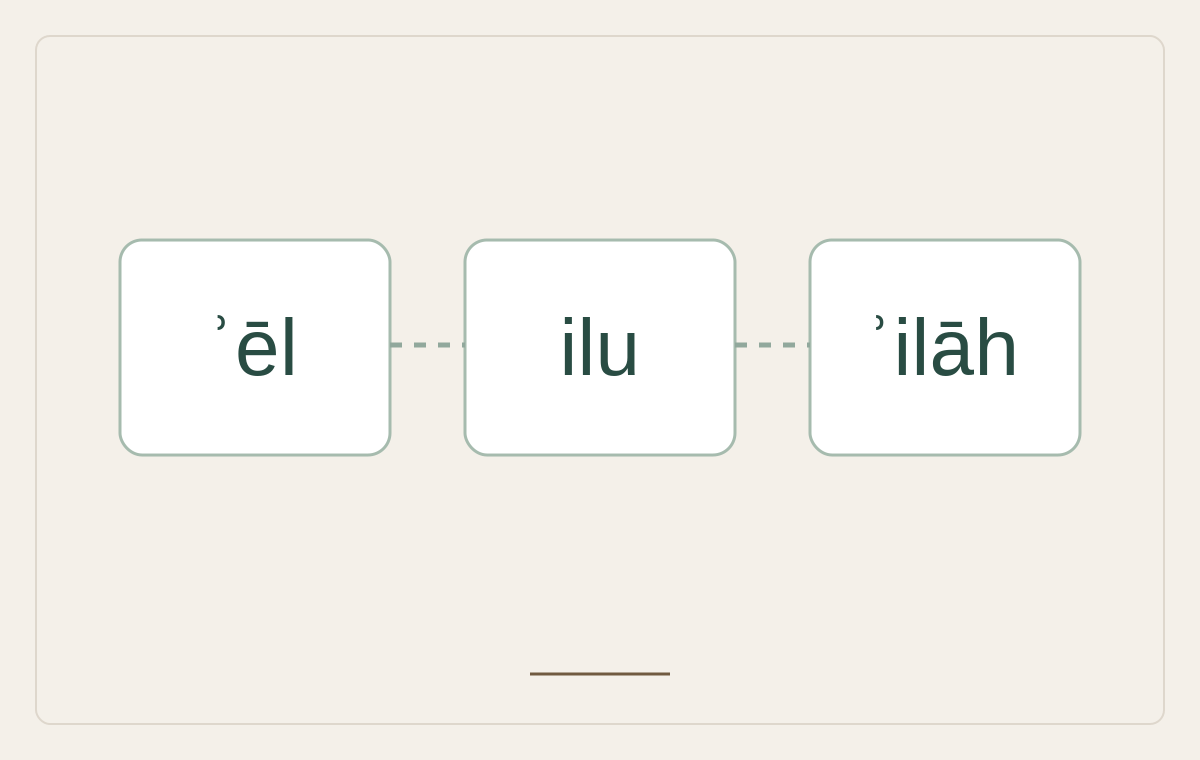
Comparative linguistics reconstructs an early Semitic form close to ʾil- meaning “god” from independent linguistic evidence, including Akkadian ilu, Ugaritic ʾil, Hebrew ʾēl, and other reflexes. The asterisk marks a scholarly reconstruction, not an inscription preserving the vowels of a single documented “Proto-SemiticProto-SemiticThe inferred ancestral language of Semitic, reconstructed from comparative sound, morphological and lexical evidence; no direct Proto-Semitic inscription survives.Glossary · Click to read the explanation” speaker. Vowels and endings vary between languages; sound correspondences and morphology are required, not just a resemblance between written letters. [2]
Older scholarship associated the word with “strength” or “power,” but its more remote etymology remains uncertain. Whether strength developed as a secondary sense of “god,” or whether the divine noun grew out of a word for power, cannot be decided by pointing to a similar word alone. Independent linguistic and historical arguments are needed. [3]
Akkadian: ilu and cuneiform writing
An ORACC Akkadian lexical corpus records ilu, including spellings i-lu and i-lum and the cuneiformCuneiformWriting with wedge-shaped signs, developed from Mesopotamian recording traditions and used for several languages from the third millennium BCE.Glossary · Click to read the explanation writing DINGIR, with the lexical sense “god.” Plural forms include ilānu. These attest an Akkadian common noun, not the worship of the specific Ugaritic figure in every occurrence. [4]
Sumerian–Akkadian lexical lists equate Sumerian diŋir with Akkadian ilu. Yet DINGIR may act as a logogram for “god” or as a determinative preceding a divine name, according to its use in the text. Distinguishing an unpronounced graphic sign from a pronounced Akkadian word is essential before treating the sign as evidence for a proper name. [5]
Ugarit: the word and the deity El
In the archives of UgaritUgaritAncient city and kingdom at Ras Shamra on the Syrian coast, flourishing between the fourteenth and early twelfth centuries BCE and preserving multilingual archives.Glossary · Click to read the explanation, a coastal Syrian city that flourished during the Late Bronze AgeLate Bronze AgeAn archaeological period around 1600–1200 BCE in much of the Near East, with international diplomacy, exchange and religious diversity; its endpoints vary by region.Glossary · Click to read the explanation, the form ʾil was written in the Ugaritic cuneiform alphabet. Mythological works including the Baal CycleBaal CycleA group of Late Bronze Age Ugaritic religious texts recounting Baal’s conflicts, relationships with the gods and the building of his palace.Glossary · Click to read the explanation employ El as the name of the head of a divine family, in contexts that describe his relations with other deities. In other contexts, the ʾil word family can function as a generic designation for a god. This is a difference of usage, not evidence for a second figure created by a spelling variation. [6]
The article's cover is a modern conceptual artwork; the comparison below is a modern typographic diagram made by the archive. Its connecting lines are not a complete linguistic family tree or a borrowing route, and ʾilāh differs morphologically from ʾil.
The Louvre holds Ugaritic tablets from the Baal Cycle, including two joined fragments catalogued as AO 16641 and AO 16642 and broadly dated to 1400–1200 BCE. A particular inscribed tablet enables contextual study, but an image of it alone does not prove that every word discussed here appears on the photographed face. The museum reference documents the material setting, not a claim to have read the tablet line by line. [7]
Hebrew: El, Eloah, and Elohim
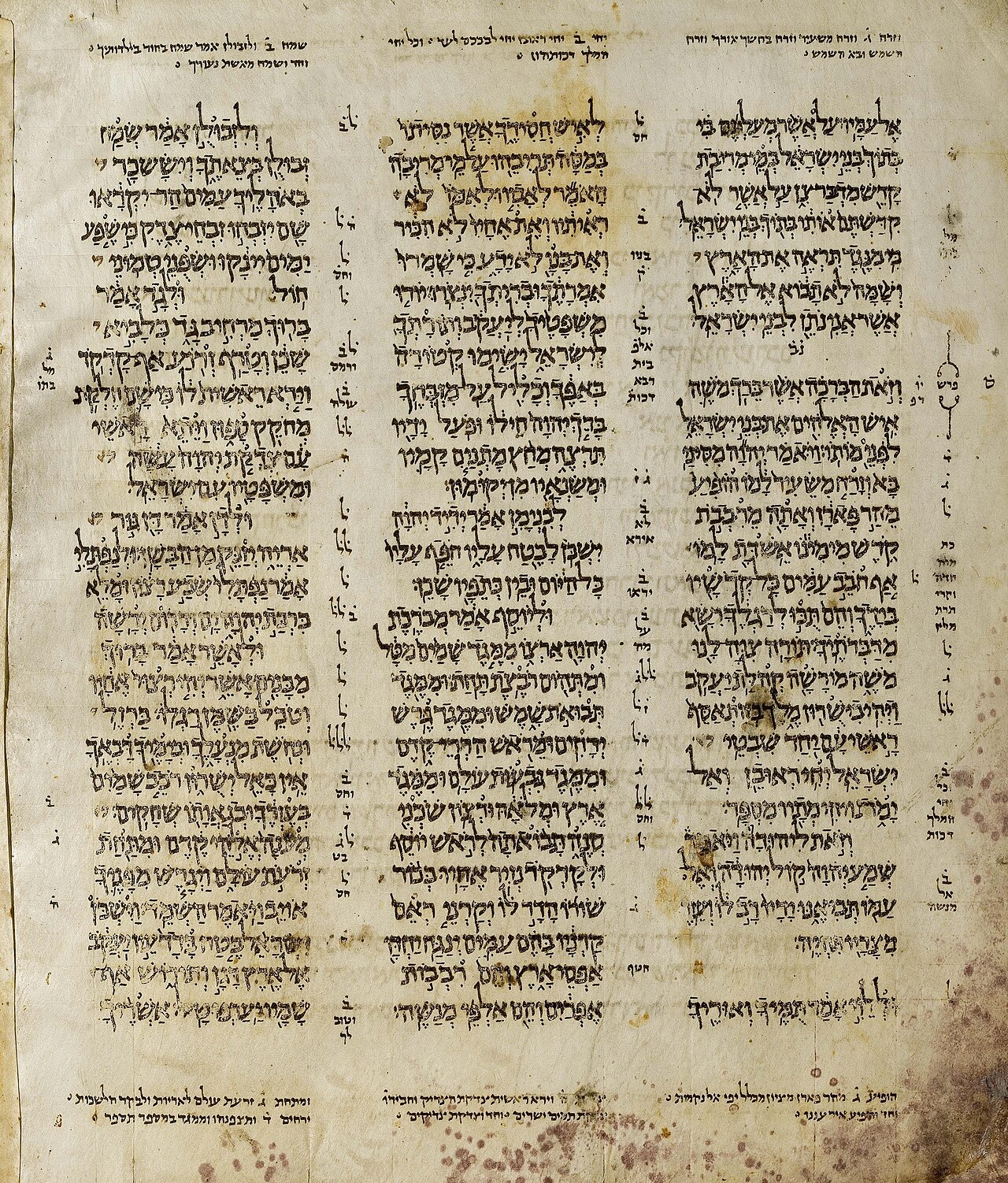
Biblical HebrewHebrewA Northwest Semitic language of the Canaanite group, encompassing Iron Age epigraphy, Biblical, Rabbinic, medieval and Modern Hebrew; its scripts and pronunciations changed over time.Glossary · Click to read the explanation has ʾēl (אֵל), ʾĕlōah (אֱלוֹהַּ), and ʾĕlōhîm (אֱלֹהִים). Their frequency and functions differ: ʾēl occurs in epithets, compounds, and poetry; ʾĕlōah is conspicuous in poetry, especially Job; and ʾĕlōhîm is common in prose as well. Listing these forms cannot replace determining the meaning of each occurrence. [8]
ʾĔlōhîm is plural in form, but depending on its construction it can mean either “gods” or singular “god/God.” In Genesis 1:1, the verb “created” (בָּרָא, bārāʾ) is singular alongside ʾĕlōhîm. That is direct grammatical evidence that the passage refers to a singular actor; the noun's morphology alone cannot tell us the history of the author's or audience's religious beliefs. [9]
Psalm 82:1 uses ʾĕlōhîm both near the opening and at the end in a scene of assembly and judgment. Translations of the latter occurrence vary among “gods,” “divine beings,” and “judges.” Interpretation thus depends on the scene and translation decisions, rather than assigning one fixed sense to every occurrence. [10]
Aramaic and Arabic: elah and ilah
Biblical AramaicAramaicNorthwest Semitic language varieties documented since the early first millennium BCE, including Old and Imperial Aramaic, Syriac, Jewish dialects, and living Neo-Aramaic forms.Glossary · Click to read the explanation uses ʾĕlāh (אֱלָהּ) for a god, as well as the emphatic form ʾĕlāhā and plural forms. These are related to Arabic ʾilāhArabic ilahʾIlāh: Arabic common noun for a god or deity, with the broken plural āliha; distinct from the specific designation Allāh and understood from context.Glossary · Click to read the explanation (“deity”), despite historical differences in morphology and inflection. The presence of h in the word family is not mere ornamental spelling, nor does it by itself demonstrate that Arabic borrowed the term directly from Aramaic. [11]
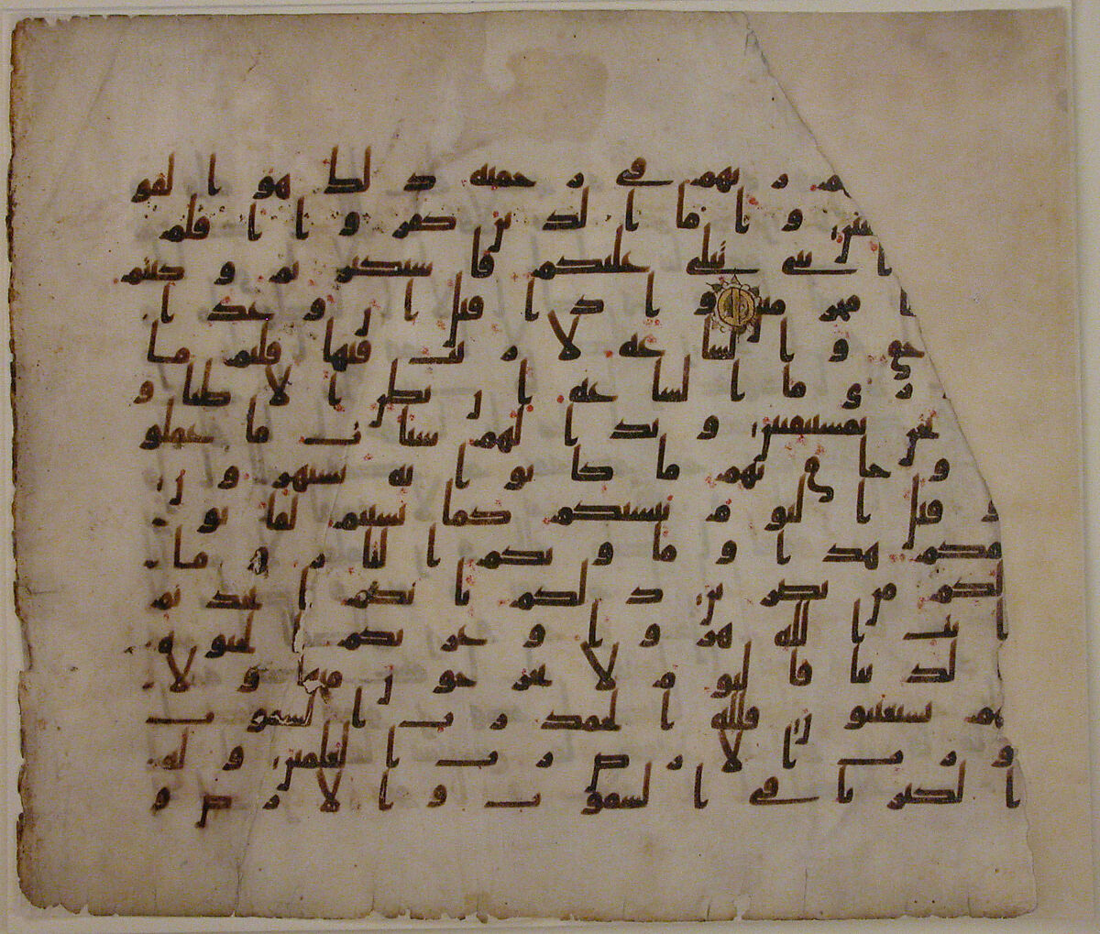
The morphological annotation of the Qur'an distinguishes the common noun ʾilāh, whose plural is ālihah, from AllāhAllahAllāh: the Arabic designation of the one God in Islam, also used in other Arabic-speaking traditions. Its pre-Islamic attestations vary in context and historical meaning.Glossary · Click to read the explanation, treated as a proper noun in Qur'anic usage. Qur'an 21:22 contains plural ālihah, whereas 112:1 has Allāh as a proper name. Those textual observations alone do not resolve every historical etymology proposed for Allāh; nor do they make Arabic ʾilāh the name of the Ugaritic god El. [12]
Compounds, epithets, and personal names
The shared element can occur in a personal name or divine epithet. Exodus 6:3 mentions El ShaddaiEl ShaddaiA compound El name or title associated with ancestral narratives and identified with Yahweh in Exodus 6; Shaddai’s meaning and etymology remain uncertain.Glossary · Click to read the explanation in the narrative about the ancestors and sets it alongside the disclosure of the name YHWHYahwehThe proper name of Israel’s deity, written יהוה (YHWH), the Tetragrammaton. Its exact ancient pronunciation is not directly preserved; texts and inscriptions witness its history.Glossary · Click to read the explanation. The passage itself does not establish when the title arose or how two divine traditions became associated historically: it is evidence for the wording of a biblical narrative that relates both names while distinguishing their settings. [13]
Genesis 33:20 preserves El Elohe Israel in the Hebrew account of Jacob naming an altar. The expression is variously rendered “El, the God of Israel” or “God, the God of Israel”; context informs its meaning. Nor does the presence of El in people's names show that all bearers worshiped an identical deity. A separate study of the element El in names explores that question. [14]
Where historical interpretation begins
The lexical comparison establishes related terms for “god”; it does not yield a single chain of literal borrowing from one language into all the others. In 2025, Benjamin D. Suchard proposed a morphological explanation in which reconstructed ʾilāh-, potentially originating as a broken plural, acquired singular meaning and helps account for Hebrew ʾĕlōhîm as well as Aramaic and Arabic forms. This is an argued scholarly hypothesis, for which the author discusses alternatives and limitations, not testimony from Proto-Semitic speakers directly recording the change. [2]
Three questions remain distinct: are two words historically cognate; does a particular passage use one as a common noun or as a proper name; and did ideas about a god move or cults merge historically? Comparative phonology and morphology address the first, close reading addresses the second, and the third needs additional religious and historical evidence. This entry helps identify names; it does not reduce the histories of Ugaritic ElElEl is a senior deity in Late Bronze Age Ugaritic texts, portrayed as father of the divine family and a council authority, alongside his consort Athirat. This entry does not cover every linguistic use of El.Glossary · Click to read the explanation or YHWHYahwehThe proper name of Israel’s deity, written יהוה (YHWH), the Tetragrammaton. Its exact ancient pronunciation is not directly preserved; texts and inscriptions witness its history.Glossary · Click to read the explanation to a shared syllable.
References and notes (14)
- Heath D. Dewrell and Andrew M. Garbarino, “Names of God in the Hebrew Bible,” Oxford Bibliographies in Biblical Studies, 24 April 2023. The accessible introduction distinguishes El as a common noun or a proper name according to context. Open introduction only, not the entire reference article Return to the text ↑
- Benjamin D. Suchard, “Semitic *ʾilāh- and Hebrew אלהים: From plural ‘gods’ to singular ‘God’,” Journal for the Study of the Old Testament 49, no. 4 (online 29 May 2025), DOI: 10.1177/03090892251332286. An argued morphological reconstruction, not direct ancient testimony. Full accessible main argument through the conclusion; selected footnotes, not the entire bibliography Return to the text ↑
- Louis F. Hartman and S. David Sperling, “God, Names of,” Encyclopaedia Judaica, 2nd ed., available on Jewish Virtual Library; the “ʾEl” section considers the uncertain etymology and competing explanations involving strength. Entire “ʾEl” section and relevant portions on epithets and Elohim Return to the text ↑
- ORACC, Akkadian ilu [GOD] (noun), indexed glossary excerpt listing DINGIR, i-lu, i-lum, and ilānu. Direct access failed; only the indexed entry excerpt was inspected. Indexed lexicon excerpt only; direct page unreachable Return to the text ↑
- ORACC ePSD2, Sumerian diŋir [deity], indexed entry noting lexical equivalence with Akkadian ilu. Only a search-indexed excerpt was available; the distinction between logogram and determinative is contextual. Indexed lexicon excerpt only; full page could not be retrieved Return to the text ↑
- Hartman and Sperling, “God, Names of,” Encyclopaedia Judaica, “ʾEl” section on the proper name of Ugaritic El as opposed to the common noun; compare Dewrell and Garbarino, note 1. “ʾEl” section; and open introductory extract of the Oxford reference Return to the text ↑
- Musée du Louvre, object record for joined Ugaritic fragments AO 16641 and AO 16642, Ras Shamra, circa 1400–1200 BCE, alphabetic cuneiform. Consulted for context; the inscribed lines were not independently deciphered. Museum record: identity, description, dating and findspot Return to the text ↑
- Francis Brown, S. R. Driver, and C. A. Briggs, Hebrew and English Lexicon (BDB), 1906, entries 410 (ʾēl), 433 (ʾĕlōah), and 430 (ʾĕlōhîm), compared with Suchard (note 2). Relevant indexed headwords, not the entire dictionary Return to the text ↑
- Genesis 1:1, Hebrew text and morphological analysis: בָּרָא is masculine singular; אֱלֹהִים has a plural noun form. Bible Hub provides verse analysis, not a complete manuscript-based critical edition. Genesis 1:1 and the relevant word-by-word morphology Return to the text ↑
- Psalm 82:1, Hebrew interlinear and grammatical analysis on Bible Hub, with two instances of אֱלֹהִים in an assembly and judgment scene and differing translations of the second. Psalm 82:1 only; corresponding translations on the page Return to the text ↑
- Brown, Driver, and Briggs, BDB, Biblical Aramaic אֱלָהּ (entry 426), including emphatic and plural forms, compared with Suchard (note 2). Lexicon entry 426 and the Aramaic/Arabic sections of Suchard’s article Return to the text ↑
- Quranic Arabic Corpus, root أ ل ه and word-by-word analysis of Qur’an 21:22 (ālihah) and 112:1 (Allāh). The corpus labels Qur’anic morphology, not the full pre-Qur’anic etymology. Root dictionary entry and word-level pages for 21:22 and 112:1 Return to the text ↑
- Exodus 6:3, Hebrew morphological text on Bible Hub: בְּאֵל שַׁדָּי and יהוה occur in the narrative; the verse itself does not date the historical origin of either designation. Exodus 6:3 and its lexical/morphological analysis Return to the text ↑
- Genesis 33:20, Hebrew word-by-word text with אֵל אֱלֹהֵי יִשְׂרָאֵל in the altar-naming account; not evidence for the deity worshiped by all bearers of El-names. Genesis 33:20, text and morphology only Return to the text ↑
Suggest a correction · Suggest a source for this record
Cite this record
IL Archive, «Semitic il», https://ilarchive.com/en/entities/semitic-il
Continue reading