Study
Weighing the Heart in Egypt: Justice, Ritual and the Afterlife
An extended study of a topic, with evidence and references.
- Timeline
- From 230 BCE to 150 BCE
- Region
- Egypt
Reading judgment before Osiris through Maat, the heart and the Book of the Dead: ethics, texts and ritual without assuming a single timeless scene.
Share article
Text
In the weighing of the heart, preserving a body is not by itself a guarantee of another life. The deceased enters a realm concerned with conduct, and the heart participates in judgment. Yet ethical accountability is accompanied by texts, ritualRitualAn organised or distinguished practice meaningful to a community; it may leave traces, but its form alone does not reveal an associated doctrine.Glossary · Click to read the explanation and knowledge needed to negotiate the next world. Egyptian funerary religion cannot be compressed into either ethics without rites or rites without ethics.
A heart before a tribunal
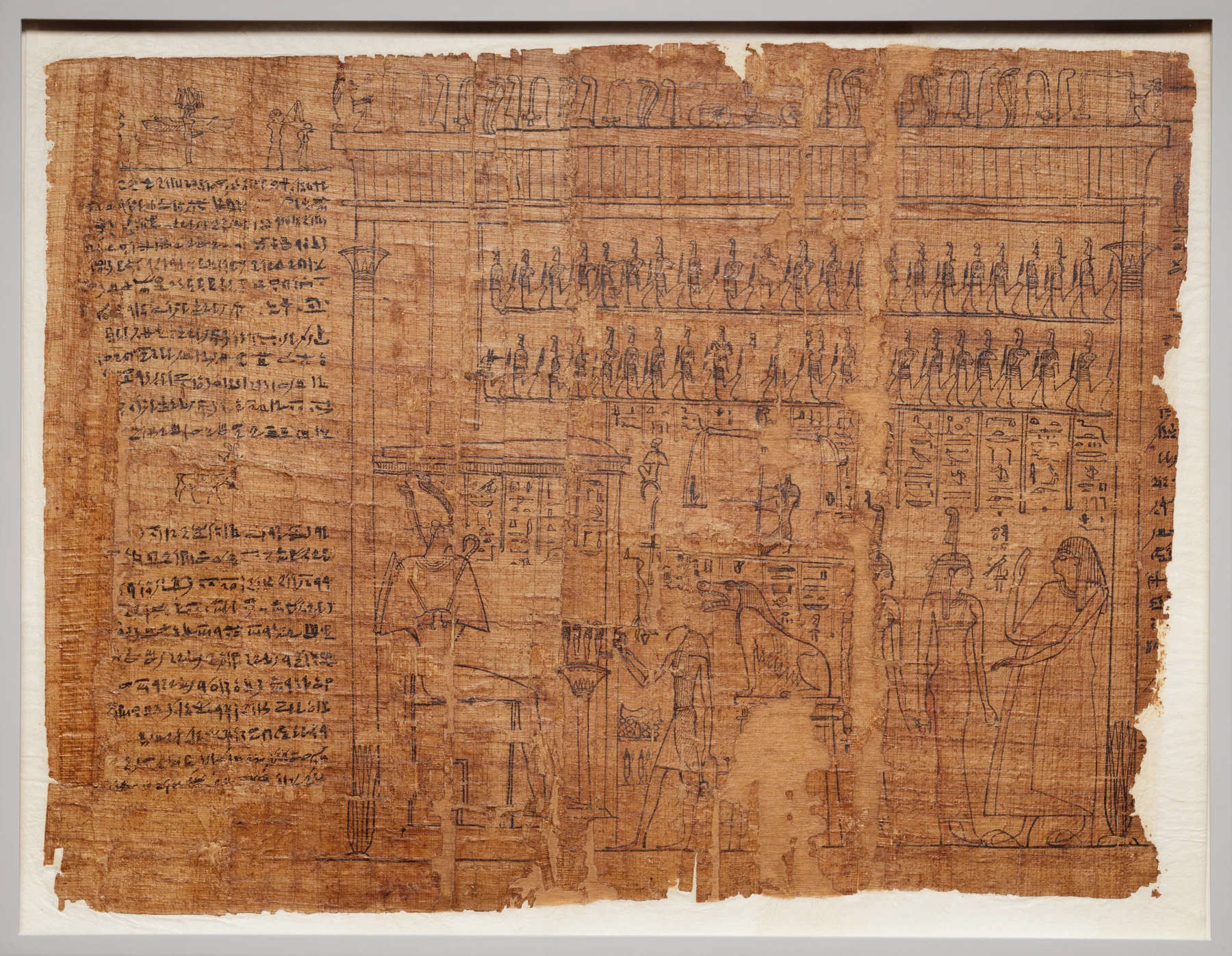
Metropolitan Museum papyrus 66.99.142 provides a material example. It dates to the Ptolemaic period, approximately 230–150 BCE, and depicts judgment before OsirisOsirisEgyptian deity associated with the dead and continued life, presiding over judgment in funerary papyri such as 66.99.142.Glossary · Click to read the explanation. It is a late witness to a wider tradition, not a date for that tradition’s first emergence.[1]
Within the scene, the heart represents thought, emotion and personhood rather than an organ subjected to a medical test. Weighing gives a lived life a visible outcome. Something inside the body becomes testimony concerning its owner.
Maat is more than goodness
MaatMaatAncient Egyptian right order, truth and rectitude, also divinely personified; represented in heart-weighing by a feather or a goddess’s figure.Glossary · Click to read the explanation combines right order, truth and rectitude with a divine personification. The comparison of heart and Maat therefore exceeds a modern tally of good and bad deeds. It concerns agreement with an order understood to sustain the world.[1]
Familiar scenes use Maat’s feather, but this particular papyrus places a small figure of Maat on the balance. The object itself warns against a single standardized picture for every period and manuscript. What is present should be read, rather than replaced with a remembered textbook image.
Distinct roles within the scene
Anubis participates in weighing, Thoth records or presents the result, and Osiris presides over reception and judgment. Judges and the devouring creature Ammut also appear. These are organized functions, not decorative figures arranged around a dead person.[1]
The scene need not duplicate a particular earthly court. Its judicial structure nevertheless makes the afterlife intelligible through testimony, authority and decision. The museum’s reading connects success with acceptance by Osiris and failure with destruction, rather than universal eternal life regardless of behavior.
Declaring innocence
The deceased’s declaration of not having committed condemned acts has ethical content. It also belongs to prepared funerary practice. It is not an independent biography proving that every owner of such a papyrus never did wrong.[1][2]
We can study what a culture wished to deny of its dead and what it regarded as unacceptable without mistaking the declaration for a factual record. Its words help construct an identity fit to pass the tribunal; they do not provide a modern judicial confession.
What kind of book was the Book of the Dead?
The Book of the DeadEgyptian Book of the DeadModern designation for funerary texts and images aiding the deceased in the next world; spells and their arrangement vary between manuscripts.Glossary · Click to read the explanation is a modern designation for funerary compositions associated with coming forth by day. It is not one author’s work with a uniform final edition. Imhotep’s Metropolitan Museum papyrus demonstrates that spells and pictures do not all follow one story from death to arrival.[3]
Some protect against danger, some provide names or knowledge, and others enable transformation or continuation. The judgment scene belongs within these many provisions for a person’s destiny, not simply within a detachable moral lesson.
Did later religions borrow judgment from Egypt?
Postmortem accountability in different traditions invites comparison, but resemblance does not by itself supply a route of transmission. A specific later text, its date, contact environment and detailed correspondences must be identified, alongside shared traditionShared traditionInherited material reaching several texts without direct dependence between them.Glossary · Click to read the explanation or independent developmentIndependent developmentSimilar elements arising without historical transmission between them.Glossary · Click to read the explanation.
A balance alone cannot establish that every later account of afterlife justice derives from Egyptian papyri. Similarity may first reveal a recurring human question about a just destiny, before establishing any particular historical chain.
The Egyptian scene makes a closer finding possible. Continued existence could require a preserved body, words, knowledge, ritual and an acceptable place within right order. The heart does not face judgment alone: gods, texts and prepared resources surround it in the effort to make life beyond death possible.
Connected readings
Akhenaten and Aten · Living above the dead · Similarity and borrowing
References and notes
- Ptolemaic funerary papyrus depicting judgment before Osiris; elements read from this particular object, not assumed universal. Met 66.99.142; ca. 230–150 BCE Return to the text ↑
- Museum explanation of judgment and ethical conduct in Imhotep’s papyrus. The Weighing of the Heart, Met, 2016 Return to the text ↑
- Curatorial study of Imhotep’s papyrus: spells and images rather than one sequential narrative; protection, knowledge and transformation. Janice Kamrin, 2016; Met 35.9.20a–w Return to the text ↑
Suggest a correction · Suggest a source for this record
Cite this record
IL Archive, «Weighing the Heart in Egypt: Justice, Ritual and the Afterlife», Edition 1, https://ilarchive.com/en/studies/egyptian-weighing-of-heart
Continue reading