Study
The Natufians: What Happened to Religion When People Began to Settle?
An extended study of a topic, with evidence and references.
- Timeline
- From 13000 BCE to 9500 BCE
- Region
- The Levant
Houses, graves, ornaments, feasts and place memory before fully developed agriculture: Natufian evidence and its limits for reconstructing rituals, ancestors and gods.
Share article
Text
Before the sacred had an address
About fifteen thousand calibrated years before the present, around 13,000 BCE, some hunter-gatherers in the LevantThe LevantThe Levant is a regional name for lands along the eastern MediterraneanGlossary · Click to read the explanation began doing something that would change their relationship with land, the dead and perhaps the sacred itself. They began to stay.
Fully developed agriculture had not yet emerged. Cereals were not domesticated crops in the later sense, nor sheep and goats domestic herds. Yet sites contained stone-built houses, heavy grinding equipment, installations sometimes interpreted as storage facilities, hearths and graves: things difficult to carry to a new camp every few weeks. Some communities repeatedly returned, stayed for long periods, built and buried their dead there.
Archaeologists call this the Natufian cultureNatufian cultureA late Epipalaeolithic Levantine archaeological culture, with some long-duration settlements before fully developed agriculture.Glossary · Click to read the explanation, broadly dated to c.13,000–9500 BCE in the Levant. These are approximate boundaries; sites and publications differ, and estimates do not establish a single uniform beginning.[1]
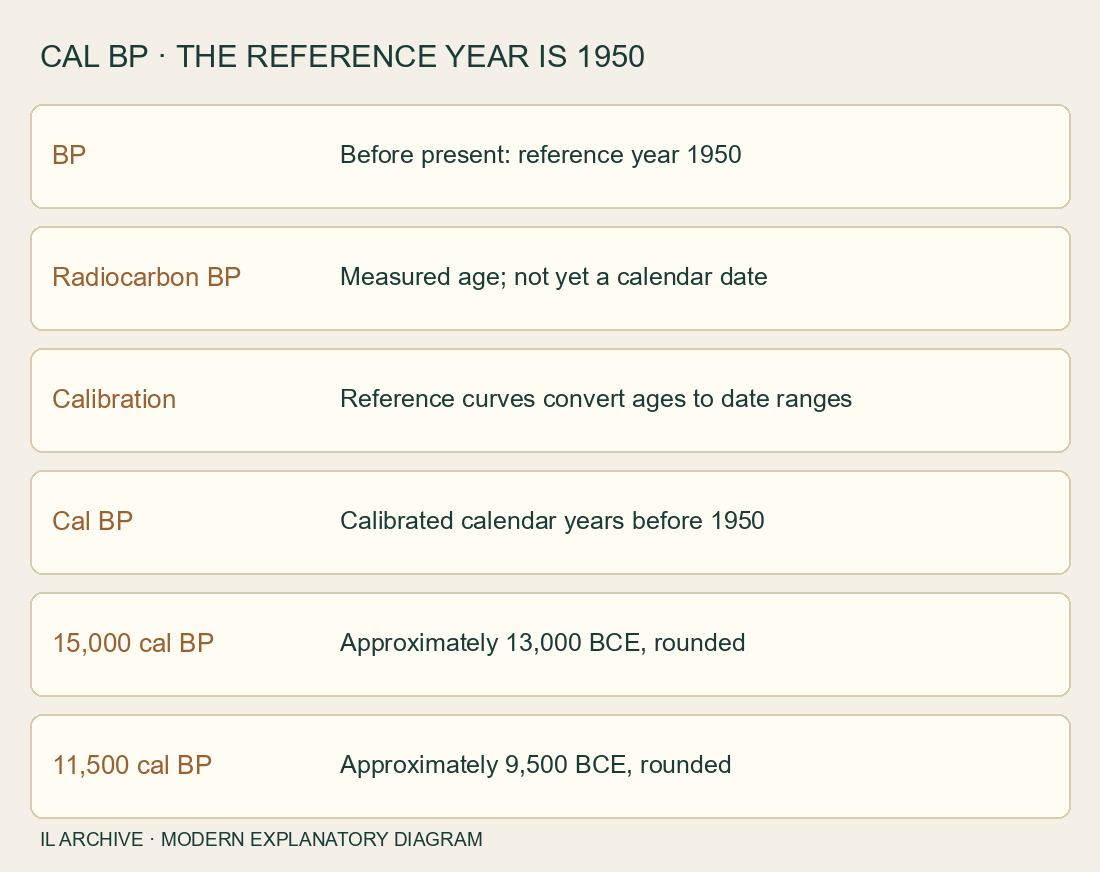
Here, cal BPCalibrated years before present (cal BP)A calendar dating convention anchored to 1950, distinct from an uncalibrated radiocarbon age.Glossary · Click to read the explanation means calibrated calendar years before 1950, rather than before the year this article was written. Approximately 15,000–11,500 cal BP corresponds, in rounded terms, to 13,000–9500 BCE. An uncalibrated radiocarbon age cannot be converted into a calendar date simply by subtracting 1950.[11]
The transformation concerns more than settlement and agriculture. Staying allows a place to acquire a history. The question is no longer only where people performed ritualsRitualAn organised or distinguished practice meaningful to a community; it may leave traces, but its form alone does not reveal an associated doctrine.Glossary · Click to read the explanation, but what happens to the sacred when people have a home to revisit, ground to inhabit, dead nearby and locations remembered across generations.
Research places the Natufian at an important transition between mobile foraging societies and Neolithic agricultural communities, with changes in settlement, subsistence, social relationships and ritual practices. These changes were uneven across sites.[1]
Who were the Natufians?
Natufian is not a name these people are known to have used for themselves. We do not know what they called their communities or what language they spoke. No writing supplies the name of a tribe, deity or ancestor. It is an archaeological label for a material culture of the late Epipalaeolithic Levant.
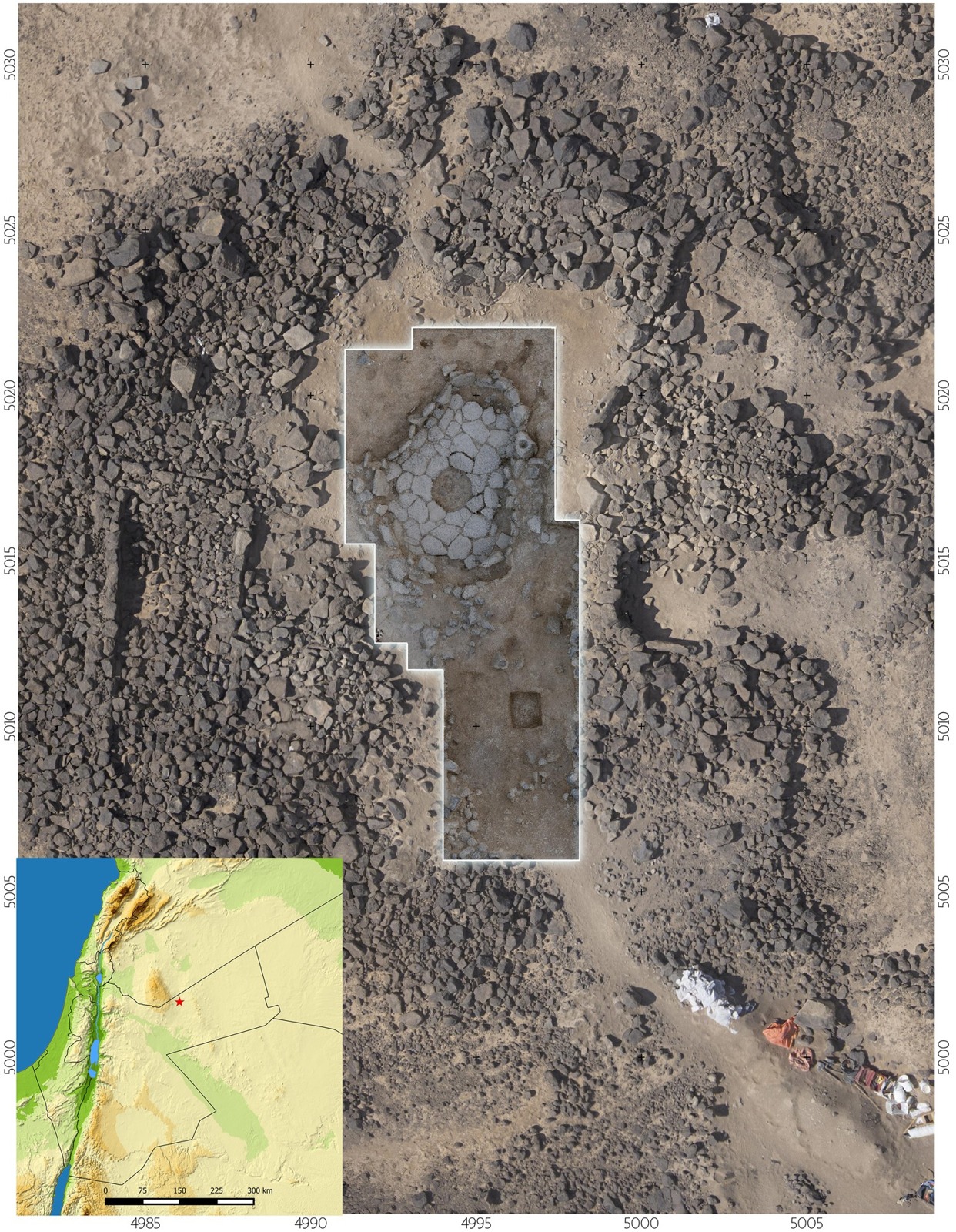
Its sites occur in areas of present-day Palestine, Jordan, Lebanon and Syria, with concentrations in Galilee, Mount Carmel and the Jordan Valley. Shubayqa 1 in northeast Jordan shows that the culture was not confined to the Mediterranean environments once considered its core.[1]
Nor does the label describe one society unchanged for three millennia. Sites, regions and phases differ. Some communities were more settled; others may have remained seasonal or partly mobile. Burial and occupation patterns also changed. An image of the first permanent village fits certain contexts better than it describes every Natufian person.
Settlement before agriculture
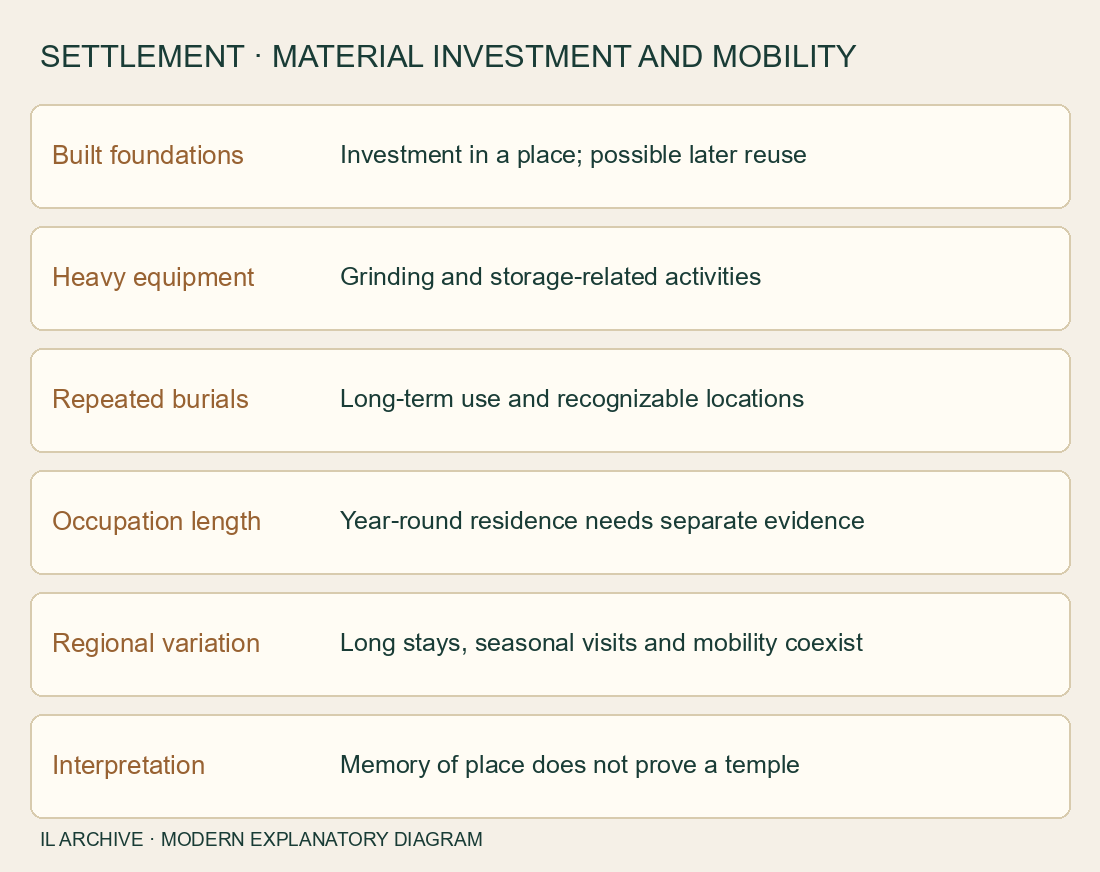
SedentismSedentismReduced residential mobility and prolonged or recurring occupation; architecture alone does not establish year-round residence.Glossary · Click to read the explanation refers here to reduced residential mobility, extended stays or repeated returns. Permanent year-round residence requires its own evidence.
For a long time, a sequence of agriculture, surplus, settlement and village seemed self-evident. The Natufian record shows that events could also proceed differently: some communities hunting animals and gathering wild plants invested in long-duration settlements before fully developed agriculture.
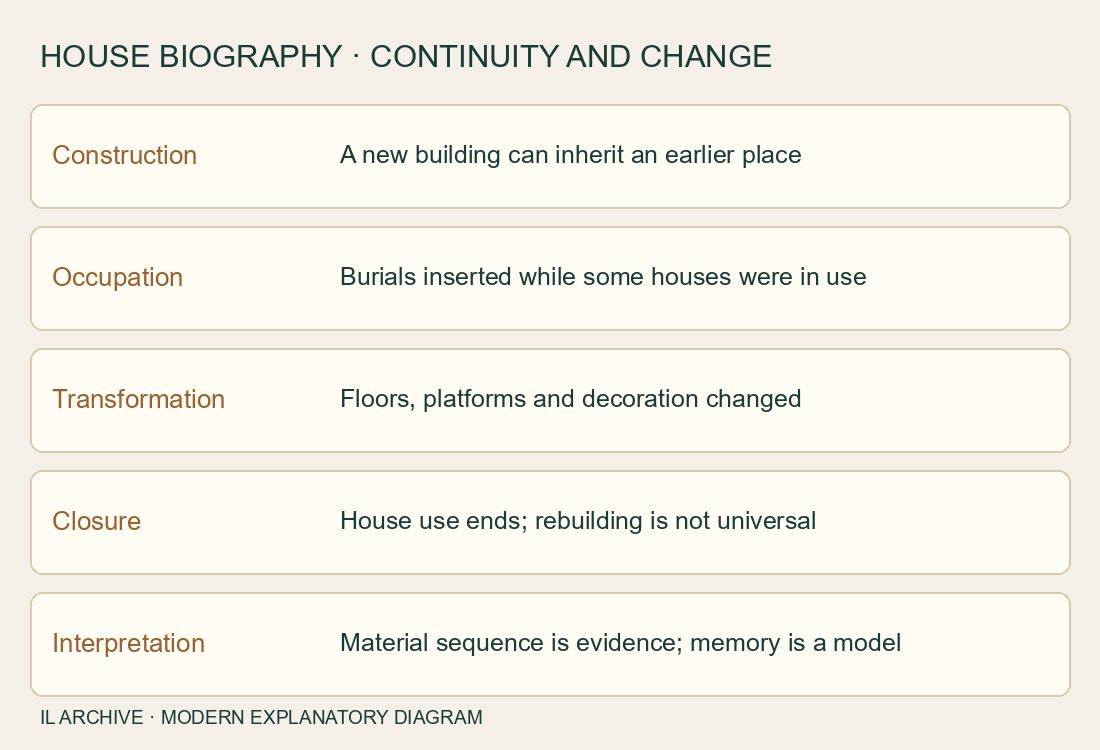
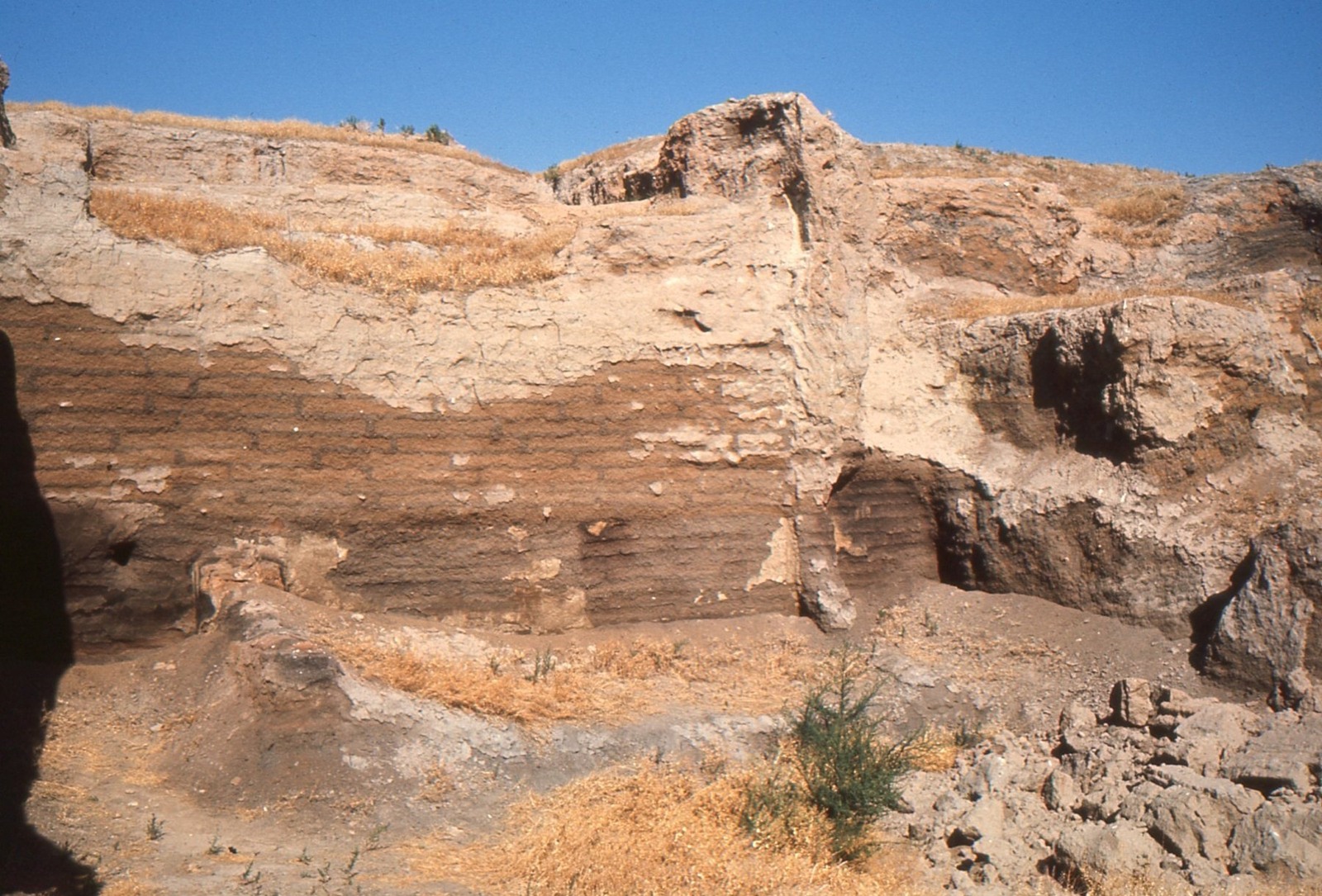
Eynan, also known as Ain Mallaha, in the upper Jordan Valley is a prominent example. Excavations revealed circular or semicircular buildings sunk partly into the ground, together with numerous burials, grinding equipment, animal bones and stone tools. It helped establish that sedentism could precede agriculture.[2]
Its inhabitants continued to hunt, fish and gather. Nevertheless, they invested heavily in their surroundings: building, grinding, storing resources and burying people. Such investment differs from a group visiting a place once and never returning.
Settlement was not a switch
It is tempting to turn this into a straight line: mobile hunters settled, began farming and eventually built cities. The evidence is more complex. Some Natufian sites indicate prolonged residence; others were occupied intermittently. Mobility may have increased again in some late contexts.
Wadi Hammeh 27 in Jordan illustrates substantial architectural investment, but the length of individual stays and frequency of return remain questions. Researchers therefore distinguish sedentism and semi-sedentism without assuming every Natufian community inhabited a fixed village throughout the year.[3]
This matters for religion too. We are not seeking an instant when mobile people suddenly acquired sacred places. We are tracing a longer process in which relationships between communities and locations became denser and more lasting.
What changes when you know you will return?
Mobile groups can certainly have sacred places. Religion does not require a village, and burial and potentially ritual or symbolic behaviour long predate the Natufian. Settlement did not invent religion, but it may have changed the conditions in which it was practised.
When people expect to return, they can build something they need not carry, hollow a mortar into rock, bury someone and remember the location years later, reuse a structure, leave something for an unborn generation and attach a family or community story to a fixed point. A place can retain memory alongside the people who remember it.
The dead became part of the place
At several Natufian sites, burial became denser and more organized. Human burial was much older, but repeated treatment of the dead became closely associated with locations revisited over generations.
At Eynan, some early graves were associated with building floors and some individuals wore ornaments. Later phases included pits containing several people. El-Wad, Nahal Oren, HayonimHayonim CaveA Galilean cave with Natufian graves and ornaments; its long funerary use informs research on identity and place memory.Glossary · Click to read the explanation and RaqefetRaqefet CaveA Mount Carmel cave with plant-lined burial evidence and mortars whose possible use for brewing has been debated.Glossary · Click to read the explanation also preserve substantial burial groups, sometimes discussed as early cemeteries.[2][5]
At certain sites, a grave therefore became part of a community's social geography. The dead were not simply bodies left at a location that the living would never revisit.
Hayonim: a burial place used for over three thousand years
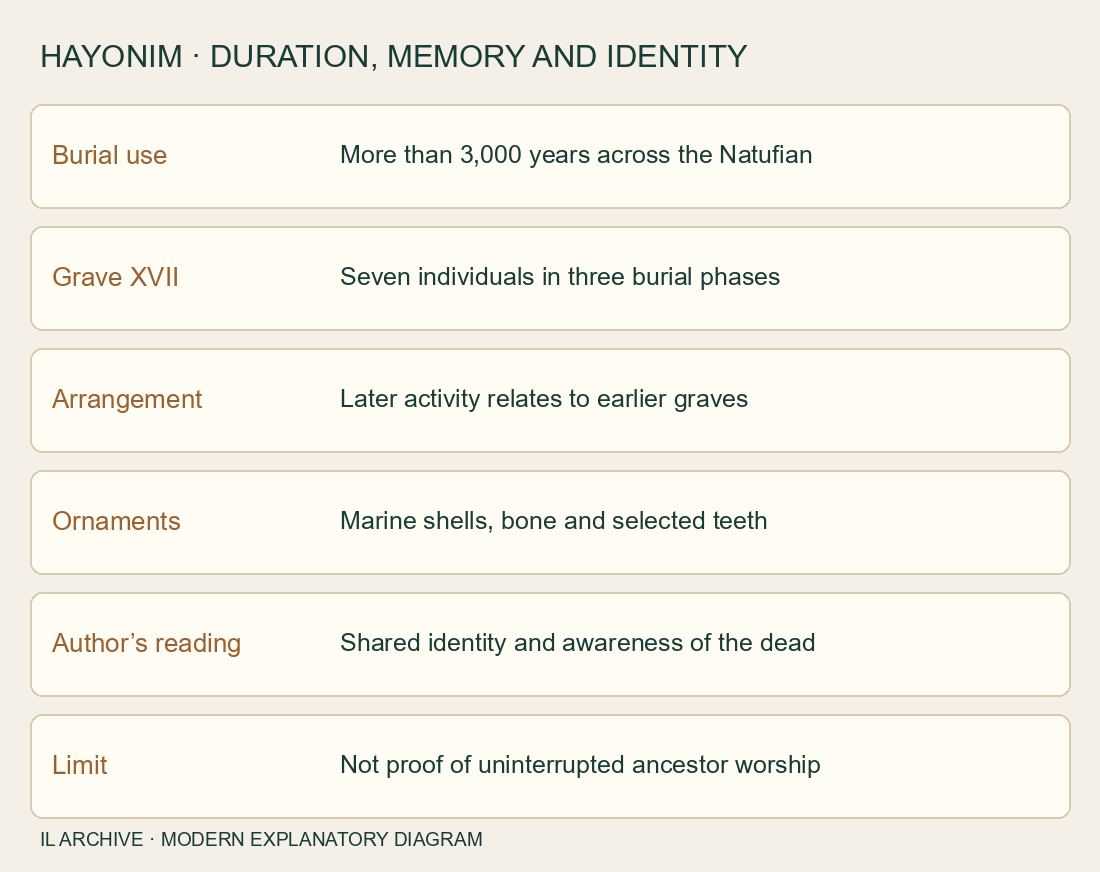
Hayonim CaveHayonim CaveA Galilean cave with Natufian graves and ornaments; its long funerary use informs research on identity and place memory.Glossary · Click to read the explanation in Galilee provides a particularly valuable case. A recent study describes burial use extending through much of the Natufian, over more than three thousand years. The arrangement of later burials suggests awareness of earlier graves and persistence of practices associated with the cave.[4]
The authors interpret these patterns in relation to social identity, cohesion and collective memory. The duration of burial use does not prove uninterrupted memory or one biologically continuous community throughout the entire span.
Someone could be born and die without personally knowing the first individual buried there; further generations could continue using the place. Memory was no longer carried only by living individuals. It also acquired material anchors in the ground.
Does that mean ancestor worship?
Not necessarily. Returning to known graves may fit beliefs concerning ancestors, but the remains do not tell us that the dead were worshipped, that their spirits protected the community or that the living believed them conscious beneath the ground.
We can say more securely that some dead people retained social importance, and that burial helped create memory and identity tied to place. Moving from that statement to Natufian ancestor worship requires additional evidence.
Even a grave became an event
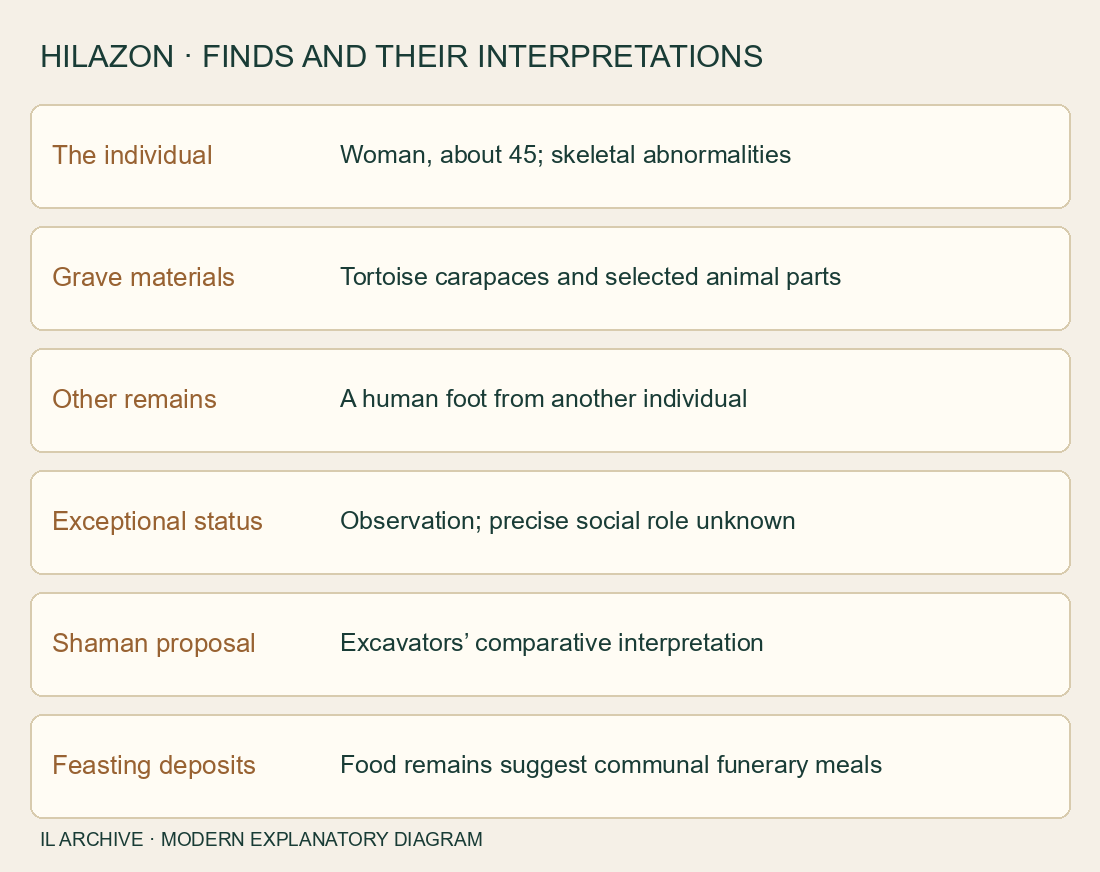
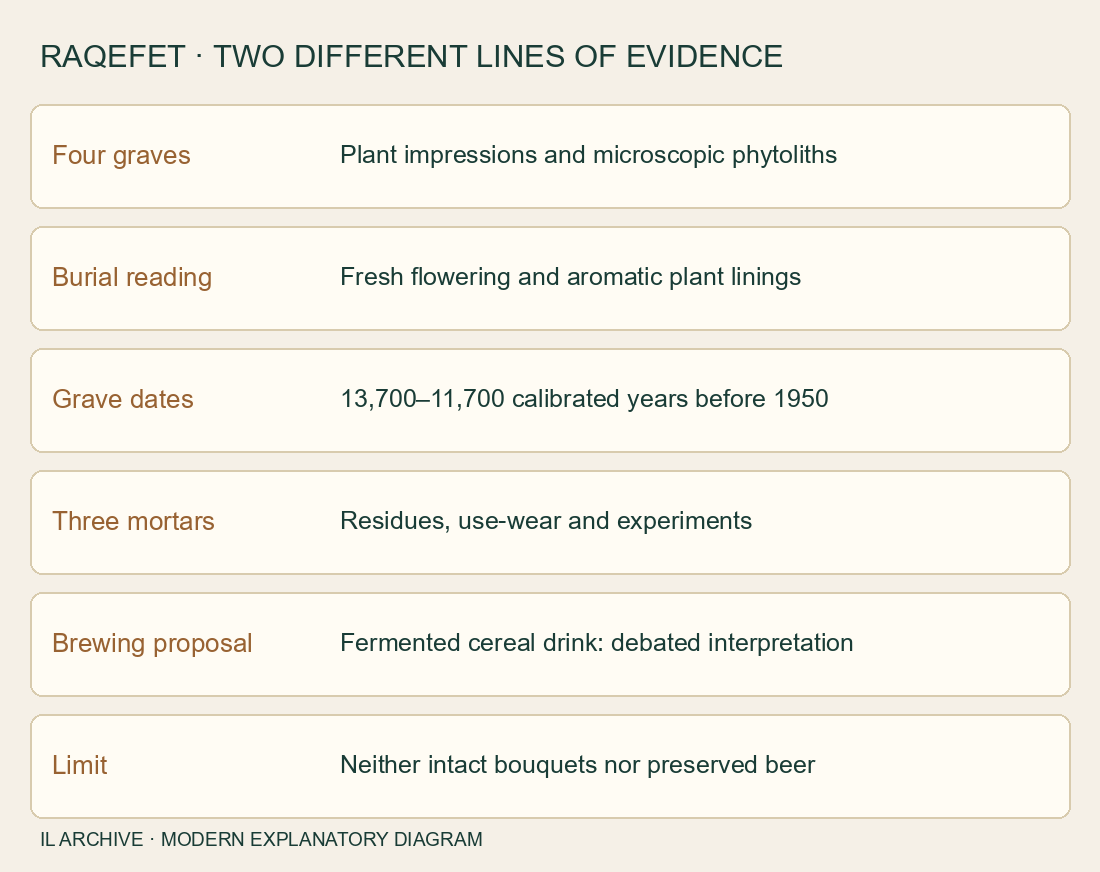
At Raqefet CaveRaqefet CaveA Mount Carmel cave with plant-lined burial evidence and mortars whose possible use for brewing has been debated.Glossary · Click to read the explanation on Mount Carmel, four graves preserve plant impressions and microscopic plant silica bodies. Researchers interpret these traces as linings of fresh, flowering plants beneath the dead, including aromatic species. Intact bouquets were not recovered: the evidence consists of plant traces in the grave lining.[5]
The burials date to approximately 13,700–11,700 cal BP, around 11,750–9750 BCE. Grave preparation could include cutting the bedrock and laying plant material before placing the body. This was a deliberate arrangement involving time, effort and choices.[5]
We cannot recover the words spoken at the burial. We can nevertheless see an organized performance, potentially involving scent and colour, in a society preceding fully developed agriculture.
A feast at a burial
At Hilazon TachtitHilazon TachtitA Late Natufian burial cave in Galilee, with an exceptional woman’s grave and deposits interpreted as funerary feasts.Glossary · Click to read the explanation in Galilee, a burial cave used around twelve thousand years ago, roughly 10,000 BCE, unusual accumulations of tortoise and wild-cattle remains indicate processing and consumption.
A study interprets these deposits as evidence for substantial communal feasting associated with burial. Quantities, bone treatment and depositional context suggest special gatherings larger than an ordinary small family meal.[6]
A feast does not identify a god, but it shows how death could bring the living together. Food can create relationships, unite groups and produce a shared memory. The authors propose that Natufian feasts helped social integration at a time of changing community size and complexity.[6]
The woman of Hilazon: an exceptional burial
The cave also contained an exceptional grave of a small woman, estimated to have died around age forty-five. Skeletal abnormalities probably affected her mobility. The burial contained more than fifty whole tortoise carapaces according to the study's main text, selected parts of a wild boar, golden eagle, aurochs and leopard, two stone-marten skulls (Martes foina), and a human foot from another individual.[7]
The excavators proposed that she might have been a shaman, a specialist in ritual practice. The exceptional treatment and carefully selected materials are observations; shaman is an influential interpretation, not a word left by the Natufians. She may have had a ritual role or another kind of special status.
Whatever her precise role, the community did not treat all its dead in the same way.
Perhaps drink was part of the gathering
A study of microscopic residues, use-wear and three stone mortars at Raqefet proposed wild-cereal processing, plant storage and production of a fermented wheat- or barley-based drink. The authors connect possible brewing around thirteen thousand years ago with ritual feasting.[8]
This is among the earliest proposed archaeological evidence for cereal brewing, but it depends on starch traces, use analysis and experimental reconstruction. A later published discussion addressed the brewing reconstruction and mortar functions. Beer-making remains an interpretation, rather than a recovered beverage or a direct measurement of ancient alcohol.[9]
Food and drink need not be exclusively religious or exclusively social. At a funeral they can be both. Yet this possibility cannot establish the complete beliefs of those taking part.
Ornament was more than decoration
Natufian ornaments used shells, bone, teeth and stone. Hayonim burials included pierced marine shells, fox and hyena teeth and ornaments made from gazelle and bird bones. Some individuals had belts, bracelets, necklaces or clothing carrying many beads.[4]
Ornaments were not distributed equally. Differences between individuals or sites can help investigate identity and intercommunity relationships. A bead, however, is not automatically a religious amulet. Ornament can express beauty, age, gender, status, belonging, a relationship with death or a ritual role, sometimes several meanings at once.
It supports symbolic and social communication, rather than independently proving a particular doctrine.
Art became more visible
Natufian material includes engraved stone and bone, animal forms, geometric designs and a small number of human representations. These cannot all be reduced to a practical function. A limestone pebble from Nahal Ein Gev II, east of the Sea of Galilee, depicts a human face and is approximately twelve thousand years old.[10]
The study places it within an expansion of artistic variety and quantity in the southern Levant, while stressing that human images remain rare. The face pebble was found in 2016 on the surface of exposed Late Natufian deposits during path construction. Its precise architectural context and function are unknown, so it cannot be identified as a deity or assigned to a specific worship space.[10]
We have symbols, art, ornaments, elaborate burials and feasts. We still do not have the name of a god.
Did settlement make a place sacred?
People settled, buried the dead and made a place sacred: it is an attractive sequence, but the final step cannot be demonstrated automatically. Not every residence is sacred, every cemetery a temple or every relationship with ancestors a cult.
More lasting residence allowed material history to accumulate. A house stood here; someone died here; a grave was dug and a feast held. Children buried parents, were buried themselves, and left places recognizable to grandchildren who never personally knew the first dead.
At Wadi Hammeh 27, successive constructions and markers over an earlier burial location have been interpreted as evidence of collective memory and possibly claims to place.[3]
Settlement does not create sacredness by itself. It provides material conditions in which sacred associations might grow.
People could begin to live within their memory
Mobile communities can preserve stories, ancestors and known places along their routes. A repeatedly inhabited location can give some of those memories more durable material form. A wall, grave, heavy tool or engraving can remain within the environment of a later generation.
A child can grow up above the grave of someone never met. A house can outlive its inhabitants. Land, ancestors and identity can acquire different relationships. Not all of this must be called religion, but it touches the conditions from which belonging, remembrance and ideas of the sacred may emerge.
A lasting place can also create boundaries
A group that built stone foundations, buried its dead and left heavy equipment has a different relationship with land from one continually moving. A house, grave or storage facility does not prove private property in a modern legal sense. It can nevertheless announce a history of presence.
Repeated burial, ornament traditions and variations in funerary practice have been related to local group identity and social cohesion. A cemetery can become a social claim connecting people to a place.[4]
In that sense the dead may acquire a role they did not need while living: linking a community with its ground.
Did rituals become more collective?
There are reasons to ask. Large feasts require more than a small household; repeated cemeteries involve collective memory; shared ornament patterns can express group identity; durable houses enable different spatial arrangements from a brief camp.
This does not demonstrate a separate religious institution. We have no named Natufian priests, a known central temple visited by all Levantine communities or a pantheonPantheonThe set of deities associated with a religious tradition, including their roles and relationships.Glossary · Click to read the explanation we can reconstruct. The evidence shows a capacity to anchor activities materially in place. It does not show religion organized as in cities thousands of years later.
Can we identify a Natufian temple?
The evidence discussed here does not allow a building to be confidently identified as a temple of a known deity. There are special buildings, burial areas and caves repeatedly used for funerary activity, but a special building is not automatically a temple.
No writing, dominant image or offerings tied to an identifiable divine being establish that equation. Ritual could develop for a long time within homes, cemeteries and gathering places without a separate religious building.
Can we identify a god?
We cannot identify a particular Natufian deity. That does not mean no gods existed in their beliefs. It means the available material cannot establish their identity. There is no written name, and the evidence examined here does not reveal a repeatedly dominant figure that can confidently be classified as divine.
Human and animal representations do not come with labels identifying a lordRabbTitle of lordship, ownership or care by context; applied to God in Lord of worlds.Glossary · Click to read the explanation of heaven, a goddess of death or a community's patron. Hilazon's exceptional burial reveals exceptional treatment of a person. The feast reveals funerary and social activity; the plant lining reveals care for the dead. These are different kinds of evidence from the identification of a god.
Could they have had an unpictured god?
Certainly. Belief in an unrepresented higher being would not leave a statue. Oral stories, songs and rituals might disappear when their final transmitters died.
No divine image has been identified does not entail no belief in a deity. Equally, that possibility does not justify inserting an unattested god into the record. A deity or several deities may have been part of Natufian beliefs, but the known archaeological record does not identify their names, attributes or identities.
One god or several?
Even if some burials, feasts and symbols reflected religious practices, they cannot be converted into a count of gods. Two figurinesFigurineSmall three-dimensional representations of people, animals or other beings. Size and appearance alone do not establish a toy, portrait, ritual object or deity; manufacture, discovery context and use require study.Glossary · Click to read the explanation need not represent two deities; two animals do not establish two gods; absence of figurines does not prove one god.
The evidence cannot decide between monotheismMonotheismBelief in a single God as the only deity, rather than merely the highest among several gods.Glossary · Click to read the explanation, polytheism, beliefs about spirits or ancestors without a pantheon, or combinations of such ideas. Nor is there a historical rule requiring every population to move through these categories in one fixed order.
Does absence have any significance?
It does, when a hypothesis predicts something observable. The Natufian record contains art, ornament and elaborate burial. A hypothesis proposing one central deity repeatedly pictured across all Natufian communities would encounter the lack of that recurrent image in the known record.
A hypothesis proposing an unpictured higher being would not be refuted by missing images. Negative evidenceNegative evidenceFailure to find an expected trace can test a hypothesis when preservation and investigation make discovery expectable; not every absence is evidence.Glossary · Click to read the explanation weakens hypotheses that would lead us to expect the missing trace; it cannot indiscriminately exclude every possible belief.
What can we say about Natufian religion?
Established: these were hunter-gatherers, among whom some sites show considerable investment in architecture and prolonged residence before fully developed agriculture and domestication. Burials were dense and repeated at several revisited places. Some dead received ornaments and special treatment; funerary practices were not uniform.
Strong evidence supports the interpretation of funerary feasting at Hilazon and careful plant-lined grave preparation at Raqefet. These practices plausibly carried social, symbolic and ritual meanings relating to death, identity and memory.[5][6][7]
Probable: extended residence gave certain places deeper collective histories and may have enhanced the symbolic importance of ground, home and cemetery. Possible: particular dead people acquired an ancestral role, or particular living people performed ritual specialties.
Not established: a full ancestor cult, a temple in the historical sense or a particular named deity. Currently unresolved: whether the beliefs involved one god, several gods, spirits, ancestors or a combination. These are limits of the evidence, rather than a statement that religious ideas were absent.
What happened to religion when people began to settle?
The clearest observable change may concern relationships with place rather than the number of gods or the appearance of a new deity. Longer residence allowed people to accumulate material memory: building where others had built, burying the dead where they lived or returned, gathering for a burial feast, adorning a body and cutting the rock.
People could come back years later knowing that individuals from their community's history lay below the ground. A location acquired layers: life, a grave, a later generation, memory, identity and perhaps sacred associations.
We must not reverse the relationship and claim that settlement created religion. Burial, symbolism and potentially ritual practices were much older. Settlement gave some practices durable places in which to take root.
The Natufian contribution to this history does not consist in the discovery of the first god. Rather, the known Levantine record makes visible, at a striking density, communities repeatedly linking the dead, memory, identity and gatherings to locations. Before the sacred had a temple, perhaps it could acquire an address. Before we know a deity's name, we can see people returning to ground where their dead were buried.
References and notes
- Tobias Richter, Amaia Arranz-Otaegui, Lisa Yeomans & Elisabetta Boaretto (2017). High Resolution AMS Dates from Shubayqa 1, northeast Jordan Reveal Complex Origins of Late Epipalaeolithic Natufian in the Levant. Scientific Reports. DOI: 10.1038/s41598-017-17096-5. Introduction and selected PDF passages, pp. 1–7: dates, architecture and regional variation; Figure 1 on p. 3, licence on p. 10. Approximate boundaries do not establish one uniform beginning. Return to the text ↑
- François R. Valla et al. (2017). Eynan (Ain Mallaha). In Quaternary of the Levant, 295–302. DOI: 10.1017/9781316106754.034. Publisher summary only: settlement before agriculture, semi-subterranean buildings, burial phases and foraging. The full chapter was not read. Return to the text ↑
- Phillip C. Edwards (2015). Ice Age villagers of the Levant: renewed excavations at the Natufian site of Wadi Hammeh 27, Jordan. Antiquity Project Gallery 89(347), 1–7. DOI: 10.15184/S2978855200900465. Introduction and 2014 excavation section: residence duration remains open; architecture and stone markers over an earlier burial. Memory and place claims are interpretations, not modern legal ownership. Return to the text ↑
- Leore Grosman & Anna Belfer-Cohen (online 2022; print 2023). Insights into Natufian Social Identity: A Case Study from the Graveyard of Hayonim Cave. Cambridge Archaeological Journal 33(2), 247–264. DOI: 10.1017/S0959774322000282. Abstract, introduction, Grave XVII phases, decorated burials and discussion: burial use over three millennia, identity and memory. Not proof of uninterrupted memory, one biological group or ancestor worship. Return to the text ↑
- Dani Nadel et al. (2013). Earliest floral grave lining from 13,700–11,700-year-old Natufian burials at Raqefet Cave, Mt. Carmel, Israel. PNAS. DOI: 10.1073/pnas.1302277110. Abstract, methods, results and selected discussion: four graves, plant impressions and phytoliths, and lining interpretation. Dates are cal BP; no intact bouquets were recovered. Return to the text ↑
- Natalie D. Munro & Leore Grosman (2010). Early evidence (ca. 12,000 B.P.) for feasting at a burial cave in Israel. PNAS. DOI: 10.1073/pnas.1001809107. Full-text results and discussion: tortoise and aurochs remains, processing, deposition and funerary-feasting interpretation. Structure A’s count differs from the woman’s grave count; contexts must remain distinct. Return to the text ↑
- Leore Grosman, Natalie D. Munro & Anna Belfer-Cohen (2008). A 12,000-year-old Shaman burial from the southern Levant (Israel). PNAS. DOI: 10.1073/pnas.0806030105. Abstract, results and discussion: woman about 45; main text reports over fifty tortoise carapaces, golden eagle and two stone martens among the finds. Shaman is a comparative interpretation; 12,400–12,000 cal BP is not BCE. Return to the text ↑
- Li Liu, Jiajing Wang, Danny Rosenberg, Hao Zhao, György Lengyel & Dani Nadel (2018). Fermented beverage and food storage in 13,000 y-old stone mortars at Raqefet Cave, Israel: Investigating Natufian ritual feasting. Journal of Archaeological Science: Reports. DOI: 10.1016/j.jasrep.2018.08.008. University-repository abstract and indexed methods excerpt; full paper not read. Brewing reconstruction relies on microscopic residues, use and experiments; its link with feasting is the authors’ proposal. Return to the text ↑
- Li Liu et al. (2019). Response to comments on archaeological reconstruction of 13,000-y old Natufian beer making at Raqefet Cave, Israel. Journal of Archaeological Science: Reports 28, 101914. DOI: 10.1016/j.jasrep.2019.101914. University of Haifa abstract only: establishes a published discussion of fermentation and mortar functions. Neither full criticism nor full response was read; no claim that the debate is resolved. Return to the text ↑
- Leore Grosman et al. (2017). A human face carved on a pebble from the Late Natufian site of Nahal Ein Gev II. Antiquity 91(358), e2. DOI: 10.15184/aqy.2017.122. Main text: face, site and discussion. Found in 2016 on exposed Natufian deposits; exact feature context and function unknown. No established deity identity. The supplied Nature (2021) link is unrelated and excluded. Return to the text ↑
- Oxford Radiocarbon Accelerator Unit. Radiocarbon Calibration. Calibration explanation and date conventions: present = 1950; cal BP means calibrated calendar years. Raw radiocarbon ages require calibration curves. BCE examples in this article are approximate and rounded. Return to the text ↑
Suggest a correction · Suggest a source for this record
Cite this record
IL Archive, «The Natufians: What Happened to Religion When People Began to Settle?», Edition 1, https://ilarchive.com/en/studies/natufians-settlement-religion
Continue reading