Study
Satan, Mastema and Belial: different names for evil
An extended study of a topic, with evidence and references.
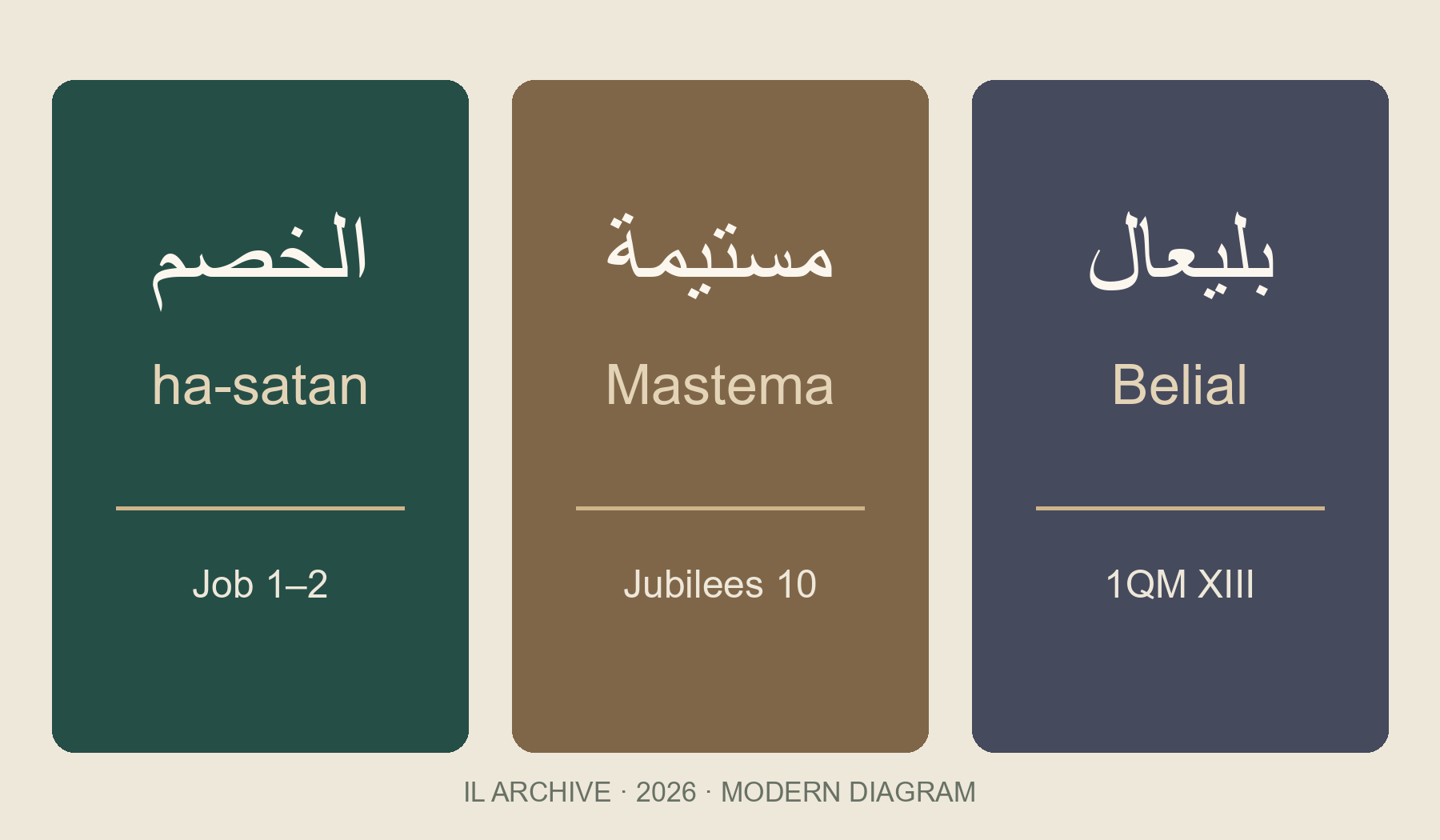
Comparing Job’s adversary, Mastema in Jubilees and Belial at Qumran: personal names, local identifications and limits of hostile authority.
Share article
Text
Similar names do not tell one story
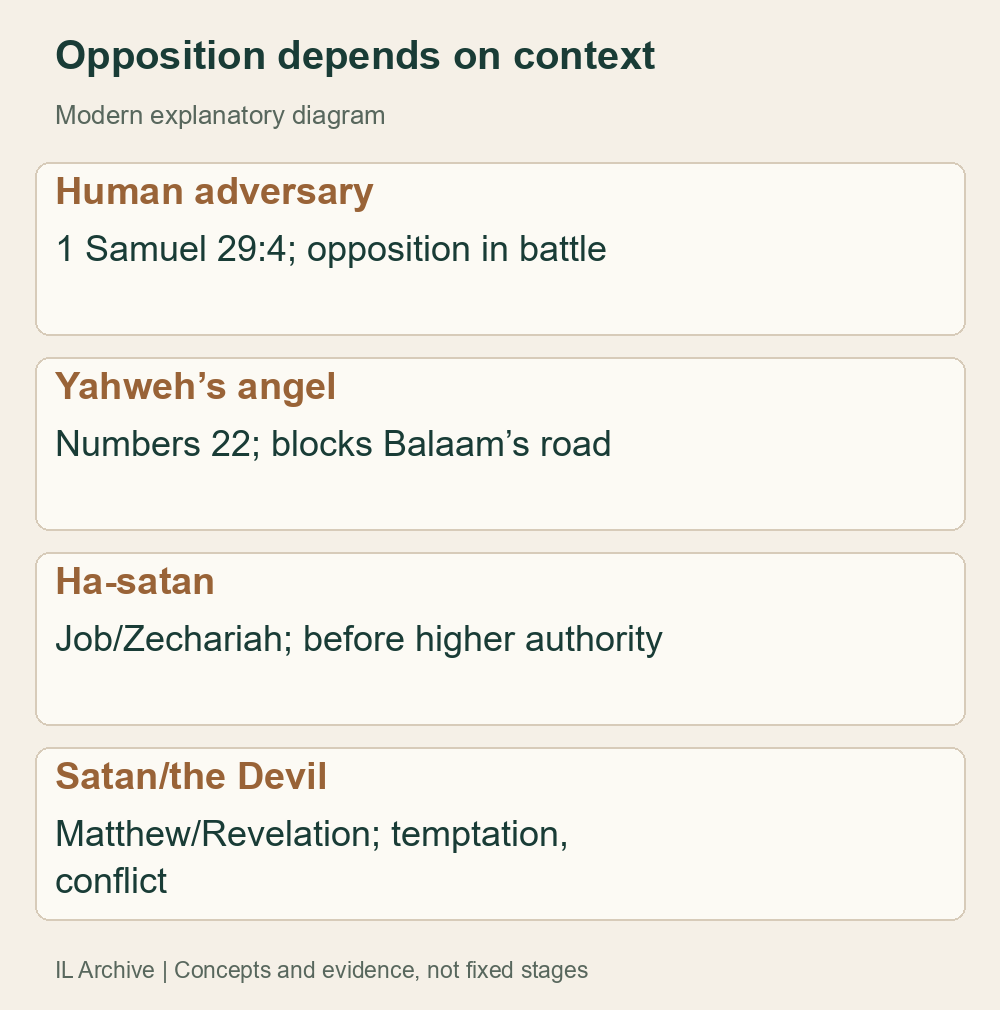
Reading Satan, MastemaMastemaLeader of harmful spirits in Jubilees; requests some spirits and proposes Abraham’s test, subject to divine limits.Glossary · Click to read the explanation and BelialBelialFigure associated with darkness and wickedness in some Qumran texts; not a fixed alias for every heavenly adversary.Glossary · Click to read the explanation together makes it easy to imagine three names for a permanent enemy of God and humanity who has directed evil from the beginning. Ancient texts do not provide that unified dictionary. Some depict an adversary within a heavenly council, others a prince seeking to retain harmful spirits, others a leader of darkness. Some passages use the words for hostility or human depravity without describing a heavenly being.
This study complements How did “the adversary” become Satan? with a narrower question: when is a word a personal designation, when do figures converge, and how far does their authority extend within each text? The subject is the history of writing and interpretation, rather than a judgment on the truth of religious belief.
Three questions to keep separate
A word’s presence, a character bearing it, and identification with a character in another book are different matters. Finding “Belial” does not establish a chief of demons. Similar accusatory functions do not establish identical understandings between authors.
Context provides the first test: does someone speak, receive an address, or direct spirits? Or does the word describe people or hostility? The second test concerns the text’s boundaries: a possible identification within JubileesBook of JubileesJewish retelling of Genesis and Exodus framed as angelic teaching to Moses, adding chronology, narratives and interpretation.Glossary · Click to read the explanation does not become a shared doctrine of every Second Temple Jew. Collecting different manuscripts at QumranDead Sea ScrollsJudaean Desert manuscripts, especially Qumran cave finds. Biblical copies and other works reveal textual diversity; a copy’s age is not the work’s initial date.Glossary · Click to read the explanation does not give all their authors one outlook. [21]
Job’s adversary: accusation and harm under permission
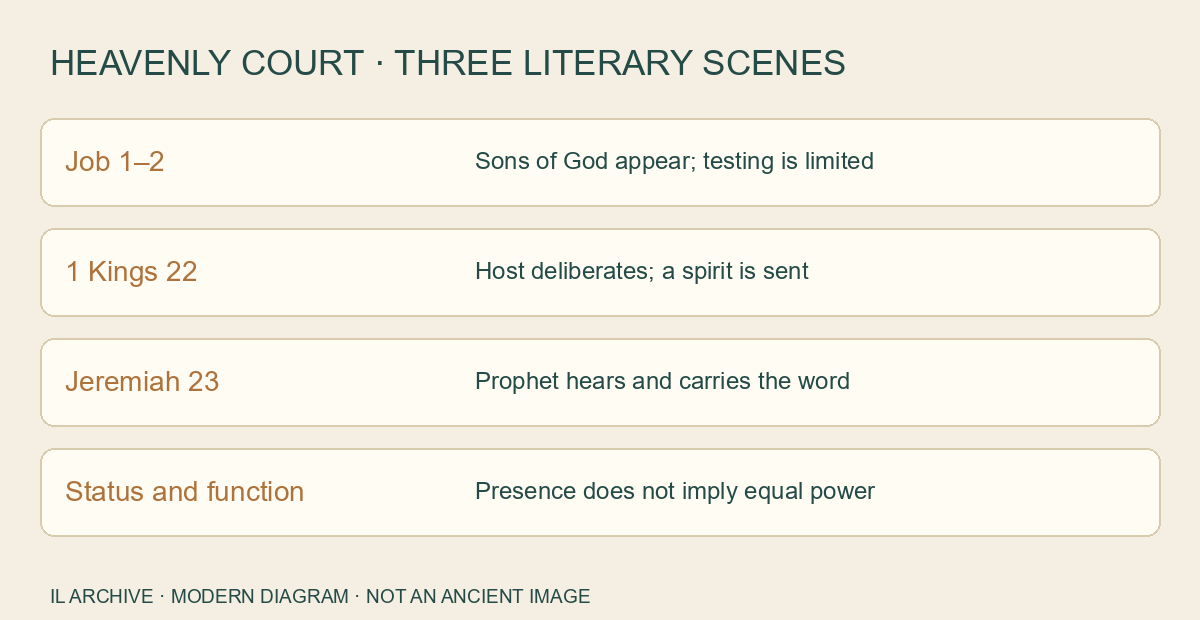
Job 1:6–12 places ha-satanHa-satan in JobThe adversary or accuser in Job, with the Hebrew definite article; among the sons of God, acting within permission and limits rather than carrying every later Satanic trait.Glossary · Click to read the explanation, with the HebrewHebrewA Northwest Semitic language in the Canaanite group, with ancient and modern forms.Glossary · Click to read the explanation definite article, among the sons of GodSons of GodA Hebrew expression for heavenly beings in texts such as Job; context determines its meaning, rather than biological descent or a fixed angelic roster.Glossary · Click to read the explanation appearing before YahwehYahwehThe divine proper name written YHWH in the Hebrew Bible.Glossary · Click to read the explanation. He questions Job’s loyalty: is his reverence grounded in integrity or in protected prosperity? Yahweh permits interference with his possessions but sets a boundary concerning Job himself. [1]
In Job 2:1–7 permission extends to Job’s body while preserving his life; the adversary then inflicts bodily harm. We should neither soften him into an entirely neutral official nor make him an independent king governing a realm equal to God’s. He initiates accusation and causes harm within an authority that determines his scope of action. [2]
Mastema after the flood: requesting one tenth
The Book of Jubilees retells Genesis and Exodus, presenting itself as instruction conveyed by an angel to MosesMosesCentral figure in Exodus, Torah traditions and the Qur’an; childhood accounts differ in detail.Glossary · Click to read the explanation. Composition is generally placed in the second century BCE. This dates the book, not the conversation it locates after the flood. Kristen H. Lindbeck presents this setting in discussing the rewriting of Abraham’s trial. [20]
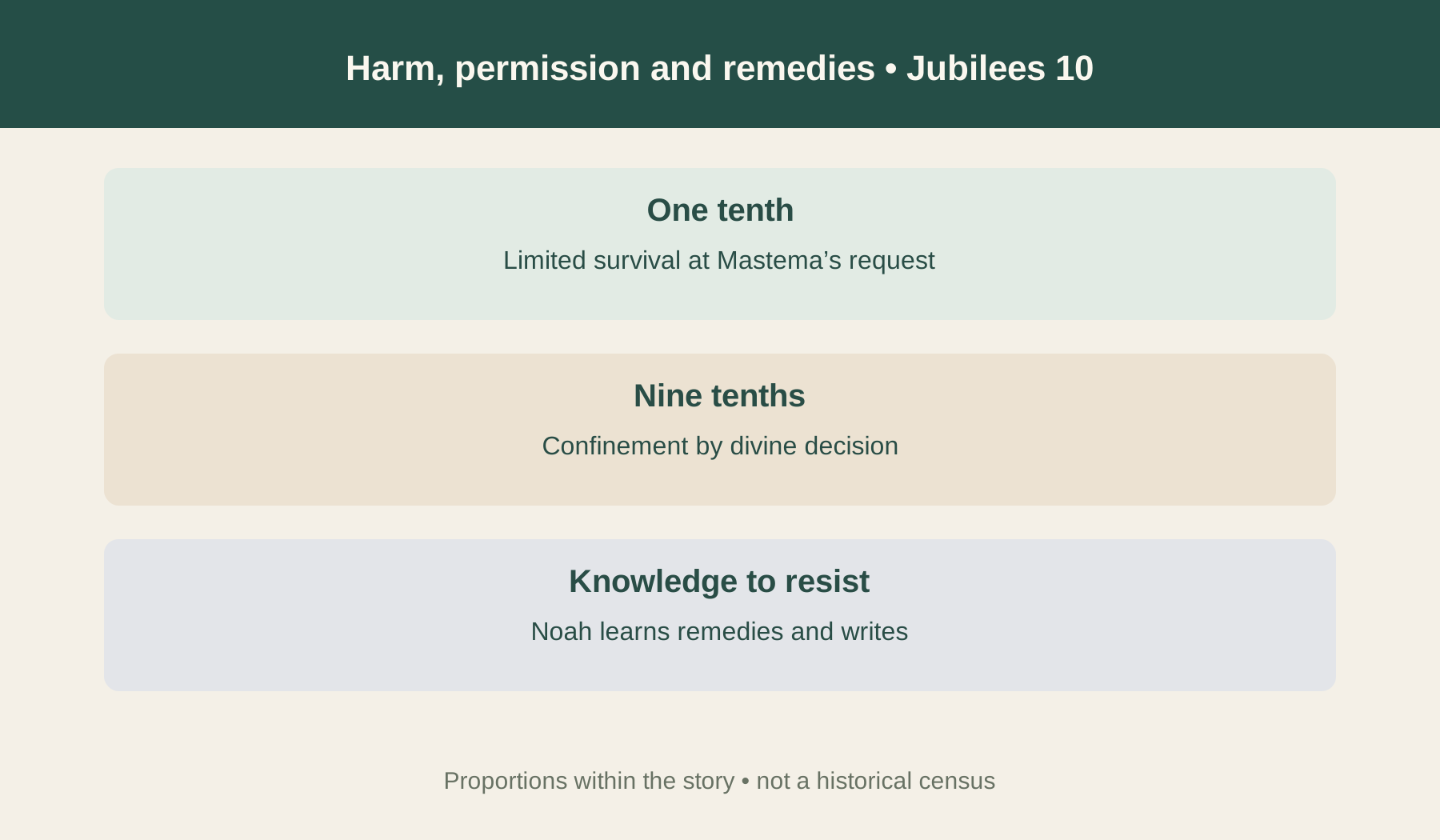
In Jubilees 10:1–9 unclean spirits harm NoahNoahNoah is the flood-story figure in Genesis and a prophet in the Qur’anGlossary · Click to read the explanation’s descendants, and he prays for their imprisonment. Mastema, prince of the spirits, requests that some remain for his activity among humans. The decision leaves one tenth and confines the other nine parts. This proportion belongs to the narrative’s ordering of the world; it is not a historical census of beings a historian can count. [6]
At 10:11 the remaining portion is described as subject to “Satan.” The context permits reading a convergence between Mastema and Satan here. It does not establish that every occurrence of both names throughout the literature denotes an identical entity. A local connection should remain local until wider evidence is found. [6]
Medicine belongs to the same narrative
Noah’s story does not end with the division of spirits. God orders that Noah learn remedies against their diseases. The account describes medicines from plants of the earth, followed by a written book entrusted to Shem. [6]
This prevents reducing the narrative to evil’s sovereignty: a world allowing limited harm also supplies knowledge to resist it. Historians can describe prayer, angels, medicine and writing together without assuming modern therapeutic efficacy, or treating the remedies as a solution to every ethical question raised by innocent suffering.
Abraham’s trial: rewriting why suffering begins
Genesis 22 opens with God testing Abraham, without an adversary requesting the test. [9] Jubilees 17:15–18 adds heavenly discussion of Abraham’s fidelity and Mastema’s proposal to demand Isaac’s offering as a test of his devotion. In the following chapter Mastema stands present, the son is spared by divine command, and the prince’s humiliation is reported. [7] [8]
This structure can be compared with Job: a claim about someone’s fidelity, an ordeal, and the exposure of an accusation’s limits. It is a specific literary comparison; it neither merges Job and Abraham nor independently identifies the transmission route of every detail. Jubilees’ addition must not be attributed to Genesis itself. The web page heading also contains an erroneous Roman chapter number: the passage used here is Jubilees 17:15–18. [7]
Mastema in the exodus: a changing scope of action
In Jubilees 48 Mastema tries to harm Moses, assists the Egyptian magicians, and promotes pursuit of Israel. Yet he is bound and released within an arrangement determined by others; even accusation has scheduled limits in the narrative. [10]
At 49:2–4 the killing of Egypt’s firstborn is assigned to Mastema’s powers, followed by a description of the LordRabbTitle of lordship, ownership or care by context; applied to God in Lord of worlds.Glossary · Click to read the explanation’s powers obeying orders and protecting houses marked with blood. The passage combines a harmful prince with execution of divine judgment. It resists a simple division into two independent states, one good and one evil. Divine orders also do not remove the dangerous actions described elsewhere. This is a complex narrative distribution of responsibility, rather than an agreed philosophical resolution of evil. [11]
Belial before becoming a camp’s leader
In 1 Samuel 1:16 Hannah denies being a “daughter of Belial” after being suspected of drunkenness. At 2:12 Eli’s sons are called “sons of Belial,” and their misconduct concerning offerings follows. Neither passage describes biological descent from a demon; both describe humans through a vocabulary of depravity. [3] [4]
Similarly, maśṭēmâ in Hosea 9:7–8 denotes hostility. Mastema’s name belongs to this linguistic field, but every mention of hostility is not an appearance of the prince. Moving from an abstract noun to a personal name requires narrative evidence beyond the persistence of the same letters. [5]
The War Scroll: evil in communal and military language
The War ScrollWar ScrollDead Sea Scroll text portraying war between the sons of light and the hostile camp; its principal copy is designated 1QM.Glossary · Click to read the explanation, designated 1QM, depicts conflict between the sons of light and a camp associated with Belial. Column I joins human enemies to heavenly alignments in an imagined final war; names of peoples and armies do not make it a report of an event that occurred as narrated. This column can be read in the excerpt PBS published from Wise, Abegg and Cook’s translation. [13]
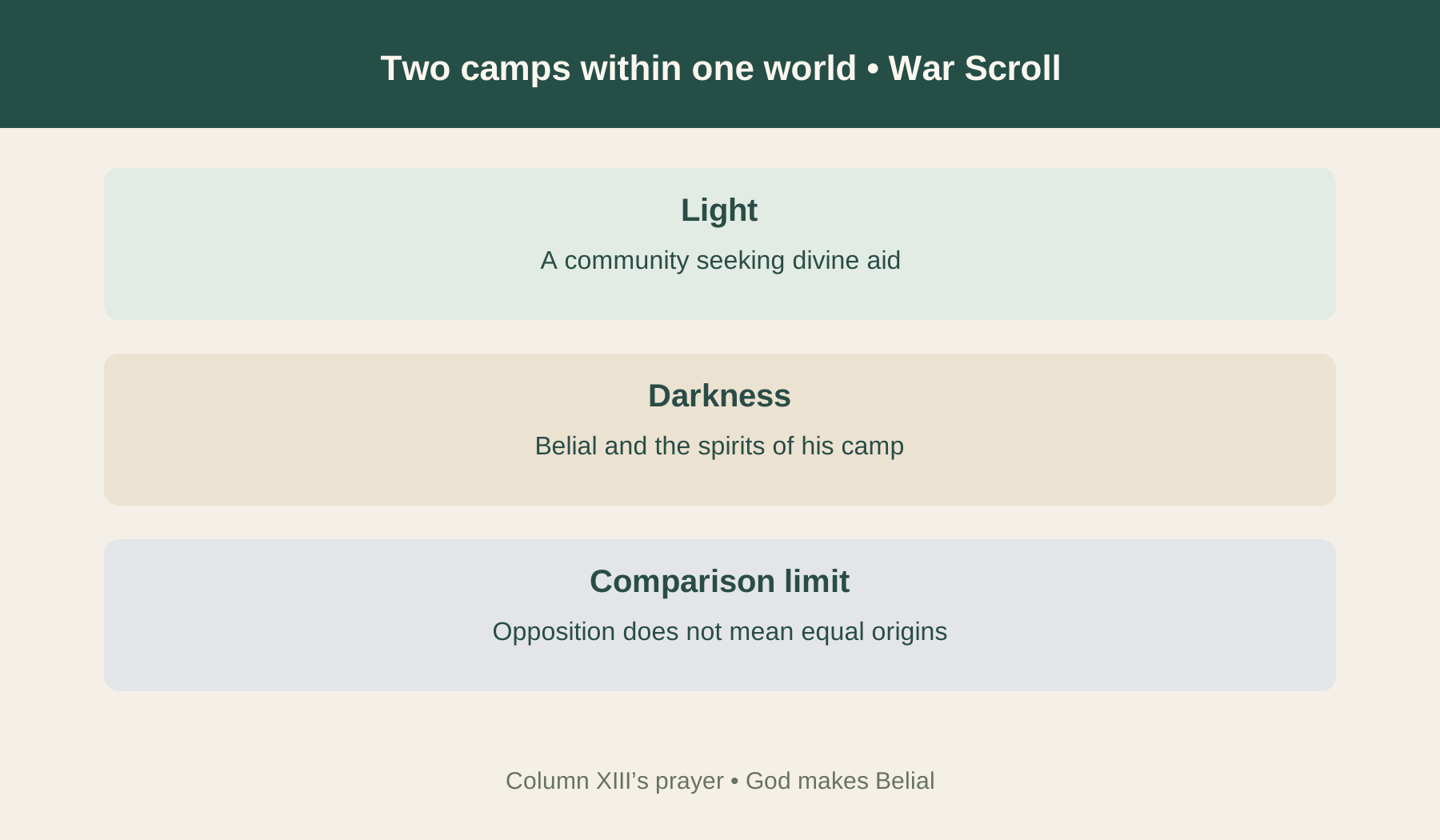
The prayer in column XIII:9–13 places Belial within a world of darkness and harmful spirits, contrasted with God’s aid to his community. This is a heavenly center of the hostile camp, beyond “Belial” as a description of misconduct. Assigning human opponents to that camp also draws the speaking community’s boundaries. It shows how it understands its enemies, rather than providing modern researchers with a neutral classification of them. [12]
Why opposition does not imply equal gods
1QM XIII:11 attributes Belial’s making to God. Scholars differ over the phrase concerning corruption or destruction and the relationship of the “angel of hostility” to Belial, but the structure does not make him an eternal independent origin equal to the creator. [12]
Dualism of camps must therefore be distinguished from dualism of origins. Light and darkness, angels and harmful spirits can contend within a world where ultimate authority remains divine. This does not empty conflict of danger; it distinguishes temporary hostile agency from unlimited sovereignty. Nor does such ordering independently demonstrate borrowing from IranIranIran is the modern country containing Shush, ancient SusaGlossary · Click to read the explanation or another religion. Transmission requires chronology, contact evidence and details beyond the broad opposition of good and evil.
The Community Rule: conflict reaches the human heart
The passage called the Teaching of the Two Spirits, 1QS III:13–IV:26, describes spirits of truth and perversity, a Prince of Lights and an Angel of Darkness. III:21–24 allows the sons of righteousness themselves to stumble, while III:25 affirms God’s creation of the spirits of light and darkness. [14]
IV:23 locates the spirits’ struggle within the human heart. They participate in communal and heavenly language and in an account of inward conduct. The passage should neither be confined to modern individual psychology nor turn every “spirit” into a separate named person. In the modern reading Thomas Farrar discusses, internal and external dimensions coexist. [19]
The Hebrew passages were read through QDR, based on Abegg’s transcriptions and ETCBC data. Reading a published transcription is not independently collating every letter on the manuscript’s skin or reviewing all its copies. [14]
Jubilees’ “spirit of Beliar”: the word does not settle identity
Jubilees 1:20 has Moses pray that the “spirit of Beliar” not rule, accuse and mislead the community. The expression’s presence in the preserved translation is clear. Whether it names a particular heavenly person or refers to wickedness remains an interpretive dispute noted by Farrar. [15] [19]
Two errors are possible: denying the expression’s presence and treating it as proof that Mastema, Belial and Satan are wholly interchangeable. Establish the wording, discuss its meaning, and then test identification. The War Scroll’s arrangement cannot be imported into Jubilees merely because the language is similar.
Belial in an early Christian text
2 Corinthians 6:14–16 opposes righteousness and lawlessness, light and darkness, Christ and Belial. Here Belial serves as a hostile pole in discourse defining religious affiliation. [18]
The passage shows the name continuing within an early Christian setting. It does not supply a complete biography or explain the identification of all names for evil. Similar camp language can be compared with some Qumran texts, but resemblance does not prove that the author read our surviving 1QM manuscript or that separate communities adopted one system in every detail. These are questions of contact and interpretation, not conclusions supplied by a single word.
Not every sin is a Satan narrative
Sirach 15:11–20 warns against blaming God for one’s wrongdoing and connects responsibility to chosen conduct. James 1:13–15 describes temptation through human desire and subsequent sin. Neither passage’s argument depends on naming a demonic prince who explains every act. [16] [17]
The name’s absence here does not establish the absence of harmful beings from the entire work or every reader’s beliefs. It does prevent reducing reflection on evil to a single history of Satan’s increasing power. Languages of testing, accusation, hostile camps, harmful spirits, desire and responsibility can coexist rather than replace one another.
Narrative dates and reading limits
A conversation Jubilees places in Noah’s lifetime is not a manuscript witness written then. Similarly, 1QM’s future war does not date an actual battle. Events within a narrative, composition and the age of a surviving copy must remain distinct.
This study uses the passages specified in the notes. Charles’s historical translation mediates reading rather than replacing a modern critical edition. Articles consulted in extracts are not recorded as books read completely. Conclusions remain bounded by the witnesses examined; textual variants and interpretation remain open to further research.
What comparison permits
The texts demonstrably use these words in multiple ways. Jubilees depicts Mastema requesting permission and constrained by it; the War Scroll gives Belial leadership while attributing his making to God; the Community Rule brings conflict into heart and conduct. Universal identity across all periods, or direct derivation of every figure from a single Mesopotamian deity, is not established by these witnesses.
Connections become clearer when a specific action is compared with its counterpart: proposing a test, managing spirits, accusing, or dividing human camps. Differences remain visible through further questions: who grants permission, who fixes the ending, and is the word a personal name at all? Studying evil thereby becomes a history of multiple works, communities and interpretations, preserving the distance between a text’s statements and a researcher’s conclusions.
References and notes
- Selected Hebrew passage. Job 1:6–12 Return to the text ↑
- Selected verses and permission limits. Job 2:1–7 Return to the text ↑
- Selected Hannah context. 1 Samuel 1:13–17 Return to the text ↑
- Selected verses on Eli’s sons. 1 Samuel 2:12–17 Return to the text ↑
- Hebrew wording in both verses. Hosea 9:7–8 Return to the text ↑
- Complete passage in Charles’s historical translation. Jubilees 10:1–17; R. H. Charles (1902) Return to the text ↑
- Complete passage; correct chapter is 17. Jubilees 17:15–18; Charles (1902) Return to the text ↑
- Complete chapter in historical translation. Jubilees 18:1–19; Charles (1902) Return to the text ↑
- Selected Hebrew narrative. Genesis 22:1–19 Return to the text ↑
- Complete passage in historical translation. Jubilees 48:1–19; Charles (1902) Return to the text ↑
- Verses 1–4 only. Jubilees 49:1–4; Charles (1902) Return to the text ↑
- Selected Hebrew transcription; no independent collation. 1QM XIII:9–13; QDR / Abegg / ETCBC Return to the text ↑
- Displayed column I, not whole scroll. 1QM I; Wise, Abegg & Cook (1996), PBS excerpt (1998) Return to the text ↑
- Two Spirits teaching in selected Hebrew transcription. 1QS III:13–IV:26; QDR / Abegg / ETCBC Return to the text ↑
- Selected passage; Beliar’s meaning disputed. Jubilees 1:1–26, especially1:20; Charles (1902) Return to the text ↑
- Verses 11–20, not entire book. Sirach 15:11–20; historical KJV Apocrypha Return to the text ↑
- All three verses. James 1:13–15; historical KJV Return to the text ↑
- Three verses in historical translation. 2 Corinthians 6:14–16; historical KJV Return to the text ↑
- Selected PDF passages, not whole article. Thomas J. Farrar (2019), JTS 70/1:21–68; doi:10.1093/jts/fly165 Return to the text ↑
- Selected passages; body dates BCE. Kristen H. Lindbeck (2025), sections on Job, Jubilees and the Akedah Return to the text ↑
- Library overview and classification diversity. Library of Congress, The Qumran Library, overview26–36 Return to the text ↑
Media
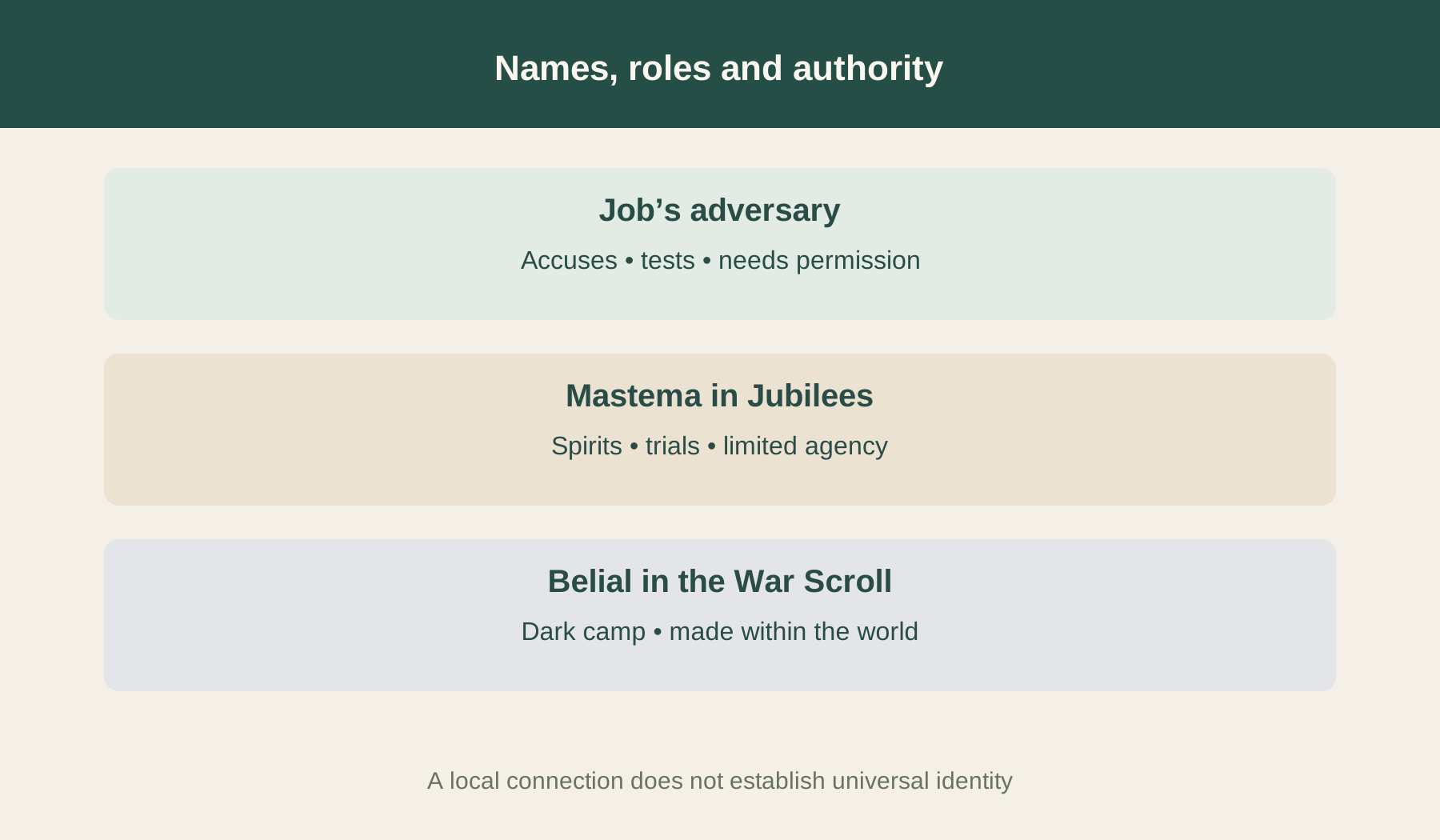
Illustration — not a photograph of the original object
Modern comparative diagram distinguishing names, roles and authority in the cited passages; neither ancient portraits nor a fixed genealogy.
CC0 · Original explanatory diagram: IL Archive, 2026 · Original IL Archive explanatory SVG,2026; CC0 dedication. Modern textual comparison, not ancient artifact, portrait or universal identification.
Suggest a correction · Suggest a source for this record
Cite this record
IL Archive, «Satan, Mastema and Belial: different names for evil», Edition 1, https://ilarchive.com/en/studies/satan-mastema-belial
Continue reading