Study
Dhul Qarnayn and Alexander traditions: texts, dating and debate
An extended study of a topic, with evidence and references.
Sun, horns, metal gate, Gog and Magog: comparing al-Kahf with the Syriac Legend, distinguishing narrative relationship from a proven source and historical identity.
Share article
Text
Introduction
Why compare the Quranic Dhul Qarnayn with stories about AlexanderAlexander the GreatMacedonian king who lived from 356 to 323 BCE and became a hero of stories in different languages and traditions after his death.Glossary · Click to read the explanation? Surat al-Kahf describes a king who reaches the edges of the world and builds a barrier against Gog and MagogGog and MagogNames with different roles in genealogies, invasion prophecy, end-time nations and barrier traditions.Glossary · Click to read the explanation. A SyriacSyriacA literary form of Aramaic, with an extensive Christian heritage and earlier non-Christian attestations.Glossary · Click to read the explanation Christian story about Alexander shares a striking group of images. This study examines their similarities and differences and asks what the evidence permits us to say about their relationship; it does not judge the truth of a religious belief. [1] [2] [3]
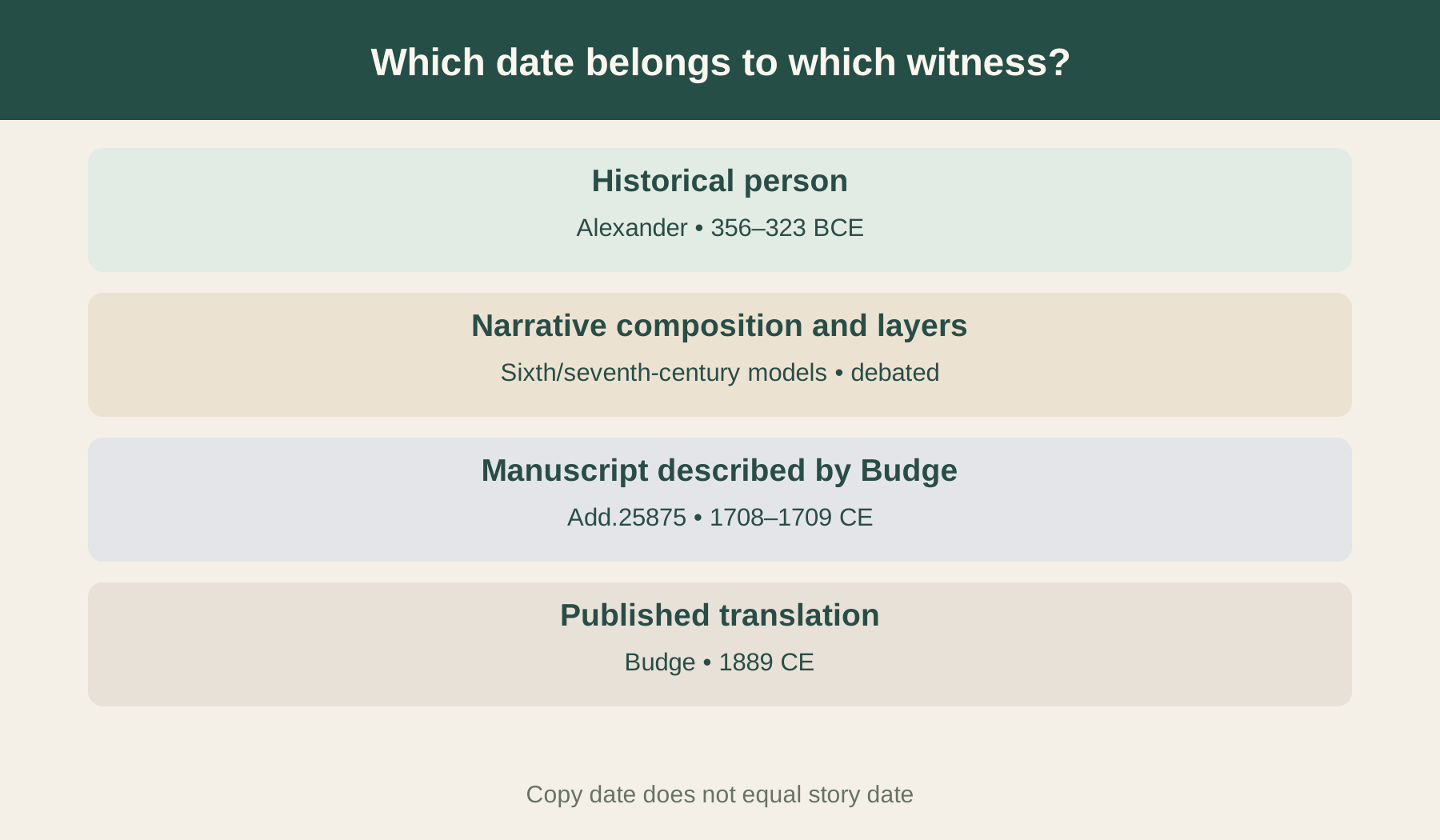
Surat al-Kahf belongs to the seventh-century QuranQuranCentral text of Islam, used here as evidence of its religious discourse.Glossary · Click to read the explanation. The date and layers of the Syriac story remain debated, while the particular manuscript described by BudgeE. A. Wallis BudgeBritish Egyptologist and ancient-language scholar (1857–1934) who published a historical English translation of Syriac Alexander texts.Glossary · Click to read the explanation is much later. We therefore distinguish the fourth-century BCE historical Alexander, the composition of a story, and the date of a surviving copy. Do shared details establish a direct source, or might stories circulating and changing across languages also explain them? [4] [7] [8] [9]
The king who reached the world's edges
A king receives power on earth, reaches the setting and rising of the sun, and builds a barrier between communities. The work is followed by a divine promise and an end before which human structures cannot endure. This is Dhul Qarnayn in Surat al-Kahf. A Syriac narrative about Alexander the Great also presents a king seeking the world's edges, the sun and peoples along its course, a metal gate restraining invading nations, and a prophecy of its destruction. [1] [2] [3]
This combination makes comparison serious. It does not by itself establish that a particular manuscript reached a particular author, or make the literary figure identical to the historical king. Three questions remain distinct: are the narratives related, when was the version being compared composed, and how could transmission have occurred?
What al-Kahf says and leaves unnamed
Verses 83–91 begin with a question about Dhul Qarnayn. Empowerment and the provision of means precede arrival at the sun's setting and a people beside a muddy spring. Justice shapes the encounter: wrongdoing is distinguished from belief and good deeds. Following another means, the king reaches the sun's rising, where a people have been given no covering against it. [1]
In verses 92–98 he reaches a place between two barriers. A community requests protection against Gog and Magog's corruption and offers payment. He prefers what his LordRabbTitle of lordship, ownership or care by context; applied to God in Lord of worlds.Glossary · Click to read the explanation has given him and requests their assistance; pieces of iron are assembled and heated, and qitr is poured over them. Al-TabariAl-TabariAbbasid-era historian and Qur'anic exegete (c. 839–923 CE). His commentary records competing views on Abraham's son, then favors Isaac.Glossary · Click to read the explanation explains qitr as copper but also records a view that it means molten iron. [16] The attackers cannot climb or pierce the structure. Dhul Qarnayn calls it his Lord's mercy and connects its destruction to the coming promise. Surging, the trumpet, gathering and the display of Hell follow. [2]
The passage names neither Alexander nor Cyrus, supplies neither a date nor coordinates, and describes no physical horns. The epithet is present; its explanation and bearer require additional evidence. Nor should the fish in the preceding MosesMosesCentral figure in Exodus, Torah traditions and the Qur’an; childhood accounts differ in detail.Glossary · Click to read the explanation narrative, or the water of life in some of its later explanatory reports, be inserted into this passage and counted as explicit elements within it.
The historical Alexander and the Alexander of narratives
Alexander the Great, who lived in the fourth century BCE, 356–323 BCE, became a figure in multilingual literature after his death. These accounts are not all contemporary witnesses to his campaigns. Later Christian narrators could make him a pious king serving God's plan, although their religious framework developed centuries after his lifetime. [7]
In the text translated by Budge, Alexander prays to the God who gives him horns to subdue kingdoms, speaks of the Messiah as God's Son, and promises to place his throne in JerusalemJerusalemJerusalem is a city of religious importance in Judaism, Christianity and IslamGlossary · Click to read the explanation for him. Angels, worship and victory over Persia shape the story. This is a Christian literary character; its existence does not establish that the historical Alexander was Christian. [3]
Consequently, a mismatch between the historical king's beliefs and Dhul Qarnayn's portrayal cannot alone decide whether the narratives are related. The comparison may concern a religiously reshaped Alexander rather than a fourth-century biography.
Which Syriac text is being compared?
A long narrative connected with Pseudo-Callisthenes, a shorter Christian prose text, and a poem about Alexander are distinct works, even when collected in one volume. The main comparison here concerns the Syriac Christian Alexander LegendSyriac Christian Alexander LegendChristian prose narrative of Alexander’s journeys and the gate restraining nations; distinct from Romance and Poem, with debated dating.Glossary · Click to read the explanation, also called the Neṣḥānā, in Budge's 1889 translation, pages 144–158. [3] [7]
Attributing the poem to Jacob of SerughJacob of SerughSyriac author of the late fifth and early sixth centuries, credited with a homily on the youths of Ephesus.Glossary · Click to read the explanation does not suffice to date it before his death in 521. Sebastian BrockSebastian P. BrockSyriac literature scholar who distinguishes the Syriac Alexander Romance, Christian Legend and poem.Glossary · Click to read the explanation rejects that attribution. The poem's dating cannot automatically be assigned to the prose text either. Identifying the work and its version must precede comparison. [7]
The horns: significant evidence with limits
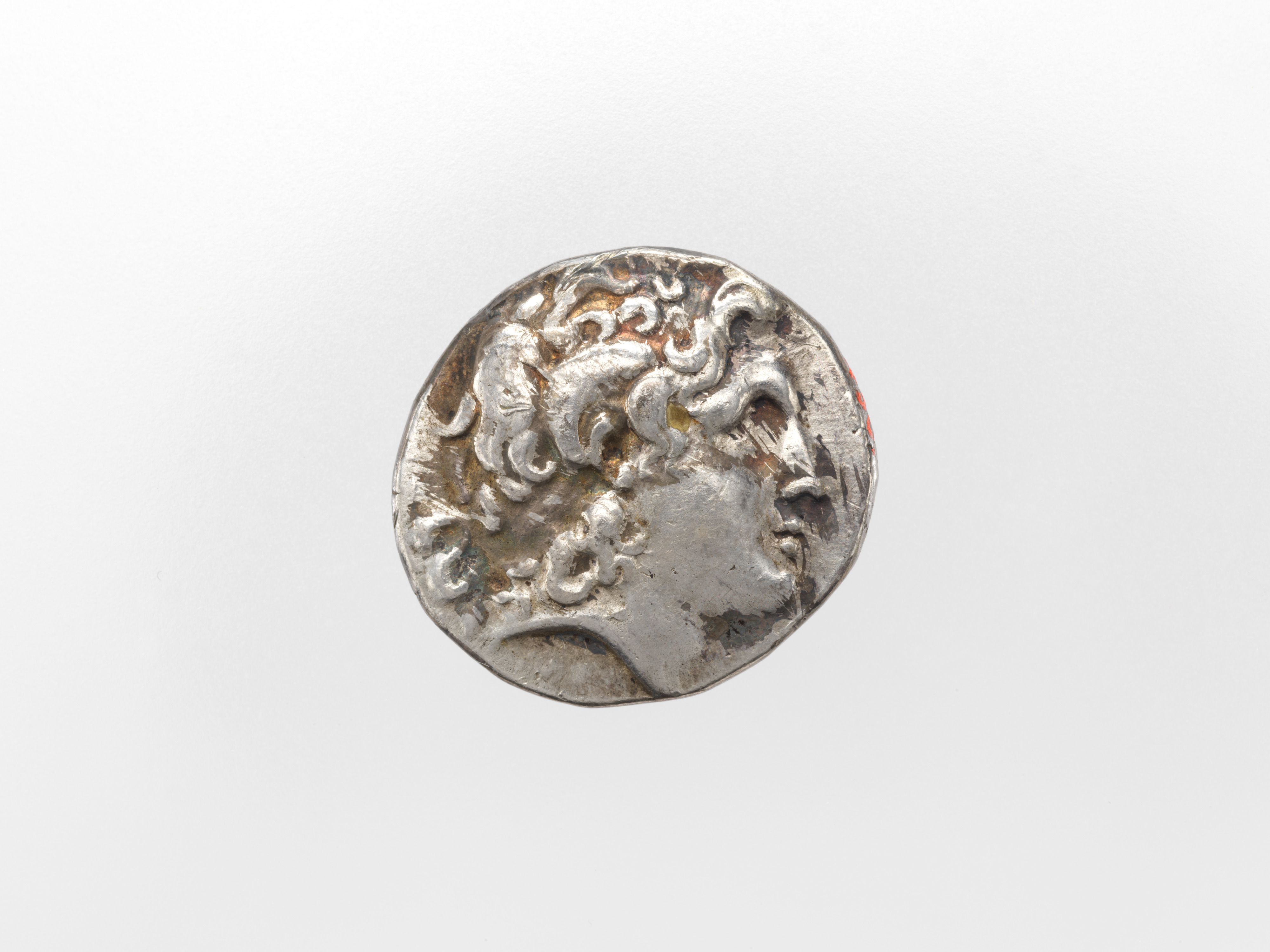
The illustrated coin of LysimachosLysimachusA successor of Alexander who ruled Thrace; his coins showed Alexander with Ammon’s horn.Glossary · Click to read the explanation, one of Alexander's successors, shows Alexander's head with a ram's horn. The Metropolitan Museum dates it to 297–281 BCE, after Alexander's death. It witnesses a horned portrayal in Hellenistic tradition, not a securely identified portrait of the Qur'an's Dhul Qarnayn. [15]
In the Christian narrative the horns become an instrument God grants the king. Tommaso TeseiTommaso TeseiScholar of late-antique traditions and the Quran who proposes an earlier layer for the Syriac Alexander Legend.Glossary · Click to read the explanation discusses the interaction of older horn imagery and biblical interpretation. The connection makes Alexander an intelligible candidate in the epithet's history, but does not by itself establish transmission of the entire Qur'anic passage. Al-Tabari's commentary on verse 83 also records different explanations of the name, including blows to the head, rule over two regions, and hornlike features. These are exegetical reports, not details all affirmed by the Qur'an. [3] [10] [14]
Sea and spring: related imagery, different scenes
The Syriac text describes an impassable, foul-smelling sea at the world's boundary. Alexander tests its danger by sending condemned men, who die; he then retreats. This harsh experiment differs from the Qur'anic scene announcing a rule of justice for an encountered people. [3]
The Qur'an places a muddy spring at the sun's setting. Al-Tabari presents the readings ḥamiʾa and ḥāmiya, associated respectively with mud and heat, and accepts the possibility of both characteristics coexisting. The phrase cannot simply be equated with the foul ocean without argument, nor can its reading history be suppressed. [1] [13]
Boundary and water imagery may participate in a narrative relationship. Equating sea with spring or experiment with just punishment nevertheless erases differences that a dependence hypothesis must explain. This is historical literary comparison, not an attempt to locate the spring or test religious belief using a modern map.
Does Alexander travel east in this same passage?
After the sea, Alexander reaches the place where the sun enters heaven's window in Budge's translation. The narrator then describes sunrise, people fleeing its heat into sea or caves, and the sun's night journey back to its rising point. The sun is the subject of substantial portions of this account. [3]
Al-Kahf explicitly narrates Dhul Qarnayn's arrival at the sun's rising after following another means. One should therefore not turn the sun's course in the Syriac text into the king's itinerary and present both sequences as unproblematically identical. Peoples affected by the sun provide a parallel; the journey's explicitness and sequence differ. The text itself permits this distinction before a modern interpretation is selected. [1] [3]
A barrier of iron and another metal
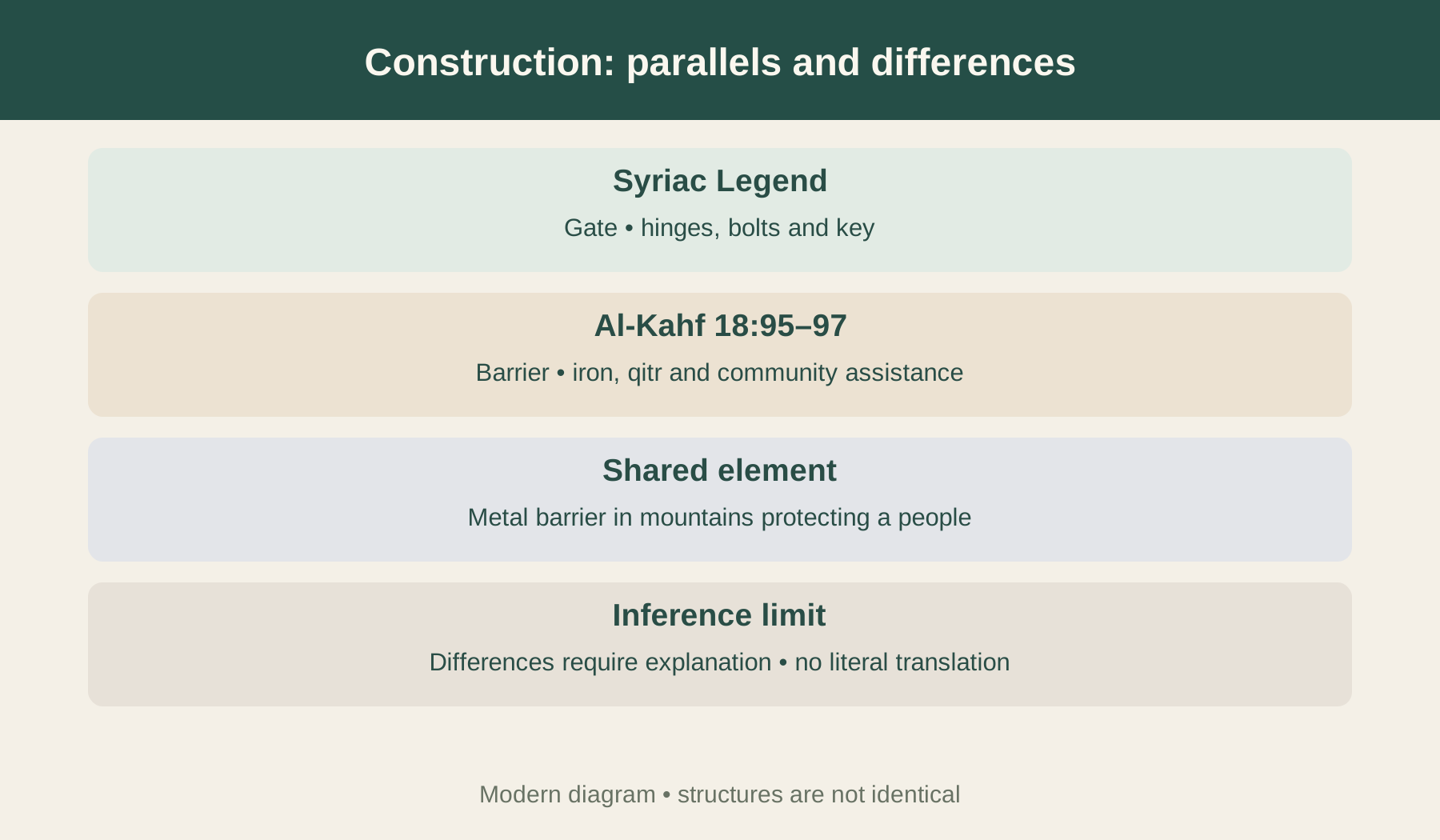
One of the strongest shared elements is a metal structure in a mountain passage, built under royal authority to restrain harmful peoples. In the Syriac narrative Alexander gathers workers in iron and the metal Budge calls brass, constructing a gate with thresholds, hinges, bolts and a key. Gog and Magog appear among names of Hunnic kings. [3]
In the Qur'an, pieces of iron are assembled between the two mountainsides for a blocking structure, heated and covered with poured qitr, with assistance from the people seeking protection. This is not a description of a keyed gate opened in ordinary life. Materials and broad purpose are related, while engineering, organization and structure differ. [2]
Such differences do not automatically exclude dependence: adaptation can change details. They do exclude describing the texts as a literal translation or constructing a comparison that retains similarities and deletes differences.
What predates the Syriac narrative?
In Jewish War 7.7.4, JosephusFlavius JosephusFirst-century Jewish historian who retold older narratives, including Abraham’s test, in Jewish Antiquities.Glossary · Click to read the explanation, a first-century Jewish Roman historian, mentions iron gates attributed to Alexander's closure of a passage and describes the Alans passing through to raid Media and Armenia. In Antiquities 1.6.1, he associates Magog with the Scythians. [5] [6]
Alexander's connection with gates and the associationShirkAssociating others with God in Quranic discourse; not equivalent to denying God’s existence.Glossary · Click to read the explanation of northern peoples with Magog thus were not isolated inventions of the later Syriac text. But Josephus does not supply the complete Qur'anic narrative: those two passages alone do not contain the entire sequence of sun, barrier and promise. Attributing a gate to Alexander also does not archaeologically prove that he built it.
Older elements could therefore be combined and reinterpreted. Dating their assembly into the version being compared remains a separate question.
The gate and the end of time
Alexander has predictions inscribed on the gate in the Syriac narrative, including the numbers 826 and 940 years. A divine act eventually destroys the structure and opens the way, rather than the king's key. The future is connected with Roman supremacy and the Messiah. [3]
In al-Kahf the barrier disappears when the Lord's promise comes, and the text moves toward gathering and judgment. A temporary barrier and divine future form a clear parallel. But the Qur'anic passage gives neither number, announces no Roman victory, and describes no throne delivered to the Messiah. Importing the complete Syriac scenario into the verses and then treating the imported scenario as proof of identity would be circular. [2] [3]
Three dates that must remain separate
First comes the king's time within the story; second, the composition of the narrative or a textual layer; third, the surviving copy available to an editor. Budge dates his British manuscript Add.25875 to 1708–1709 CE. That is the date of this copy, not a finding that everything it contains was composed in the eighteenth century. Conversely, Alexander's presence as its hero makes none of its words automatically contemporary with him. [4]
Brock's Syriac heritage encyclopedia presents the common dating of the Christian Legend shortly after HeracliusHeraclius, Byzantine emperorByzantine emperor who ruled 610–641 CE; his victory over Persia informs dating proposals for some Syriac Alexander texts.Glossary · Click to read the explanation's victory in 629–630. Tesei's book, published online in 2023, proposes an earlier version under JustinianJustinian IEastern Roman emperor from 527 to 565 CE; his reign is used in a proposed dating of a Syriac Alexander Legend layer.Glossary · Click to read the explanation, 527–565. His chapter abstract on the 940 prophecy treats the reference to events of 626–629 as an interpolation into an earlier composition. This is his historical and philological reconstruction, not a dated manuscript discovered from Justinian's reign. [7] [8] [9]
The disagreement matters. If the entire version dates to the late 620s, transmission into the Qur'an has a narrow window depending on a scholar's dating of the passage. If some material belongs to the sixth century, more time is available. Priority alone still establishes neither direction nor intermediary; the layer and datable details also require identification.
How strong is the direct-source model?
Brock reports the view of Kevin van BladelKevin van BladelPhilologist and historian of the Near East and the transmission of learning across languages.Glossary · Click to read the explanation that the Syriac Legend supplied the Qur'anic passage. The model's strength lies in a distinctive cluster: king, world's edges, sun, metal barrier, enclosed peoples and divine ending. It merits more attention than a generic travelling-king parallel. Van Bladel's complete study was not read for this article; the position is presented through the acknowledged scholarly intermediary, without attributing detailed arguments that have not been reviewed. [7]
In a 2026 study, researcher Yasin KaraYasin KaraAuthor of a 2026 study comparing Dhul Qarnayn with the Syriac Alexander tradition.Glossary · Click to read the explanation prefers a shared narrative milieu and stresses differences in water, punishment and building. These differences matter. Yet a different word or omitted scene does not alone disprove dependence; religious and literary adaptation can account for change. Conversely, a shared-tradition hypothesis remains incomplete until it explains circulation of the distinctive elements. Both models are treated here as testable, rather than as consensus or proof of total independence. [11]
Researcher Marianna KlarMarianna KlarScholar of Quranic narrative in its late-antique literary contexts.Glossary · Click to read the explanation's methodological observation in her chapter abstract also helps keep Qur'anic narratives' literary function within comparison. Purpose, audiences and scene arrangement form part of the evidence; they should not be removed merely to make resemblance appear. [12]
What is established, and what remains open?
The texts establish a strong cluster of connected images. The Christian narrative has imperial and Christian purposes not wholly reproduced in al-Kahf, while its gate-building and solar course differ from Qur'anic details. Manuscript, composition and king also belong to distinct times.
Historically, the most plausible broad conclusion is that Dhul Qarnayn's story engages a world of Alexander traditions, world boundaries and enclosed nationsEnclosed nationsNarrative motif of peoples beyond a barrier until their release, not a fixed ethnic name.Glossary · Click to read the explanation. Identifying one particular Syriac text as its direct source, establishing the route, precisely dating its layers, and identifying Dhul Qarnayn as one historical individual remain questions this comparison cannot settle alone. Possibilities are not equally strong merely because conceivable: chronology, details, sequence and contact evidence must weigh them.
The king reaching the edges and building a barrier remained available for rewriting within different religious frameworks. Research reveals a history of narrative formation rather than a biography transmitted unchanged: what each version retained, what it transformed, and which routes remain undocumented.
References and notes
- Arabic text: power,sun and justice; historical identity unnamed. Quran 18:83–91; Arabic primary text Return to the text ↑
- Barrier,iron,qitr,promise and gathering; no imported imperial scenario. Quran 18:92–102; Arabic primary text Return to the text ↑
- Complete English translation of this text; critical passages checked against scans. No direct Syriac collation. E. A. Wallis Budge, The History of Alexander the Great (1889), Christian Legend, pp. 144–158; PDF 264–278 Return to the text ↑
- Date of one manuscript,not narrative composition. Budge (1889), Introduction, p. i; manuscript Add. 25875; PDF 23 Return to the text ↑
- Complete gates/Alans passage; literary attribution does not prove the builder archaeologically. Josephus, Jewish War 7.7.4; William Whiston, public-domain translation Return to the text ↑
- Genealogical passage associating Magog with Scythians; not the full later narrative. Josephus, Antiquities 1.6.1; William Whiston, public-domain translation Return to the text ↑
- Brock entry: distinct works and dating model. Van Bladel’s thesis reported through it; full study unread. Sebastian P. Brock, Alexander Cycle, Gorgias Encyclopedic Dictionary of the Syriac Heritage (2011), electronic entry Return to the text ↑
- Publisher abstract only; earlier Justinianic version attributed to author. Tommaso Tesei, The Syriac Legend of Alexander’s Gate; online 19 October 2023, print 3 November 2023, copyright 2024; abstract Return to the text ↑
- Chapter abstract only; interpolated940prophecy within earlier version is Tesei’s interpretation. Tesei, chapter 3, The 940 ag Prophecy, pp. 30–44; DOI 10.1093/oso/9780197646878.003.0004; abstract Return to the text ↑
- Abstract on horns and biblical reinterpretation; chapter not read in full. Tesei, chapter 9, Alexander’s Horns, pp. 137–155; abstract Return to the text ↑
- Selected pages2–14read; attributed objections,not definitive exclusion of influence. Yasin Kara, The Question of the Source of the Dhūl-Qarnayn Narrative, 18 April 2026; DOI 10.20486/imad.1896168; PDF pp. 2–14 Return to the text ↑
- Chapter abstract only; narrative function and context. Full chapter unread. Marianna Klar, Qur’anic Exempla and Late Antique Narratives (2020), pp. 128–139; abstract Return to the text ↑
- Complete displayed commentary entry; muddy/hot readings,not geographical proof. Al-Tabari, commentary on Quran 18:86; displayed entry Return to the text ↑
- Exegetical explanations of the epithet; reports not independently authenticated. Al-Tabari, commentary on Quran 18:83; displayed entry Return to the text ↑
- Lysimachos coin portraying Alexander; identity and rights checked,not proof of Dhul Qarnayn. Metropolitan Museum, 05.44.430, Silver tetradrachm of Lysimachos, 297–281 BCE Return to the text ↑
- Al-Tabari on al-Kahf 18:96: the complete displayed verse entry was read. It interprets qitr as copper and records a view of molten iron; the entire commentary was not read. Quran 18:96, displayed commentary entry Return to the text ↑
Media

Modern comparison: shared iron and another metal; keyed gate differs from barrier with local labour. Not archaeological reconstruction.
CC0 · Original diagram:IL Archive,2026 · Original IL Archive explanatorySVG2026;CC0dedication. Textual/methodcomparison,notancientartifact,actualgatelocationorprovendirectsource. Arabic reference label revised for reliable RTL display; textual source: https://archive.org/details/historyalexande00callgoog
Research history
Substantive changes are retained here. Minor copy edits remain in the internal operational log.
-
Substantive record update
Suggest a correction · Suggest a source for this record
Cite this record
IL Archive, «Dhul Qarnayn and Alexander traditions: texts, dating and debate», Edition 2, https://ilarchive.com/en/studies/dhul-qarnayn-and-alexander-traditions
Continue reading