Study
The Tree of Life and Gilgamesh’s Plant: Did Genesis Borrow the Serpent Story?
An extended study of a topic, with evidence and references.
- Region
- The Near East
A close comparison of Gilgamesh XI’s rejuvenating plant with Genesis 2–3’s two trees and serpents, testing Levantine circulation, the limits of borrowing claims, and later Qur’anic reception.
Share article
Text
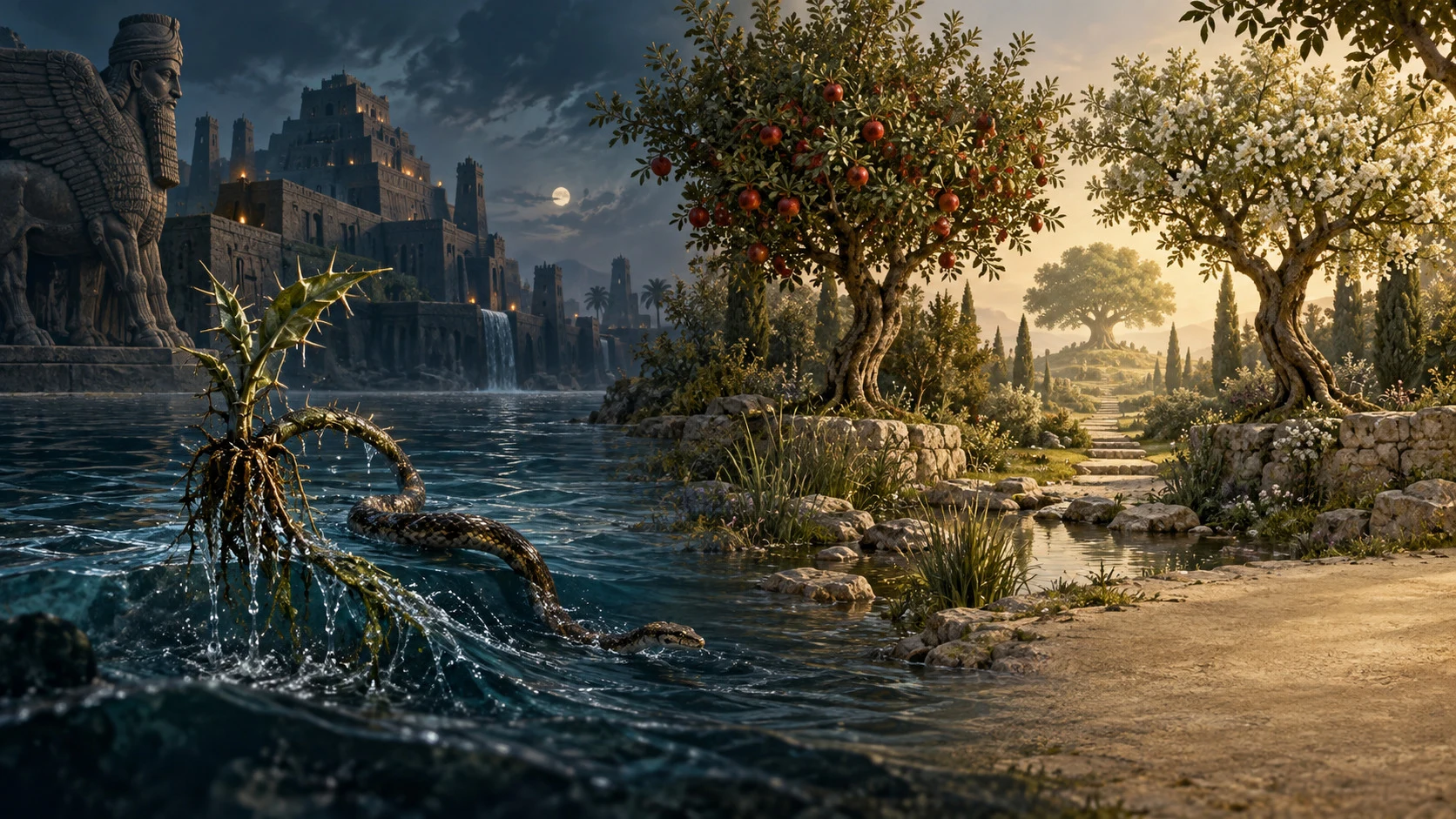
A serpent, a plant, and lost access to life appear in two of the ancient Near EastAncient Near EastA historical and geographical term covering Mesopotamia, the Levant and neighbouring ancient societies.Glossary · Click to read the explanation's best-known stories. In Tablet XI of Gilgamesh, the king descends into water to obtain a plant that restores youth, only to lose it to a snake. In Genesis, a serpent speaks to a woman in a garden with two trees, and the story ends with the human being barred from the tree of lifeTree of Life in GenesisA tree distinct from the knowledge tree in Genesis 2–3; after the other tree is eaten, the way to it is guarded lest humans eat and live forever.Glossary · Click to read the explanation. It is tempting to set the scenes side by side and call one the “original” of the other. Historical comparison begins with the details that claim overlooks: Which plant or tree is involved? Who eats? Who keeps the human being from life? And what kind of life is at stake? [1][2][3]
The plant that did not end Gilgamesh's mortality
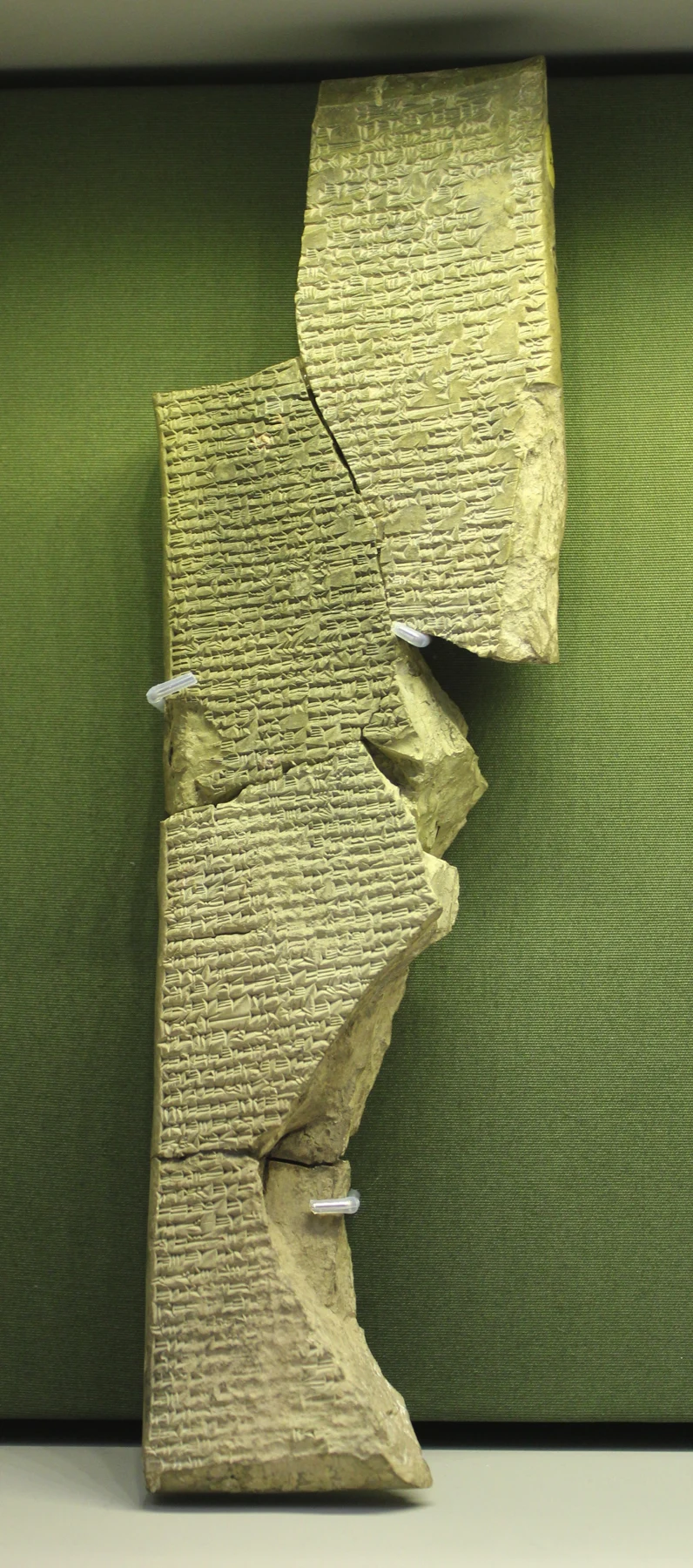
Gilgamesh's search for life does not begin with the snake. The death of his friend Enkidu confronts him with his own mortality, and he travels to find Uta-napishtim, the flood survivor who was granted an exceptional form of life. Meeting this distant figure does not give Gilgamesh the same immortality. After failing a test of staying awake, he hears of a thorny plant beneath the water. He takes it and says that he will carry it back to UrukUrukAncient city at Warka in southern Iraq, a major urban centre around 3200 BCE that preserved early writing and accounting tablets.Glossary · Click to read the explanation, test it on an old man, and then consume it himself to regain his youth. The prospect is clearly renewal of age. It does not establish that eating the plant would have made its eater incapable of dying. Uta-napishtim's extraordinary deathless life and the plant's promise to make an old man young are different things within the same tablet. [1][4]
On the way home, Gilgamesh sees cool water and goes down to bathe. A snake scents the plant and takes it; the image of shedding its skin follows, while Gilgamesh weeps over the loss of his labor. This readily suggests why a serpent might appear to renew itself while people remain mortal. Yet we should not insert familiar details from popular retellings into the surviving lines. The translation examined here describes the snake smelling and seizing the plant and the shedding of its skin. That it explicitly ate the plant is an interpretation found in some commentary, not a stated action in the lines on which this study relies. Parts of the tablet are damaged or restored, and line numbers vary between editions. We therefore identify the scene and edition instead of building a theory on an isolated line number. [1][11]
Genesis has two trees, not one
Genesis 2:9 names both the tree of life and the tree of the knowledge of good and evilTree of the Knowledge of Good and EvilThe tree forbidden in Genesis 2:17 and discussed by the serpent before the eating in Genesis 3; it is not the tree of life.Glossary · Click to read the explanation. The command in 2:16–17 then prohibits eating from the knowledge tree. This distinction matters: in the wording of the story, the first prohibition does not concern the tree of life. In Genesis 3 the serpent discusses the forbidden tree, saying that eating will open the humans' eyes and make them know good and evil. The man and woman eat and become aware of their nakedness. The serpent steals neither a tree nor its fruit, and the story says nothing about it shedding its skin. [2][3]
The tree of life becomes decisive at the end. Genesis 3:22 says the human has acquired knowledge of good and evil and is then prevented from reaching for the tree of life and living forever. The human is sent out of the garden, and cherubimCherubimBeings or figures with guarding and sacred functions in Hebrew texts, at the tree-of-life access and on the ark; not equivalent to every heavenly messenger.Glossary · Click to read the explanation and a flaming sword guard the way to the tree. Access to lasting life thus ends through a divine decision and a guarded route, not through a snake's theft of the plant. Where Gilgamesh plans to recover his youth, Genesis associates the tree of life with living forever. The stories meet in the loss of access to life but differ in the benefit offered and the way it is lost. [1][3]
What does the shared serpent show?
Three common elements can be recorded without strain: a serpent, a plant or tree connected with life, and a human who ultimately does not obtain a life beyond the usual human limit. On that basis, John Day has considered the possibility that the author of the EdenEden: The Setting of Genesis’s GardenThe place in which the garden of Genesis 2–3 is planted; the story describes rivers, trees and a human test, while its archaeological location and name’s derivation remain unsettled.Glossary · Click to read the explanation story reworked elements known from Gilgamesh traditions. He nevertheless calls the result an interesting possibility rather than a certainty. He observes that the epic's plant comes from underwater and restores youth, whereas Genesis places two trees on dry land and its serpent intervenes in eating from the knowledge tree. A sound comparison does not discard these differences in order to preserve the serpent alone. [1][2][3][6]
The serpent's narrative and moral roles also differ. In Gilgamesh, it does not debate a divine command with the hero; it arrives after he succeeds in gathering the plant and turns his journey into a loss. In Genesis, it speaks before the eating, recasts the prohibition, and is cursed afterward. Its speech leads to knowledge and a new limit on human life, not to the serpent's possession of the tree of life. Genesis 3 does not call it “Satan” at this point: 3:1 presents it among the creatures of the field made by the LordRabbTitle of lordship, ownership or care by context; applied to God in Lord of worlds.Glossary · Click to read the explanation. An explicit identification with Satan belongs to later religious interpretation rather than to the wording of that verse. [1][3][6]
The relationship can therefore be described at several levels. Textual resemblance in some elements is observable. Shared regional tradition is possible: mortality, wisdom, serpents, and plants were subjects in ancient Near Eastern cultures. Direct literary dependenceLiterary dependenceA relationship explaining a text’s composition through another text.Glossary · Click to read the explanation requires stronger evidence: a rare detail arranged in a similarly distinctive sequence, or a witness to transmission that can be connected to Genesis's composition, rather than a serpent and a tree alone. Conversely, differences in plot do not make all interaction impossible; an ancient writer could recast a familiar image and change its meaning. [5][6][10]
Did the epic reach the Levant?
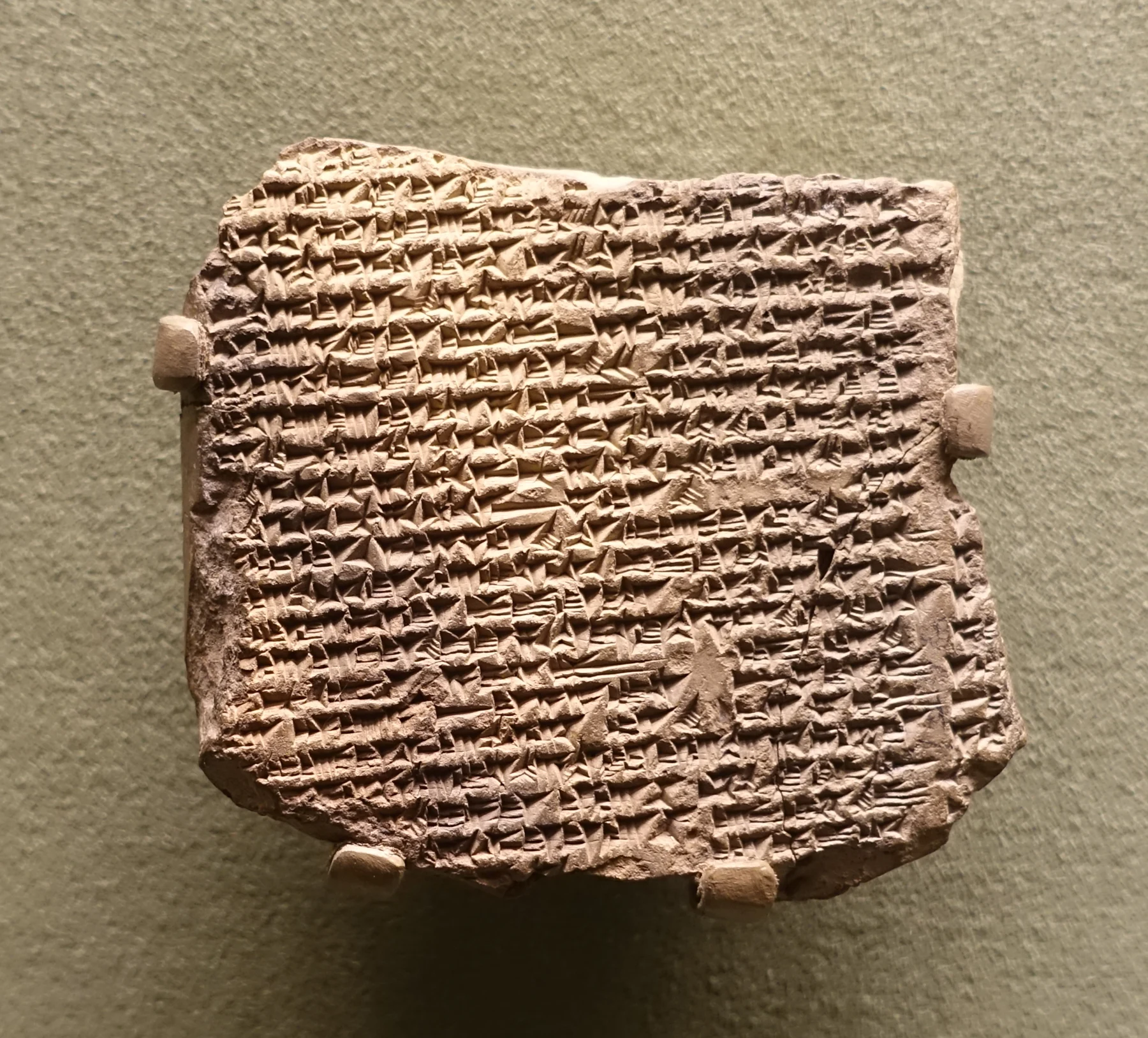
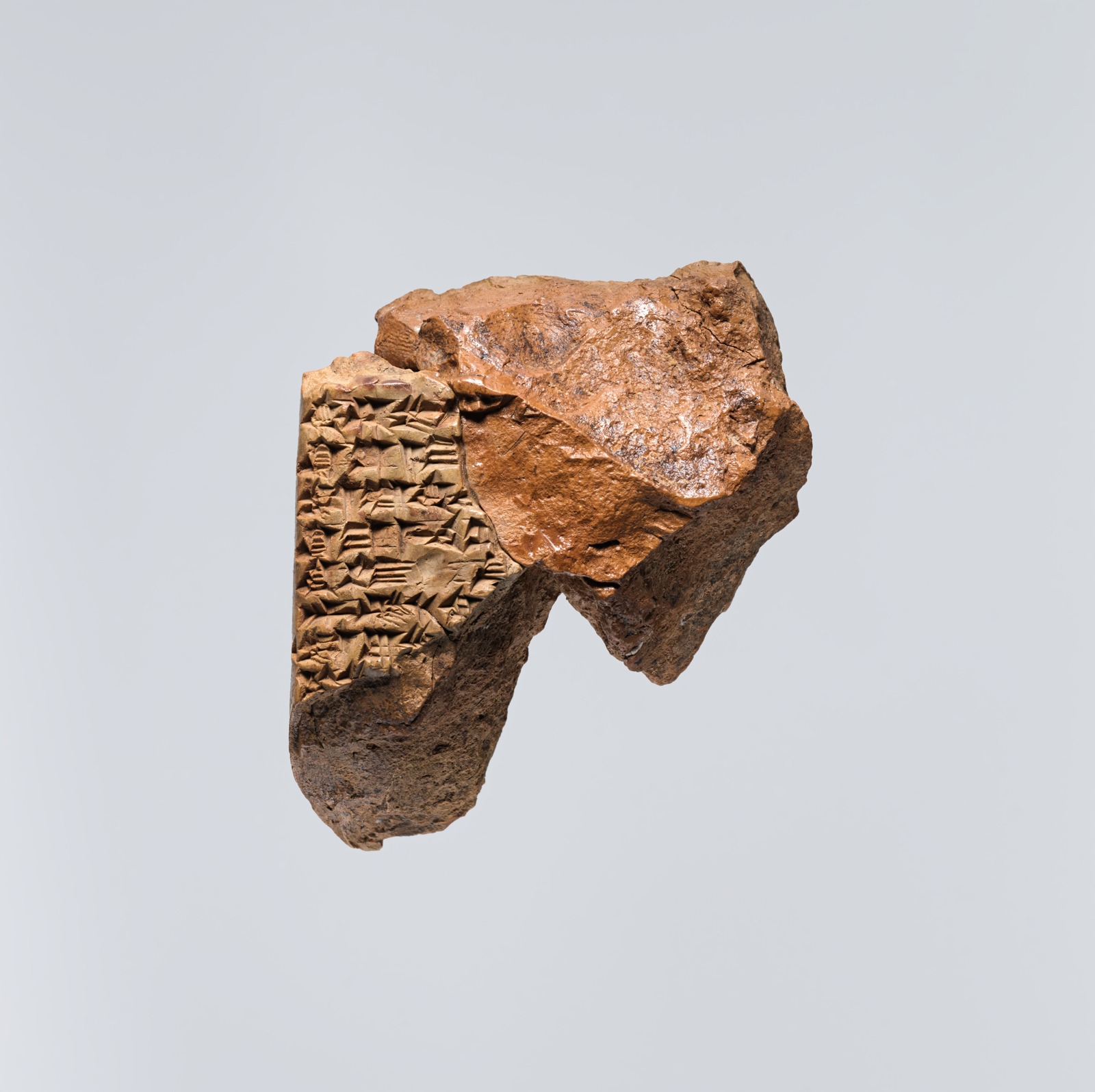
Yes. Evidence independent of our literary comparison survives. Late Bronze AgeLate Bronze AgeAn archaeological period conventionally around 1600–1200 BCE in much of the Near East, with regional variation.Glossary · Click to read the explanation Gilgamesh copies were found in the Megiddo area, at Emar, and at UgaritUgaritAncient city and kingdom at Ras Shamra on the Syrian coast, flourishing between the fourteenth and early twelfth centuries BCE and preserving multilingual archives.Glossary · Click to read the explanation. Andrew George studied the published Ugaritic pieces in the setting of cuneiformCuneiformWriting with wedge-shaped signs, developed from Mesopotamian recording traditions and used for several languages from the third millennium BCE.Glossary · Click to read the explanation scribal learning. One Ugaritic tablet preserves the epic's opening; other fragments concern Gilgamesh and Enkidu's journey into the Cedar Forest and their encounter with Humbaba. The cuneiform catalogue also records a Middle Babylonian Gilgamesh tablet associated with the Megiddo area, while marking its precise findspot as uncertain. Such evidence establishes that the epic and its characters were not confined to southern MesopotamiaMesopotamiaA historical region associated with the Tigris and Euphrates, home to many societies and civilisations.Glossary · Click to read the explanation. [5][7]
It does not establish a second proposition: “An Ugaritic tablet preserves the plant-and-snake scene read by the author of Genesis.” The known Ugaritic pieces described by George do not contain that scene, and the accessible Megiddo record does not justify attributing it to that fragment either. Nor was the epic a single fixed text throughout the second millennium BCE. Its earlier and middle-period versions are varied and fragmentary; the composite Tablet XI we read today rests on later witnesses and textual editing. A possible route for stories does not tell us which version travelled, when it travelled, or whether any particular Genesis writer used it. [4][5][7]
The word “older” therefore needs care. There are Sumerian poems and ancient Babylonian witnesses about Gilgamesh, but they are not complete pages of the Standard Babylonian epic as it is read today. An early attestation of his name or of another poem does not date every detail of the plant episode to the age of the Sumerian poems. On the other side, scholars debate the stages through which the Eden narrative took shape. The order of surviving witnesses invites a question about cultural contact; it does not produce a simple timeline of one complete ancient version copied into a second complete version. [4][5][10]
Is the same story in the Qur'an?
The Qur'an belongs to a later history of receiving and retelling Adam's story. It is not a witness to the composition of Gilgamesh or Genesis. In Qur'an 7:20 the text explicitly attributes the whispering to Satan and reports his promise that the pair might become angels or among the everlasting. In 20:120 he invites Adam to a “tree of eternity” and a dominion that will not decay; 20:121 then says that the pair ate from it. The tempter's speech here explicitly invokes permanence. That differs from Genesis's wording, which calls the serpent an animal and does not put a promise about the tree of life in its mouth. [3][8][9]
Comparative history may trace how later Jewish, Christian, and Muslim traditions reread the serpent, temptation, and immortality. But chronology prevents the Qur'anic wording from being used as an explanation of what the AkkadianAkkadianAn ancient East Semitic language written in cuneiform in Mesopotamia.Glossary · Click to read the explanation or HebrewHebrewA Northwest Semitic language in the Canaanite group, with ancient and modern forms.Glossary · Click to read the explanation text “really meant” centuries before. These Qur'anic verses also mention neither Gilgamesh's plant nor a snake stealing it. They belong to a comparison of reception and changing meaning, not evidence of direct borrowing from the Babylonian epic. [1][2][3][8][9]
Where does the evidence leave us?
The firm conclusion is specific. The known Gilgamesh text depicts the loss of a rejuvenating plant to a snake. Genesis depicts eating from the knowledge tree and then the closing of the route to the tree of life. The Qur'an frames Adam's temptation with explicit language of everlasting life and names Satan. Gilgamesh circulated in the LevantThe LevantThe Levant is a regional name for lands along the eastern MediterraneanGlossary · Click to read the explanation before many biblical writings, so its imagery, or related imagery, could have belonged to the cultural background in which the Eden story moved. But we have neither a Levantine fragment preserving the plant-and-snake scene nor a document tracing its transfer to an author of Genesis 2–3. [1][2][3][5][7][8][9]
Keeping the distinctions makes the comparison more illuminating. Each text asks in its own way why humans lack divine life: a journey ending in the loss of a remedy for age, a garden whose path to life is guarded, or a whisper promising eternity. Historically connected questions and images deserve investigation. The evidence does not demonstrate that the three texts are one unchanged story. [1][2][3][6][8][9]
References and notes
- Alexander Heidel, The Gilgamesh Epic and Old Testament Parallels (1949), Tablet XI, pp. 91–92 in the University of Chicago copy; these pages were read and visually checked, not the whole book. Alexander Heidel, The Gilgamesh Epic and Old Testament Parallels (1949), Tablet XI, printed pp. 90–93, especially 91–92 Return to the text ↑
- Genesis 2 in Hebrew with parallel JPS translation; the chapter was read, especially verses 9 and 16–17. Genesis 2, Hebrew/JPS parallel, especially 2:9 and 2:16–17 Return to the text ↑
- Genesis 3 in Hebrew with parallel JPS translation; the chapter was read, especially verses 1–7 and 22–24. Genesis 3, Hebrew/JPS parallel, especially 3:1–7 and 3:22–24 Return to the text ↑
- Andrew George, Cambridge excerpt on The Epic of Gilgamesh (2007), PDF pp. 2–4 and 9; excerpt only, not the full book. Andrew R. George, The Epic of Gilgamesh, Cambridge Companion excerpt (2007), PDF pp. 2–4 and 9 Return to the text ↑
- Andrew George, “The Gilgameš Epic at Ugarit” (2007); pp. 237–239 and 246 of the 18-page university-hosted paper read closely, the rest selectively inspected. Andrew R. George, 'The Gilgameš Epic at Ugarit,' Aula Orientalis 25 (2007), pp. 237–239, 246 Return to the text ↑
- John Day, “The Serpent in the Garden of Eden and its Background” (2015); introduction and relevant comparative sections read, reader comments excluded. John Day, 'The Serpent in the Garden of Eden and its Background' (2015), main discussion of Genesis and Gilgamesh Return to the text ↑
- CDLI catalogue, Gilgamesh fragment P273198 from the Megiddo area; complete artifact metadata read, not the original cuneiform signs. CDLI, Gilgamesh Middle Babylonian Megiddo-area artifact P273198 Return to the text ↑
- Qur’an 7:20, Arabic morphological display in the Quranic Arabic Corpus; this verse and adjacent words checked, not the whole sura. Qur'an 7:20, Arabic and morphological display Return to the text ↑
- Qur’an 20:120–121, Arabic morphological display in the Quranic Arabic Corpus; both verses checked, not the whole sura. Qur'an 20:120–121, Arabic and morphological display Return to the text ↑
- David Carr, “Precursors to the Eden Narrative” (2020); publisher abstract only, not the full chapter. David M. Carr, 'Precursors to the Eden Narrative' (2020), publisher abstract Return to the text ↑
- Secondary display of K.8517’s eBL-derived transliteration with Thompson’s 1928 translation; Tablet XI 298–317 inspected, not the museum’s original image. K.8517 manuscript display derived from eBL, SB XI 298–317 Return to the text ↑
Suggest a correction · Suggest a source for this record
Cite this record
IL Archive, «The Tree of Life and Gilgamesh’s Plant: Did Genesis Borrow the Serpent Story?», Edition 1, https://ilarchive.com/en/studies/immortality-gilgamesh-and-genesis
Continue reading