Study
Moses and the servant of God: the fish and water of life
An extended study of a topic, with evidence and references.
Quran, hadith, al-Tabari, the Alexander Poem and Talmud: recurring fish motifs, different functions, and the evidence needed to establish transmission.
Share article
Text
Introduction
Why does a fish mark MosesMosesCentral figure in Exodus, Torah traditions and the Qur’an; childhood accounts differ in detail.Glossary · Click to read the explanation' meeting place in surah al-Kahf, while AlexanderAlexander the GreatMacedonian king who lived from 356 to 323 BCE and became a hero of stories in different languages and traditions after his death.Glossary · Click to read the explanation's fish reveals life-giving water in a SyriacSyriacA literary form of Aramaic, with an extensive Christian heritage and earlier non-Christian attestations.Glossary · Click to read the explanation poem and its fragrance points to EdenEden: The Setting of Genesis’s GardenThe place in which the garden of Genesis 2–3 is planted; the story describes rivers, trees and a human test, while its archaeological location and name’s derivation remain unsettled.Glossary · Click to read the explanation in a Jewish account? This study compares the three scenes, identifying both their shared details and their different purposes. It then asks what the surviving evidence can establish about the movement of the story between traditions. [1] [7] [9]
Moses' scene occurs in the QuranQuranCentral text of Islam, used here as evidence of its religious discourse.Glossary · Click to read the explanation, which emerged in the seventh century CE. Scholar Sebastian BrockSebastian P. BrockSyriac literature scholar who distinguishes the Syriac Alexander Romance, Christian Legend and poem.Glossary · Click to read the explanation places the Syriac Alexander PoemSyriac Alexander PoemPoetic work about Alexander and life-water, distinct from the long Romance and prose Legend; attribution and date require examination.Glossary · Click to read the explanation after HeracliusHeraclius, Byzantine emperorByzantine emperor who ruled 610–641 CE; his victory over Persia informs dating proposals for some Syriac Alexander texts.Glossary · Click to read the explanation' victory in 629–630 CE, but that is a scholarly dating proposal, not a dated authorial manuscript. Preserving a story in the Talmud does not by itself date the origin of each detail. We will distinguish the verses from hadith and exegesis, and compare what the fish does in each account before assessing a possible connection. [8] [9] [14]
The fish that marks the way
In al-Kahf, a fish taken on a journey becomes the sign directing Moses to an unexpected encounter. In a Syriac poem about Alexander, a salted fish reveals water able to bestow life. In the Babylonian Talmud, a fragrance arising while fish are washed leads Alexander to think of Eden. Comparison is worthwhile, but assembling the scenes into one story erases distinctions that research needs. [1] [7] [9]
The question is not whether the ancient world knew stories about water and life; it did. We should ask which details recur, in which text, when that text could circulate, and what those details do within it. This requires beginning with the verses before adding information from later reports.
What the verses say about the fish
Moses announces that he will continue to the meeting of the two seas, however long the journey takes. On reaching it with his young companion, they forget their fish, which takes its way into the sea. After passing the place, Moses asks for food. His companion recalls the incident at the rock. Moses recognizes the intended place, retraces their steps, and encounters a servant granted mercy and knowledge by God. [1]
The passage does not name the companion Joshua or the servant KhidrKhidrName of the servant in Islamic reports about Moses’ journey; al-Kahf leaves him unnamed.Glossary · Click to read the explanation. It names no water-of-life spring or quest by Moses for immortality. Nor does it explicitly say here that the fish was salted and dead before returning to life. The fish’s activity and the route invite interpretation, but the Quranic wording must remain distinct from explanations of how the event occurred.
The story continues beyond the water
The meeting begins another journey. Moses asks to follow the servant to learn and is told that patience will be difficult without knowing the explanation. Three actions follow: damage to a boat, the killing of a boy, and repairing a wall in a village whose inhabitants refuse the travellers food. Moses objects; explanations are deferred until their companionship ends. [2]
Those explanations concern the boat’s poor owners and a king seizing boats, the boy’s parents, and treasure belonging to two orphans beneath the wall. Historical reading need not turn these acts into contemporary legal rules. Their narrative function is to expose a distance between appearances and the knowledge the text claims reveals their consequences. Reducing the passage to fish and spring excludes most of the story from comparison.
Where does the name Khidr come from?
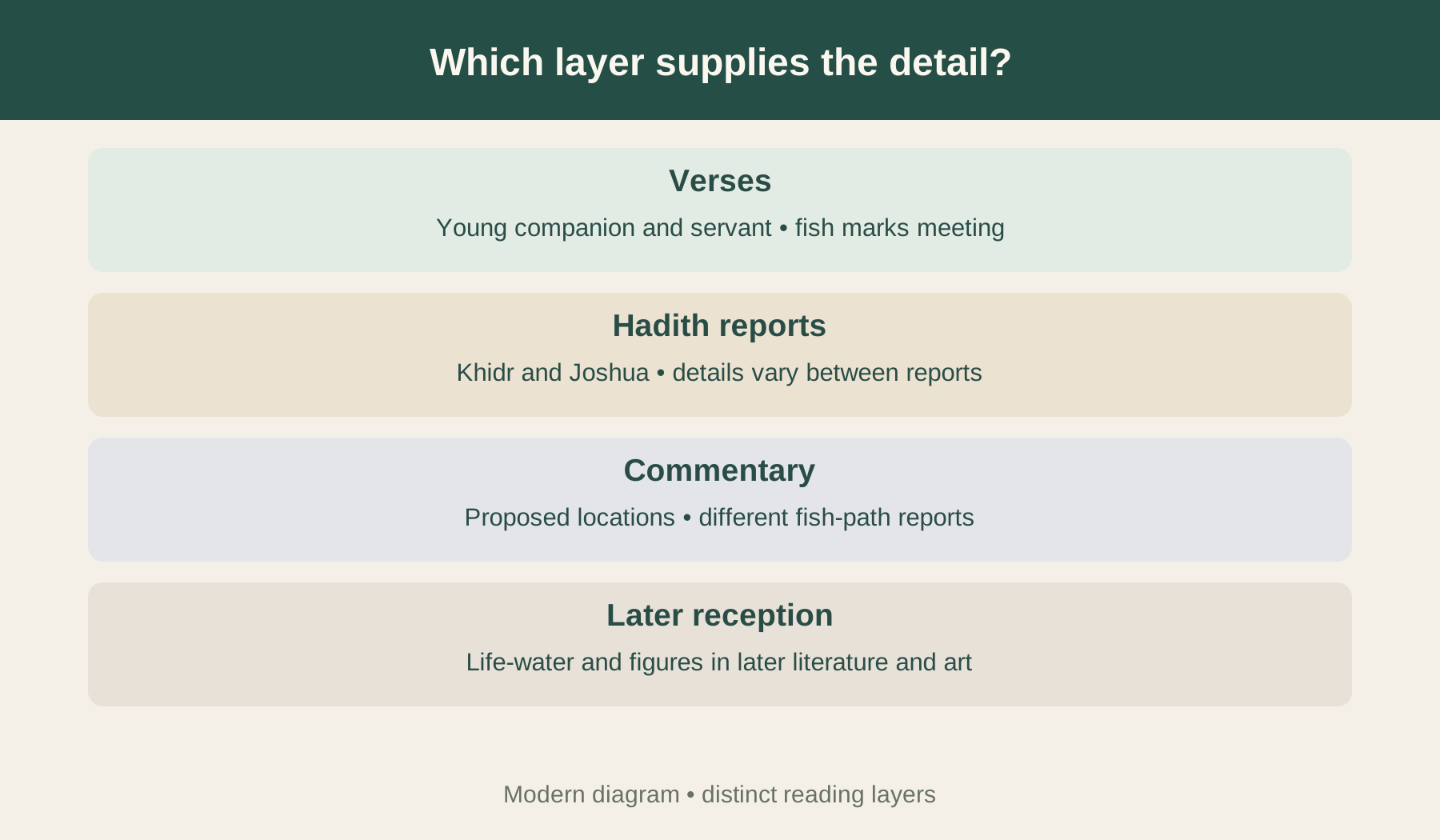
The hadith narrative names the servant KhidrKhidrName of the servant in Islamic reports about Moses’ journey; al-Kahf leaves him unnamed.Glossary · Click to read the explanation and identifies the companion as Joshua son of Nun. Bukhari 4727 introduces the journey through a question about the most knowledgeable person and Moses’ answer, followed by direction to a servant possessing knowledge not given to Moses. The basket, sleep and a bird pecking at the sea illustrate how little human beings know beside God’s knowledge. [3]
These names are not modern inventions; they have a real place in Islamic tradition. They are nevertheless absent from the verses themselves. Distinguishing layers serves neither to discard the reports nor to authenticate them historically, but to identify the source of each detail. Reading this particular report is not reading the entire collection; displaying its text cannot substitute for independent study of its transmission chains.
The spring of life and different reports
The cited Bukhari report includes a spring of life at the rock and connects its water with the fish’s renewed movement. Immediately before the detail, however, Sufyan, a transmitter of the report, specifies that the detail comes from a narration other than that of Amr, another transmitter in the chain. That small qualification matters: even a long report displayed on one page acknowledges another narrative layer. [3]
Muslim 2380c describes a salted fish moving and taking a path through the water without naming the spring of life in this version. This does not establish that all Muslim’s reports omit it. It establishes that details do not always form a fixed package. Even a report mentioning life-giving water does not make every later claim about Khidr’s perpetual survival Quranic wording or a necessary conclusion of that report. [4]
The meeting of the seas is not a settled coordinate
Quran commentator al-TabariAl-TabariAbbasid-era historian and Qur'anic exegete (c. 839–923 CE). His commentary records competing views on Abraham's son, then favors Isaac.Glossary · Click to read the explanation (839–923 CE), in his discussion of verse 60, presents opinions involving the Persian and Roman seas and includes a report connecting the place with TangierTangierCity in northern Morocco by the Strait of Gibraltar, proposed in one interpretation of the Quran's meeting of the seas.Glossary · Click to read the explanation. On verse 61 he discusses the fish’s path as an opening in the water, a trace, or other forms described by reports. Variation belongs to the evidence; it should not be removed to leave a single map. [5] [6]
Selecting the location nearest our expectations does not establish a route of narrative transmission. A proposed place may reflect linguistic interpretation, sacred geography or an attempt to locate something obscure. Al-Tabari’s inclusion of a report does not mean that we have independently authenticated its chain or established a journey at the stated site.
The fish in the Syriac Alexander Poem
In the Syriac Alexander PoemSyriac Alexander PoemPoetic work about Alexander and life-water, distinct from the long Romance and prose Legend; attribution and date require examination.Glossary · Click to read the explanation, the king seeks a life-giving fountain in a dark land. An old guide explains how to return by using female asses and their young, and how to test the waters using a salted fish carried by the cook. When the cook washes the fish in the desired water, it revives and escapes. He enters the water after it but fails to catch it. [7]
The king hears about the fountain but cannot find the place to bathe and live for ever. The guide explains that God did not intend to grant him endless life. These details were read on pages 170–175 of BudgeE. A. Wallis BudgeBritish Egyptologist and ancient-language scholar (1857–1934) who published a historical English translation of Syriac Alexander texts.Glossary · Click to read the explanation’s English translation of 1889. The selected pages do not explicitly declare the cook immortal; entering the water does not authorize presenting that conclusion as a quotation from this passage.
Which Alexander text are we comparing?
The long Romance, the Poem and the Christian prose Legend known as the NeṣḥānāSyriac Christian Alexander LegendChristian prose narrative of Alexander’s journeys and the gate restraining nations; distinct from Romance and Poem, with debated dating.Glossary · Click to read the explanation are distinct works. Moving details between them and calling the mixture “the Syriac text” misrepresents the evidence. An old attribution to Jacob of SerughJacob of SerughSyriac author of the late fifth and early sixth centuries, credited with a homily on the youths of Ephesus.Glossary · Click to read the explanation does not by itself establish his authorship. Sebastian Brock, a scholar of Syriac literature, questions the attribution and dates the Poem shortly after Heraclius’ victory in 629–630. [8]
This is a scholarly dating model, not a date written by the author. Our comparison uses a specific passage of a historical translation; we have not independently collated the Syriac or read the entire modern critical edition. Revised dating of the prose Legend must not automatically be applied to the Poem. Where the witness’s date remains disputed, the direction of dependence requires investigation.
The Talmud: fragrance rather than revived fish
In Tamid 32b of the Babylonian Talmud, a collection of rabbinic writings shaped in late antiquityLate antiquityHistorical frame for late ancient transformations; boundaries vary by region and subject.Glossary · Click to read the explanation [14],, Alexander washes salted fish to remove salt, encounters a pleasant fragrance, and concludes that the water comes from Eden. The narrative then preserves alternatives: washing his face or following the water to Eden’s gate. He is refused admission and receives something resembling an eye. The story explains that a human eye remains unsatisfied by gold and silver until covered with dust. [9]
The passage combines Alexander, fish, water and limits to ambition, but does not narrate the fish’s return to life. Changing fragrance into revival increases resemblance at the text’s expense. Preservation in the Talmud also does not make the story contemporary testimony to Alexander’s campaigns. The hero’s lifetime must be distinguished from the narrative’s date and its written witness.
One sign, different functions
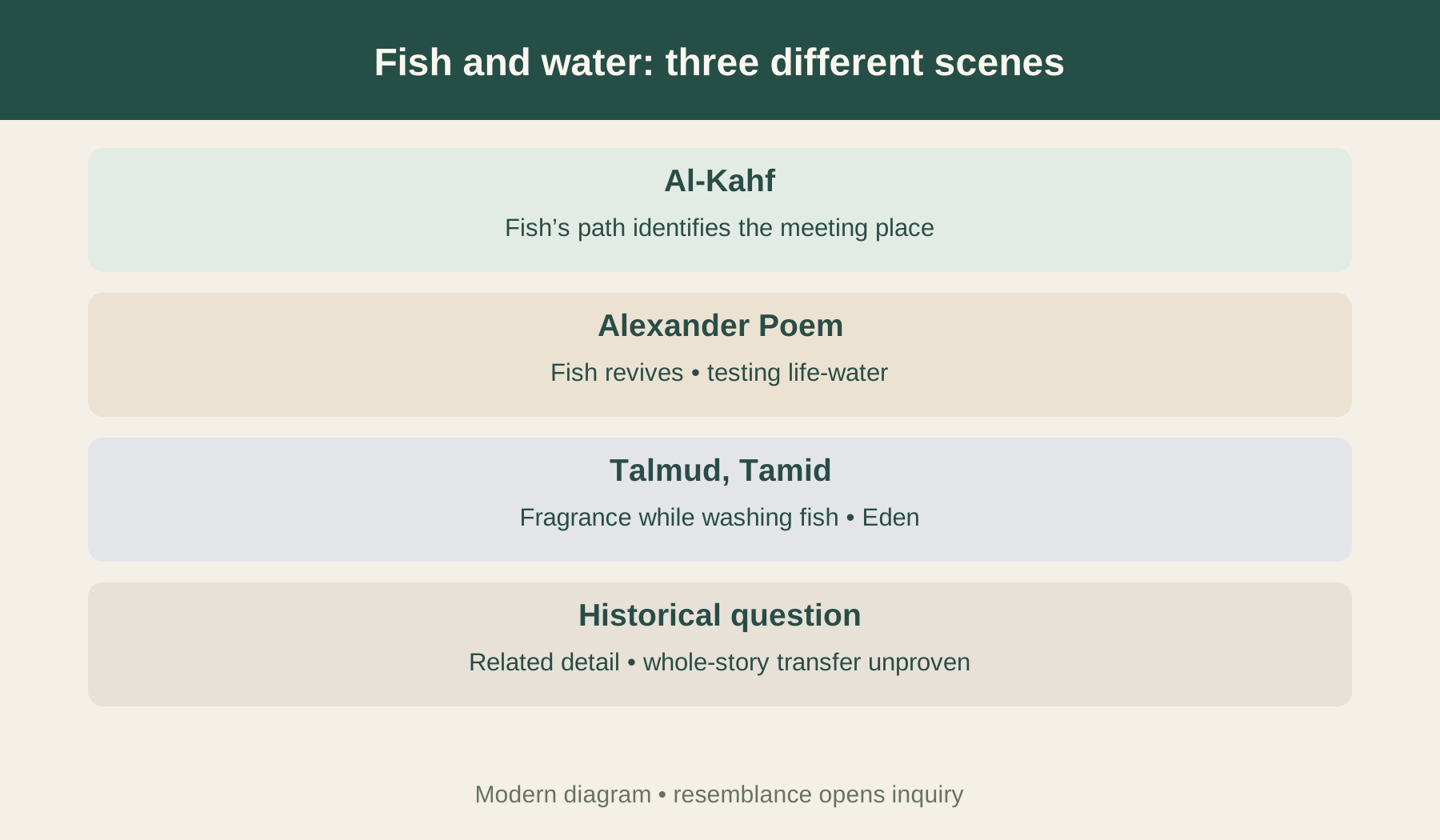
In al-Kahf, the fish identifies the meeting place where Moses’ learning begins. In the Poem it tests water sought by the king for perpetual life. In Tamid, fragrance reveals a connection with Eden before limits to admission and desire emerge. This is a network of related images, not three identical texts. [1] [7] [9]
A distinctive detail carries more comparative weight than a journey or water alone. It does not establish that everything following that detail travelled with it. Demonstrating dependence of the entire teaching narrative requires comparing the boat, boy, wall and explanations rather than stopping at the fish. Different functions do not automatically exclude borrowing: an image’s function can change when it travels.
Why do scholars disagree?
Islamic-studies scholar Brannon WheelerBrannon M. WheelerScholar of the history of religion and early Islamic exegesis.Glossary · Click to read the explanation objects to conflating the Quran with exegesis when proposing direct derivation from Alexander or Gilgamesh. Here we rely on his introductory page 191, available in the publisher’s preview, not on reading pages 192–215 or evaluating his complete argument. Such limits matter when presenting scholarly disagreement. [10]
Scholar Tommaso TeseiTommaso TeseiScholar of late-antique traditions and the Quran who proposes an earlier layer for the Syriac Alexander Legend.Glossary · Click to read the explanation reads the fish and the meeting of the seas against late antique ideas about Eden and waters. He connects them with life-water imagery and proposes a cosmological interpretation of the route. We read his full article, but its model remains scholarly interpretation, not documentation of a particular translator or single transmission route. [11]
What does Gilgamesh add?
In Tablet XI of the AkkadianAkkadianAn ancient East Semitic language written in cuneiform in Mesopotamia.Glossary · Click to read the explanation Epic of GilgameshEpic of GilgameshMesopotamian literary tradition with multiple versions, concerning Uruk’s king, Enkidu and mortality. Standard Tablet XI preserves Utnapishtim’s flood; manuscript date does not date the tradition’s origin.Glossary · Click to read the explanation, UtnapishtimUtnapishtimGilgamesh’s flood hero narrates survival to a king seeking immortality. Ea warns him; life is preserved; hero and wife receive exceptional life. Literary character, not an archaeologically established person.Glossary · Click to read the explanation and his wife receive an exceptional status far away at the mouth of the rivers. Gilgamesh fails a test of staying awake and later obtains a plant able to renew youth, which he loses because of a serpent. Renewing youth differs from bestowing eternal life; a plant differs from a spring discovered through a fish. [12]
The comparison shows how old questions about death, journeys, water and human limits are. It does not by itself prove direct passage from Akkadian text into al-Kahf. Our sources here are specified portions of Budge’s historical translation and summary, not the complete latest Akkadian edition. Gilgamesh’s fame cannot replace a missing intermediate witness.
What would establish transmission?
First identify the actual recension, rather than a broad label such as Alexander literature. Separate composition from the date of its surviving manuscript. Examine possible contact between languages and communities, the cluster and order of details, and the likely means of transmission. An earlier text in a distant region does not complete that chain.
Alternatives include borrowing a particular text, circulating an oral story, reshaping shared traditionShared traditionInherited material reaching several texts without direct dependence between them.Glossary · Click to read the explanation, or adding details to later exegesis. They do not always carry equal weight; available evidence determines it. Nor should a later Jewish tale be declared a pre-Quranic source without checking its earliest witness and date of recording.
A later image of reception
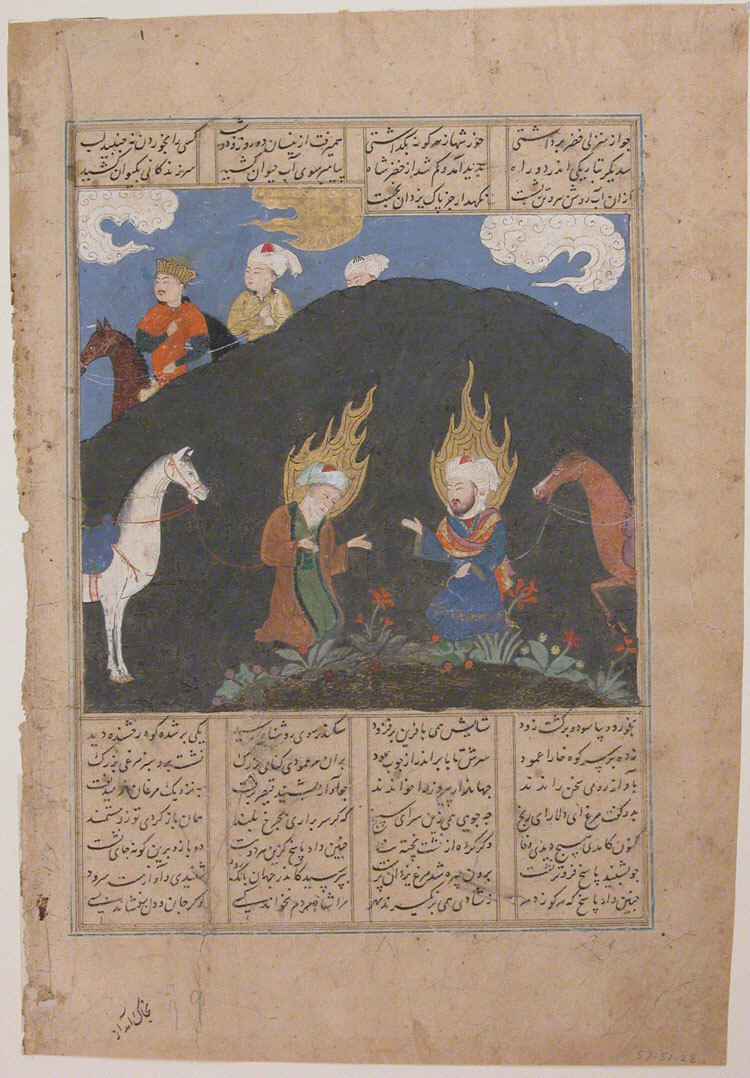
The main image is a late fifteenth-century Persian Shahnama leaf depicting Elias and Khizr at the fountain of life. It witnesses later reception, not a pre-Quranic source. [13]
An image can show figures and motifs coming together in a later tradition, but beauty cannot fill a historical gap. Its caption therefore preserves its identity and date instead of presenting an authenticated ancient portrait of Moses or Khidr.
What do we know, and where do we stop?
The compared texts preserve fish, water and journeys. Islamic reports add names and details to the verses; the Poem explicitly revives the fish, while Tamid describes fragrance. Comparison probably belongs within a multilingual narrative world. Identifying a direct source, each detail’s direction of movement and its date still requires additional evidence.
The Quranic narrative cannot be reduced to a quest for immortality; resemblance cannot be dismissed merely because it serves another purpose. Careful reading can retain both recurring images and the different meanings texts give them. History then becomes a question open to testing, without turning into a verdict on the truth or falsity of a religious belief.
References and notes
- Six verses; wording distinguished from exegesis. Quran 18:60–65; Arabic primary text Return to the text ↑
- Entire specified teaching journey, acts and explanations. Quran 18:66–82; Arabic primary text Return to the text ↑
- Complete report; Sufyan’s qualification retained. Sahih al-Bukhari 4727; Book 65, Hadith 249; displayed Arabic and English Return to the text ↑
- Specified salted-fish version; no claim about every report. Sahih Muslim 2380c; Book 43, Hadith 223; displayed Arabic and English Return to the text ↑
- Geographical reports; no fabricated archaeological location. Al-Tabari, commentary on Quran 18:60; complete displayed main entry Return to the text ↑
- Different fish-path reports kept distinct. Al-Tabari, commentary on Quran 18:61; complete displayed main entry Return to the text ↑
- Six translation pages; no independent Syriac collation. E. A. Wallis Budge, The History of Alexander the Great (1889), metrical Discourse, pp. 170–175; PDF 292–297 Return to the text ↑
- Brock: distinct works and proposed Poem dating. Sebastian P. Brock, Alexander Cycle, GEDSH (2011); complete electronic entry Return to the text ↑
- Fragrance, Eden and eye; no narrated fish revival. Babylonian Talmud, Tamid 32b, segments 1–4; official Sefaria API Return to the text ↑
- Introductory page 191 only; remainder unread. Brannon M. Wheeler, Moses or Alexander? Early Islamic Exegesis of Quran 18:60–65, JNES 57/3 (1998), pp. 191–215; first-page preview p. 191; DOI 10.1086/468638 Return to the text ↑
- Complete article; cosmological model attributed. Tommaso Tesei, Some Cosmological Notions from Late Antiquity in Q 18:60–65, JAOS 135/1 (2015), pp. 19–32; DOI 10.7817/jameroriesoci.135.1.19 Return to the text ↑
- Specified historical translation and summary, not latest Akkadian edition. E. A. Wallis Budge, The Babylonian Story of the Deluge (1920), Tablet XI translated lines 198–205 and summary pp. 54–56 Return to the text ↑
- Shahnama leaf: identity, date and rights checked. Metropolitan Museum, 57.51.28, Elias and Khizr at the Fountain of Life; late fifteenth century Return to the text ↑
- The Babylonian Talmud formed in layers over centuries; the accessible publisher summary was read, not the full chapter. Cambridge History of Judaism, 'The formation and character of the Babylonian Talmud' (2006), publisher summary only; composition from 3rd to 6th/7th c. CE. Return to the text ↑
Research history
Substantive changes are retained here. Minor copy edits remain in the internal operational log.
-
Substantive record update
-
Substantive record update
-
Substantive record update
Suggest a correction · Suggest a source for this record
Cite this record
IL Archive, «Moses and the servant of God: the fish and water of life», Edition 4, https://ilarchive.com/en/studies/khidr-and-ancient-life-water
Continue reading