Study
Kumarbi and Kronos: divine generations and the succession of kingship
An extended study of a topic, with evidence and references.
- Region
- Anatolia and the eastern Mediterranean
The Hittite Kumarbi song and Hesiod’s Kronos–Zeus narrative: succession, swallowing and birth, the dates of damaged witnesses, and possible routes of story circulation.
Share article
Text
Introduction
What connects KumarbiKumarbiHurrian divine figure in Hittite CTH 344; challenges Anu and carries the storm god after swallowing his seed.Glossary · Click to read the explanation’s story in AnatoliaAnatoliaAnatolia is the region occupying the Asian part of present-day TurkeyGlossary · Click to read the explanation with that of KronosKronosGreek divine figure and Zeus’s father; Hesiod connects his reign with struggles between divine generations.Glossary · Click to read the explanation and ZeusZeusZeus is the sky god and leading deity in many Greek traditions. In the Iliad he presides over divine gatherings while others can still speak and object.Glossary · Click to read the explanation in Greek poetry? In both accounts, rule changes between generations of gods, and bodily injury, swallowing and extraordinary birth play a part in the struggle. This study compares the resembling scenes, the dates of their textual witnesses and the possible circulation of some elements across the eastern Mediterranean.
The comparison also helps us read damaged witnesses. The stone episode is clear in HesiodHesiodGreek poet whose major work is generally dated to the late eighth or early seventh century BCE, including the Theogony.Glossary · Click to read the explanation’s poem, whereas scholars reconstruct its Hittite counterpart from incomplete lines. We will distinguish what can be read from what is proposed to fill the gaps, then consider how each tradition gave divine succession its particular meaning.
How does rule change between divine generations?
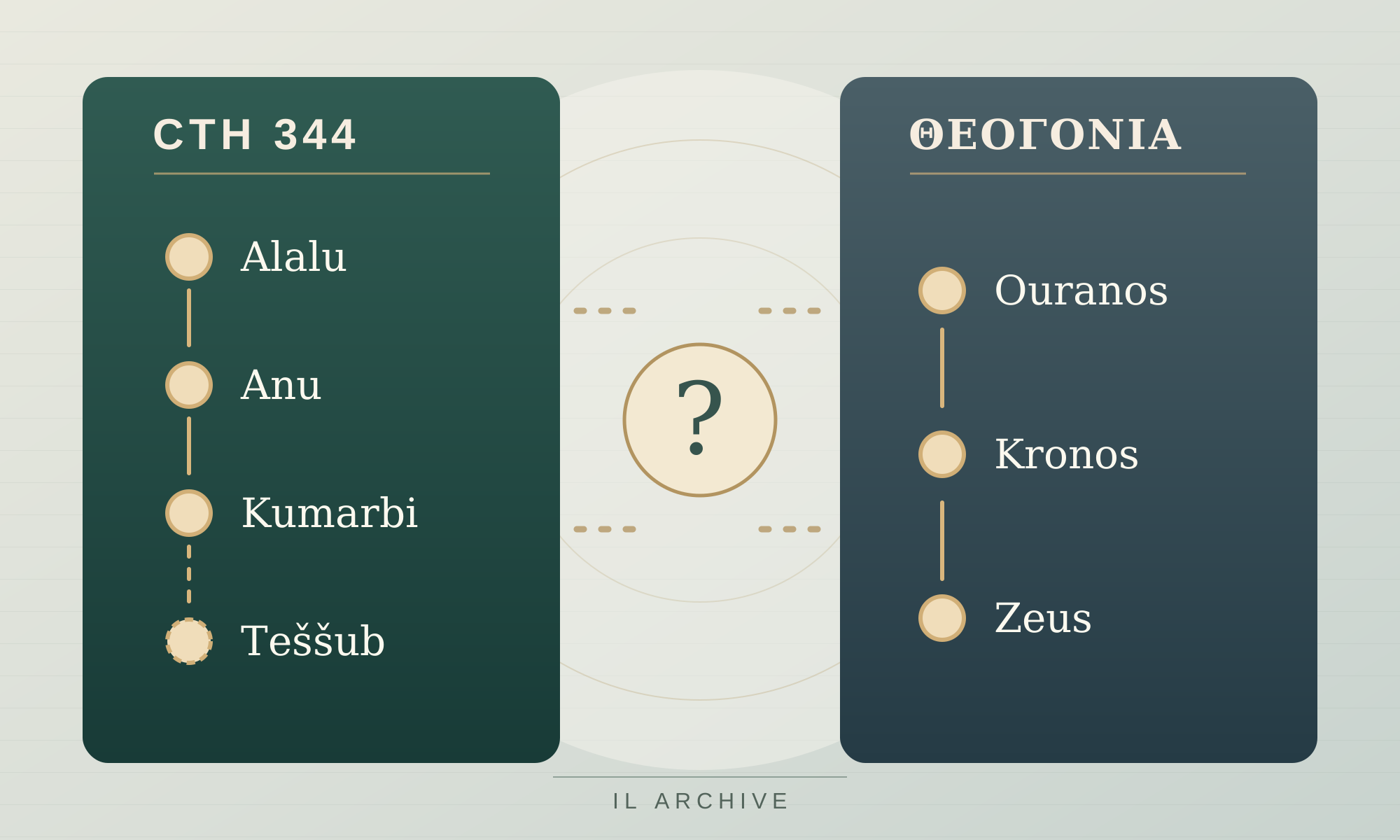
In a Hittite song, AlaluAlaluFirst heavenly ruler in the surviving Kumarbi song; defeated by Anu, he flees to the dark earth.Glossary · Click to read the explanation rules heaven, AnuAn / AnuSumerian/Akkadian sky god; multifunctional AN alone cannot identify him in the earliest texts.Glossary · Click to read the explanation defeats him, and Anu then faces another adversary, Kumarbi. In Greek poetry, Kronos overthrows his father OuranosOuranosSky as a divine figure in Greek poetry; Kronos’s father in Hesiod.Glossary · Click to read the explanation; Zeus subsequently escapes Kronos and becomes king. These figures belong to the world of divine narratives understood by their texts’ audiences. Their struggle explains who holds authority and how it becomes established. [1][2][3][4][5]
The comparison is striking because several events converge: the ruler’s displacement, injury to his body, unusual pregnancy or birth, and fear of an heir who will overthrow him. These details go beyond two cultures having gods called kings. Their order and consequences differ, so each account needs to be read separately before its relationship to the other is investigated. [1][2][3][9][11]
A damaged Hittite text and a continuous Greek poem
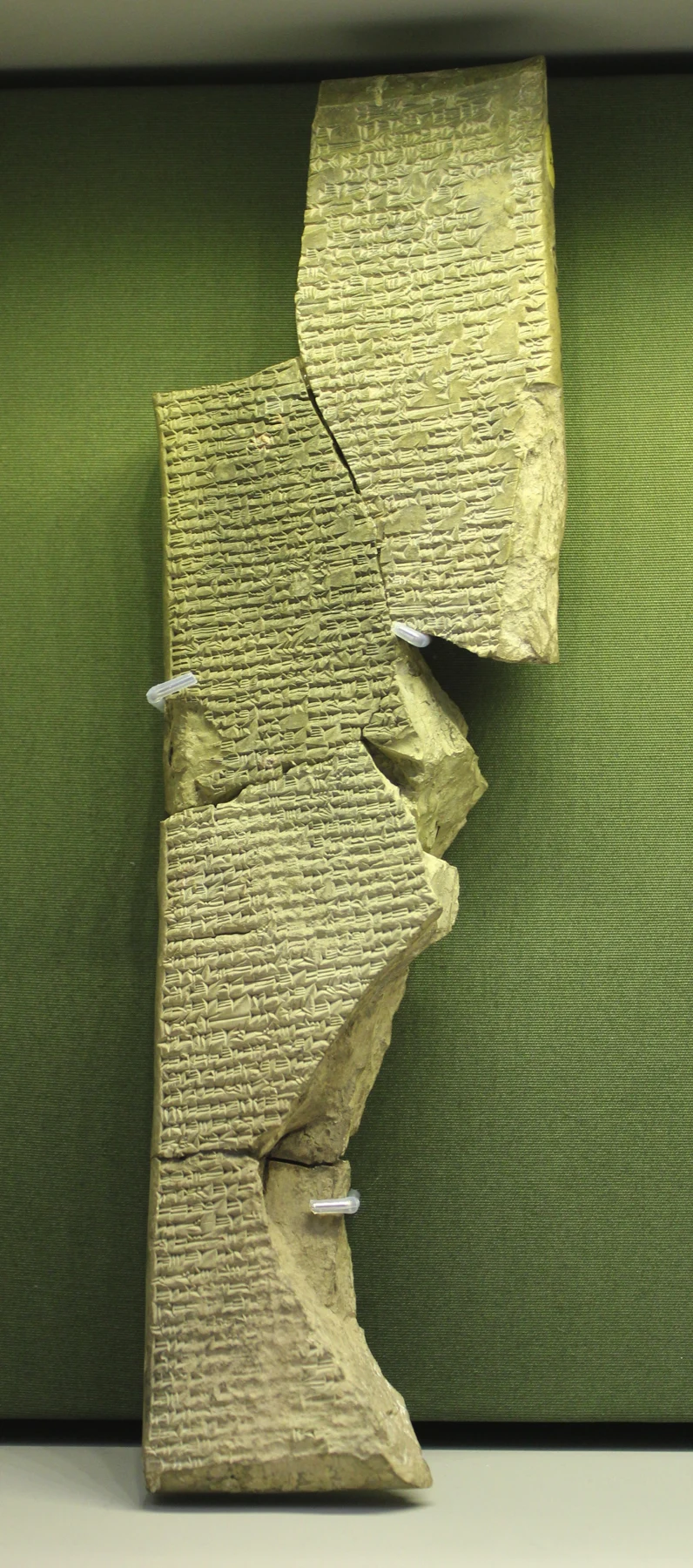
The HittitesHittitesAncient people and kingdom of Anatolia, dominating much of Anatolia and northern Syria around 1650–1200 BCE.Glossary · Click to read the explanation established a kingdom in Anatolia, the Asian part of modern TürkiyeTurkeyTurkey is a modern country including Anatolia and territory in southeastern EuropeGlossary · Click to read the explanation, during the second millennium BCE. Their tablets preserve the composition scholars catalogue as CTH 344. It was called the Song of Kumarbi or Kingship in Heaven; part of its colophon later pointed to an ancient title closer to the Song of Going Forth or Song of Emergence. [1][9][12][14]
The text is written in Hittite and associated with HurrianHurriansAncient Near Eastern groups and language, prominent in northern Mesopotamia, the Levant and Anatolia in the second millennium BCE.Glossary · Click to read the explanation tradition. Hurrian peoples and language were known in areas of northern MesopotamiaMesopotamiaA historical region associated with the Tigris and Euphrates, home to many societies and civilisations.Glossary · Click to read the explanation, the LevantThe LevantThe Levant is a regional name for lands along the eastern MediterraneanGlossary · Click to read the explanation and Anatolia, with traditions prominent in the second millennium BCE. The song also contains divine names familiar from Mesopotamia. Scholars therefore study the interaction of different traditions within it, while the date of its earliest form remains uncertain. [9][10][12][13][15]
In his 2010 doctoral thesis on this story’s connections with the Aegean world, Erik van DongenErik van DongenResearcher who examined Kumarbi–Hesiod connections in a 2010 doctoral thesis at University College London.Glossary · Click to read the explanation places the main surviving copy approximately in the late thirteenth century BCE, using its script and the scribe’s name. The colophon says that the scribe worked from a worn copy, and many lines remain incomplete. We are dating a copy of the story; some of its material may have circulated earlier. [1][9][14]
Hesiod was a Greek poet whose TheogonyHesiod’s TheogonyGreek poem on divine generations and Zeus’s kingship; its surviving form does not identify all of Hesiod’s sources.Glossary · Click to read the explanation, concerning the gods’ origins and generations, is generally dated to the late eighth or early seventh century BCE. It survives as a continuous literary poem, unlike the damaged Hittite text. The Hittite witness precedes it by centuries, but the interval leaves open how stories circulated during that time. [9][11][16]
Alalu, Anu and Kumarbi
Alalu rules for nine years, while Anu stands before him as a servant presenting his drink. Anu then fights and defeats him, and Alalu flees into the dark earth. After nine years of Anu’s rule, Kumarbi confronts him. Anu escapes toward heaven, but Kumarbi catches his feet and pulls him down. [1]
Kumarbi bites off and swallows Anu’s genitals. This causes him to carry the storm god and other figures, including the AranzaḫAranzahRiver as a divine figure, named among those Kumarbi carries in the Hittite song.Glossary · Click to read the explanation River and TašmišuTashmishuDivine figure named in Kumarbi’s pregnancy with the storm god and the river Aranzah.Glossary · Click to read the explanation. What enters his body is his adversary’s member and seed; the swallowing of previously born children will appear later in the Greek account. [1][12]
The order of rulers needs to be distinguished from their genealogy. A phrase commonly translated “Kumarbi, descendant of Alalu” may, according to Christian ZgollChristian ZgollScholar at Göttingen working on ancient languages and comparative mythology, including Greek poetry and Hittite texts.Glossary · Click to read the explanation, a scholar of ancient languages and comparative mythology, designate “Anu, descendant of Alalu”. In his 2021 study, Zgoll argues for this reading using the sentence’s grammar and Mesopotamian god listsGod listsTexts collecting divine names for preservation, teaching and classification, with varying theological organization.Glossary · Click to read the explanation, and proposes one sequence of divine generations. Yet he treats Kumarbi’s parentage from Anu as possible and unproven. We consequently know the succession of rulers more clearly than their family tree. [1][10]
The comparison also changes according to whom we count. Van Dongen contrasts four Hittite figures with three Greek male rulers: Ouranos, Kronos and Zeus. Zgoll includes GaiaGaiaEarth as a divine figure, active in the gods’ origins and conflicts in Hesiod.Glossary · Click to read the explanation in the Greek comparison, making four figures. Gaia is Earth in the poem and has a decisive role in the gods’ emergence and struggle. The different counts follow the roles each scholar chooses to compare. [2][9][10]
Gaia, the sickle and Ouranos
In Hesiod’s poem, Ouranos, the sky god and Kronos’s father, confines some of his children within Gaia. In pain, she makes a sickle and asks her children for help. Kronos agrees; when Ouranos arrives, he cuts off his genitals with the sickle and casts them away. The blood and sea foam generate further beings, including AphroditeAphroditeGreek goddess whose origin Hesiod relates to foam after the assault on Ouranos.Glossary · Click to read the explanation in the poem’s account. [2][3]
The two stories converge in bringing down an earlier ruler through an assault on his body. But the acts have different consequences. Kumarbi bites and swallows, carrying Anu’s offspring within him; Kronos uses a tool and throws the member away. Gaia’s plan, the blood and foam, and their resulting births give the Greek episode its own structure. [1][3][4]
Swallowed children and the stone
Kronos marries RheaRheaZeus’s mother in Hesiod, hiding the child and giving Kronos a stone instead.Glossary · Click to read the explanation and learns that a child will overthrow him, so he swallows each newborn. Rhea asks Gaia and Ouranos for help. The infant Zeus is hidden on CreteCreteGreek island in the eastern Mediterranean, associated in Hesiod with hiding the infant Zeus.Glossary · Click to read the explanation, an island in the eastern Mediterranean within modern Greece. Kronos receives a wrapped stone instead of the child and later brings up what he swallowed, including the stone. The Greek verses allow us to follow the deception’s motive and means, and the child’s escape. [4][5]
A stone appears in a damaged part of Kumarbi’s Hittite story. But the lines connecting his demand for the child with what he eats are incomplete; even the sign designating the child is partly missing. Van Dongen sees internal details that make a substituted stone plausible. The Hittite episode remains a reconstruction, alongside a clearly preserved Greek scene. [1][9][12]
This difference directly affects the comparison. If we fill the tablet’s gap from Hesiod, that supplementation is difficult to use as independent evidence that Hesiod borrowed from it. The stone substitute can be investigated as a hypothesis with internal support while keeping the gap visible. Likewise, kunkunuzzi, sometimes translated “diorite”, does not securely identify a particular rock. [9]
Male pregnancy and birth from the head
Kumarbi’s pregnancy raises an unusual question: where will the child emerge? Jenny Strauss ClayJenny Strauss ClayProfessor emerita at the University of Virginia, specializing in early Greek poetry and its gods and human–divine relations.Glossary · Click to read the explanation, a specialist in early Greek poetry, and Amir GilanAmir GilanTel Aviv University scholar of Hittite texts and ancient Anatolia, studying religion, ritual, literature and historiography.Glossary · Click to read the explanation, a specialist in Hittite texts, connect some birth passages with the storm god’s emergence from his head. In the Theogony, Zeus swallows MetisMetisDivine figure and Athena’s mother in Hesiod; Zeus swallows her while pregnant to forestall a possible successor.Glossary · Click to read the explanation while she is pregnant with AthenaAthenaGreek goddess associated in Hesiod with Zeus, Metis and birth from the head.Glossary · Click to read the explanation, fearing a prophecy about a successor; Athena then emerges from his head. Male pregnancy and head birth form a striking resemblance. [1][7][8][12]
The causes of pregnancy and the characters’ roles differ. Kumarbi carries offspring after ingesting what belongs to Anu, his adversary; Zeus swallows Metis, Athena’s mother, to prevent the transfer of rule to an heir he fears. In the Hittite witness, birth unfolds through damaged lines and readings of names that vary with Hurrian and Hittite contexts. Each passage’s preservation and interpretation therefore enter the comparison. [1][7][8][10]
What connects the verbs of “coming out”?
Strauss Clay and Gilan identify a resemblance in the description of emergence. In Hesiod’s lines 157 and 495, a verb associated with sending or letting out describes a child or children leaving unusual confinement. In line 669, the Hundred-HandersHundred-HandersBeings in Hesiod’s poem, shown in one scene leaving captivity and darkness for light.Glossary · Click to read the explanation, beings in the poem, pass from darkness into light after imprisonment. That last scene concerns release from captivity. [2][5][6][12]
The study compares these uses with Hittite verbs describing emergence and ascent in scenes involving Kumarbi’s offspring. Linguistic differences matter: the Greek verb has someone bringing another out, whereas the Hittite verbs describe a figure’s own emergence. In grammatical terms, the former is transitive and the latter intransitive. This is a resemblance of imagery and expression across languages rather than a phonetic identity between words. [1][12]
Such a parallel may add weight to the narrative resemblance, especially when combined with unusual births. Identifying a particular route or carrier, however, requires another witness; the verbal passages leave that question open. [12]
Gaia’s and Rhea’s roles in the struggle
Gaia and Rhea act decisively in Hesiod’s poem. Gaia makes the sickle and seeks a way to free her children; Rhea protects Zeus with Gaia’s and Ouranos’s help. Adrian KellyAdrian KellyProfessor of Ancient Greek Literature at Oxford and Balliol, researching early poetry and the traditions shaping it.Glossary · Click to read the explanation, a scholar of ancient Greek literature, regards the mothers’ agency as important for understanding the Greek narrative’s particular construction, even where it shares imagery with ancient Near Eastern traditions. [2][4][5][11]
This observation concerns the characters and passages being read. Female roles across the whole Hittite text are harder to recover because parts are missing. We can describe the preserved difference, while some characters’ roles in the lost sections remain less clear. [1][9][11]
How does Zeus’s rule become stable?
Zeus wins, the gods acknowledge his kingship, and he distributes honours among them. He then swallows Metis to prevent his father’s fate from recurring. This sequence addresses a fundamental question: how does the series of overthrows stop, leaving the last king in power? [7][8]
The Hittite Song of Emergence preserves the storm god’s birth and strands of his conflict with Kumarbi, but provides no complete account of his accession. The ending may have appeared in a lost continuation or other poems of the Kumarbi cycle. The goal reconstructed by a scholar differs from a final paragraph that can be read on the tablet. [1][9][10]
Possible routes between Anatolia, the Levant and Greece
Anatolia, northern Syria and the Aegean world between Anatolia and Greece were connected through trade, politics and culture. This setting permits us to imagine stories moving through oral performance, translation and reformulation. Scholars differ over the details of the proposed route. [9]
Van Dongen proposes an overland path from Neo-Hittite traditions in southeastern Anatolia to PhrygiaPhrygiaHistorical inland Anatolian region with an Iron Age kingdom; Gordion was a major center.Glossary · Click to read the explanation and then to the Aegean coast. Here Neo-Hittite traditions belong to the Iron Age kingdoms following the great kingdom’s fall around 1200 BCE. Phrygia is an inland Anatolian region whose kingdom flourished in the first millennium BCE. He assembles evidence for regional exchange but acknowledges that this story’s passage through each station is not directly documented, including the supposed role of Neo-Hittite diviners at a Phrygian court. He also allows an earlier Bronze Age transfer. [9][17]
Gilan proposes a possible encounter near Mount HazziMount Kasios — Jebel AqraCoastal mountain in the Syrian–Turkish border area, known as Jebel Aqra and by ancient names including Kasios.Glossary · Click to read the explanation, also known as Jebel Aqra, on the Syrian-Anatolian coast, where Greek traders might have encountered storm-god traditions. Witnesses refer to a regional festival in which a Song of Kingship was associated with Hittite and Hurrian material. Yet Strauss Clay and Gilan explain that this festival song cannot currently be identified as CTH 344. The festival suggests a possible context for contact; performance of this particular song, or Hesiod’s presence there, is undocumented. [12][13][18]
A broader model envisages succession imagery circulating through a Syro-Mediterranean network before Greek poetic recomposition. Kelly considers other Mesopotamian material in weighing the resemblance. He also notes that Philo of ByblosPhilo of ByblosWriter of about the first–second centuries CE and author of Phoenician History, distinct from Philo of Alexandria.Glossary · Click to read the explanation, a writer of about the first–second centuries CE familiar with Hesiod, cannot by himself provide independent evidence of a route predating the poet. Contact remains a significant possibility, with several routes and traditions potentially involved. [11][12][19]
Preserved evidence and the limits of reconstruction
Clear in the texts: the succession of Alalu, Anu and Kumarbi; Kumarbi’s biting and swallowing of Anu’s member; Kronos’s cutting and casting away of Ouranos’s; and Kronos’s swallowing of children and a stone in the Greek poem. [1][3][4][5]
A substantial comparison: the combination of succession, bodily violence and extraordinary birth. It may reflect contact among eastern Mediterranean traditions, with roles and meanings rearranged within each account. [9][11][12]
Still debated: the designation of Alalu’s descendant, the substituted stone in the damaged passage, the independent weight of emergence verbs, and the time and route of transmission. Present witnesses preserve neither a complete chain of narrators nor a particular Hittite copy read by Hesiod. They also leave undocumented a performance of CTH 344 itself at Mount Hazzi and an intact ending concerning the storm god’s enthronement. [1][9][10][12]
What does the comparison reveal?
Both accounts address rule, succession and birth, then give these images different functions. In Greek poetry, Gaia’s plan, Rhea’s protection, the stone’s fate and Zeus’s established rule form an integrated construction. In the preserved Hittite story, Kumarbi’s pregnancy and bodily turmoil lie at the centre. These differences help us understand what may be shared and what each tradition shaped in its own way. [1][3][4][5][7][11]
The comparison remains useful even when a single route cannot be identified. It connects texts from cultures in contact while preserving the distinction between surviving writing, restoration and historical interpretation. A new tablet or improved reading of a damaged passage could alter some conclusions. The stories remain preserved in their different forms, and the history of their relationship remains open to further research.
References and notes
- Specified German translation and its broken lines; not an intact tablet. CTH 344, German translation, text lines 1-296 and translation notes 1-84 Return to the text ↑
- Hesiod 130–174, Greek and historical translation. Theogony 130-174, Greek and Evelyn-White 1914 English Return to the text ↑
- Lines 175–209: Kronos cuts and throws the member away. Theogony 175-209, Greek and Evelyn-White 1914 English Return to the text ↑
- Lines 450–479: swallowed children and succession warning. Theogony 450-479, Greek and Evelyn-White 1914 English Return to the text ↑
- Lines 480–504: the stone and Zeus’s survival. Theogony 480-504, Greek and Evelyn-White 1914 English Return to the text ↑
- Lines 650–699, especially 669: prisoners’ release, not birth. Theogony 650-699, especially 669, Greek and Evelyn-White 1914 English Return to the text ↑
- Lines 870–899: kingship and swallowing Metis. Theogony 870-899, Greek and Evelyn-White 1914 English Return to the text ↑
- Lines 900–929: Athena’s birth from the head. Theogony 900-929, especially 924-929, Greek and Evelyn-White 1914 English Return to the text ↑
- Van Dongen thesis: specified pages only, not the whole thesis; stone passage and proposed route. Erik van Dongen, Studying external stimuli to the development of the ancient Aegean, UCL doctoral thesis (2010): printed pp.45-51, 78-85, 140-145, 211-213, 240-246 (PDF pages one less than printed page numerals in displayed web extraction) Return to the text ↑
- Zgoll: main argument 208–225; Alalu’s genealogy and narrative layers. Christian Zgoll, The Hittite 'Theogony' or Song of Going Forth (CTH 344): Stratification of Mythical Traditions, Journal of Ancient Near Eastern Religions 21 (2021), 208-227 Return to the text ↑
- Kelly: main argument 119–134; Gaia and Rhea in the comparison. Adrian Kelly, Gendering the Succession Myth in Hesiod and the Ancient Near East, Classica 32.2 (2019), 119-138 Return to the text ↑
- Strauss Clay and Gilan: pp. 1–7 and note 25 read in a reproduction; festival song not identified with CTH 344. Jenny Strauss Clay and Amir Gilan, The Hittite Song of Emergence and the Theogony, Philologus 158.1 (2014), 1-9 Return to the text ↑
- Gilan chapter summary and metadata only; complete chapter not read. Amir Gilan, The Social Setting of the Hurro-Hittite Song of Emergence, 2021, pp.19-36 Return to the text ↑
- Short KUB 33.120 fragment record only; no tablet photograph examined. LAMAN fragment record KUB 33.120, CTH 344, New Hittite script classification Return to the text ↑
- The Metropolitan Museum of Art — Mesopotamia,2000–1000BCE Timeline and Hurrian/Mitanni context. Return to the text ↑
- Hesiod, Theogony selections — publisher critical introduction Publisher summary and metadata: late eighth or early seventh century BCE; not the full chapter. Return to the text ↑
- Penn Museum — Iron Age Gordion Historical passages on Gordion,Phrygia,the Hittite kingdom’s fall and regional exchange. Return to the text ↑
- Carolina López-Ruiz, Siting the Gods (2021) Publisher summary only: Mount Hazzi identified with Jebel Aqra,not the full chapter. Return to the text ↑
- SBL Press — distinguishing writers named Philo Name paragraph: Philo of Byblos about the first–second centuries CE,distinct from the Alexandrian writer. Return to the text ↑
Research history
Substantive changes are retained here. Minor copy edits remain in the internal operational log.
-
Substantive record update
-
Substantive record update
Suggest a correction · Suggest a source for this record
Cite this record
IL Archive, «Kumarbi and Kronos: divine generations and the succession of kingship», Edition 3, https://ilarchive.com/en/studies/kumarbi-chronos-and-succession
Continue reading