Study
Genesis and Enuma Elish: creation, parallels, and the limits of borrowing
An extended study of a topic, with evidence and references.
- Timeline
- From 1200 BCE to 500 BCE
- Region
- Mesopotamia
A detailed comparison of waters, heaven, humanity, and rest, separating textual evidence from proposed transmission and seven Tablets from seven days.
Share article
Text
Set the opening of Genesis beside the Babylonian Enuma ElishEnuma ElishBabylonian Akkadian composition celebrating Marduk’s elevation and cosmic/divine ordering. Human creation is in VI, Nibiru in VII; a Tablet I reference cannot document those passages.Glossary · Click to read the explanation and several features invite comparison: initial waters, heaven and earth, the ordering of celestial bodies, and the creation of humanity. These are real textual observations. Calling Genesis a copy of Enuma Elish, however, requires further evidence. The stories differ in their sequence, the creator’s identity, the purpose of human existence, and the destination of the narrative.
This study compares Genesis 1:1–2:3 with Enuma ElishEnuma ElishBabylonian Akkadian composition celebrating Marduk’s elevation and cosmic/divine ordering. Human creation is in VI, Nibiru in VII; a Tablet I reference cannot document those passages.Glossary · Click to read the explanation. It keeps this account distinct from the garden narrative that follows in Genesis. It also separates an ancient text we can read from a historical relationship scholars reconstruct. Investigating that relationship does not itself decide religious claims about revelation or establish the worth of a religious community.
Which Babylonian text?
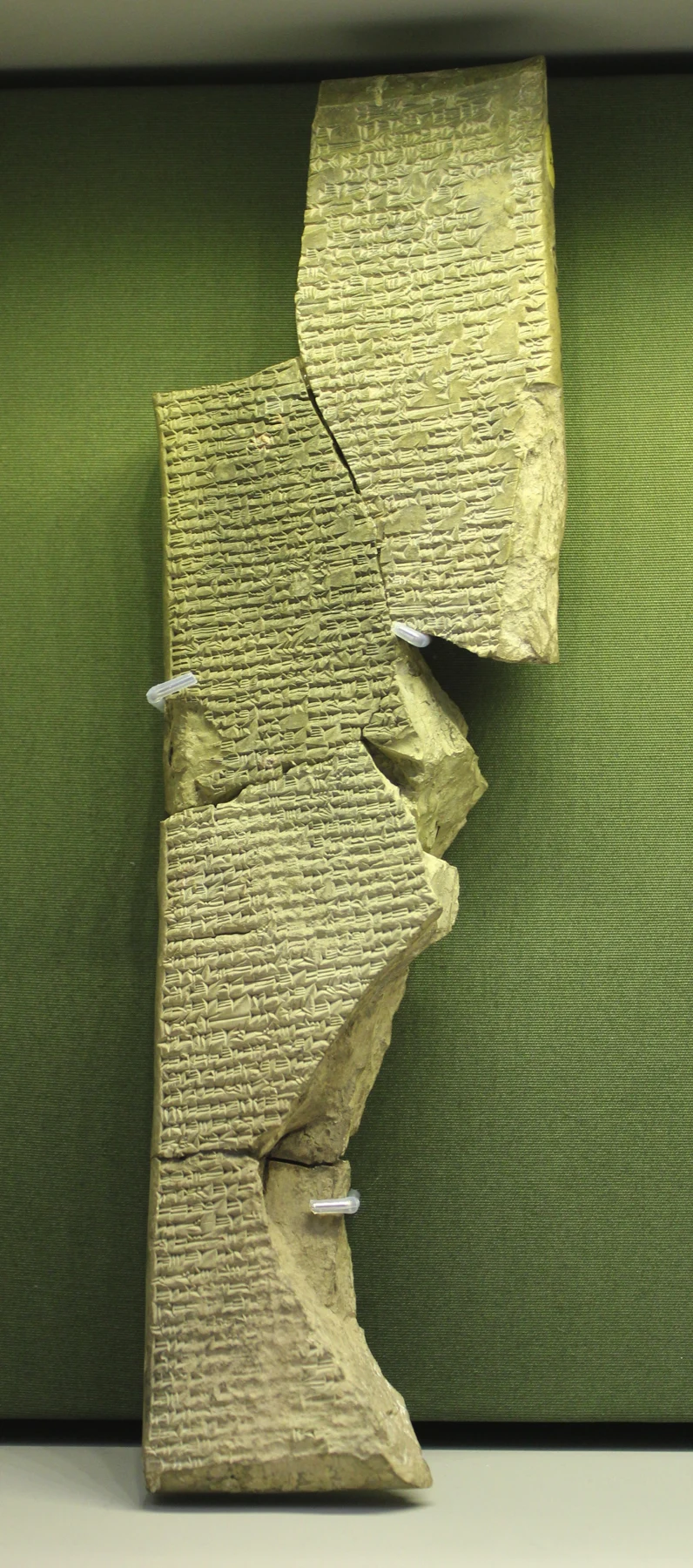
Enuma Elish is an AkkadianAkkadianAn ancient East Semitic language written in cuneiform in Mesopotamia.Glossary · Click to read the explanation poem named from its opening words, meaning approximately “When above.” Its seven literary Tablets are reconstructed from multiple manuscripts and fragments. We do not possess a single intact autograph, and the surviving copies need not be contemporary with composition. [1][2]
The date of composition remains debated. Enrique Jiménez discusses arguments for the late second millennium BCE while reviewing the difficulties of dating the poem from its language or MardukMardukBabylon’s god, elevated with the city’s history. Enuma Elish celebrates his rise and cosmic ordering; sources associate him with Nibiru and Jupiter. Earliest origins and functions remain uncertain.Glossary · Click to read the explanation’s rise alone. A particular year should consequently not be presented as an established date of authorship. [2]
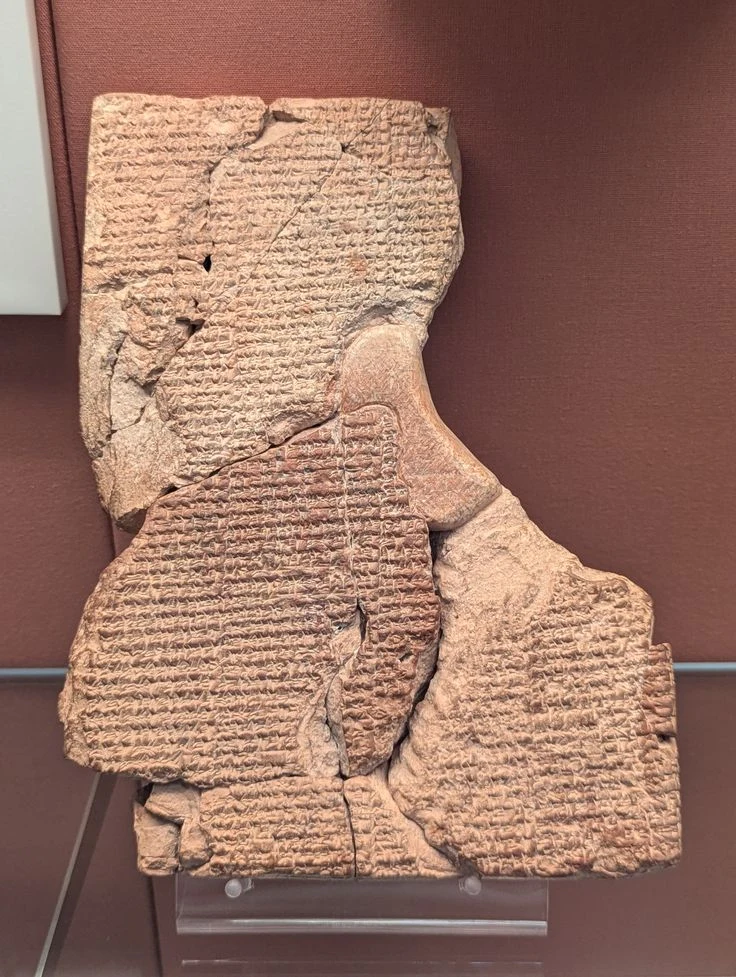
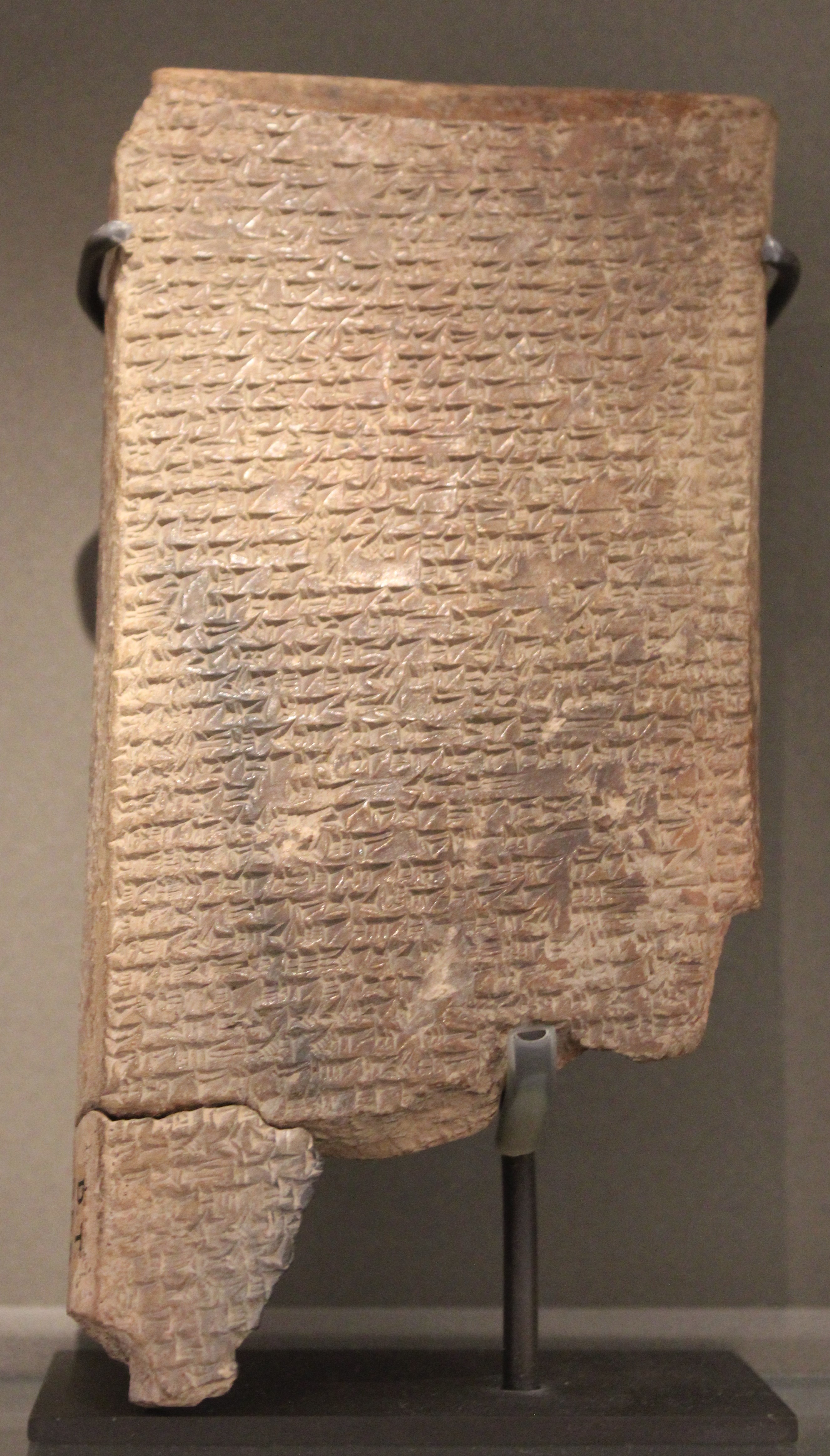
The photographed tablet, K.3473, is a witness from NinevehNineveh and KuyunjikNineveh is an ancient Assyrian city near Mosul in northern Iraq; Kuyunjik is one of its archaeological moundsGlossary · Click to read the explanation, associated with the Assyrian royal library, rather than the first copy of the poem. Babylonian literature does not become Assyrian in origin because an Assyrian library preserved a manuscript. The distinction between a tradition’s emergence, its copying, and its archaeological discovery matters throughout this comparison. [3]
Before the world: water and divine generations
The poem opens before heaven and earth have received their names. The waters of ApsûApsûPrimordial waters and divine progenitor in Enuma Elish.Glossary · Click to read the explanation and TiamatTiamatPrimordial watery divine figure in Enūma Eliš, later Marduk’s opponent; her defeated body provides material for cosmic arrangement.Glossary · Click to read the explanation mingle, and successive generations of gods emerge. Cosmic history is also the history of a divine family: births and relationships precede conflict within it. [1]
The younger gods disturb Apsû, who proposes destroying them to regain his rest. Tiamat initially objects to the destruction of their offspring. She should therefore not be reduced, from the first line onward, to absolute evil. EaEnkiMesopotamian deity associated with deep fresh water, wisdom and Eridu, known as Ea in Akkadian tradition. The earliest preserved written mention does not date his cult’s origin or identify Ubaid Eridu’s deity.Glossary · Click to read the explanation acts against Apsû; a subsequent crisis brings Tiamat to assemble an army and elevate QinguQinguTiamat’s commander, whose blood forms humanity in Enuma Elish.Glossary · Click to read the explanation to its command. [1][2]
These details affect the comparison. The poem is not simply about a good deity discovering an evil monster outside the world and killing it. The opponents belong to one divine history, and the second conflict grows from earlier events. Its celebration of victory also articulates the victorious side’s perspective within the story.
How Marduk becomes king
MardukMardukBabylon’s god, elevated with the city’s history. Enuma Elish celebrates his rise and cosmic ordering; sources associate him with Nibiru and Jupiter. Earliest origins and functions remain uncertain.Glossary · Click to read the explanation volunteers to confront Tiamat but makes his mission conditional on receiving supreme authority. The gods assemble, acknowledge his position, and test the effectiveness of his command. He then enters battle, using weapons, a net, and wind to kill Tiamat and overcome her allies. [1][2]
After victory, he divides her body, makes part of it into a heavenly covering that restrains the waters, and organizes the celestial bodies and time. Combat is not an incidental episode: it helps establish the new order and justify Marduk’s supremacy. Other gods continue within that order, their positions redistributed. [1]
Marduk is not the solitary, ungenerated creator at the poem’s beginning. He is born within a divine succession, gains recognition, and fights. The narrative explains how he becomes ruler, rather than beginning with a single deity whose authority already stands beyond all conflict.
Genesis opens with authority already in place
Genesis 1 presents an unprepared earth, darkness over the deep, and water. It supplies no genealogy for God, no assembly conferring the right to create, and no battle with a character called Tiamat. The ordering of the world proceeds through commands and acts attributed to the deity who already holds authority. [4]
Light appears, waters are separated, dry land is identified, and plants, heavenly lights, creatures, and humans follow. This sequence must be read from the text itself. Rearranging episodes into a convenient list of parallels would remove evidence that a historical comparison needs to explain.
Several historical explanations are possible. A writer might have reshaped familiar cosmic imagery within another understanding of divine authority, or drawn on traditions broader than direct acquaintance with this poem. The absence of combat in Genesis is a textual fact. Reading that absence as a deliberate response to Marduk’s battle is an interpretation requiring an argument.
Is the Hebrew deep Tiamat?
HebrewHebrewA Northwest Semitic language in the Canaanite group, with ancient and modern forms.Glossary · Click to read the explanation təhôm designates the deep or deep waters in this context. Its relationship to other Semitic water words, including the Babylonian name Tiamat, is linguistically significant. A relationship between words does not by itself establish that a writer borrowed a goddess’s name and removed her from the story.
David Tsumura argues for a shared Semitic origin of təhôm and challenges inference of a primordial combat narrative from the word alone. This is a particular scholarly position, not a cancellation of every possible comparison. [5]
David Carr, conversely, argues that Genesis 1 engages Enuma Elish while also drawing on other cosmological traditions. [6] The debate therefore concerns how relationships are explained. A lexical cognate offers weaker evidence for direct dependence than a demonstrably unusual detail or distinctive chain of events.
Waters, heaven, and celestial bodies
A more substantial resemblance concerns a world bounded by water and organized through heaven and earth. Tablet IV places a heavenly covering over restrained waters; Genesis 1:6–8 describes an expanse separating waters below and above. Yet the Babylonian covering is made from a defeated opponent’s body. Genesis does not identify divine bodily material used to construct heaven. [1][4]
In Tablet V, Marduk orders the celestial stations, the year, months, and moon. Genesis 1:14–18 connects the heavenly lights with signs, appointed times, days, and years. Their calendrical function is a genuine parallel. The presentations nevertheless differ: the Babylonian bodies are associated with gods, whereas Genesis places them in the heavens as creations. [1][4]
This observation alone cannot establish the transmission of a particular text. Societies using the sky to regulate their calendars can share related imagery. Evidence becomes stronger when precise similarities and their distribution are explained together, while differences and alternatives remain in view.
Why create human beings?
In Tablet VI, Marduk proposes humanity so that humans will undertake divine labour and the gods can rest. The assembly identifies Qingu as responsible for the conflict. He is killed, and Ea makes humanity from his blood within Marduk’s plan. Humans are not made here from Marduk’s own blood. Nor should this account be silently combined with other narratives involving clay and the blood of a different deity. [1][2]
Genesis 1:26–30 associates humanity with God’s image, mentions male and female, gives a blessing and responsibility in relation to other creatures, and assigns plant food. It describes neither the slaughter of a god to produce humans nor human creation as a solution to labour exhausting a group of gods. [4]
This is a clear difference in narrative function. It does not establish that every Mesopotamian despised humanity, or that human value throughout Mesopotamian literature amounted only to service. Two particular texts are being compared, not two civilizations ranked morally. Service in the Babylonian poem also belongs to an order its audience could understand as meaningful.
Seven Tablets are not seven days
The number seven appears in the poem’s division and in the biblical creation week. It merits observation. But a Tablet is a unit in the organization of a text, while a day is a unit of narrated time. The early Tablets relate divine generations and crises; the battle falls in IV, humanity in VI, and the naming and praise of Marduk continue into VII. [1]
The Babylonian text does not state that creation took six days followed by a sacred weekly seventh day. Its temple-building episode includes a year of brick preparation and the arrival of a second year. There is no complete correspondence in which Tablet I simply becomes day one, and so on. [2]
Scholars can still propose a symbolic relationship between the two structures. Such a proposal concerns literary organization, not proof that Enuma Elish narrates the same seven days. A title or short summary should preserve this distinction.
Rest has a different place in each account
Divine rest is an explicit reason for creating humanity in Enuma Elish. Afterwards, the gods construct Marduk’s temple in BabylonBabylonBabylon is an ancient city in central present-day Iraq, south of BaghdadGlossary · Click to read the explanation and gather there; the poem culminates in the expansion of his names and status. Its cosmos has a particular royal and temple centre. [1][2]
In Genesis 2:1–3, God finishes the work, ceases on the seventh day, and blesses and sanctifies that day. This passage does not say that humans exist to relieve a group of gods of their tasks, or make Babylon the world’s centre. It also does not yet set out a detailed command telling people how to observe the Sabbath. The sanctity of a day in the creation narrative should be distinguished from laws subsequently connecting it with human rest. [4]
These endings show a difference in what each narrative establishes. Rested gods and a sacred day are not identical meanings, even when their conjunction invites historical investigation.
From resemblance to historical relationship
Eckart Frahm proposes reading Genesis as a counter-story to the Babylonian poem, while leaving the time, location, and intermediate form of contact unresolved. [2] This model can explain differences as deliberate reshaping, but it does not make every difference automatic evidence for borrowing.
Several connected questions test the proposed relationship:
- Chronology: Was the Babylonian tradition available before the biblical layer under comparison? A manuscript’s date is not the date of composition, and Genesis requires its own dating argument.
- Contact: Babylonian and Assyrian encounters, including sixth-century BCE exile, offer possible settings. Contact alone does not identify the work a writer read.
- Specificity: Waters and celestial bodies are widespread motifs. A proven unusual expression or detailed sequence may carry more weight.
- Structure: The accounts must be compared across the chosen scope, including combat, creation, humanity, and their endings.
- Route: No statement by Genesis’s author identifies a particular tablet as a source. Contact could have been written, oral, or mediated by another tradition.
- Alternatives: Linguistic kinshipLinguistic relatednessA relationship through shared linguistic ancestry, distinct from direct borrowing or identical beliefs.Glossary · Click to read the explanation, shared cosmological imagery, and engagement with Levantine or Egyptian traditions also require examination.
What can be established?
The narratives share imagery concerning waters, the organization of heaven and time, and humanity. They also differ substantially in divine genealogy, combat, creative material, human purpose, and conclusion. A historical literary connection is an important scholarly model; its exact form, directness, and date are not established by a list of resemblances alone.
Nor does the comparison show that every later creation story came from one Babylonian source. Religious traditions select, reshape, debate, and produce new meanings. Studying these processes where evidence supports them explains textual history without replacing the theological questions communities ask of their texts.
Sources and scope: Heidel’s translation of all seven Tablets was consulted, with comparison passages checked in the recent edition. Selected portions of that volume’s essays were read, not the entire book. Carr’s abstract and Tsumura’s publisher description were consulted; a full reading of those works is not claimed. Notes identify locations and limits.
Further reading: Marduk and Babylon, The flood before Noah, Similarity does not prove borrowing, and When was the Torah written?.
References and notes
- The seven-Tablet translation was read in full; used for the ancient narrative with checks against a recent edition. The whole book was not read; this is not the latest critical edition. Alexander Heidel, The Babylonian Genesis, 2nd ed. (1951), pp. 18–60; Tablets I–VII Return to the text ↑
- Selected translation passages and the stated dating/reception discussion were consulted, not the complete volume. Frahm’s and Jiménez’s proposals are attributed modern interpretations. Haubold, Helle, Jiménez & Wisnom (eds.), Enuma Elish (2025 imprint; repository 2024); I 1–64, IV 1–35, 95–146, V 1–21, VI 1–65; Jiménez pp. 99–102; Frahm pp. 158–161 Return to the text ↑
- Museum object metadata consulted to identify the photographed witness, not to date first composition. Cover photography has a separate photographer and licence. British Museum catalogue contribution; K.3473; Nineveh/Kouyunjik, Neo-Assyrian Return to the text ↑
- Complete passage read. The historical English translation does not settle disputed Hebrew questions; no goddess identity or later philosophical creation-from-nothing account is imposed. Genesis 1:1–2:3; public-domain KJV Return to the text ↑
- Publisher description and stated thesis consulted, not the full book. Used for the specific linguistic objection, not as a consensus finding. David T. Tsumura, Creation and Destruction (2005); publisher description and conclusions Return to the text ↑
- Chapter abstract only: proposes engagement with Enuma Elish and other traditions. Full chapter inaccessible; unread details are not attributed to it. David M. Carr, The Formation of Genesis 1–11 (2020), chapter 1, pp. 7–29; abstract only Return to the text ↑
Suggest a correction · Suggest a source for this record
Cite this record
IL Archive, «Genesis and Enuma Elish: creation, parallels, and the limits of borrowing», Edition 1, https://ilarchive.com/en/studies/genesis-and-enuma-elish
Continue reading