Study
Leviathan and Lotan: the serpent across Ugaritic and Hebrew poetry
An extended study of a topic, with evidence and references.
- Region
- The Levant
KTU 1.5 and Isaiah 27 pair a related name with the fleeing and twisting serpent epithets. What supports a shared tradition, and where does evidence for borrowing stop?
Share article
Text
Before the HebrewHebrewA Northwest Semitic language in the Canaanite group, with ancient and modern forms.Glossary · Click to read the explanation books mentioned LeviathanLeviathanA poetic sea being in Hebrew texts, related to Ugaritic ltn; its role varies between combat and creation imagery.Glossary · Click to read the explanation, a similar name had been written on a clay tablet at UgaritUgaritAncient city and kingdom at Ras Shamra on the Syrian coast, flourishing between the fourteenth and early twelfth centuries BCE and preserving multilingual archives.Glossary · Click to read the explanation, on the Syrian coast. The tablet does not picture a seven-headed monster. It preserves a few poetic lines in which the god MotMotGod of death in the Baal Cycle; an adversary who returns even after a violent attack.Glossary · Click to read the explanation reminds BaalBaalStorm god and protagonist of Ugarit’s Baal Cycle; exercises active kingship while El retains importance and authorizes the palace.Glossary · Click to read the explanation that Baal had once struck a serpent written in Ugaritic consonants as ltn. The text calls it the fleeing and twisting serpent, with seven heads. Centuries later, Isaiah 27:1 speaks of “Leviathan the fleeing serpent” and “Leviathan the twisting serpent.” This close sequence is difficult to dismiss as chance. But what historical relationship does it establish? Did a Hebrew author use a particular Ugaritic tablet, or did both texts preserve an older poetic formula? [1][2][3]
The Ugaritic tablet: what can we actually see?
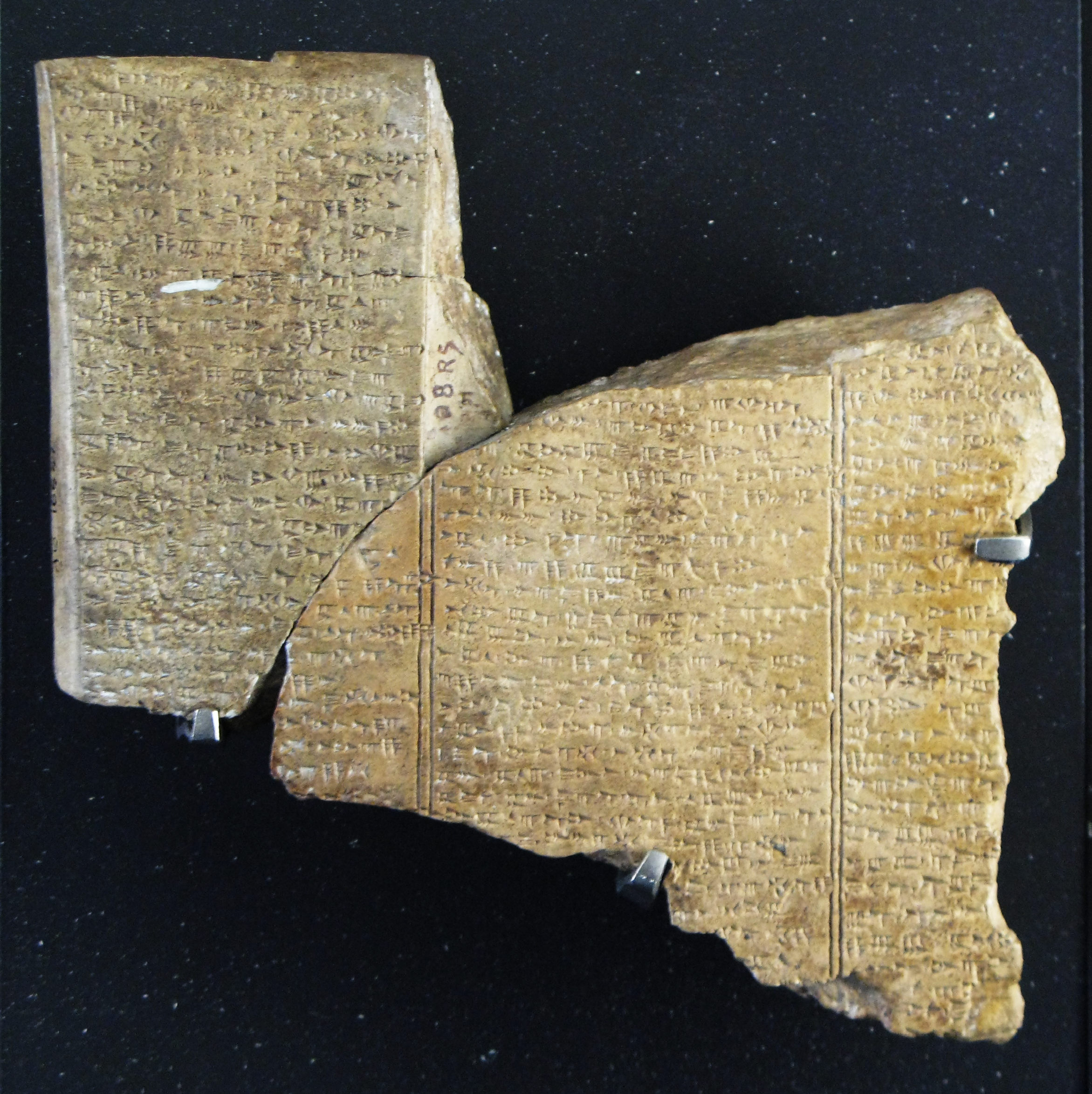
The image accompanying this article shows two fragments of a clay tablet in the Louvre, AO 16641 and AO 16642. Together they form part of KTUKTU: Ugaritic Text ReferencesAbbreviation for a modern scholarly corpus of alphabetic cuneiform texts; its numbers are references, not dates.Glossary · Click to read the explanation 1.5 in the Baal CycleBaal CycleA group of Late Bronze Age Ugaritic religious texts recounting Baal’s conflicts, relationships with the gods and the building of his palace.Glossary · Click to read the explanation. The museum records their excavation numbers as RS 2.[022] and RS 3.[565] (brackets indicate supplied characters in the catalogue), dates the physical object broadly to 1400–1200 BCE, and locates its findspot in the “House of the High Priest” on the Ras Shamra acropolis. The photograph is modern and the tablet ancient; the image is not an authenticated depiction of Leviathan or Lotan. [1][12]
This physical distinction matters. We have a particular artifact and a particular text, but the date of the clay carrying a poem does not tell us when its imagery was first composed. Nor does the beginning of tablet five narrate a complete battle between Baal and the serpent. In its opening lines, Mot recalls an earlier blow dealt by Baal while threatening him. The poem seems to assume that its hearers know a tradition it does not retell in full. Ola WikanderOla WikanderScholar of ancient Near Eastern texts and the Hebrew Bible at Lund University, studying Ugaritic and shared poetic imagery.Glossary · Click to read the explanation quotes the first lines from the KTU3 edition. Their essential sense can be rendered: “You struck ltn, the fleeing serpent; you finished off the twisting serpent, the one of seven heads.” They provide neither the date or course of a battle nor a definitive list of its participants. [2]
Where exactly does Isaiah resemble the tablet?
We can compare the phrases without concealing their differences:
- Name: KTU 1.5 writes ltn, conventionally pronounced “Lotan”; Isaiah 27:1 has Leviathan (liwyātān).
- First epithet: Ugaritic bṯn brḥ is the fleeing or swift serpent; Hebrew nāḥāš bārîaḥ is the fleeing serpent.
- Second epithet: Ugaritic bṯn ʿqltn is commonly rendered the twisting serpent; Hebrew nāḥāš ʿăqallātôn is the twisting serpent.
- Heads: The tablet explicitly counts seven; Isaiah's verse gives no number.
- Divine action: The tablet recalls Baal's past blow, while Isaiah announces future punishment and killing by YHWHYahwehThe divine proper name written YHWH in the Hebrew Bible.Glossary · Click to read the explanation.
The resemblance goes beyond the broad theme of a sea monster. A related name is followed in both texts by the fleeing and then the twisting serpent. This combination is much narrower than a generic battle story. Yet the Ugaritic and Hebrew words for “serpent” here are not identical: bṯn in one text, nāḥāš in the other. The action also shifts from an allusion to Baal's previous deed to a prophecy of YHWH's act “on that day.” A shared poetic formula can explain the resemblance without erasing the different uses to which it was put. [2][3][4]
Does the tablet actually say “Lotan”?
The tablet writes the consonants ltn. Like other alphabetic Ugaritic texts, it does not record the vowels needed to establish its pronunciation with certainty. “Lotan” is conventional in many modern books, but those additional vowels are not written on the tablet. Aren Wilson-Wright and John Huehnergard have proposed reading it /lītan-/ and reconstructing a common Northwest Semitic linguistic ancestor that explains its relationship to Hebrew Leviathan. They interpret the parallel expressions as an inherited poetic formula. This is a published linguistic argument, not merely a guess from similar sounds; nevertheless, reconstructing an ancient pronunciation remains scholarship, not an audio recording from Ugarit. [4]
There is a further grammatical issue. ʿqltn is usually rendered as an epithet, “the twisting one.” Wilson-Wright and Huehnergard examine whether it could instead be an appositional name. We should therefore avoid deriving a fixed number of separate monsters from the punctuation supplied by modern translators. These lines do not contain an explained roster of named beings. [4]
Sea and serpent: one adversary or several?
Another passage in the Baal Cycle complicates the picture. In KTU 1.3 III 38–42, the goddess AnatAnatAn active and violent goddess in Ugaritic literature; pressures El over Baal’s palace and addresses him with paternal and wisdom language.Glossary · Click to read the explanation speaks of confronting Yamm, Sea, NaharYam / NaharSea god and Baal’s opponent for kingship, also associated with Nahar, River.Glossary · Click to read the explanation, River, Tunnan, and the twisting serpent or seven-headed one. Some of these expressions resemble those in KTU 1.5. Scholars have read the sequence as evidence for closely related or fluid identities among the sea and serpent adversaries. In some settings, several names and images might overlap around a single being. But scholars have not reached a settled identification for every name in every line. Jürg Eggler leaves open whether the seven-headed creature should simply be equated with Yamm, while Paul Cho describes a fluidity of identity rather than an absolute equation. [5][6]
It would therefore overstate the evidence to say that “Lotan was permanently Yamm's subordinate and Baal killed him in one fully known scene.” Mot attributes a blow against ltn to Baal in KTU 1.5, whereas Anat recounts her own victories in KTU 1.3. These may be overlapping narratives and forms of divine praise. They cannot be arranged into a complete sequence of battles that our surviving text does not supply. [2][5][6]
How many heads did Leviathan have?
The Ugaritic tablet explicitly gives its creature seven heads. Psalm 74 says that God broke the sea, crushed the heads of the sea monsters, and then crushed the “heads of Leviathan.” The plural matters, but the psalm does not say seven. It recalls divine victory in the past while pleading against the destruction of the sanctuary; it does not give us a full creation narrative either. We may compare multi-headed monster imagery in the two traditions while keeping the precise number where it actually appears. [2][7]
Isaiah 27, by contrast, looks toward “that day” when YHWH will punish Leviathan and kill the dragon in the sea. The rest of the chapter speaks of Israel as a vineyard and of gathering exiles. Here the dragon enters the language of future judgment rather than simply a story set at the beginning of time. Scholars also disagree about the composition date of Isaiah 24–27; there is no universally accepted year for this verse. Whatever the formula's earlier history, its Hebrew use has its own literary setting. [3][10]
Leviathan in a sea without a battle
Not every Hebrew text presents the same combat relationship. In Psalm 104:25–26, ships cross the sea, creatures small and large live in it, and God has formed Leviathan. The psalm does not say that God strikes it or severs its heads. Its final Hebrew phrase permits two translations: Leviathan may play in the sea, or God may play with it. These readings differ on who is involved in the play, but both place Leviathan within the created world rather than as an undefeated rival to its maker in these verses. That differs from Psalm 74's combat image. [8][9]
Job 3:8 likewise narrates no battle. Job calls on those who can curse days and rouse Leviathan to curse the day of his birth. Job 26:12–13 mentions Sea, Rahab, and a fleeing serpent while describing divine power, but does not name Leviathan in those verses. Later, in God's address to Job, the question changes: Can a human catch Leviathan with a hook, make a covenant with it, or command its strength? The poem describes scales, teeth, smoke, and fire, using human inability before this creature to probe the limits of human power and understanding. The passage begins at Job 40:25 in Hebrew numbering, commonly Job 41:1 in English translations. Its poetic details should not be reduced to a confidently identified animal or assumed to be a continuous biography of the serpent in KTU 1.5. [11][13][14]
The Hebrew term tannîn also requires care. It occurs beside Leviathan in Isaiah 27, in the plural in Psalm 74, and as the “great sea creatures” created in Genesis 1:21. These words and images are relevant to comparison, but every occurrence of tannîn need not denote the individual Leviathan. A text's context determines what the image does; a shared dictionary entry cannot turn all the creatures into one. [3][7][15]
What about the seven-headed dragon of later texts?
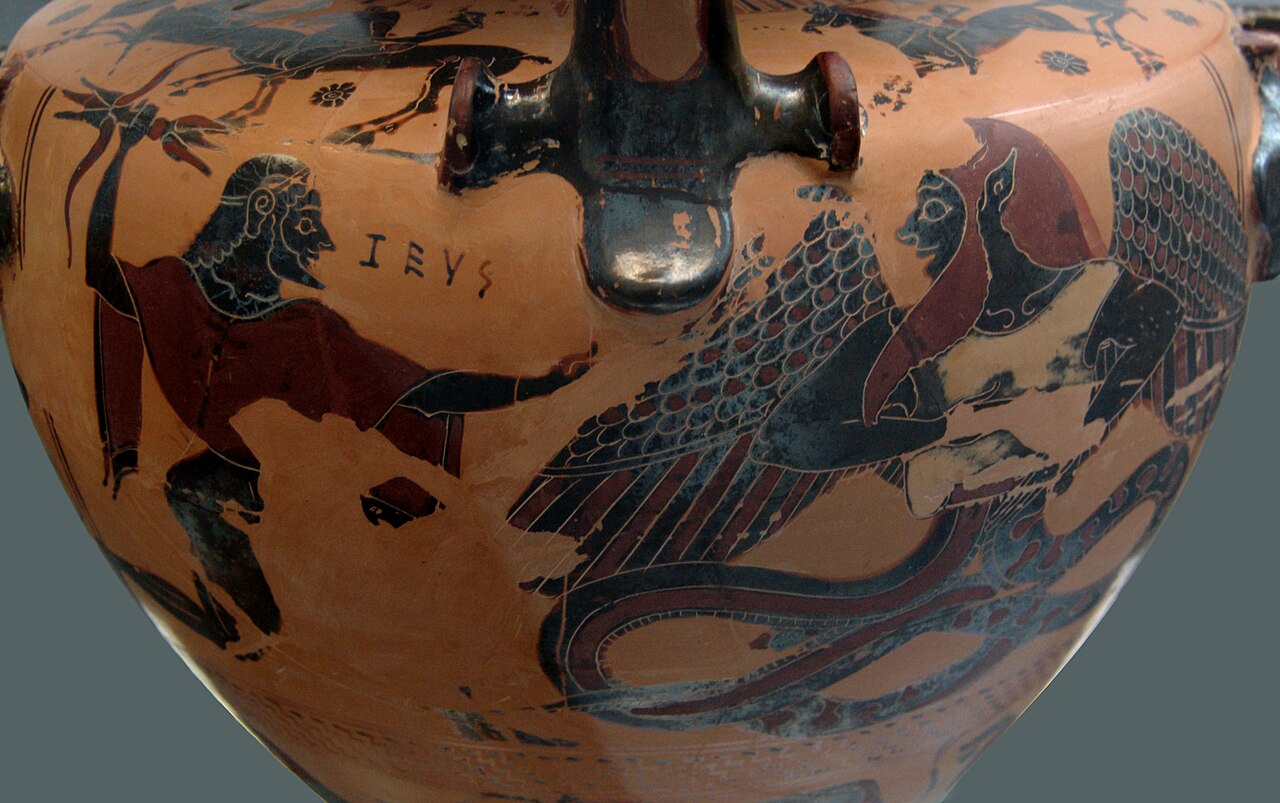
Later Jewish and Christian texts develop more imagery of sea monsters and the end of time. Revelation 12 depicts a dragon with seven heads and identifies it in verse 9 as “the devil” and “the old serpent.” This is a later deployment of dragon imagery in a new symbolic setting. It does not call the dragon Leviathan, however, and cannot tell us that the poet of KTU 1.5 or the writer of Isaiah 27 meant “Satan” by that name. A Talmudic discussion in Bava Batra 74b similarly elaborates Leviathan's fate and the feast of the righteous. It, too, has its own later setting and purpose; it is not a Bronze Age commentary on the Ugaritic tablet. Keeping these layers separate lets each be read on its own terms. [16][17]
Can we trace a direct quotation from Ugarit to Isaiah?
We have strong evidence of a relationship within shared language and poetic tradition. The related name followed by the fleeing and twisting serpent epithets is much more specific than a generic divine battle with a monster. The witnesses also belong to different times and settings: a Late Bronze AgeLate Bronze AgeAn archaeological period conventionally around 1600–1200 BCE in much of the Near East, with regional variation.Glossary · Click to read the explanation tablet and a Hebrew verse situated in a prophetic collection with its own history of composition and transmission. But no chain of manuscripts or ancient testimony establishes that the writer of Isaiah 27 read KTU 1.5 or copied directly from it. Wikander argues that the formula was part of a shared Northwest Semitic poetic repertoire, so neither author needed the particular tablet of the other. Wilson-Wright and Huehnergard likewise argue for inheritance in their linguistic account, while debating the fine points of its morphology and syntax. [2][4]
Put precisely, the Ugaritic tablet may be our earliest surviving witness to a phrase without marking the place where that phrase first arose. The Hebrew writer could preserve and redirect it without copying the photographed piece of clay. The difference between the oldest surviving witness and the origin of a tradition is central to responsible historical comparison. [1][2][3]
What can we say now?
- Certain: Louvre tablet KTU 1.5 belongs to the Baal Cycle, and a particular passage mentions ltn, the fleeing and twisting serpent, and seven heads. [1][2]
- Certain: Isaiah 27:1 combines Leviathan with the fleeing and twisting serpent epithets and presents divine punishment as future. [3]
- Strongly supported: The passages share a Northwest Semitic poetic formula, not merely a general idea of a god fighting a monster. [2][4]
- Possible and debated in detail: The original pronunciation of ltn, the grammar of ʿqltn, and how fully Yamm, Tunnan, and the seven-headed serpent overlap at Ugarit. [4][5][6]
- Not established: That Isaiah's author read this very KTU 1.5 tablet; that every biblical Leviathan passage narrates one identical battle; or that Revelation licenses calling the Ugaritic creature “Satan.” [2][8][16]
The texts kept a name and poetic pattern alive but did not give them one permanent function. At Ugarit, Mot reminds Baal of a serpent he struck; in Isaiah, YHWH will punish Leviathan; in Psalm 74, its crushed heads are recalled; and in Psalm 104 it appears among the creatures of the sea. The formula's history is larger than any one use of it. Comparison thus reveals a substantive connection without flattening the differences between these texts. [2][3][7][8]
Related reading
- El and Baal: the old father and the young god: Baal's place in the Ugaritic Cycle and his relationship to the head of the divine councilDivine councilA representation of divine beings acting as an assembly with authority and differentiated roles.Glossary · Click to read the explanation.
- El at Ugarit: father, king and head of the council: the religious setting in which the Baal Cycle tablets survive.
- Genesis and Enuma Elish: a separate comparison testing sea and creation imagery against the evidence for borrowing.
- Marduk and Babylon: the purpose of a sea battle in a different Babylonian text.
References and notes
- Full museum object record read for identity, broad date and findspot; the artifact was not examined in person. Louvre, AO 16641 + AO 16642, RS 2.[022] + RS 3.[565], KTU 1.5 Return to the text ↑
- PDF pp. 0–5 read and selections from pp. 6–8 inspected. KTU text is quoted from KTU3 in modern scholarship, not independently collated with the tablet. The whole chapter was not read. Ola Wikander, “From Indo-European Dragon-Slaying to Isaiah 27.1,” pp. 116–121; KTU 1.5 I 1–4 Return to the text ↑
- Complete chapter read, especially verse 1 and its vineyard/exile context; only brief sense translation used. Isaiah 27, especially 27:1; Hebrew and JPS 1917 Return to the text ↑
- Publisher abstract and indexed excerpts from pp. 154 and 160 only; publisher PDF blocked full access. Pronunciation and syntactic proposals are attributed to the authors, not claimed as a full-paper reading. Aren M. Wilson-Wright and John Huehnergard, Vetus Testamentum 72 (2022), 151–162 Return to the text ↑
- Introduction and selected PDF pp. 13–16 and 20–22 read, not all 28 pages; comparison with KTU 1.3 III and Psalm 104 checked there. Paul K.-K. Cho, “The Sea as Everyday Space (Psalms 104 and 107),” selected pages Return to the text ↑
- Full three-page entry read, especially its caution about equating the seven-headed being with Yamm; images are not used to claim a secure likeness of Litan. Jürg Eggler, Iconography of Deities and Demons, “Yam,” prepublication (2008), pp. 1–3 Return to the text ↑
- Complete psalm read; plural “heads,” with no number seven, and the sanctuary-destruction setting checked. Psalm 74, especially 74:13–14; Hebrew and JPS 1917 Return to the text ↑
- Complete psalm read; ships, sea life, Leviathan as formed and absence of a battle in these verses checked. Psalm 104, especially 104:25–26; Hebrew and JPS 1917 Return to the text ↑
- Complete online note read for “play in it” versus “play with him”; the full commentary book was not read. UBS translation commentary, Psalm 104:24–26 Return to the text ↑
- Selected pages of the same chapter discussing disputed dating of Isaiah 24–27 read; no fixed composition date inferred. Wikander, same sample chapter, discussion of Isaiah 24–27 date, selected pages Return to the text ↑
- Complete chapter read; verse 8 invokes those who rouse Leviathan in a curse on a birth day, not a battle story. Job 3, especially 3:8; Hebrew and JPS 1917 Return to the text ↑
- Full file page, rights and attribution read; original image visually inspected and object numbers matched against the Louvre. Used unchanged. Rama, original photograph, 20 October 2007, CC BY-SA 2.0 France Return to the text ↑
- Complete chapter read; Sea, Rahab and a fleeing serpent occur, but Leviathan is not named in these verses. Job 26, especially 26:12–13; Hebrew and JPS 1917 Return to the text ↑
- Complete Job 40 and 41 read; differing Hebrew/English numbering at the Leviathan opening and the human-control questions checked. Job 40:25–41:26 in Hebrew numbering; also https://mechon-mamre.org/p/pt/pt2741.htm Return to the text ↑
- Complete chapter read; Genesis 1:21 mentions great tanninim/sea creatures but not Leviathan by name. Genesis 1:21; Hebrew and JPS 1917 Return to the text ↑
- Specified verses checked: a seven-headed dragon is identified as Satan in a later text but is not named Leviathan. Revelation 12:3, 7–9; public-domain KJV Return to the text ↑
- Selected Leviathan passages inspected on the text page and Sefaria compilation; neither the entire Talmudic discussion nor a critical edition was read. Bava Batra 74b, selected Leviathan traditions; compare https://www.sefaria.org/Sheet.131053 Return to the text ↑
Suggest a correction · Suggest a source for this record
Cite this record
IL Archive, «Leviathan and Lotan: the serpent across Ugaritic and Hebrew poetry», Edition 1, https://ilarchive.com/en/studies/leviathan-and-lotan
Continue reading