Study
Blood and Atonement: What Do Offerings Do?
An extended study of a topic, with evidence and references.
Blood may purify a sacred place or establish a covenant, while flour can provide atonement. Leviticus, a Hittite rite, Hebrews and the Qur’an help explain what offerings do in each setting.
Share article
Text
Introduction
Is there a historical connection between the use of blood in the offerings described in the TorahTorah / PentateuchGenesis, Exodus, Leviticus, Numbers and Deuteronomy: Mosaic corpus with a compositional history. Torah can also mean teaching or law beyond these five books.Glossary · Click to read the explanation and ritualsRitualAn organised or distinguished practice meaningful to a community; it may leave traces, but its form alone does not reveal an associated doctrine.Glossary · Click to read the explanation known to other peoples of the ancient Near EastAncient Near EastA historical and geographical term covering Mesopotamia, the Levant and neighbouring ancient societies.Glossary · Click to read the explanation? This study compares instructions in Leviticus with a Hittite ritual from AnatoliaAnatoliaAnatolia is the region occupying the Asian part of present-day TurkeyGlossary · Click to read the explanation, examining similarities and differences, the dates of the evidence, and possible contact between these traditions.
We then trace how offerings were interpreted differently in Jewish and Christian traditions and in the QuranQuranCentral text of Islam, used here as evidence of its religious discourse.Glossary · Click to read the explanation. The aim is to understand the history and meanings of these practices: where might we find a shared traditionShared traditionInherited material reaching several texts without direct dependence between them.Glossary · Click to read the explanation or possible transmission, and where do similar actions carry different meanings?
Offerings and atonement in context
A priest stands before an altar, applying blood at particular locations. In another scene, MosesMosesCentral figure in Exodus, Torah traditions and the Qur’an; childhood accounts differ in detail.Glossary · Click to read the explanation sprinkles blood on a community accepting a covenant. Then we find someone who cannot afford an animal bringing flour instead, and the text states that the person is forgiven. These scenes all concern offerings, but each has its own purpose and procedure.
An offering is something presented in a religious act; it may be an animal or food. In the passages we will read, atonement concerns addressing wrongdoing or impurity and restoring a relationship with the sacred. Understanding it requires following the participants' actions: what do they present, where do they place it, and what result does the text announce?
We begin with Leviticus, the third of the Torah's five books, containing instructions for priests, offerings and purity. Its narrative places these instructions in Moses's time at SinaiSinai: peninsula and biblical mountainSinai is a peninsula in eastern Egypt; in the Torah the name also denotes the mountain of revelation to MosesGlossary · Click to read the explanation. Their composition and editing belong to a different question. Kathryn SchifferdeckerKathryn M. SchifferdeckerOld Testament scholar at Luther Seminary, studying biblical interpretation and creation theology in Job.Glossary · Click to read the explanation's introduction suggests that the book reached its final form in the late sixth or early fifth century BCE, incorporating older material, and notes disagreement over the age of its traditions. This is a proposed scholarly date for the book's formation, not for every rite it contains. [18]
We then compare a Hittite action from AnatoliaAnatoliaAnatolia is the region occupying the Asian part of present-day TurkeyGlossary · Click to read the explanation before turning to Jewish and Christian interpretations and two Qur'anic verses. Our purpose is to understand what these witnesses share and where they differ, presenting their practitioners' beliefs as the texts explain them.
Offerings include more than slaughter
Leviticus 2 begins with an offering of flour, oil and frankincense, an aromatic substanceOusia — essenceGreek term for essence or nature, with meanings changing between authors.Glossary · Click to read the explanation burned as incense. A priest burns part on the altar; the rest belongs to the priests. The chapter then describes forms involving bread, grain and salt. Here someone presents food to the sacred without slaughtering an animal or using blood. [1]
The example helps distinguish two words used in Arabic. Qurbān, an offering, has a broad meaning, whereas dhabīḥa directs attention to a slaughtered animal. Knowing what is presented is the first step toward understanding an ancient rite.
The next question is what happens to the offering. Burned food differs from food eaten by priests or participants, and blood applied to an altar performs another action. Even when an animal is presented, some parts may be burned or eaten according to the rite's particular instructions. We therefore read the offering's type and distribution together before assigning it a single purpose such as seeking forgiveness.
Where does the blood go?
In Leviticus 4, the text describes an offering following an offense by the anointed priest. A bull is slaughtered and some blood taken into the tent of meeting, the narrative's tent sanctuary. Blood is sprinkled before the curtain, applied to the incense altar's horns—the projections at its corners—and the remainder poured at the base of the burnt-offering altar. [2]
The instructions change when the offerer is a ruler or an ordinary person: blood is applied to the burnt-offering altar's horns. Location forms part of the rite's arrangement. The priest works with blood on sacred places, and the procedure concludes with atonement and forgiveness for a person. Washing the person in animal blood is absent from this passage's actions.
Purifying the sanctuary becomes clearer in Leviticus 16. The bull's and goat's blood treats the sanctuary, tent of meeting and altar because of Israel's impurities and transgressions. Iniquities are subsequently confessed over a living goat's head, and it is sent outside. Blood works within the sanctuary while the goat carries iniquities away: two actions within one rite. [3]
Here a question arises that concerns scholars: how does an action on an altar or sanctuary produce a result for people? The instructions specify blood's locations and the announced result, while studies differ over how to explain their relationship.
Purity and moral wrongdoing
Leviticus 12 addresses a woman after childbirth. It specifies periods concerning purity and access to the sanctuary, then requires a burnt offering and an offering many translations call a sin offering. It concludes with purification from the source of bleeding. Childbirth is a condition requiring a ritual procedure here; the chapter narrates no crime committed by the mother. [4]
Scholars call this kind of classification ritual impurityRitual impurityReligious classification concerning sacred access and purification; not automatically moral condemnation or a modern medical diagnosis.Glossary · Click to read the explanation: a condition governing access to the sacred and participation in certain rites. It differs from judgment on an action such as injustice or lying. The word impurity alone therefore cannot establish the text's attitude toward a person, particularly when its contemporary Arabic associations differ from ancient HebrewHebrewA Northwest Semitic language in the Canaanite group, with ancient and modern forms.Glossary · Click to read the explanation terminology.
The same applies to the Hebrew offering's name, ḥaṭṭāʾt. Alongside the familiar sin offering, scholars also use purification offering. Marc BrettlerMarc Zvi BrettlerHebrew Bible scholar and professor emeritus at Duke, studying biblical texts historically and literarily.Glossary · Click to read the explanation and Amy-Jill LevineAmy-Jill LevineNew Testament and Jewish studies scholar at Hartford International University, studying Jewish contexts of early Christianity.Glossary · Click to read the explanation present Jacob MilgromJacob MilgromJewish biblical scholar (1923–2010), noted for studies of Leviticus, priestly traditions, purity and offerings.Glossary · Click to read the explanation's interpretation, which focuses on cleansing the sanctuary. Yitzhaq FederYitzhaq FederScholar of purity, expiation and ritual in the Hebrew Bible and its ancient setting, including Hittite comparisons.Glossary · Click to read the explanation instead explains atonement through compensation and appeasement: addressing liability and placating the offended party. [5][6]
These are different interpretations of ritual atonementRitual atonement: kipperHebrew verb in offering and purification instructions; meaning depends on action, target, and beneficiary, rather than declaring someone outside a religion.Glossary · Click to read the explanation, rather than a dispute merely about selecting an Arabic word. The actions are clear in the witnesses read, but reconstructing their meaning and history requires considering the range of contexts. We therefore preserve the distinction between the text's instructions and a scholar's explanation.
Blood and life in the text's explanation
Leviticus 17 connects the ban on consuming blood with life residing in blood and blood being given on the altar for atonement. The chapter supplies a religious explanation for its use: its relationship to life places it under particular rules. [7]
Blood nevertheless does not always go to an altar. When an edible wild animal or bird is hunted, the passage orders its blood poured out and covered with earth. The prohibition on eating blood thus extends beyond its use in atonement, with instructions for each situation.
This clarifies what can be inferred from the statement that life is in blood. The connection with life is explicit; interpreting every sacrifice as a life replacing the offender's life is a generalization requiring evidence from the particular rite. How blood is used remains as important as the substance itself.
Likewise, words such as ḥaṭṭāʾt and atonement developed meanings within their own languages and traditions. We can explain them while preserving differences revealed by comparing ancient Hebrew usage with later Arabic or religious usage.
Atonement through flour
Leviticus 5 clearly shows how resources affect an offering. It describes particular offenses and confession, then arranges what is presented according to the person's means: a flock animal, two birds for someone unable to afford it, or flour for someone unable to afford even the birds. [8]
In the final case, the person brings a tenth of an ephah of fine flour; an ephah is a grain measure. Neither oil nor frankincense is added. The priest burns a portion, and verse 13 states atonement and forgiveness. This passage itself therefore provides atonement involving no blood.
The flour differs from Leviticus 2's offering, accompanied by oil and frankincense. The substance is similar but the instructions and context differ. Moreover, this alternative applies to the cases specified in the passage, rather than becoming a rule for replacing every other offering with flour.
Other parts of the chapter describe cases requiring restitution plus one fifth of its value alongside an offering. The injured party's rights remain part of addressing wrongdoing. The system thus includes presenting things, confession and correcting certain material harms; its shape becomes clearer when these actions are read together.
A Hittite rite from Anatolia
The HittitesHittitesAncient people and kingdom of Anatolia, dominating much of Anatolia and northern Syria around 1650–1200 BCE.Glossary · Click to read the explanation had a powerful kingdom in Anatolia, the Asian part of modern TurkeyTurkeyTurkey is a modern country including Anatolia and territory in southeastern EuropeGlossary · Click to read the explanation, whose influence extended into neighboring areas between approximately 1650 and 1200 BCE. This describes the kingdom's period, rather than precisely dating every Hittite text. Among its ritual traditions is the text attributed to PapanikriPapanikriPapanikri is the named ritual specialist associated with a Hittite ritual addressing the omen of a damaged birth stoolGlossary · Click to read the explanation, studied by Feder under the designation CTH 476. [15][9]
The rite treats damage to a birth stool as an omen requiring action. Procedures include applying birds' blood to new equipment, alongside other offerings. In this example, blood is applied to things associated with the beneficiary. The study used Feder's published excerpts, rather than reading the complete tablet. [9]
This action makes comparison with Leviticus more specific. The question concerns applying blood to an object or place, beyond the mere presence of offerings in both cultures. A birth stool nevertheless differs from an altar, and treating an omen differs from addressing wrongdoing or impurity. The connection with childbirth does not turn Leviticus 12's instructions into moral condemnation of the mother.
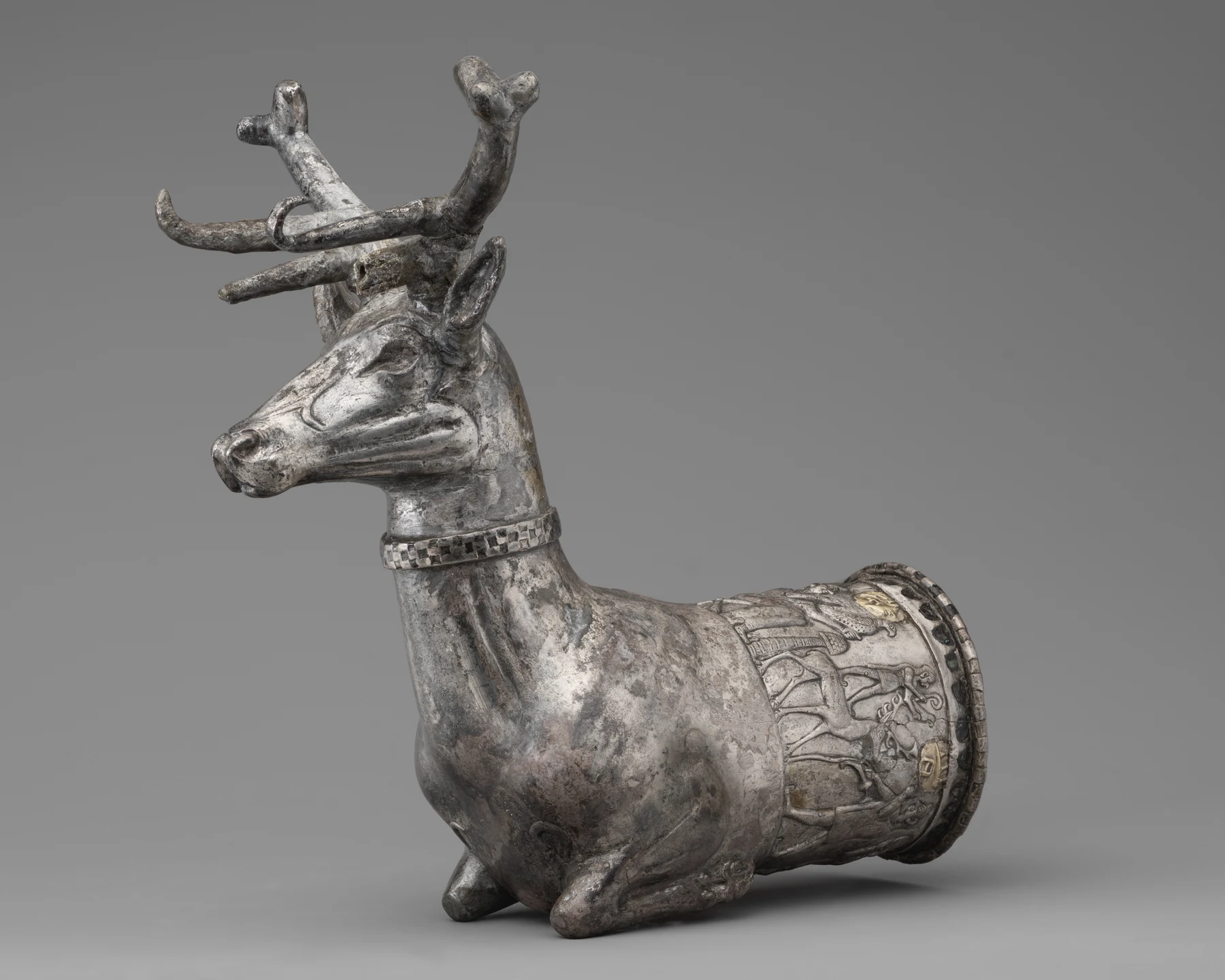
The Metropolitan Museum dates the Hittite vessel pictured in this article to approximately the fourteenth–thirteenth centuries BCE and identifies it as silver with gold inlay from central Anatolia. It helps us imagine rituals' material culture, but its museum identification neither connects it with Papanikri nor establishes that it held blood. [10]
Did the rite travel between cultures?
Feder proposes that the Hittite and biblical witnesses may relate to a shared Hurrian–Syrian tradition: a setting of traditions in the northern LevantThe LevantThe Levant is a regional name for lands along the eastern MediterraneanGlossary · Click to read the explanation and connected areas that might have carried certain ritual actions over time. He acknowledges a chronological gap and the absence of documented direct exchange between Hittites and Israel. [9]
To assess this possibility, we begin with actions. What is smeared with blood? Under what circumstances? What result does the text announce? Then we examine witnesses' dates and possible routes of contact. These questions give us a comparison that can be evaluated beyond noting that both cultures slaughtered animals.
A rite might persist through practice or oral transmissionOral transmissionCirculation through performance and hearing, potentially involving change.Glossary · Click to read the explanation before being written down, but evidence is needed for the links in that continuity. Moses's time within the Torah's narrative also differs from the composition and editing of its instructions. Shared tradition therefore remains an explanatory model rather than a documented chain from one tablet to Leviticus's writer.
We have similarities in some actions, differences in circumstances and meanings, and gaps in contact. Specifying Anatolia and the northern Levant is useful here instead of placing all material under the label MesopotamiaMesopotamiaA historical region associated with the Tigris and Euphrates, home to many societies and civilisations.Glossary · Click to read the explanation: geography belongs to the historical argument.
Blood establishing a covenant
Exodus 24 takes us to another scene in Moses's narrative. Moses reads the covenant book, and the community accepts what it hears. He divides the offerings' blood between altar and people, calling it covenant blood. Here a covenant is a relationship of commitment between God and the community, and blood helps establish it in the narrative. [11]
The scene shares animals, an altar and blood with some Levitical offerings, but its sequence differs: words are read, a commitment accepted and a relationship established. This gives blood its role in the scene, distinct from addressing an individual's offense or purifying the sanctuary.
One detail of Exodus 24 is that the book is read. The passage does not describe sprinkling blood on the book, or mention water, scarlet wool and hyssop in this procedure. Those elements will appear in Hebrews, a later text. Keeping the accounts separate lets us see what reinterpretation added.
Repentance, prayer and forgiveness
In 1 Kings 8:46–50, within a prayer attributed to SolomonSolomonSolomon is the biblical king, David’s son, associated in Kings with Jerusalem and building the templeGlossary · Click to read the explanation, people have been taken captive. They confess wrongdoing, return wholeheartedly to their God and pray. The prayer asks that their supplication be heard and they be forgiven. This passage contains no blood offering in the place of captivity. [12]
It is another way of speaking about forgiveness within Hebrew tradition itself. Temple and offerings remain part of the wider chapter, but this particular scene puts returning and prayer at the relationship's center. Reading several contexts therefore broadens our understanding beyond one procedure at an altar.
After the Romans destroyed JerusalemJerusalemJerusalem is a city of religious importance in Judaism, Christianity and IslamGlossary · Click to read the explanation's temple in 70 CE, offerings could no longer continue there. Brettler and Levine explain the importance of repentance, prayer and charity in subsequent Jewish interpretation of atonement. This is a change in practice and interpretation following the temple's loss, with offerings retaining value in understandings of earlier rites. [16][5]
These examples help us follow the idea under different conditions: sanctuary instructions, prayer from captivity, and interpretation after the loss of a place of worship. Each context has its needs, and the word atonement alone does not summarize them.
Hebrews: a Christian reading of offerings
Hebrews is a work of the Christian New Testament. Patrick GrayPatrick GrayReligious studies scholar at Rhodes College, researching the New Testament, early Christianity and biblical interpretation.Glossary · Click to read the explanation's scholarly introduction places it in the latter half of the first century CE, with its exact year of composition unsettled. In chapter 9, the author interprets sanctuary service and offerings through ChristJesus ChristJesus Christ is Christianity’s central figure, who lived in the first century CEGlossary · Click to read the explanation's work. [16]
The text distinguishes purification of the flesh from purification of conscience, presenting Christ's offering as an event requiring no annual repetition. The author advances these meanings within a religious argument that deliberately uses earlier biblical traditions. [13]
Verse 22 says that almost all things are purified with blood under the law, then speaks of no forgiveness without bloodshed. Almost matters because it is part of the argument's wording. Leviticus 5's flour alternative remains among the older text's instructions; we read both with attention to each passage's purpose.
Verse 19 retells Moses's covenant with water, scarlet wool, hyssop and sprinkling upon book and people. Comparison with Exodus 24 reveals additions in the later account. We can observe interpretation gathering and reshaping elements of tradition without assigning every detail to the earlier narrative.
Hebrews's connection with biblical traditions is clear. Connecting its interpretation directly to Papanikri's rite would require stages and evidence absent from this comparison. We present the letter's statements about Christ and salvation as its religious interpretation while examining the history of its use of sources.
The Qur'an: feeding others and piety
We turn to the Qur'an in the setting of Islam's emergence in the seventh century CE. Islamic tradition places revelation to MuhammadMuhammad, prophet of IslamMuhammad is the prophet of Islam, living about 570–632 CE in the setting of Islam’s seventh-century emergenceGlossary · Click to read the explanation between 610 and 632 CE, as the University of BirminghamBirmingham, United KingdomBirmingham is a city in England whose university preserves early Qur’anic parchment leavesGlossary · Click to read the explanation's introduction explains. This provides general context rather than an individual date for the two verses considered here. [17]
In al-Hajj 22:36, the animal offering remains explicit: God's name is pronounced, followed by eating and feeding others. The next verse states that meat and blood do not reach God, whereas piety does. The text retains material action and explains what gives it value in its religious reasoning. [14]
The emphasis differs from passages applying blood to sacred implements. Feeding and piety appear within the rite's description itself. The two verses let us understand this particular formulation, while the history and rules of pilgrimage offerings and animal sacrifice require broader research.
Arguing that these verses rewrite Leviticus 17 or directly address Hebrews would require evidence of a literary connection. Sharing animals and blood permits comparison without settling borrowing. Differences in meaning express each text's conception rather than ranking religions from lower to higher.
What do we know from this comparison?
The witnesses reveal several roles for blood: treating sacred locations in some Levitical instructions, establishing a covenant in Exodus 24, and a meaning connected with Christ in Hebrews. Meanwhile, Leviticus preserves atonement through flour, and prayer and repentance appear in other contexts of forgiveness.
The Hittite comparison helps examine a specific action: applying blood to something connected with a rite's beneficiary. It leaves transmission open, however. A shared regional tradition is proposed, while differences and gaps prevent a direct chain being drawn. These witnesses do not establish one Mesopotamian origin for every practice of atonement.
Later texts then show how offerings are explained again: explicit Christian interpretation in Hebrews, and Qur'anic emphasis on feeding others and piety. We can follow the idea through these stages while retaining each text's context and time.
The question that makes these details understandable is what happens in the rite and what its practitioners say it achieves. Starting from actions and witnesses makes both similarities and differences clearer, allowing comparison to remain an inquiry into history and meaning.
Further reading: The sent-away goat and removal rites; Offering after the flood; Covenant and imperial treaties; Similarity does not establish borrowing.
References and notes
- Whole chapter read in Hebrew and English; Leviticus 2 involves neither slaughter nor blood. Leviticus 2:1–16; Hebrew and facing English Return to the text ↑
- Complete chapter read; blood destinations differ by case, without washing the offerer in animal blood. Leviticus 4:1–35; especially 5–7, 16–20, 25–35 Return to the text ↑
- Whole chapter read in scapegoat research; blood/removal passage reread here. No original manuscript examination. Leviticus 16:1–34; especially 14–22, 30–33 Return to the text ↑
- Whole chapter read; no maternal crime narrated. An offering’s name alone does not establish moral condemnation. Leviticus 12:1–8 Return to the text ↑
- Article and 30 notes read; Milgrom accessed through the authors’ account, not his whole commentary. Neither their book nor the whole rabbinic corpus read. Marc Zvi Brettler and Amy-Jill Levine, 2021; full article and 30 footnotes Return to the text ↑
- Article and notes read; compensation and appeasement attributed to Feder, not an agreed meaning for every offering. Yitzhaq Feder, 2015; article and 21 footnotes Return to the text ↑
- Whole chapter read; the blood/life connection does not erase distinct treatment of hunted animals’ blood. Leviticus 17:1–16; especially 10–14 Return to the text ↑
- Whole chapter read: flour alternative and restitution plus fifth. Final section’s chapter numbering differs among editions. Leviticus 5:1–26 Hebrew numbering; 11–13; 15–16, 20–26 (= English 6:1–7) Return to the text ↑
- Specified pages and primary excerpts read, not whole book or CTH 476 tablet. Shared tradition remains a model with gaps. Yitzhaq Feder, Blood Expiation in Hittite and Biblical Ritual, SBL 2011; pp. 7–13, 115–127, 261–262; CTH 476 (KBo 5.1) I12–30, 41–47 Return to the text ↑
- Museum identity, rights and API checked; original viewed. Hittite silver/gold-inlay vessel, not established apparatus of a particular blood rite. Metropolitan Museum 1989.281.10; Vessel terminating in the forepart of a stag; ca. 14th–13th century BCE Return to the text ↑
- Whole chapter read; book read, not blood-sprinkled in this account. Hebrews 9 additions retained as later retelling. Exodus 24:1–18; especially 3–8 Return to the text ↑
- Five specified verses read, not whole chapter; no general rejection of offerings inferred. 1 Kings 8:46–50; public-domain KJV Return to the text ↑
- Whole chapter read; almost qualifier and Moses-retelling additions preserved, distinguishing authorial interpretation from every earlier text’s meaning. Hebrews 9:1–28; especially 13–14, 19–22, 24–28; public-domain KJV Return to the text ↑
- Both verses read in Arabic and translation: feeding, piety, meat/blood not reaching God. Neither full offering history nor direct borrowing established. Qur’an, al-Hajj 22:36–37; Arabic and displayed English Return to the text ↑
- The Met, The Hittites: the kingdom’s influence in Anatolia and neighboring areas, ca. 1650–1200 BCE. Historical paragraphs read; this range does not date the particular Papanikri tablet. The Hittites (Metropolitan Museum, 2002), historical paragraphs; kingdom context, not a precise date for CTH 476. Return to the text ↑
- Patrick Gray, The Letter to the Hebrews, three-page introduction: composition in the latter half of the first century CE, with the year debated, and Roman destruction of the temple in 70 CE. Excerpt read, not the complete study Bible. Patrick Gray, The Letter to the Hebrews, three-page scholarly introduction; Authorship and Date, pp. 1–2. Return to the text ↑
- University of Birmingham: Islamic tradition places revelation to Muhammad in 610–632 CE. Page read for general chronology, not to date these verses or use a manuscript of surahs 18–20 as their witness. University of Birmingham, What is the Birmingham Qur’an? General historical context; not an individual date for al-Hajj 22:36–37. Return to the text ↑
- Kathryn Schifferdecker, Luther Seminary, Summary of Leviticus: multiple sources and proposed dates for traditions and final form. Introduction read, not an exhaustive critical analysis. Late sixth/early fifth century BCE is this introduction’s proposal, not a consensus date for every rite. Kathryn Schifferdecker, Summary of Leviticus, revised March 2024; narrative setting, authorship and dating sections. Return to the text ↑
Research history
Substantive changes are retained here. Minor copy edits remain in the internal operational log.
-
Substantive record update
-
Substantive record update
-
Substantive record update
-
Substantive record update
Suggest a correction · Suggest a source for this record
Cite this record
IL Archive, «Blood and Atonement: What Do Offerings Do?», Edition 5, https://ilarchive.com/en/studies/blood-atonement-and-sacrifice
Continue reading