Study
Qumran
An extended study of a topic, with evidence and references.
Between stability and plurality: Qumran witnesses, MT, shorter Jeremiah, harmonistic Torah and the Septuagint’s Hebrew source, with limits of copy dating and reconstruction.
Share article
Text
Familiar books, unexpected witnesses
QumranDead Sea ScrollsJudaean Desert manuscripts, especially Qumran cave finds. Biblical copies and other works reveal textual diversity; a copy’s age is not the work’s initial date.Glossary · Click to read the explanation’s surprise was not limited to unfamiliar religious works. It also involved copies of Genesis, Exodus, Deuteronomy, Isaiah, Jeremiah, Samuel and Psalms. These familiar books appeared in witnesses far older than the complete HebrewHebrewA Northwest Semitic language in the Canaanite group, with ancient and modern forms.Glossary · Click to read the explanation manuscripts scholars had relied on, sometimes remarkably close to them, sometimes different in words, paragraphs or arrangement. [1][4]
The QumranQumranSite near the northwestern Dead Sea; neighboring caves preserve ancient Jewish textual finds, not one complete Bible.Glossary · Click to read the explanation finds within the Dead Sea ScrollsDead Sea ScrollsJudaean Desert manuscripts, especially Qumran cave finds. Biblical copies and other works reveal textual diversity; a copy’s age is not the work’s initial date.Glossary · Click to read the explanation revealed that some authoritative books circulated in more than one textual form at the same time. They did not show that everyone had a completely different Bible. The historical question is how careful preservation and plurality coexisted before particular traditions became standard.
Caves that expanded the archive
Discoveries began in 1947 near the northwestern shore of the Dead SeaDead SeaThe Dead Sea is a salt lake in the Jordan Rift Valley, near sites where ancient manuscripts were foundGlossary · Click to read the explanation. Further finds and excavations brought the number of caves known for written remains to eleven. Tens of thousands of fragments represent over nine hundred manuscripts in the Antiquities Authority’s general account; figures are approximate and depend on joining fragments and counting witnesses. [2][3]
Most cave material dates roughly from the third century BCE to the first century CE. HebrewHebrewA Northwest Semitic language in the Canaanite group, with ancient and modern forms.Glossary · Click to read the explanation predominates, alongside AramaicAramaicA group of Northwest Semitic language varieties with a long history across the Near East.Glossary · Click to read the explanation and Greek. The wider expression “Dead Sea Scrolls” includes other Judean Desert sites and periods; their dates should not all be assigned to Qumran. [1][14]
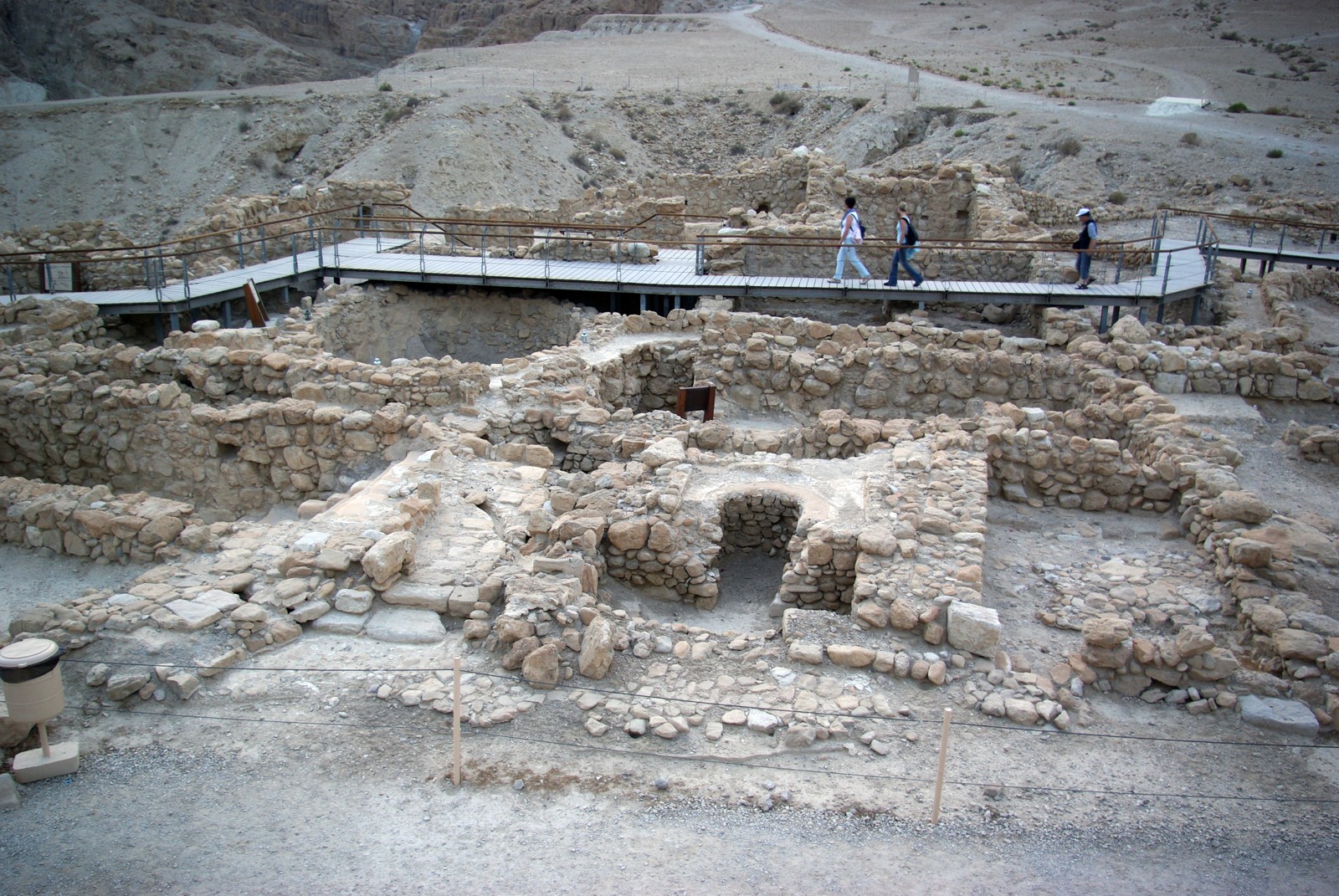
The modern cover photograph shows Qumran site remains; it is not a photograph of the cave or fragments underlying the Jeremiah analysis. [13]
What do the numbers count?
The Antiquities Authority refers to approximately 230 “biblical” manuscripts: witnesses to works included in the later Hebrew Bible. This does not mean 230 complete copies of a single Bible. A witness may be a tiny fragment of one book, or an extensive text such as the Great Isaiah Scroll. [1]
Esther is not attested among the identified books in this collection. Its absence alone does not prove community rejection, just as the number of copies alone does not establish a book’s authority for all Jews. The discoveries are a surviving sample, not a census of the period’s libraries.
Before the medieval codices
The damaged Aleppo Codex is usually dated around 925 CE; the Leningrad Codex, a complete Hebrew Bible witness, to 1009. Qumran enabled comparison with copies more than a millennium earlier in many cases. Older Hebrew fragments and ancient Greek translations were also known, so not every previously available witness was medieval. [4]
Comparison could now test continuity or change rather than assume it. Close agreement with a later tradition establishes persistence of particular readings; disagreement reveals another textual history requiring explanation.
Masoretic and proto-Masoretic
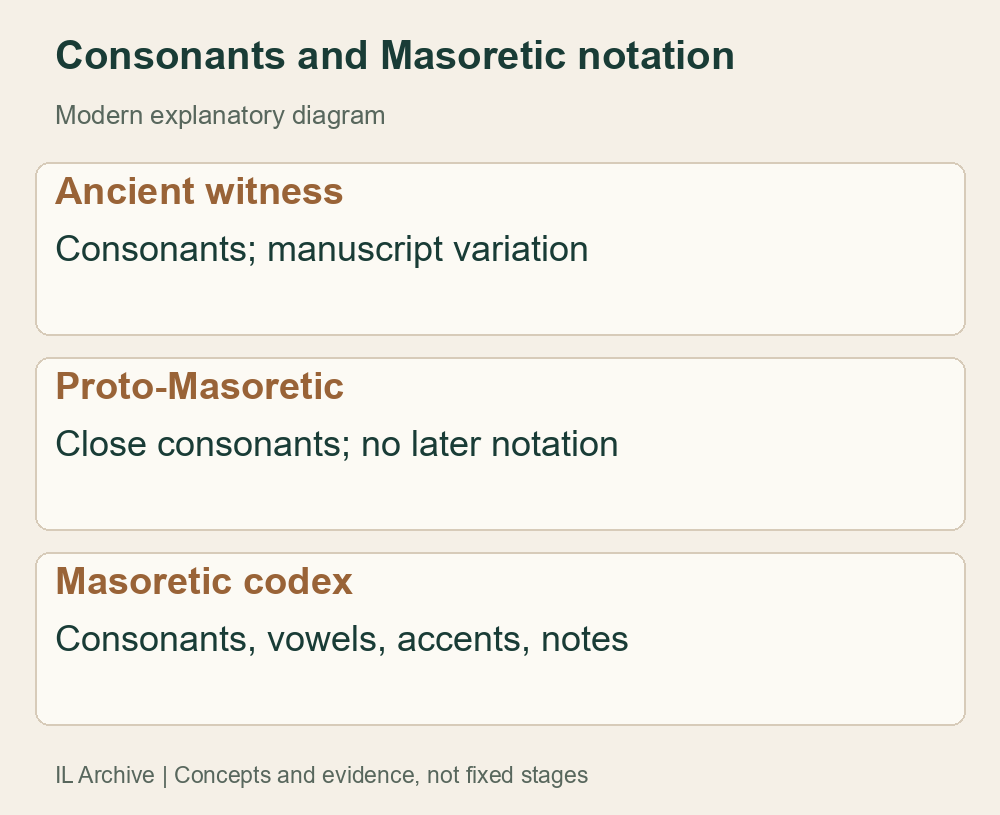
The Masoretic TextMasoretic TextA Hebrew textual transmission and reading tradition, compared in textual criticism with ancient manuscripts and translations.Glossary · Click to read the explanation combines the Hebrew consonantal text with vowels, accents and copying/reading notes organized by the Masoretes during the first millennium CE. They did not compose the books anew, but worked with older traditions. [4]
An ancient witness close to their consonantal text is therefore called proto-MasoreticProto-Masoretic textAncient witness close to later Masoretic consonants, without necessarily its vowels, accents and notes.Glossary · Click to read the explanation. It does not already contain the full medieval pointing, nor match every Masoretic manuscript letter for letter. Distinguishing consonants from later reading aids preserves the meaning of continuity without erasing differences.
Beyond closed text families
Studies use labels such as proto-Masoretic, harmonistic or pre-Samaritan, close to the presumed Hebrew source of the SeptuagintSeptuagintTraditional designation for ancient Greek translations of Jewish scriptures, whose readings sometimes differ from the Hebrew Masoretic Text.Glossary · Click to read the explanation, and nonaligned. These assist comparison; they are not four textual states with fixed borders. Some witnesses agree with one branch in one passage and another elsewhere. [5][8]
Not every fragment can be assigned automatically, and similarity is not proven direct descent. Missing text can prevent a decision; a “family” may describe shared readings or editorial features rather than a fully recoverable genealogy.
Variation has different scales
Differences range from spelling, conjunctions and grammar to a missing sentence or material brought in from a parallel passage. A consistent pattern of expansion or reorganization may indicate another literary edition. Size alone does not identify a cause: a copying error can omit a long paragraph. [4][5]
Textual criticismTextual criticismComparing witnesses to explain variation and infer earlier readings or editions, distinguishing preserved from reconstructed text.Glossary · Click to read the explanation compares witnesses, context and copying/translation practices to explain each case. Not every variant is a theological campaign; not every difference is a minor error without consequence.
Jeremiah: the shorter translation
Old Greek Jeremiah differs substantially from Masoretic Jeremiah: it is shorter and some sections, especially oracles against the nations, occupy different positions. Estimates of the length difference depend on the basis of calculation. It is safer here to describe a substantial difference than make “one sixth” a fixed, settled proportion. [4][6]
Before Qumran, some differences could be attributed to translator abbreviation. Hebrew witnesses, especially 4QJerᵇ, support shorter readings close to Greek in surviving passages. A different Hebrew source became a stronger explanation than assuming every omission arose in translation. [5]
The limits of Jeremiah’s fragments
4QJerᵇ does not preserve the whole book. Its surviving text cannot by itself establish the complete Greek version’s length or the order of all its sections. Direct evidence is what remains; reconstructing a complete edition relies on wider Hebrew/Greek comparison and analysis of translation technique. [5][6]
Distinguish “an ancient Hebrew reading agrees with the shorter text here” from “this scroll matched the entire Septuagint.” A preserved passage supports the former; the latter exceeds what this witness alone can establish.
Was one edition earlier?
Many scholars regard the shorter form as an earlier stage and the longer as an editorial expansion. This interprets the editions’ relationship; it is not a statement written on the manuscript. “Earlier” is not automatically “religiously truer,” and “expanded” does not mean “forged.” [6]
An editor might add older material absent from a previous edition, or reorganize and interpret it. Historians must specify the stage being reconstructed and separate the inferred direction of development from the established existence of variation.
The Samaritan Pentateuch is more than a changed mountain name
The Samaritan PentateuchSamaritan PentateuchSamaritan Hebrew five-book tradition sharing an older textual history, with linguistic and theological variants, including readings involving Mount Gerizim.Glossary · Click to read the explanation preserves the Samaritan tradition of the five books, not the rest of the Hebrew Bible. It has orthographic, linguistic and editorial differences, including readings emphasizing Mount Gerizim. Its history cannot be reduced to replacing a place name in a Masoretic text. [8]
Qumran shows that many features, especially expansion from parallel passages, existed before the distinctively sectarian Samaritan form. The question becomes one of an older shared textual history and the additions or choices distinguishing later traditions.
How harmonization works
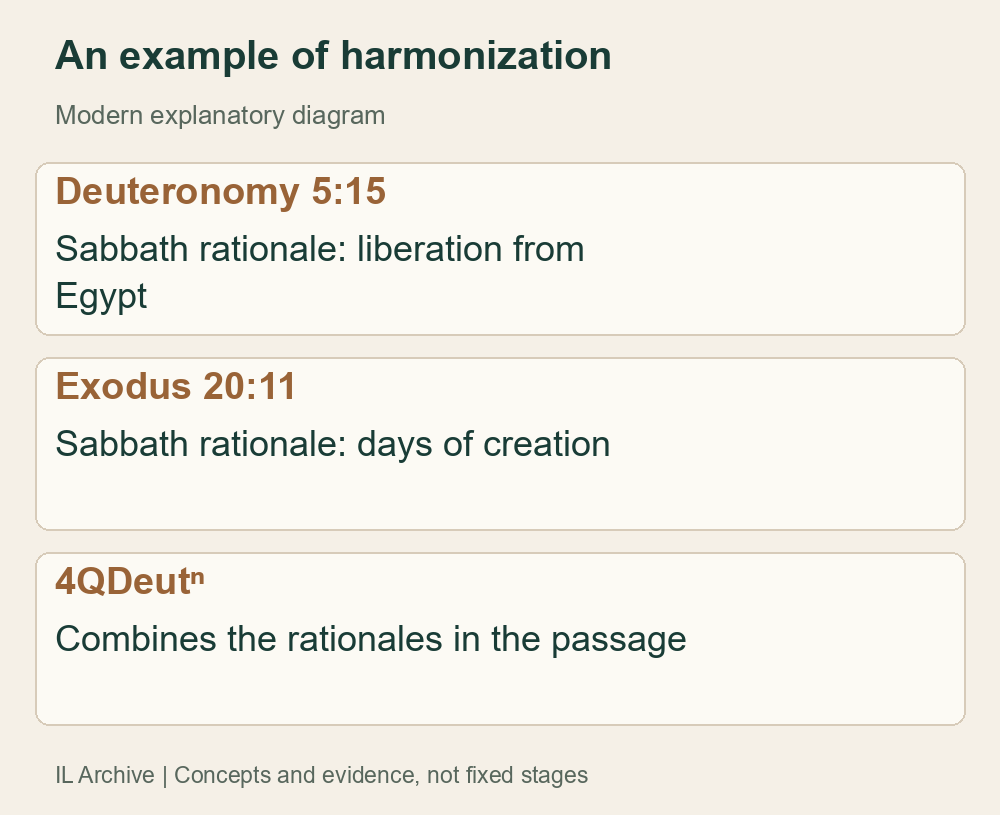
Textual harmonizationTextual harmonizationAligning parallel passages through additions or changes; may be deliberate editing, not proof of a copyist’s identity.Glossary · Click to read the explanation makes parallel passages more consistent. Details of an order’s fulfilment can be inserted into its command, or Deuteronomy material into Exodus. Ulrich discusses recurring expansions in harmonistic Exodus and 4QNumᵇ, a pattern extending beyond an isolated copying mistake. [7]
A specific example is 4QDeutⁿ: Deuteronomy5:15’s Sabbath rationale is enlarged with Exodus20:11’s creation-day material. This witness does not match the Samaritan text everywhere; harmonization alone does not establish a closed text family or a religious community. [11]
“Pre-Samaritan” is a description, not an identity card
4QpaleoExodᵐ, 4QExod-Levᶠ and 4QNumᵇ share important features with the Samaritan tradition. Hence “pre-Samaritan”; “harmonistic” instead emphasizes observable editing without automatically making the copyist Samaritan. [8]
4QpaleoExodᵐ appears not to have included the distinctive Gerizim commandment addition. Crucially, its location requires reconstruction from fragments and available space. This inference is not equivalent to reading a completely preserved passage. Evidence of shared expansions is stronger than evidence for the scribe’s sectarian identity.
Script does not identify the text family
Some Qumran scrolls use paleo-Hebrew script, others square script; an ancient script can also write the divine name within a square-script text. These differences matter for dating and writing practice, but do not make every old-script witness Samaritan. [14]
Anderson and Giles explain that paleo-Hebrew texts themselves vary, while harmonistic texts occur in different scripts. Letter shapes, readings and religious identity are related questions, not interchangeable ones. [8]
Copyists between precision and interpretation
A scribe can copy a harmonistic text precisely, or make mistakes when copying a proto-Masoretic one. Distinguish editing of the exemplar from the performance of its copyist: an addition need not originate with the manuscript’s final scribe. [5][7]
Clarification or harmonization may have been understood as preserving meaning and completing an account. That interprets a practice, not every scribe’s declared intention. Respect, control and modification coexisted in different degrees, without unlimited openness or one compulsory mechanism.
The Septuagint also witnesses to a source text
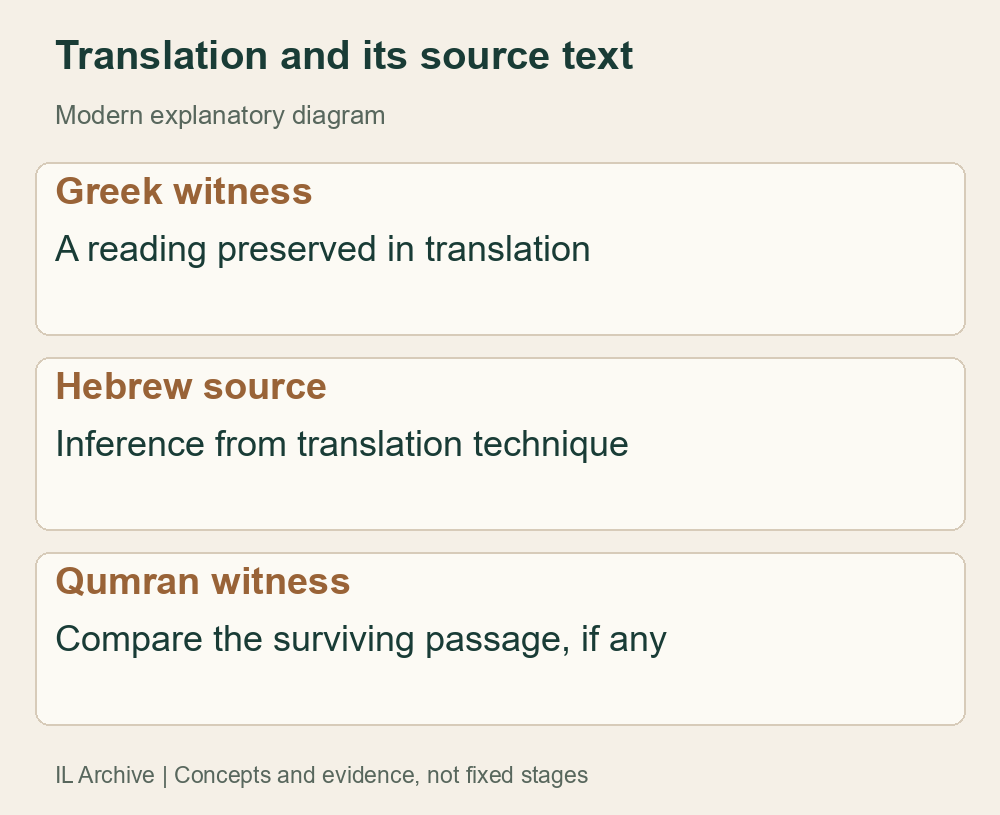
The SeptuagintSeptuagintTraditional designation for ancient Greek translations of Jewish scriptures, whose readings sometimes differ from the Hebrew Masoretic Text.Glossary · Click to read the explanation is not always a secondary translation to be corrected against MT. Differences can reflect a translator’s choices, interpretation or error; sometimes the Hebrew source textHebrew VorlageHebrew text underlying a translation; may survive partly or be inferred, so reconstruction is not a discovered copy.Glossary · Click to read the explanation was genuinely different. Jeremiah is central to distinguishing these levels. [6]
Recovering that source from Greek is not automatic. One Greek word may represent several Hebrew words, and syntax can change in translation. Study the individual translator’s practice and compare surviving Qumran passages where available. Agreement in a reading does not establish two identical whole books.
Samuel: why each passage needs examination
Samuel witnesses also assist comparison with Greek, but not every Samuel addition should be labelled “agreement with the Septuagint.” VanderKam’s account of the extra Nahash paragraph before 1 Samuel11 identifies 4QSamᵃ and Josephus, while noting its absence from other versions. [11]
A witness may preserve a valuable reading without Greek agreement. A long difference can arise from an eye-skip between similar phrases rather than a new theological edition. Neither length nor a text-family label replaces examination of the particular case.
The sixth day or the seventh?
In Genesis2:2 MT reads that God finished the work on the seventh day; the Samaritan, Old Greek and SyriacSyriacA literary form of Aramaic, with an extensive Christian heritage and earlier non-Christian attestations.Glossary · Click to read the explanation read the sixth. Tov considers whether “sixth” removes the apparent difficulty of completing work on the rest day. This interprets the direction of change, not an automatic result. [9]
The example compares textual traditions; it is not a variant preserved in a Qumran manuscript of this passage. It explains why neither shorter, easier nor chronologically older is always preferable: a judgment must explain the competing readings and their context.
Where stability appears
Some Qumran witnesses are very close to Masoretic consonants. Masada and refuge-cave manuscripts show this pattern continuing in other samples, important for understanding growing dominance near the end of the Second Temple periodSecond Temple JudaismDiverse Jewish traditions under Persian, Hellenistic and Roman rule, not one creed.Glossary · Click to read the explanation and afterward. [3][12]
Their dates and surviving books do not demonstrate that every Jew adopted one form on a particular day. Standardization is a social and historical process; other traditions could coexist beyond the groups that preserved these witnesses.
Did Qumran possess one different Bible?
“The Qumran TorahTorah / PentateuchGenesis, Exodus, Leviticus, Numbers and Deuteronomy: Mosaic corpus with a compositional history. Torah can also mean teaching or law beyond these five books.Glossary · Click to read the explanation” should not mean one copy opposed to all outside copies. The collection includes diverse works and multiple witnesses to some books. Assigning every scroll to copyists from one community, or composition at the site, exceeds what the collection alone proves. [1][5]
Their coexistence establishes that different forms could be preserved together. Their precise hierarchy of authority and readers’ responses cannot be recovered simply from fragment counts. Library presence does not automatically mean every reader regarded a work as canonical.
The Septuagint was not one work on one day
The five books were probably translated into Greek in Ptolemaic Egypt during the third century BCE; other books followed at different times and in different ways. Scholars distinguish the reconstructed earliest “Old Greek” from later Greek revisions. [4]
Specify the book and Greek witness before judging “the Septuagint.” Source/translation relations differ across books; a sound Greek reading in one passage does not make all Greek readings earlier than MT.
Text history and the list of books
Two communities may regard Isaiah as authoritative while using different forms. They may share a similar text but differ over another book’s standing. Textual plurality and canon formation are interconnected histories, not the same question. [12]
Torah, prophetic works and others held considerable authority, but the evidence does not warrant a universally identical closed list. This does not mean there were no boundaries or authority; it warns against projecting every detail of later canons backward.
Which “original” are we seeking?
If sayings were delivered, collected, expanded and rearranged, the first sayings, first collection, final edition and common ancestor of surviving witnesses are different targets. “Original” should not carry all these meanings without explanation. [5]
One edition may expand an earlier one, or the direction may remain uncertain. A tree helps explain branching, but it is an explanatory model, not a settled genealogy of all biblical manuscripts.
The earliest inferable text
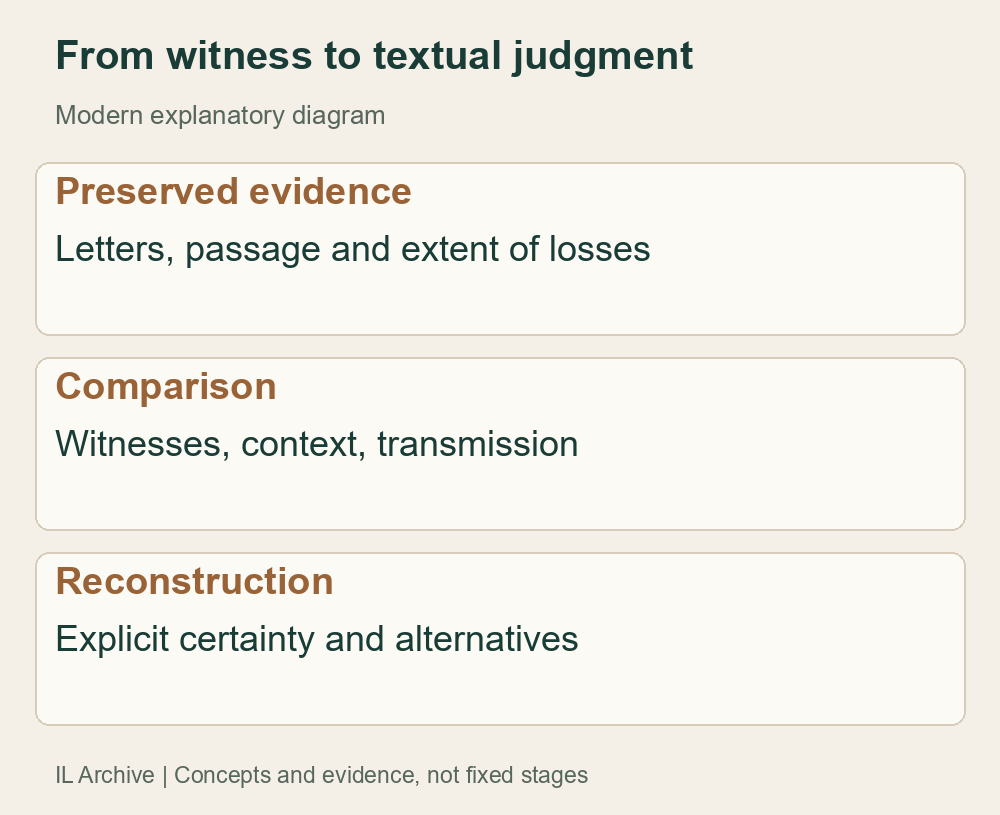
The Hebrew Bible: A Critical Edition describes a goal of recovering the earliest text inferable from witnesses. This may require representing more than one edition instead of a single hybrid that erases differences. Its goals and reconstruction methods have also received scholarly criticism. [10][5]
An inferred reading does not become a newly discovered artifact because an editor prints it. Decisions, arguments and alternatives should remain visible, marking where preserved evidence ends and reconstruction begins.
The older manuscript is not always better
A manuscript’s age dates the copied object, not every reading it contains. A later witness may copy a sound old exemplar; an earlier witness may contain a local error. Temporal proximity matters, but cannot replace examining each passage. [4][9]
Good comparison neither idolizes a copy’s date nor rejects a tradition because its surviving physical witnesses are late. It weighs meaning, context, external evidence and plausible origins of competing readings.
Composition, editing and copying have different dates
A manuscript dated around 150 BCE establishes that its textual form existed by then, within the dating’s precision. This is a terminus ante quem—a latest possible bound for that form’s existence—not evidence that it originated then or a fixed date for all its material. [4]
The form may contain older material and circulate beside another edition. Qumran cannot by itself date every book’s composition or establish a Torah invented when these scrolls were copied. It expands evidence for transmission and editing.
What continued afterward?
The tradition leading to MT grew dominant within rabbinic Judaism, particularly after the Second Temple period. This was not one decision immediately after 70 CE and did not end other branches. Samaritans retained their Pentateuch; Greek translations became important in Christianity. [4][12]
Medieval Masoretes documented reading and transmission with considerable precision. The standard text has a long history. Recovering that history does not diminish its value as a witness; it enables evaluation alongside others.
Degrees of what we know
Established: Qumran has witnesses close to MT and others diverging from it, harmonistic expansions and Hebrew readings explaining some Greek differences. Comparison also supports multiple editions of some books. Probable in influential models: shorter Jeremiah preceded the longer, and some harmonistic texts underlie the later Samaritan form. [5][6][8]
Unestablished: a complete genealogy, a copyist’s doctrine inferred from script, or one date for standardizing every book. Inaccurate: unrelated books throughout the collection, or every copy matching one letter-perfect text from composition onward.
A history made visible
Qumran did not simply supply a new Bible to replace MT. It made the route to familiar texts more visible: material, collection, editing, copying, translation, harmonization, and uneven stabilization across books and communities. Not every book must follow these steps in the same order. [5]
Some authoritative books existed in multiple forms while some readings remained stable for centuries. These facts coexist: a text can be carefully preserved within a branching history. A single page today may stand at the end of stages the page itself cannot show.
References and notes
- Israel Antiquities Authority. “Introduction.” Leon Levy Dead Sea Scrolls Digital Library. Qumran and biblical manuscripts sections: dates, languages, approximately 230 witnesses, Esther unattested, agreement and variation. Approximate counts; not an independent reading of all fragments. Return to the text ↑
- Israel Antiquities Authority. “Discovery and Publication.” 1947 discovery, 1949–1956 investigations, eleven caves and remains of over 900 manuscripts; Dead Sea Scrolls also encompasses other sites. Return to the text ↑
- Israel Antiquities Authority. “Discovery Sites.” Qumran caves and Masada: fragments of seven biblical scrolls, close to the proto-Masoretic tradition. Does not establish universal standardization on one date. Return to the text ↑
- James C. VanderKam (2016). “Texts, titles, and translations.” In The Cambridge Companion to the Hebrew Bible/Old Testament, pp. 9–27. DOI: 10.1017/CBO9780511843365.002. Pp. 9–12, 17–21: Masoretic layers, Aleppo c.925 and Leningrad 1009, witnesses, translations and variation. Counts depend on classification; no uniform percentage for all books. Return to the text ↑
- Eibert Tigchelaar (2012). “Editing the Hebrew Bible: An Overview of Some Problems.” In J. S. Kloppenborg and J. H. Newman (eds.), Editing the Bible, pp. 41–66. SBL. P.47: 4QJerᵇ, multiple editions and nonexclusive text groups; pp.50, 52–53: critical-edition objectives and problems of reconstructing origins. Filename identifies an editor, not this chapter’s author. Return to the text ↑
- Kristin De Troyer (2012). “Greek Papyri and the Texts of the Hebrew Bible.” In Editing the Bible, pp. 81–90. SBL. Pp.88–89: Ulrich/Tov models for Jeremiah, Exodus and Samuel editions; Greek can reflect different Hebrew editing. Reports scholarship, not independent collation of every manuscript. Return to the text ↑
- Eugene Ulrich (2012). “The Evolutionary Composition of the Hebrew Bible.” In Editing the Bible, pp. 23–40. SBL. Pp.32,34: Exodus additions from Deuteronomy and explicit fulfilment of commands; 4QNumᵇ. Ulrich identifies editorial editions; not automatically every scribe’s practice. Return to the text ↑
- Robert T. Anderson and Terry Giles (2012). The Samaritan Pentateuch: An Introduction to Its Origin, History, and Significance for Biblical Studies. SBL. Pp.34–35,44–48: groups, harmonization, old script, 4Q17/22/27. P.48 n.19: Gerizim commandment location requires reconstruction; its non-inclusion is an inference, not direct reading of an intact passage. Return to the text ↑
- Emanuel Tov (1982). “Criteria for Evaluating Textual Readings: The Limitations of Textual Rules.” Harvard Theological Review 75(4), pp.429–448. DOI: 10.1017/S0017816000031540. Public extract and n.37: seventh day in MT Genesis2:2 versus sixth in SP, Greek and Syriac. Explanation of change is probable; not a variant attested at Qumran itself. Return to the text ↑
- Society of Biblical Literature. The Hebrew Bible: A Critical Edition — project description. Official project description read in browser: earliest inferable text, editions and criticism. Direct page read through browser; methodological details also supported by Tigchelaar pp.50,52–53. Return to the text ↑
- James C. VanderKam (2016). “Texts, titles, and translations,” pp.18–20: examples from Samuel and Deuteronomy. Pp.18–20: Samuel and 4QDeutⁿ harmonization of Sabbath rationales, Exodus20:11/Deuteronomy5:15. Greek agreement does not automatically identify a better reading. Return to the text ↑
- Israel Antiquities Authority. “Introduction,” biblical manuscripts and refuge caves sections. Authority is not identical to a universal closed canon; refuge-cave witnesses resemble MT. Esther’s absence does not establish rejection, nor copy frequency universal canonical status. Return to the text ↑
- Berthold Werner (12 November 2008). Palestine Qumran BW 4.jpg. Wikimedia Commons, own work, PD-self. Photograph of Qumran site remains, released to public domain by creator. Not Cave4 or a Jeremiah fragment; original preserved, display resized without cropping. Return to the text ↑
- Israel Antiquities Authority. “Languages and Scripts.” Languages/scripts describe writing, not automatically scribal identity or text family; compare Anderson/Giles pp.45–46. Return to the text ↑
Suggest a correction · Suggest a source for this record
Cite this record
IL Archive, «Qumran», Edition 1, https://ilarchive.com/en/studies/qumran-textual-plurality
Continue reading
![Gold coin of Ptolemy II, Alexandria, ca. 261–246 BCE; the illustrated obverse bears Arsinoe II’s head. Context for Hellenistic Egypt, not a portrait of Philo or proof of a Torah translation commission. [24]](/media/1436)