Study
A story's date is not its manuscript's date: how do we date ancient texts?
An extended study of a topic, with evidence and references.
- Region
- Mesopotamia, the Levant, the Hejaz and Abyssinia
A story and its surviving manuscript may be centuries apart. Examples from Sargon, the flood, Enoch and the Qur'an explain how we date each stage.
Share article

Text
Introduction
When we compare a religious story with a tale from an older civilisation, how do we establish which account came first? The king mentioned in a story may have lived long before the tablet that preserves it, and a manuscript may copy a book composed centuries earlier. This study explains how to distinguish the dates of narrated events, composition, collection, and the surviving written witness.
We examine examples from the Sargon story, the Atrahasis epicAtrahasis: Epic and HeroAkkadian epic: humans created for divine labor, multiplication, noise and flood. Atrahasis, “exceedingly wise,” survives through Enki’s warning; human reproduction is regulated afterward.Glossary · Click to read the explanation, the Book of Enoch, and Quranic and Christian manuscripts. The aim is to understand the dates used in comparing religious traditions and what they can tell us about the priority of an account or its possible transmission to another culture.
When a story has more than one date
A researcher holds a tablet on which an ancient king describes his childhood. The researcher can ask when the tablet was made, when the king lived, and when the childhood story became a written text. These questions may have three different answers.
This is the case with Sargon of AkkadSargon of AkkadThird-millennium BCE king associated with later birth and ascent traditions.Glossary · Click to read the explanation, a king of the third millennium BCE, and the account of his birth preserved on a tablet written many centuries later. The same distinction matters for Mesopotamian flood stories, which survive in copies from widely separated periods. [1][2][4][5]
Other manuscripts raise further questions. A book may contain texts collected at different stages, as with 1 EnochFirst EnochLayered collection of Jewish writings about heaven, evil and judgment.Glossary · Click to read the explanation. Scientific testing may also give us the age of the skin on which a text was written, as with the Qur'an manuscript preserved in BirminghamBirmingham, United KingdomBirmingham is a city in England whose university preserves early Qur’anic parchment leavesGlossary · Click to read the explanation. [6][7][8]
“When was this story written?” therefore begins with a more specific question: do we want to date its events, its composition, its copying, or its material? Understanding the distinction helps us read the evidence and compare religious traditions.
From the events to the surviving copy
When dating textsDating textsDistinguishing narrated time, composition and surviving copy.Glossary · Click to read the explanation, we can distinguish several stages. The first is the time of the narrated events: the period in which the story places its characters, perhaps even the beginning of the world. Then comes possible oral circulationOral transmissionCirculation through performance and hearing, potentially involving change.Glossary · Click to read the explanation, when a story was told before it was written. This is difficult to date because we need evidence that it occurred; the spoken words themselves leave no manuscript.
We next ask about composition: when did the story take this written form? And about editing and collection: when were separate pieces brought together as a book? Translation into another language, or inclusion in a collection of sacred books, may add further stages. [6][7]
The surviving object has two other dates: when the text was copied onto it, and the age of the material carrying the writing, such as the skin used to make parchment. Separating them is particularly useful when the material can be tested scientifically, while the writing is dated through handwriting and other evidence. [8][9]
These stages can be close together, or centuries apart. In some cases we can estimate a copy's date with greater confidence than we can establish when the story was first told. [5][6][7][8][9]
What does the earliest copy tell us?
When we establish a manuscript's date, we know that the form of the text written in it existed at the time of copying or earlier. The copy's date does not, by itself, tell us when the text was first composed. [4][5][6][10]
A scribe may have copied a story written centuries before, or copied it soon after its composition. To assess these possibilities, historians look for older copies, dated quotations, or references within the text to events and institutions. Its language and the differences between copies also help trace its history. [4][5][6][10]
The earliest surviving copy is a point from which inquiry can begin. Earlier stages need their own evidence. An older story may have lost all its copies, but dating it takes more than assuming that it existed.
Sargon: an ancient king and a later account of his birth
Sargon of Akkad was a king of MesopotamiaMesopotamiaA historical region associated with the Tigris and Euphrates, home to many societies and civilisations.Glossary · Click to read the explanation, in ancient IraqIraqIraq is a modern country encompassing much of ancient MesopotamiaGlossary · Click to read the explanation. The British Museum places his reign approximately between 2334 and 2279 BCE, in the twenty-third century BCE. [2]
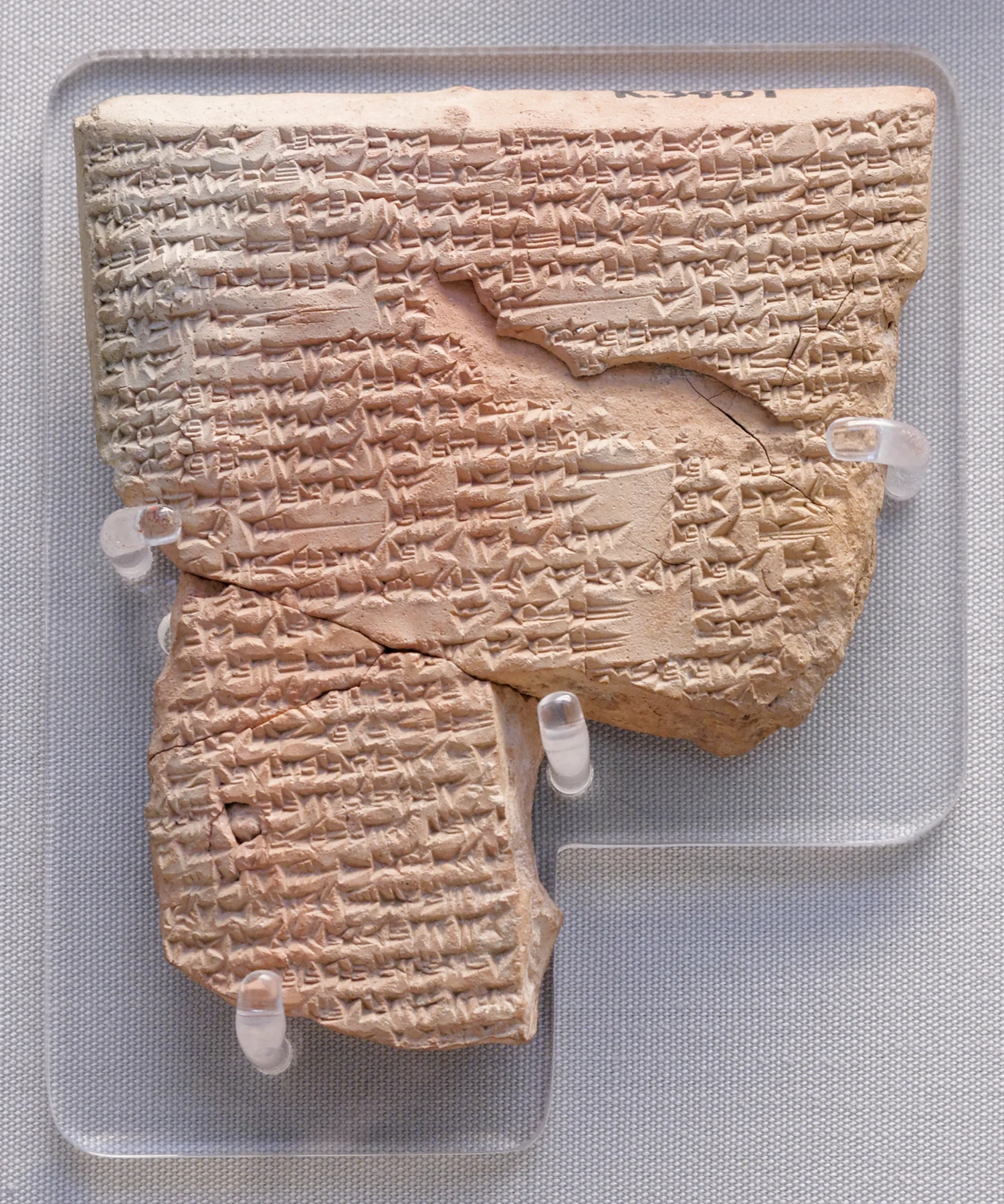
The museum also holds a fragment of his birth story, K.3401, found at KuyunjikNineveh and KuyunjikNineveh is an ancient Assyrian city near Mosul in northern Iraq; Kuyunjik is one of its archaeological moundsGlossary · Click to read the explanation. It has seventeen lines. The catalogue assigns it to the Neo-Assyrian period and associates it with AshurbanipalAshurbanipalAshurbanipal was an Assyrian king of the seventh century BCE, reigning about 668–631 BCEGlossary · Click to read the explanation's library. A long interval thus separates the king in the story from the surviving copy we read today. [1][3]
The story opens in Sargon's own voice. His mother hides her newborn child, places him in a reed basket sealed with bitumen, and the river carries him to AqqiAqqi in Sargon’s birth storyAqqi is the irrigator who finds the child in the river and adopts him in Sargon of Akkad’s birth storyGlossary · Click to read the explanation, a man who works in irrigation and adopts him. ETANA's translation presents this as an imagined autobiography written centuries after the ruler, with parts of the tablet still broken. The word “I” belongs to the way the story is told. [11]
The time of composition is a separate question. Drawing on features of language and presentation, Thomas RömerThomas RömerScholar of Hebrew Bible history and composition, holding the Biblical Milieux chair at the Collège de France.Glossary · Click to read the explanation proposes a date in the late eighth century BCE, in the context of the Assyrian king Sargon IISargon IISargon II was an Assyrian king of the late eighth century BCE; ORACC dates his reign about 721–705 BCEGlossary · Click to read the explanation. This is a hypothesis explaining the text's emergence: the archaeological catalogue classifies the object, while the scholar tries to estimate when its story was composed. [1][2][13]
The basket, bitumen, river and adoption recall the story of MosesMosesCentral figure in Exodus, Torah traditions and the Qur’an; childhood accounts differ in detail.Glossary · Click to read the explanation in Exodus, one of the books of the TorahTorah / PentateuchGenesis, Exodus, Leviticus, Numbers and Deuteronomy: Mosaic corpus with a compositional history. Torah can also mean teaching or law beyond these five books.Glossary · Click to read the explanation. In Exodus 2:1–10, Moses' mother places her infant in a pitch-coated basket of bulrushes among the reeds at the riverbank. His sister watches him, and Pharaoh's daughter finds and adopts him. [12]
These similarities are the starting point for comparing the stories. Investigating their connection also involves differences in characters, setting and purpose, the composition date of each text, and a possible route of transmission. Römer favors an adaptation of the Sargon pattern; this is a scholarly interpretation that goes beyond observing resemblance. Sargon's antiquity establishes the king's historical period, while the age of his birth story needs separate investigation. [11][12][13]
Atra-hasis: a story transmitted across centuries
Atra-hasis is a Babylonian epic that includes a flood story. The British Museum catalogues a fragment of its third part as Old Babylonian, a period commonly placed approximately between 2000 and 1600 BCE. This is a broad period range, not a precise date for the epic's composition or the copying of that fragment. [4][14]
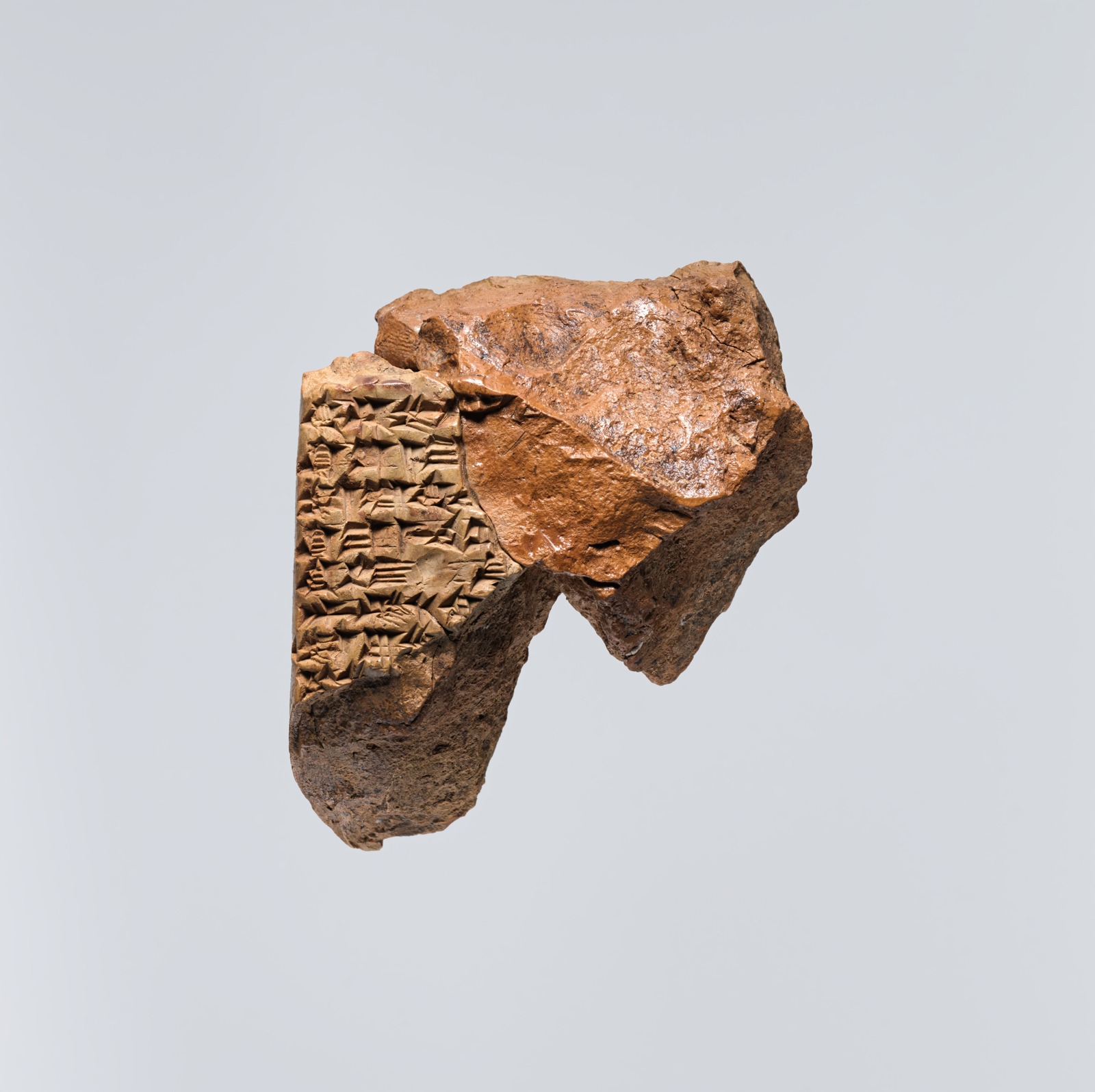
New YorkNew York CityNew York City is in the United States and houses the Metropolitan Museum of ArtGlossary · Click to read the explanation's Metropolitan Museum of Art holds another tablet from this tradition, 86.11.378a, dated approximately to the seventh or sixth century BCE. The museum explains that the epic is known from Old Babylonian copies and that its tablet attests continued circulation and copying much later. [5]
Comparing the two objects shows how a later copy can preserve an older story. Details also help trace changes in the narrative: the survivor in the later tablet is called Ut-napishtim, according to the museum's description. Researchers therefore examine what each copy preserves alongside the epic's general title. [4][5]
Here we can see a written tradition continuing through different periods. The date of the first oral flood story, and its detailed connection with NoahNoahNoah is the flood-story figure in Genesis and a prophet in the Qur’anGlossary · Click to read the explanation's story in Genesis, are broader questions requiring other evidence as well.
Qumran and Enoch: dating a part and dating the book
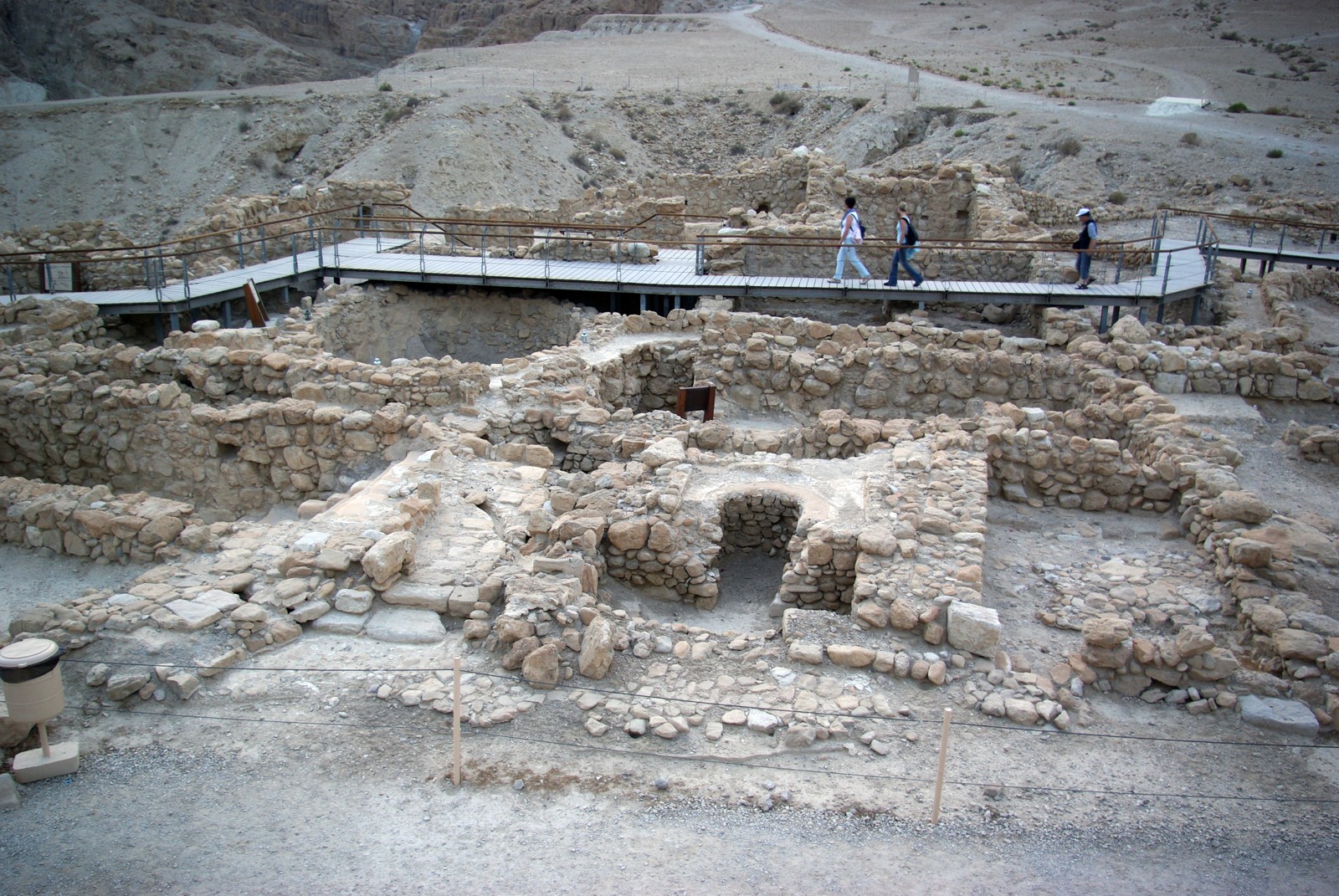
AramaicAramaicA group of Northwest Semitic language varieties with a long history across the Near East.Glossary · Click to read the explanation fragments of Enoch survive among the manuscripts from QumranQumranSite near the northwestern Dead Sea; neighboring caves preserve ancient Jewish textual finds, not one complete Bible.Glossary · Click to read the explanation, near the Dead SeaDead SeaThe Dead Sea is a salt lake in the Jordan Rift Valley, near sites where ancient manuscripts were foundGlossary · Click to read the explanation. The Israel Antiquities Authority displays a fragment called 4Q Enochᵃ and dates it to 150–50 BCE. The displayed piece concerns heavenly beings' rebellion and descent. It is an early witness to that part of the Enochic tradition. [6]
1 Enoch, as readers encounter it today, is a collection containing several sections, including the Book of WatchersWatchersDesignation for heavenly beings in Daniel and Enochic literature, covering an obedient holy watcher or a rebellious group according to context.Glossary · Click to read the explanation, the Parables and the Astronomical Book. According to the publisher's summary of Michael KnibbMichael A. KnibbBritish scholar of early Jewish literature, Ethiopic versions and the Septuagint (1938–2023), known for work on Enoch.Glossary · Click to read the explanation's chapter, a complete version survives only in Ethiopic. [7]
The Aramaic fragment helps us trace the Watchers material. Dating the collection as a whole requires evidence for its other sections, their arrangement and translation. The Parables, for instance, do not occur in the displayed fragment and cannot be assigned its date on that basis. [6][7]
Calling the book “apocryphal” or “outside the canon” also concerns its reception among particular religious communities. Here, a canon means the books a community recognizes as sacred or authoritative. It is useful to ask: outside which community's canon, and in which period? That is a question about a book's standing, distinct from the age of its manuscripts.
Birmingham's parchment: the skin and the writing
The University of Birmingham preserves two leaves, or four pages, of a Qur'an manuscript catalogued Mingana Islamic Arabic 1572a. They contain passages from the surahs al-Kahf, Maryam and Ta-Ha. Researchers assign its Hijazi handwriting to the seventh century CE. [8][9]
Radiocarbon analysisRadiocarbon datingA probabilistic date range for organic material; for parchment it dates animal skin rather than ink directly.Glossary · Click to read the explanation of the parchment returned a range of 568–645 CE, with 95.4 percent probability. Parchment is a writing material made from animal skin. The university therefore explains that the test dates the death of the animal whose skin was used. [8][9]
Writing followed preparation of the skin. The range's early endpoint, 568, consequently does not mean that the verses were written in that year. Researchers combine material testing with study of the handwriting and text to estimate when the manuscript was copied. The university says the ink's age was not measured directly by a reliable scientific method, and multispectral examination found no older hidden writing beneath the visible text. [8][9]
The leaves are important witnesses to early circulation of Qur'anic passages. Their direct evidence concerns the passages they preserve; other surahs and the stories to which the Qur'an refers need their own witnesses. Manuscript study also investigates the writing of this particular copy, while the Islamic account of revelation concerns the recitation and disclosure of the verses. [9]
The university describes the manuscript as among the earliest surviving written witnesses. That wording conveys the object's importance while leaving a worldwide ranking of the oldest manuscripts dependent on comparison of their dates and dating methods. [9]
Codex Sinaiticus: a substantial copy of older books
Codex Sinaiticus is a substantial manuscript of the Christian Bible. The project studying it dates its writing to the fourth century CE, chiefly through handwriting analysis. It also points to smaller fragments of Christian texts from earlier periods. [10]
Calling the manuscript fourth-century dates this copy. The Gospels, letters and other works it contains have histories of composition and transmission that require study of each work and its witnesses. The manuscript matters because it preserves a large collection of texts and reveals a stage in their copying and collection. [10]
Each book has its own history. Yet these examples share a question that helps make the evidence clearer: are we dating the story, the book in which it was collected, or the copy that survived?
How does dating help us compare stories?
These distinctions matter when we compare two stories and consider whether one reached another cultural setting. Chronological priority allows us to propose influence: the form suggested as a source must have been available before the text said to have drawn on it. [11][12][13]
Then comes investigation of the connection itself. Researchers examine routes of contact, shared details and their order, differences in the story's purpose, intervening copies and similar linguistic expressions. They also consider whether both texts inherited a wider tradition. These questions help explain the resemblance. [11][12][13]
In the Sargon and Moses example, we may know that the AkkadianAkkadianAn ancient East Semitic language written in cuneiform in Mesopotamia.Glossary · Click to read the explanation king lived earlier and that later copies describe his birth. Establishing which form was available to an Exodus writer, and how it reached that writer, remains part of the historical argument. The ages of the character and the tablet provide important information, each with its own role.
What do we know, and what remains open?
The surviving evidence establishes a Neo-Assyrian fragment telling a story about an earlier Sargon, Old Babylonian and later copies of the Atra-hasis tradition, and Aramaic Enoch fragments preceding the complete Ethiopic version. Birmingham's findings establish that radiocarbon dating was carried out on the parchment skin. [1][2][4][5][6][7][8][9]
Research helps estimate other dates. Combining material testing and handwriting analysis helps estimate when Birmingham's manuscript was copied. Features of language and presentation allow Römer to propose a composition date for Sargon's story. These estimates rest on scholarly arguments and remain open to reassessment. [8][9][13]
The first oral flood story, the collection of every section of 1 Enoch, the direct source of Moses' story, and the dates of stories absent from Birmingham's leaves are not settled by these objects alone. Each question requires other material to be examined. [4][5][6][7][8][9][11][12][13]
A manuscript gives us something tangible: writing on a particular material, with a script, a context, preserved portions and others that may have been lost. Knowing what could be dated makes the story's history clearer and helps comparisons explain both what we know and what we are still investigating.
References and notes
- Search-indexed British Museum catalogue metadata for K.3401 only; full page inaccessible, tablet text not independently read. British Museum, K.3401, object catalogue Return to the text ↑
- Search-indexed British Museum Sargon ruler record; approximate regnal range only. British Museum, Sargon I ruler record Return to the text ↑
- Indexed LMU K.3401 listing, not a text edition or composition date. LMU electronic Babylonian Library, K.3401 fragment metadata Return to the text ↑
- Indexed British Museum catalogue entry for the Old Babylonian Atra-hasis III fragment; no independent cuneiform reading. British Museum, 1889,0426.235 / 78942, Atra-hasis III Return to the text ↑
- Complete Met record for 86.11.378a, including date, description and image rights; no independent reading of the signs. Metropolitan Museum of Art, Atra-hasis tablet 86.11.378a, complete object page Return to the text ↑
- Full Israel Antiquities Authority featured-scrolls page, especially 4Q Enoch-a; Aramaic fragment not independently read. Israel Antiquities Authority, Featured Scrolls, 4Q Enoch-a and 4Q Genesis-g entries Return to the text ↑
- Michael Knibb's publisher summary and metadata only; restricted chapter body not read. Michael A. Knibb, 'The Ethiopic Book of Enoch', publisher summary of chapter pp. 26–55 Return to the text ↑
- Complete University of Birmingham conservation/research page, including parchment, script and ink findings; underlying lab report not read. University of Birmingham, Research and conservation, complete page Return to the text ↑
- Complete Birmingham FAQ: two-leaf contents, dating limits and permission requirement for publishing photographs. University of Birmingham, Qur'an manuscript FAQs, complete page Return to the text ↑
- Complete Codex Sinaiticus Project date page; manuscript folios not independently inspected. Codex Sinaiticus Project, Date page Return to the text ↑
- Entire short ETANA translation and note; Akkadian edition not independently collated. ETANA eTACT, The Birth-Legend of Sargon, CT 13 42–43 translation Return to the text ↑
- Exodus 2:1–10 in full, public-domain KJV; Hebrew manuscripts not collated. Exodus 2:1–10, public-domain King James Version Return to the text ↑
- Römer chapter abstract and PDF pp. 1–3 (printed 81–84) only; composition and borrowing arguments attributed to him. Thomas C. Römer, 'Moses, the Royal Lawgiver', in Remembering Biblical Figures (OUP 2013), printed pp. 81–84, especially pp. 83–84 Return to the text ↑
- The Metropolitan Museum of Art, chariot model 48.131: Old Babylonian period, ca. 2000–1600 BCE. Period and date metadata; a general period range, not the date of an Atra-hasis tablet or the whole Amorite language. Return to the text ↑
Research history
Substantive changes are retained here. Minor copy edits remain in the internal operational log.
-
Substantive record update
-
Substantive record update
-
Substantive record update
Suggest a correction · Suggest a source for this record
Cite this record
IL Archive, «A story's date is not its manuscript's date: how do we date ancient texts?», Edition 4, https://ilarchive.com/en/studies/dating-stories-versus-manuscripts
Continue reading