Study
Typhon and the storm-god battles: Illuyanka, Baal, and the limits of resemblance
An extended study of a topic, with evidence and references.
- Region
- Anatolia, the Levant and Greece
How do Illuyanka, Baal and Zeus–Typhon battles resemble one another? Hittite, Ugaritic and Greek accounts, dated witnesses, stolen body parts and possible paths of contact.
Share article
Text
Introduction
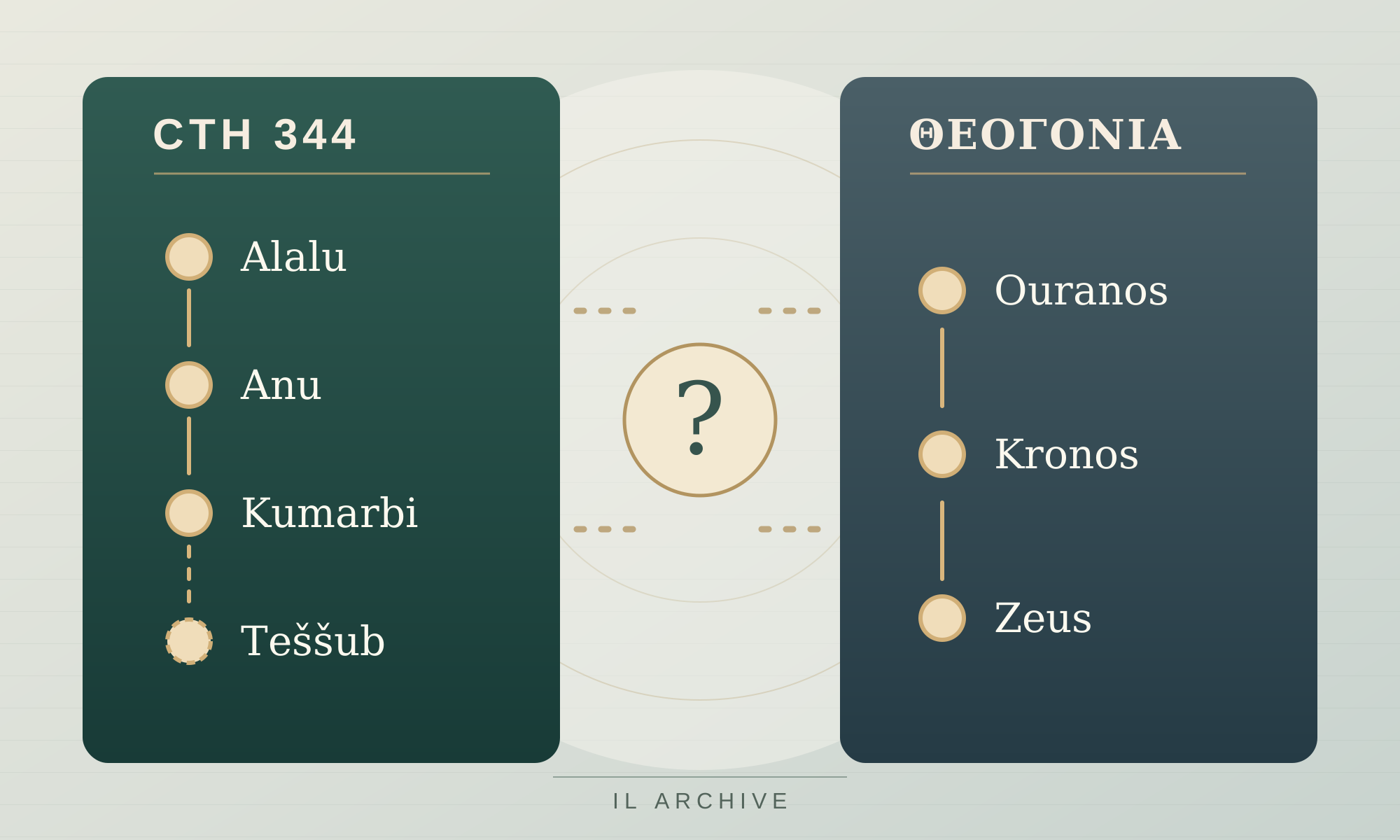
Why does the image of a storm god fighting a serpent or an enormous monster recur in Hittite, Ugaritic and Greek stories? This study compares IlluyankaIlluyankaThe serpent opposed by the storm god in two Hittite narratives preserved in CTH 321.Glossary · Click to read the explanation in AnatoliaAnatoliaAnatolia is the region occupying the Asian part of present-day TurkeyGlossary · Click to read the explanation, BaalBaalStorm god and protagonist of Ugarit’s Baal Cycle; exercises active kingship while El retains importance and authorizes the palace.Glossary · Click to read the explanation’s struggle with the Sea at UgaritUgaritAncient city and kingdom at Ras Shamra on the Syrian coast, flourishing between the fourteenth and early twelfth centuries BCE and preserving multilingual archives.Glossary · Click to read the explanation, and ZeusZeusZeus is the sky god and leading deity in many Greek traditions. In the Iliad he presides over divine gatherings while others can still speak and object.Glossary · Click to read the explanation’s battle with TyphonTyphon / TyphoeusZeus's serpent-headed opponent, whose battle differs between Hesiod and later Greek accounts.Glossary · Click to read the explanation in Greek accounts. We will read the details of each story, place its witnesses in chronological order, and examine whether some images may have travelled between these regions.
The resemblance changes with the text being compared. The loss and recovery of the god’s strength links a Hittite version with a later Greek account, whereas the episode is absent from HesiodHesiodGreek poet whose major work is generally dated to the late eighth or early seventh century BCE, including the Theogony.Glossary · Click to read the explanation’s earlier poem. That difference provides a starting point for investigating a historical relationship while preserving each story’s particular meaning.
A storm god faces a formidable opponent
In a Hittite tale, a serpent defeats the storm god, who needs others’ help to recover his power. At Ugarit, Baal, the storm god, faces YamYam / NaharSea god and Baal’s opponent for kingship, also associated with Nahar, River.Glossary · Click to read the explanation, the Sea. In Greek verse, Zeus, ruler of the gods and wielder of thunder and lightning, fights the serpent-headed Typhon. In each scene divine authority is threatened, and the struggle ends by securing or restoring it. [1][2][3][6]
These witnesses belong to a broad area of the eastern Mediterranean. Anatolia is the Asian part of modern TürkiyeTurkeyTurkey is a modern country including Anatolia and territory in southeastern EuropeGlossary · Click to read the explanation. Ugarit was an ancient city at Ras Shamra on the Syrian coast near LatakiaLatakiaA coastal city in Syria, south of ancient Ugarit at Ras Shamra.Glossary · Click to read the explanation. To the west lies the Aegean world, between Greece and Anatolia. Regional contact makes historical comparison reasonable; the strength of a connection between the stories emerges from their details as well as their shared outline.
When do we encounter these accounts?
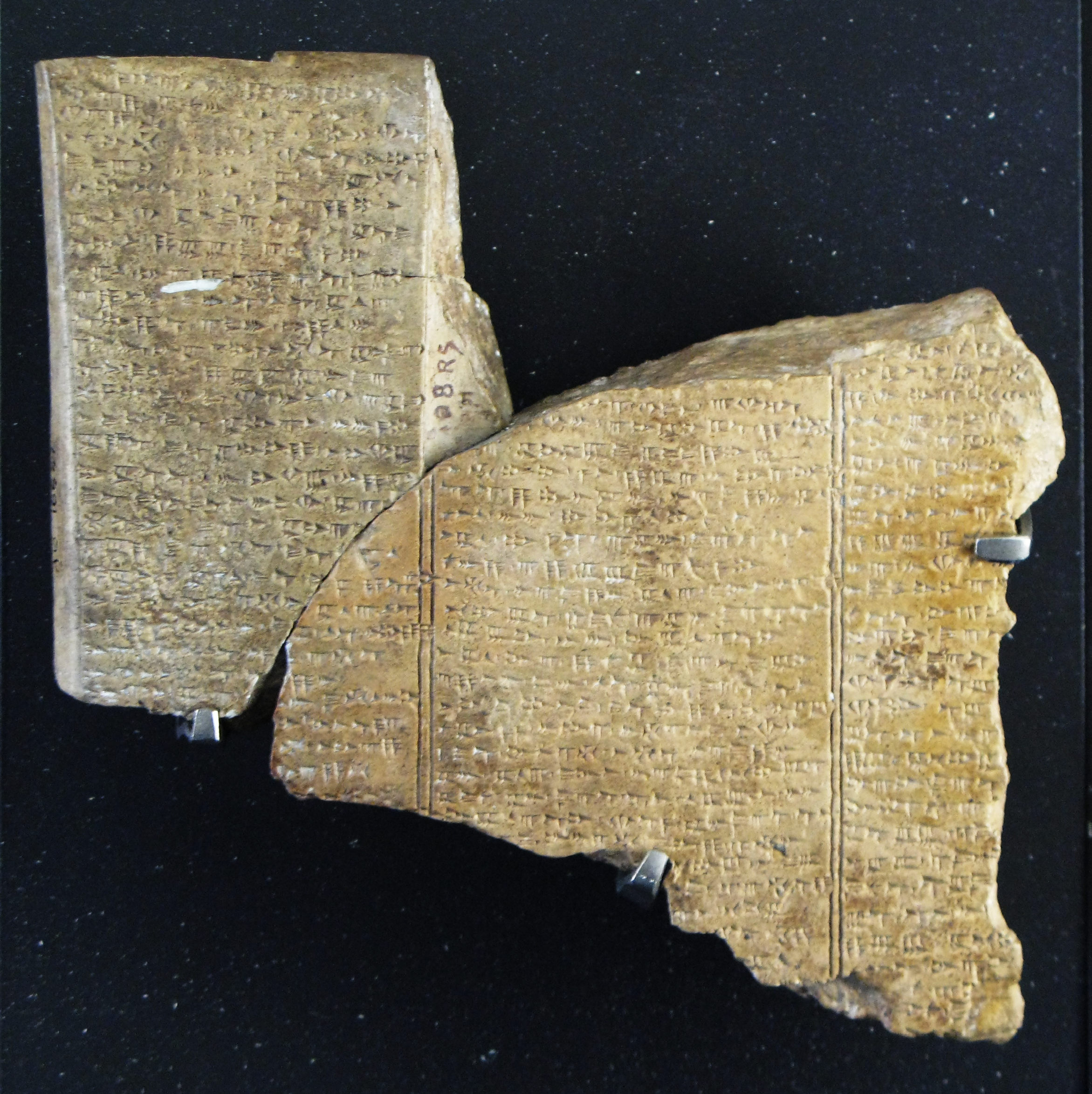
The HittitesHittitesAncient people and kingdom of Anatolia, dominating much of Anatolia and northern Syria around 1650–1200 BCE.Glossary · Click to read the explanation established a large kingdom in Anatolia during the second millennium BCE. They dominated extensive parts of Anatolia and neighbouring northern Syria around 1650–1200 BCE. Scholars identify the Illuyanka text as CTH 321 in the catalogue of Hittite compositions. Its substantial surviving copies belong to the Hittite Empire period, broadly the fourteenth and thirteenth centuries BCE. Gary BeckmanGary BeckmanScholar of the Hittite language, Hittite religion and ancient Near Eastern history, associated with the University of Michigan.Glossary · Click to read the explanation, a specialist in the Hittite language and religion, argues that some linguistic features point to an earlier composition. The surviving copies’ age therefore differs from the proposed age of the story. [8][13][14]
The text opens with the Purulli festival and a wish for the land to flourish and remain safe. This gives both accounts a ritualRitualAn organised or distinguished practice meaningful to a community; it may leave traces, but its form alone does not reveal an associated doctrine.Glossary · Click to read the explanation setting: the tale is associated with a celebration concerned with the country’s prosperity and protection. The performance of every scene at the festival is not preserved in detail. [1][8]
Ugarit’s tablets belong to the Late Bronze AgeLate Bronze AgeAn archaeological period conventionally around 1600–1200 BCE in much of the Near East, with regional variation.Glossary · Click to read the explanation; the city’s documents include texts from around the fourteenth to the early twelfth century BCE. Within its traditions we encounter Baal’s battle with Yam and a brief reference to Lotan, the seven-headed serpent. Some tablets are damaged, and scholars debate the ordering and composition of the Baal poem. A tablet’s date establishes that the text existed by that time; some of its imagery may be older. [3][5][15]
Hesiod was a Greek poet whose TheogonyHesiod’s TheogonyGreek poem on divine generations and Zeus’s kingship; its surviving form does not identify all of Hesiod’s sources.Glossary · Click to read the explanation is generally dated to the late eighth or early seventh century BCE. The poem tells of the gods’ origins and successive generations, culminating in Zeus’s established rule. Many centuries later, Typhon’s battle appears in the Bibliotheca, a Greek mythographic collection traditionally attributed to ApollodorusPseudo-ApollodorusName used for the author of the Bibliotheca, a Greek mythographic collection usually dated to the first or second century CE.Glossary · Click to read the explanation and usually dated to the first or second century CE. This interval matters because the two Greek accounts contain different details. [6][9]
The first Illuyanka account: Inara, Hupasiya and a feast
Illuyanka is a Hittite word meaning “serpent”. In the first account, the serpent defeats the storm god. The goddess InaraInaraGoddess in Hittite traditions who plans the feast enabling the serpent’s defeat in the first Illuyanka account.Glossary · Click to read the explanation intervenes, prepares a large feast and enlists a human named HupasiyaHupasiyaInara’s human helper in the first Hittite Illuyanka account, who binds the serpent after the feast.Glossary · Click to read the explanation. The serpent and its young emerge and eat and drink until they cannot return to their den. Hupasiya then binds the serpent, and the storm god arrives to kill it. Victory follows a plan involving a goddess, a human and the storm god. [1][8]
Hupasiya’s help draws him into a complicated relationship with Inara. He asks to sleep with her before assisting her. She later places him in a house and forbids him to look through the window at his wife and children. He sees them and asks to go home. What follows survives in a damaged passage, leaving his fate unclear. [1][8]
Beckman sees human participation in restoring order, and the consequences of closeness to the gods, as an important aspect of the tale’s meaning. In that interpretation, the story also asks what happens to the human helper after he has contributed to the god’s victory. [8]
The second Illuyanka account: heart, eyes and a son’s death
In the second account, the serpent defeats the storm god and takes his heart and eyes. Editors restore part of the opening description of their loss using later passages that clearly describe their request and return. [1][8]
The god marries a human woman and has a son. When the son grows up, he marries the serpent’s daughter. His father asks him to recover the heart and eyes when he enters his wife’s family home. The son receives the organs and brings them back to his father. The god regains his strength and fights again. [1][8]
This battle ends at a painful cost. The son stands with the serpent and tells his father not to spare him. The storm god kills both the serpent and his own son. Recovery here depends on marriage and entry into the adversary’s household, whereas the first account depends on a feast and binding. [1][8]
Both versions begin with the god’s defeat and end with victory, but the means and consequences differ. Some earlier scholars thought that the second version replaced the first. Beckman disputes this conclusion, connecting it partly with an earlier mistranslation of a word in the text; he reads the two accounts as complementary within their ritual setting. [8]
Hesiod’s Typhoeus: a challenge to Zeus’s rule
The Typhoeus battle in the Theogony follows the defeat of the Titans, the divine generation preceding Zeus’s supremacy. Gaia, Earth in the poem, bears Typhoeus by TartarusTartarusDeep abyss in Greek poetic imagination, named by Zeus as a place of punishment in the Iliad.Glossary · Click to read the explanation, the power associated with the depths of the world. The monster has a hundred serpent heads, varied voices and fire, and threatens to rule humans and gods. Zeus rises with thunder and lightning, burns his adversary’s heads and casts him into Tartarus. [2]
The fight tests the stability of Zeus’s rule after his previous victory. The account centres on the adversary’s power and the thunderbolt that overcomes him. These verses contain no initial defeat of Zeus or theft of parts of his body. Those details appear in another Greek witness. The resemblance between Hesiod and Illuyanka is consequently broader: a powerful god, a serpent-like challenger to his rule and a victory that restores order. [2][6]
Another Greek account: the stolen sinews
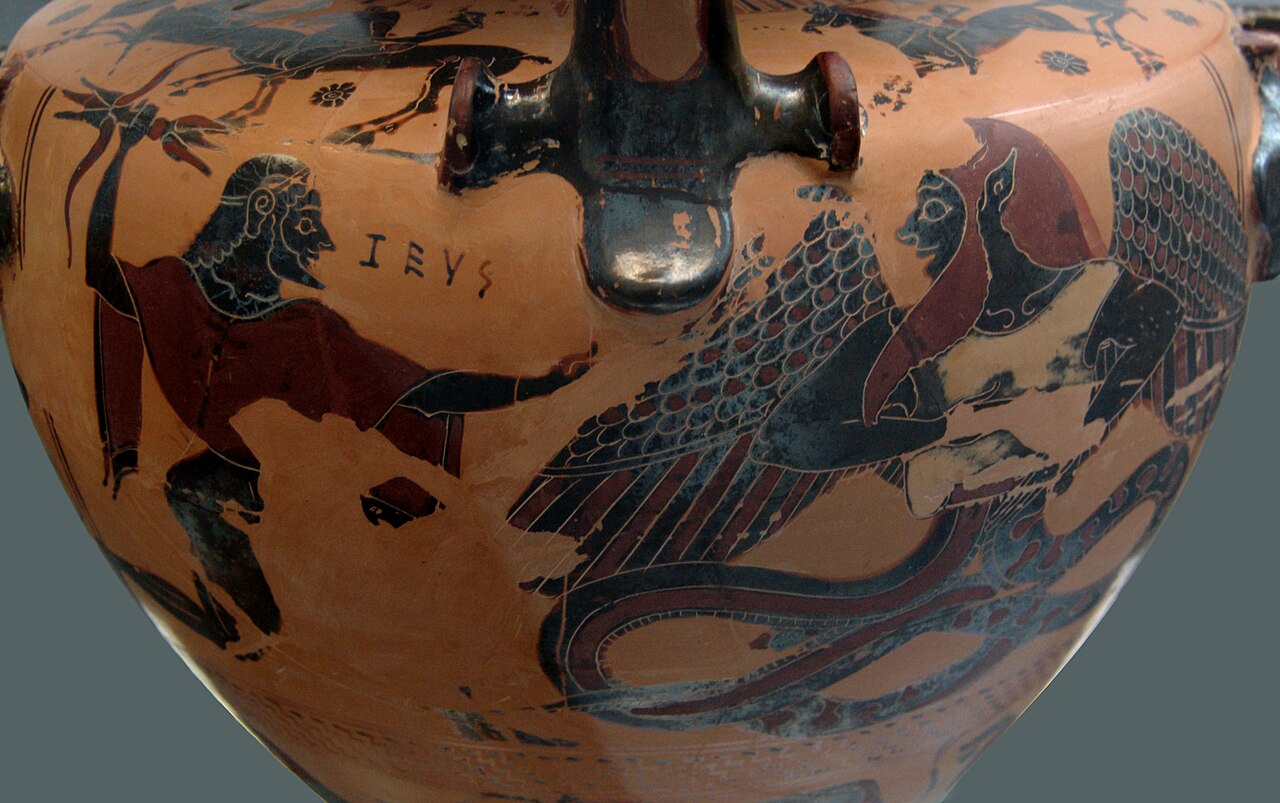
The battle takes a different form in the Bibliotheca. Zeus pursues Typhon to Mount KasiosMount Kasios — Jebel AqraCoastal mountain in the Syrian–Turkish border area, known as Jebel Aqra and by ancient names including Kasios.Glossary · Click to read the explanation in the Syrian region and grapples with him. Typhon removes the sinews from Zeus’s hands and feet and hides them in a cave in CiliciaCiliciaHistorical region on Anatolia’s southern coast in modern Türkiye, with plains and uplands connected to the Levant and Anatolian interior.Glossary · Click to read the explanation, the region on Anatolia’s southern coast. HermesHermesGreek god acting as a messenger in the Odyssey passages examined here.Glossary · Click to read the explanation and Aegipan, two divine helpers in the story, recover the sinews and restore them to Zeus. He regains his strength and continues the pursuit until he wins. [6]
The comparison with the second Illuyanka version is now more specific. In both accounts an adversary disables the storm god by taking part of his body, and others help him recover it. Yet the organs and recovery differ: a son retrieves heart and eyes through marriage in the Hittite story; divine helpers retrieve sinews in the Greek one. [6][8]
The Bibliotheca is a late witness that may preserve material older than its composition. It remains difficult to establish when the sinews episode first arose or entered Greek storytelling. The names Kasios and Cilicia draw attention to a Syrian and Anatolian setting without supplying a chain of narrators who carried the story between languages. [6][10]
Baal, Yam and the reference to Lotan
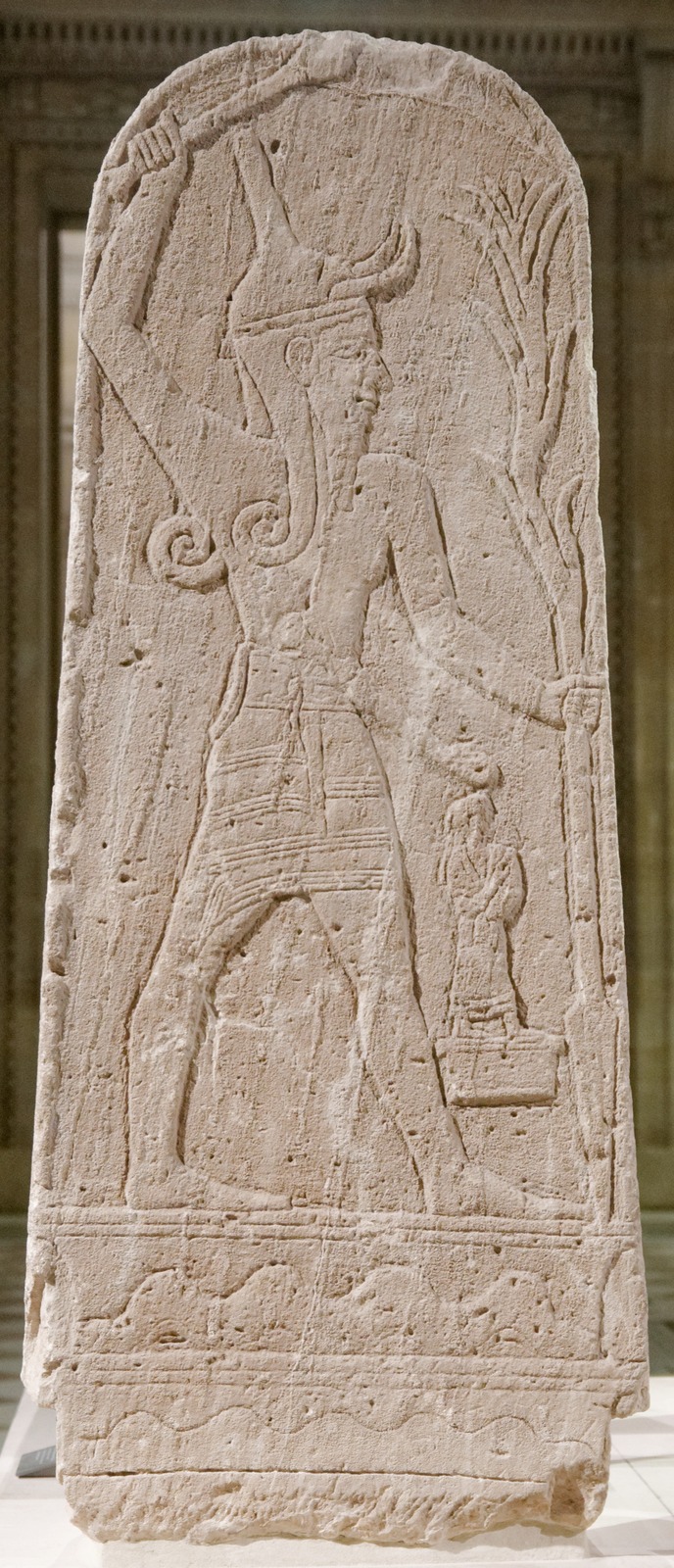
In a Ugaritic poem, Baal faces Yam, the Sea, also called Judge River. Kothar-wa-HasisKothar-wa-HasisCraftsman god in the Baal Cycle, supplying weapons and building the palace.Glossary · Click to read the explanation, the craftsman deity in this tradition, makes and names two weapons. Baal strikes his adversary twice: the first blow does not fell him, but the second hits his head and he collapses. The victory is connected with Baal’s royal status among the gods. The scene survives in the tablet scholars designate KTUKTU: Ugaritic Text ReferencesAbbreviation for a modern scholarly corpus of alphabetic cuneiform texts; its numbers are references, not dates.Glossary · Click to read the explanation 1.2, column iv. [3][4]
Elsewhere in the Baal CycleBaal CycleA group of Late Bronze Age Ugaritic religious texts recounting Baal’s conflicts, relationships with the gods and the building of his palace.Glossary · Click to read the explanation, MotMotGod of death in the Baal Cycle; an adversary who returns even after a violent attack.Glossary · Click to read the explanation, the deity associated with death, addresses Baal and recalls his earlier battle with Lotan: the fleeing or twisting serpent with seven heads. This is a short passage in KTU 1.5, column i, lines 1–4. It alludes to a victory familiar to its audience, without narrating successive stages of combat as the Illuyanka versions do. [5]
Images of Yam and Lotan may overlap within Ugaritic tradition, but the two passages provide different witnesses: a detailed confrontation with the sea deity and an allusion to a serpent battle. Their identification as one figure or one combat remains a question requiring its own interpretation. [3][5]
Where is the resemblance strongest?
The comparison can be followed at two levels. The first is a broad image: a storm-powered god, an opponent who threatens order and a victory securing rule. This pattern appears in different texts and may belong to a widespread storytelling repertoire. [1][2][3]
The second involves a particular sequence: the god’s defeat, the loss of part of his body, a helper’s intervention and the recovery of strength. This makes the second Illuyanka version closer to the Bibliotheca than to Hesiod’s verses. More shared details make a comparison narrower and more useful for investigating a possible historical relationship. Differences in the body parts, helpers and means of rescue are also part of the evidence. [1][2][6][8]
The battle has a different function in each story. The Hittite ritual frame links it to a festival and the land’s safety and prosperity, with consequential human participation. Hesiod makes the Typhoeus battle a test of Zeus’s supremacy. Baal and Yam contend for kingship within the divine world. These details show how each community used combat imagery to explain something that mattered to it. [2][3][5][8]
Did the story travel from Anatolia to Greece?
Calvert WatkinsCalvert WatkinsScholar of Indo-European languages and ancient poetry (1933–2013), who worked at Harvard and then UCLA.Glossary · Click to read the explanation, a scholar of Indo-European languages and ancient poetry, proposed a historical relationship between Illuyanka and Typhoeus and diffusion from Anatolia to Greece. In the page consulted from his 1992 study, he also acknowledges the difficulty of defining the nature of that relationship. [7]
Ian RutherfordIan RutherfordSpecialist in Greek literature and religion at the University of Reading, studying contacts with Anatolia and Egypt.Glossary · Click to read the explanation, a specialist in Greek literature and its contacts with Anatolia, considers a broader network around the northeastern Mediterranean. It brings together Hittite, Hurrian and Ugaritic traditions, mountains associated with storms and stories of conflict with the sea. Available excerpts of his 2018 study suggest that Typhon’s connection with Illuyanka is less direct than some comparisons of divine succession: the closest Hittite details appear in Greek accounts other than Hesiod’s. His 2020 chapter abstract supports the possibility of regional contact. The material available here permits this broad account of his proposal; the full argument requires more extensive reading. [10][11]
Ola WikanderOla WikanderScholar of ancient Near Eastern texts and the Hebrew Bible at Lund University, studying Ugaritic and shared poetic imagery.Glossary · Click to read the explanation, a scholar of ancient Near Eastern texts and the HebrewHebrewA Northwest Semitic language in the Canaanite group, with ancient and modern forms.Glossary · Click to read the explanation Bible, proposes a longer trajectory for serpent-fighting images and expressions between Indo-European and Northwest Semitic languageSemitic languagesA language family including Akkadian, Ugaritic, Hebrew, Aramaic and Arabic.Glossary · Click to read the explanation areas. He draws on similar epithets and poetic formulas, and sees some of Lotan’s language continuing in Hebrew LeviathanLeviathanA poetic sea being in Hebrew texts, related to Ugaritic ltn; its role varies between combat and creation imagery.Glossary · Click to read the explanation. A reconstruction of an extremely ancient first story remains hypothetical in his presentation. [5]
These approaches share an interest in contact and circulation while differing over their route and the weight of the evidence. The regions were connected, and the Hittite and Ugaritic witnesses precede the Greek poetry compared here. Establishing one particular text as another’s source also requires a more specific link. Possibilities include shared storytelling traditions, the movement of separate images in more than one direction and their local recombination. [7][8][10][11]
What about Lotan and Leviathan?
Isaiah 27:1, a passage in the Hebrew Bible, names Leviathan with two descriptions closely corresponding to the fleeing and twisting serpent in the Ugaritic text. Wikander regards the combination of a related name and distinctive epithets as evidence of shared poetic language in the LevantThe LevantThe Levant is a regional name for lands along the eastern MediterraneanGlossary · Click to read the explanation. This is a more specific clue than sea monsters simply occurring in two cultures. [5][12]
On this interpretation, poetic language continued across an area larger than the city of Ugarit. The connection between Lotan and Leviathan does not require a Hebrew writer to have seen the tablet excavated by modern archaeologists. It is a comparison within Levantine traditions; connecting it with Hesiod or Typhon requires other evidence. [5][12]
What can we conclude?
Clear in the witnesses: the Hittite text preserves two different versions. Hesiod’s Typhoeus battle lacks the sinews episode, whereas the later Bibliotheca recounts it. Ugaritic tablets describe Baal’s confrontation with Yam alongside a brief reference to Lotan. [1][2][3][5][6][8]
A strong comparison: the traditions share images of storms and adversaries threatening order. The resemblance becomes more specific between the second Illuyanka version and the Bibliotheca’s sinews episode, and between the descriptions of Lotan and Leviathan. Shared poetic traditions or influence between some accounts remain serious historical possibilities. [3][5][7][8]
Still debated: the route by which a particular story travelled, the age of the sinews episode before its earliest surviving witness and the relationship between Yam and Lotan in each setting. Present evidence does not establish that Hesiod borrowed the second Hittite version, or that all storm-god battles descend from one story whose place and date we know. [3][5][6][10]
The comparison makes two things visible together: resembling stories in the eastern Mediterranean and communities giving the fight different meanings. The Hittite tale features human help and its cost; Ugarit presents a struggle for kingship; Hesiod tests Zeus’s supremacy. Following these differences helps us understand what may have travelled between cultures and what each tradition reshaped in its own way.
References and notes
- German CTH 321 translation, lines 1–127 and notes 1–39; no independent tablet autopsy. CTH 321, German edited translation, lines 1–127 and editorial notes 1–39 Return to the text ↑
- Theogony 820–869: Greek and historical translation, not the entire poem. Hesiod, Theogony 820–869, Greek and public-domain Evelyn-White 1914 translation Return to the text ↑
- KTU 1.2 iv transcription, only pp. 137–138 of the Ugaritic primer. William M. Schniedewind and Joel H. Hunt, A Primer on Ugaritic, section 6.5, printed pp. 137–138, KTU 1.2 iv 1–39 Return to the text ↑
- Sweeney’s Baal–Yam/Habakkuk comparison; the relevant passage and notes only. Marvin A. Sweeney, Habakkuk’s Mythological Depiction of YHWH, Baal/Yam comparison with KTU 1.2 iv, article lines 217–242 and footnotes Return to the text ↑
- Selected sections of Wikander, including KTU 1.5 I 1–4 and Isaiah comparison. Ola Wikander, From Indo-European Dragon-Slaying to Isaiah 27.1, chapter pp. 116–133, especially printed pp. 117–18, 119–20, 123–32 Return to the text ↑
- Bibliotheca 1.6.3 in a university translation; this excerpt, not the entire work. Pseudo-Apollodorus, Bibliotheca 1.6.3, translation by K. Aldrich adapted by T. Mulder, Zeus Defeats Typhon section Return to the text ↑
- Watkins 1992: p. 319 only; the rest of the article was not read. Calvert Watkins, Le dragon hittite Illuyankas et le géant Typhôeus, CRAI 136.2 (1992), p. 319 only Return to the text ↑
- Beckman’s translation of both variants and selected notes; Hittite copies not collated independently. Gary Beckman, The Anatolian Myth of Illuyanka, JANES 14 (1982), printed pp. 11–25, especially edition and translation §§1–27' (pp. 12–19) and discussion pp. 20, 24–25 Return to the text ↑
- Felton: publisher summary and metadata only, not the full chapter. Debbie Felton, Hesiod, Theogony—Selections, Critical Introduction in Primary Sources on Monsters (2018), Cambridge publisher page Return to the text ↑
- Rutherford 2018: repository metadata and indexed excerpts only; full PDF inaccessible. Ian Rutherford, Kingship in heaven in Anatolia, Syria and Greece: patterns of convergence and divergence, in Wandering Myths (2018), pp. 3–22 Return to the text ↑
- Rutherford 2020: publisher abstract and chapter metadata only. Ian Rutherford, Generations of Gods and the South-East, Hittite Texts and Greek Religion (2020), chapter 7, pp. 144–162 Return to the text ↑
- Isaiah 27:1, complete verse in public-domain KJV; Hebrew phrasing cross-checked in [5]. Isaiah 27:1, public-domain KJV, with Hebrew transliteration in Wikander Return to the text ↑
- The Metropolitan Museum of Art — The Hittites (2002) Kingdom, language and Hattusha; approximate historical context for 1650–1200 BCE. Return to the text ↑
- The Metropolitan Museum of Art — Anatolia and the Caucasus, 2000–1000 B.C. Timeline and historical overview; Hittite Empire around 1380–1200 BCE. Return to the text ↑
- The Metropolitan Museum of Art — Ugarit (2004) The city’s location, documents from the fourteenth to early twelfth century BCE and regional contacts. Return to the text ↑
Research history
Substantive changes are retained here. Minor copy edits remain in the internal operational log.
-
Substantive record update
Suggest a correction · Suggest a source for this record
Cite this record
IL Archive, «Typhon and the storm-god battles: Illuyanka, Baal, and the limits of resemblance», Edition 2, https://ilarchive.com/en/studies/typhon-and-ancient-storm-battles
Continue reading