Study
What Came Before the Anunnaki?
An extended study of a topic, with evidence and references.
From city gods and Fara’s lists to Anunna: what preceded the earliest known collective name, and why the texts reveal neither one beginning nor a fixed family.
Share article
Dates
Dates have distinct roles. The timeline uses creation, composition or historical coverage, rather than publication or discovery dates.
- Historical coverage
- Approximately From 3200 BCE to 1600 BCE
Text
Before AnunnakiAnunna / AnunnakiCollective designation for gods in Mesopotamian texts, with variable scope and membership; earliest known attestations belong to the late third millennium BCE.Glossary · Click to read the explanation became a familiar name in popular culture, MesopotamiaMesopotamiaA historical region associated with the Tigris and Euphrates, home to many societies and civilisations.Glossary · Click to read the explanation’s gods already had a long history in cities, temples and texts. An, EnlilEnlilProminent Mesopotamian god associated with Nippur and Ekur, highly ranked in Early Dynastic texts before the earliest known Anunna attestation.Glossary · Click to read the explanation, EnkiEnkiMesopotamian deity associated with deep fresh water, wisdom and Eridu, known as Ea in Akkadian tradition. The earliest preserved written mention does not date his cult’s origin or identify Ubaid Eridu’s deity.Glossary · Click to read the explanation and InannaInanna / IshtarProminent Mesopotamian goddess with a major centre at Uruk, whose parentage and cult traditions vary rather than forming one fixed genealogy.Glossary · Click to read the explanation did not emerge from a primordial group first named Anunna. In the surviving evidence, that collective designation belongs to a divine world documented centuries earlier.[1]
One distinction matters throughout: we can date the earliest surviving attestation we know, but that alone cannot date the first spoken use of a name or the first conception of a group. What do texts preceding the earliest known Anunna attestations actually show?
Cities and their gods
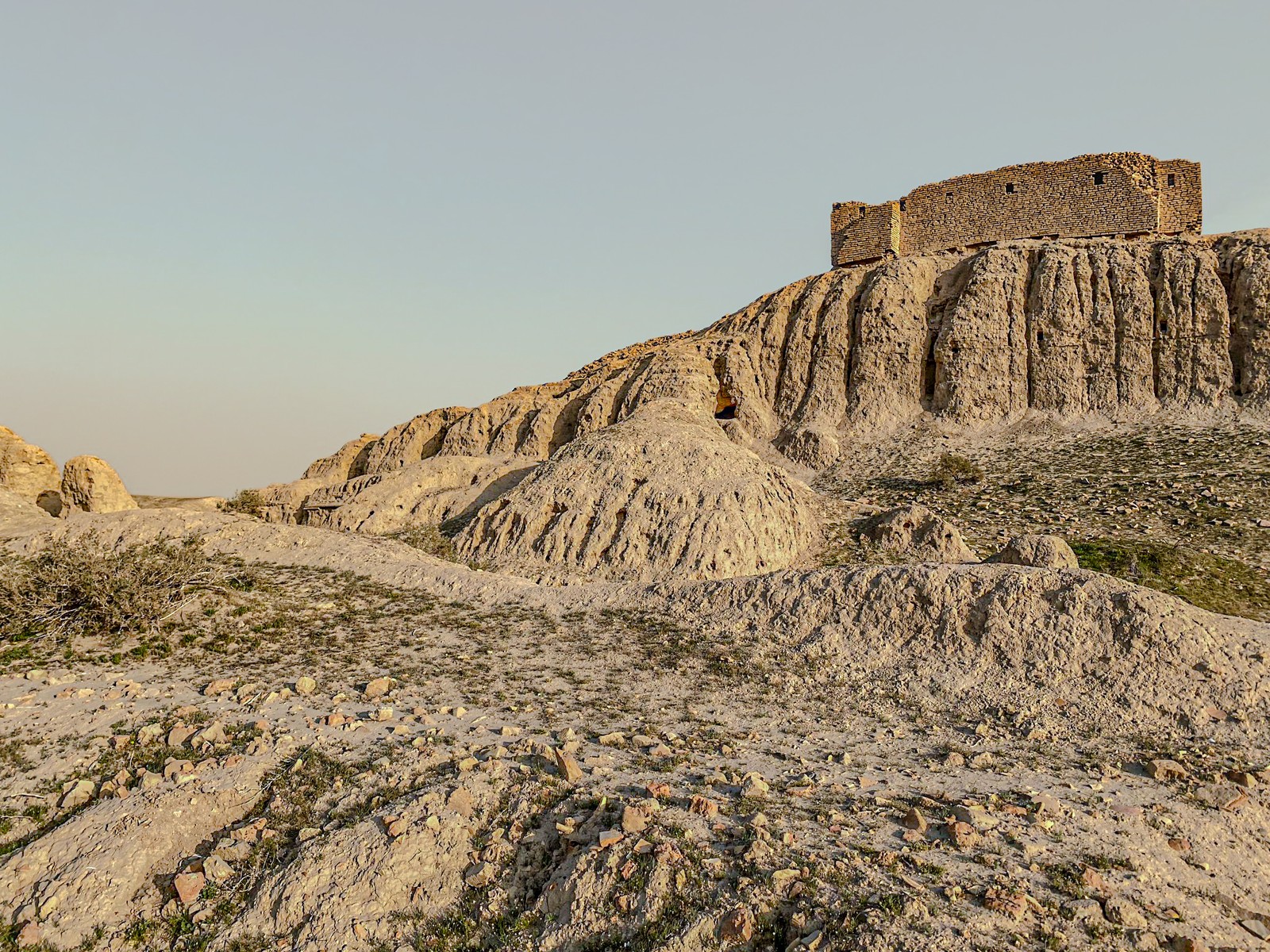
The divine world was not an identical shared inventory for every inhabitant. It had local centres: EnkiEnkiMesopotamian deity associated with deep fresh water, wisdom and Eridu, known as Ea in Akkadian tradition. The earliest preserved written mention does not date his cult’s origin or identify Ubaid Eridu’s deity.Glossary · Click to read the explanation at EriduEriduAbu Shahrain in southern Iraq, with a long architectural sequence beginning before writing. Associated with Enki in historical times, which does not establish the sacred being’s identity in its earliest layers.Glossary · Click to read the explanation, EnlilEnlilProminent Mesopotamian god associated with Nippur and Ekur, highly ranked in Early Dynastic texts before the earliest known Anunna attestation.Glossary · Click to read the explanation at NippurNippur / NuffarMesopotamian city and major Enlil cult centre, connected with kings’ legitimacy beyond the city.Glossary · Click to read the explanation, InannaInanna / IshtarProminent Mesopotamian goddess with a major centre at Uruk, whose parentage and cult traditions vary rather than forming one fixed genealogy.Glossary · Click to read the explanation at UrukUrukAncient city at Warka in southern Iraq, a major urban centre around 3200 BCE that preserved early writing and accounting tablets.Glossary · Click to read the explanation, NannaNanna / Su’en / SinMoon god associated with Ur, with early name evidence that does not date every later myth.Glossary · Click to read the explanation/Suen at Ur, and Utu/ShamashShamashMesopotamian god of the sun and justice, shown before Hammurabi on an eighteenth-century BCE stele preserved in the Louvre.Glossary · Click to read the explanation at Larsa and Sippar. Lagash had prominent traditions of Ningirsu, Nanshe and other deities.[2][3][4][5]
A city association meant a relationship with identity, worship and institutions, rather than exclusive possession. Inanna could be closely associated with Uruk and worshipped elsewhere; Nanna also had cults outside Ur. We should imagine connected centres whose gods’ importance varied by place and period.
Temples, offerings, personnel and resources devoted to worship made these relationships more than names in stories. A deity participated in a city’s organization, while the city helped define the deity’s standing.
Writing does not reveal an entire religion at once
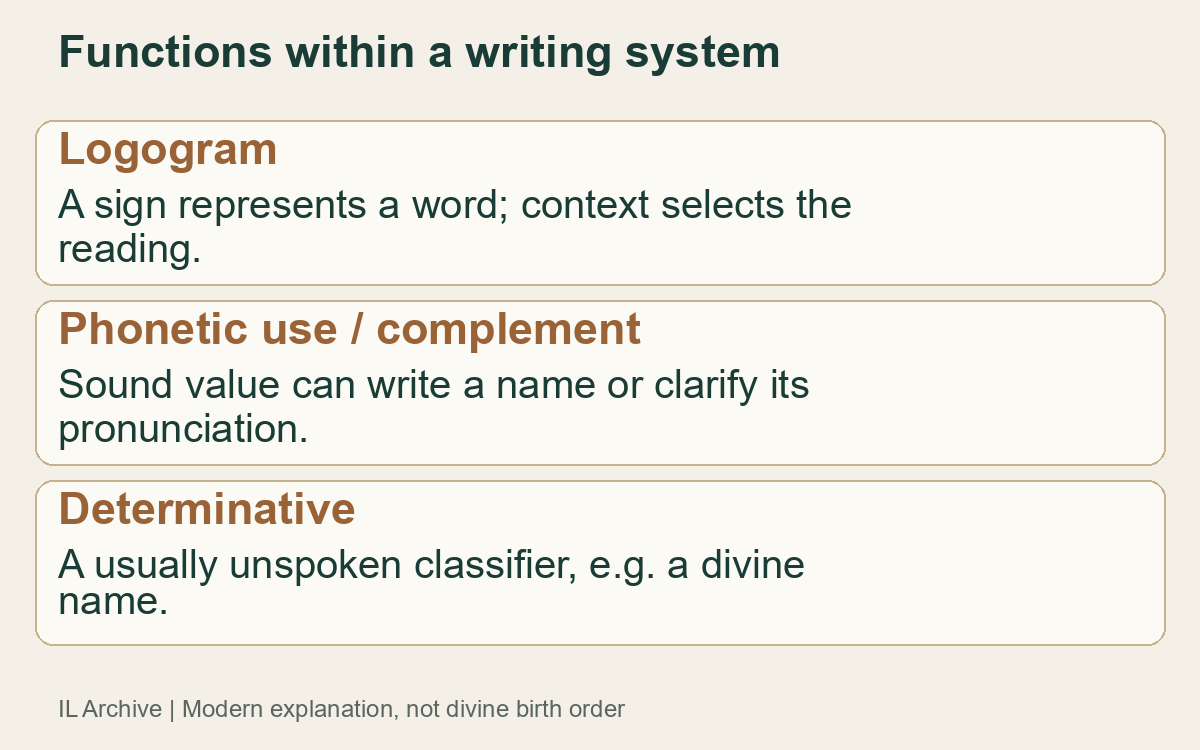
Early writing appeared at Uruk in the late fourth millennium BCE, but most surviving documents are administrative. Identifying names in them is less straightforward than in later texts. An occurrence of the sign later used to write An or mark divinity does not automatically establish a securely identified god.
Enlil provides a cautionary example: the earliest writings associated with his name and their relationship to Nippur’s name remain contested. A proposed transition from place-name to divine name does not date the “invention of Enlil.” Specialist references, meanwhile, report Nanna in personal names from the Late Uruk period.[2][4]
The partial silence of early tablets does not establish an absence of gods. The documents’ purposes, their script and the limits of modern reading keep them from being a complete account of belief.
Fara and Abu Salabikh: collecting divine names
By the middle of the third millennium, another kind of evidence appears: texts devoted to assembling divine names. Famous god listsGod listsTexts collecting divine names for preservation, teaching and classification, with varying theological organization.Glossary · Click to read the explanation come from Fara, ancient Shuruppak, and Tell Abu Salabikh. They are generally dated to Early Dynastic IIIa, approximately 2600–2500 BCE.[6][7]
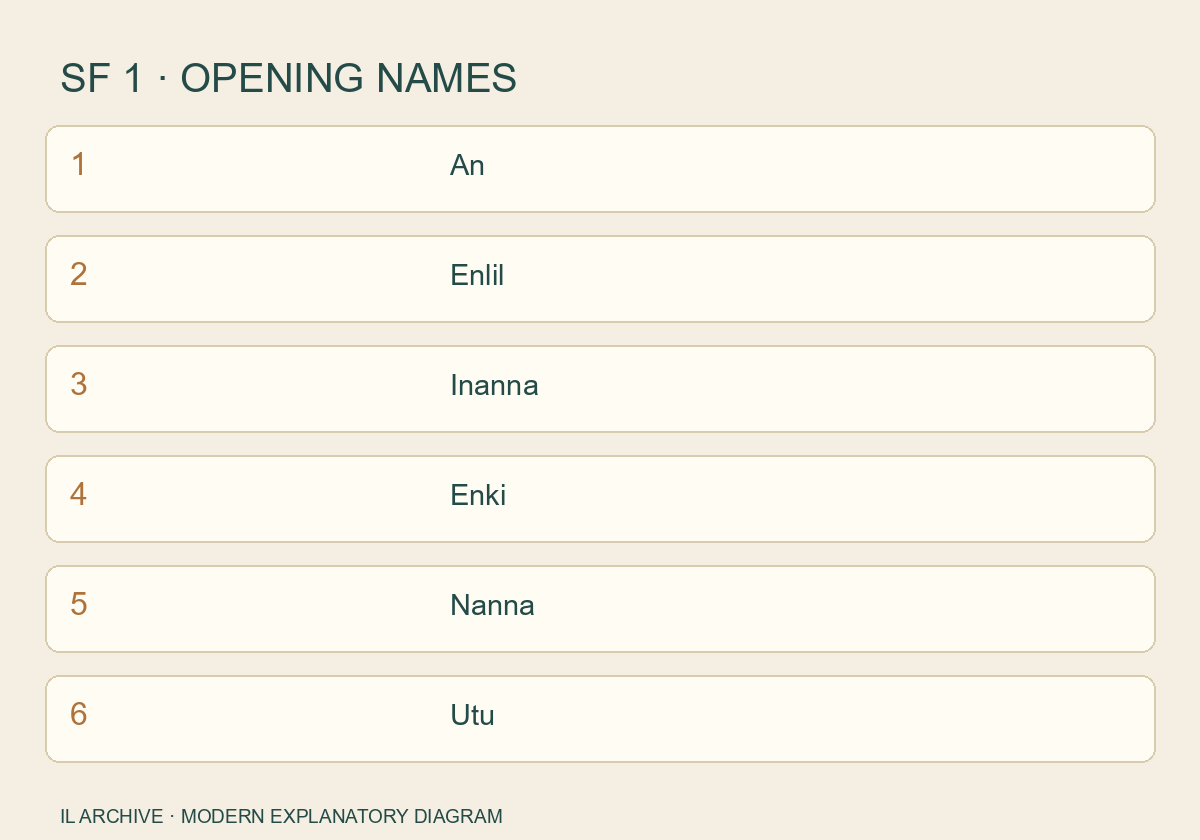
SF 1, held in Berlin as VAT 12760+, offers a specific example. CDLI’s current digital text reads its opening as An, Enlil, Inanna, Enki, Nanna and Utu. This is the sequence of a particular witness, not a universal constitution establishing precedence everywhere. Some earlier scholarship expressed uncertainty about the first position.[6][8]
The Abu Salabikh record cited here is a composite assembled from multiple witnesses, rather than a single physical tablet preserving an entire list. Such distinctions matter when comparing surviving material with scholarly reconstruction.[7]
More than five hundred names: what does that mean?
Richard Litke estimated that the Fara lists probably contained more than five hundred divine names. That is a scholarly estimate for ancient, fragmentary material. It is neither an exact count of independent beings nor the membership of Anunna, and certainly not a register of each Sumerian individual’s beliefs.[8]
Names might include small local deities, titles, manifestations and figures about whom we know very little. Some may have mattered greatly in a locality whose archive has not survived. Modern fame need not reflect importance to everyone who worshipped a deity.
A list is also a scribal document. Collecting names, preserving their spellings and teaching them could be purposes in their own right, alongside their religious significance.
Written order and theological order
Recent scholarship distinguishes early lists’ limited theological organization from later compilations such as An = Anum. Major deities occur near the beginning and some associated groups appear together, but other names cluster because their written forms share an initial sign, such as NIN.[9]
Hundreds of names together establish the ability to assemble religious knowledge beyond one city. They do not, by themselves, expose a complete genealogy or a council with defined membership. Scribes preserved traditions while making comparison and rearrangement possible.
Oral myths need not have awaited the invention of lists. Relationships among gods could precede their earliest surviving description. Practice, storytelling and scribal teaching overlapped; a list did not simply create a religion.
Local traditions were connected
The Zame Hymns from Abu Salabikh provide evidence of a wider horizon. They connect gods with cult places and accord Enlil a high position within a vision encompassing multiple centres. Their modern editors note extensive overlap with the Fara and Abu Salabikh god lists.[10]
Local traditions therefore did not imply complete religious isolation. Trade, alliances, conflict and the movement of people and scribes provided routes for names, practices and stories. These are general historical mechanisms, however, not a demonstrated single cause for every surviving divine relationship.
Family as a way to connect differences
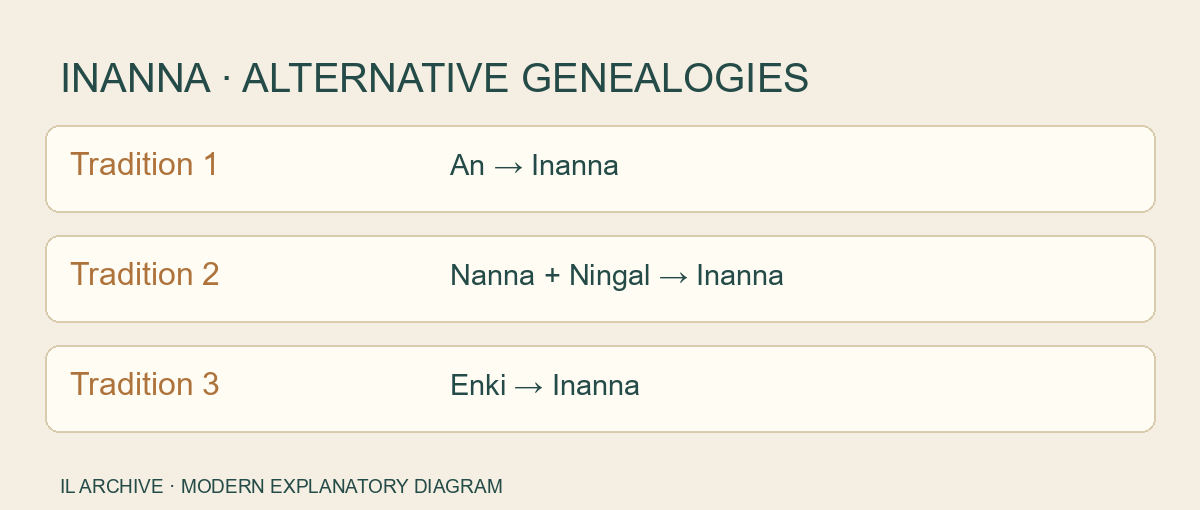
Divine kinship could connect traditions through parents, children, spouses, siblings and courts. It did not yield one immutable family tree. In different traditions Inanna is the daughter of An, of Nanna and Ningal, or of Enki.[3]
In the story of Enlil and Sud, Sud becomes NinlilNinlilGoddess later associated with Enlil and Nippur; early writings require distinguishing sign labels from place context.Glossary · Click to read the explanation. One scholarly interpretation sees an explanation for incorporating Shuruppak’s tradition into Nippur’s religious world. This is a theological reading of a myth, rather than a document dating a particular political event.[2]
Variant genealogies are valuable historical evidence: they show how relationships could be reformulated by different traditions, rather than mere mistakes in a fixed divine family register.
List, family and council
Three related concepts need distinguishing. A list collects names; a family connects them through descent and marriage; a divine councilDivine councilA representation of divine beings acting as an assembly with authority and differentiated roles.Glossary · Click to read the explanation imagines gods acting collectively to make decisions or determine destinies.
A list need not describe a meeting. A genealogy need not identify council membership. Nor does the evidence require these ideas to have arisen successively. They could overlap, and different kinds of documents preserve them.
Some texts describe divine authority, rank, messengers and service in language resembling human institutions. That resemblance does not prove that a particular political assembly was transferred literally into heaven.
Where does Anunna enter the picture?
SF 1 does not open with Anunna as the heading for the gods it names. Its major deities are documented centuries before the known attestations of the collective term.[6]
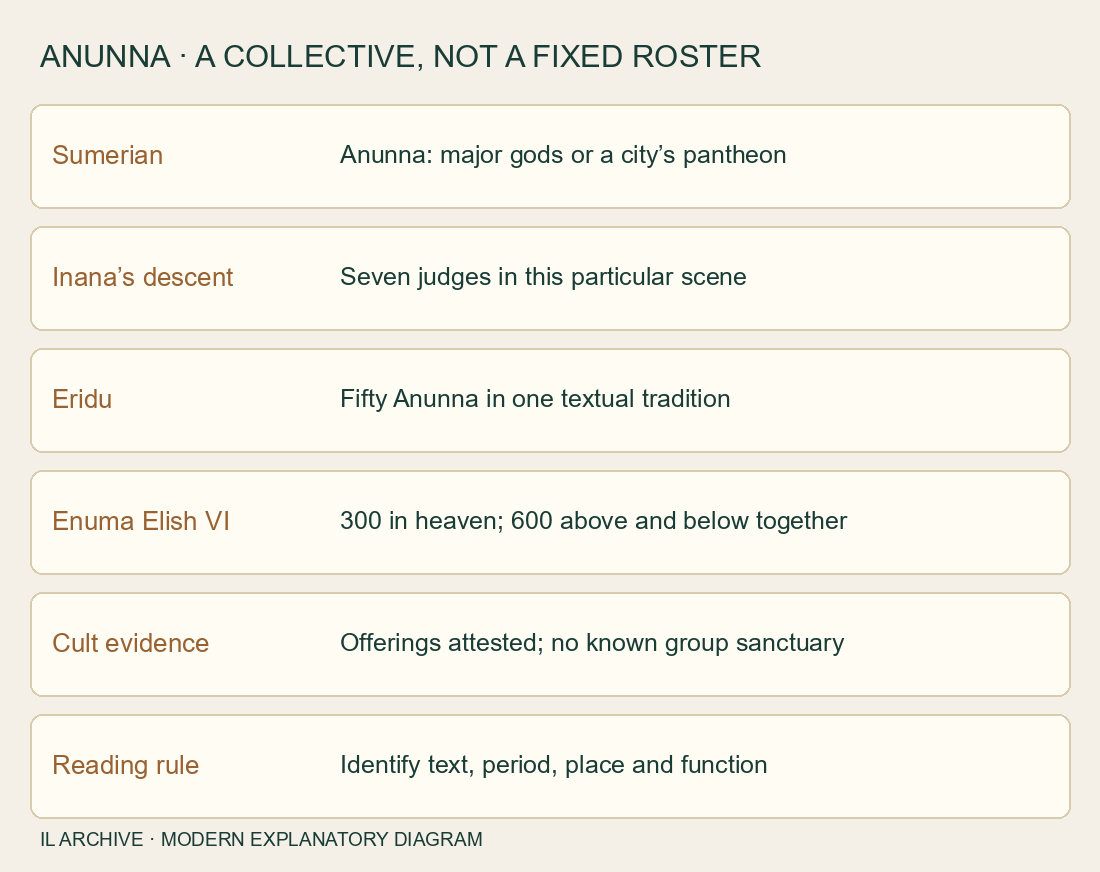
According to ORACC, AnunnaAnunna / AnunnakiCollective designation for gods in Mesopotamian texts, with variable scope and membership; earliest known attestations belong to the late third millennium BCE.Glossary · Click to read the explanation is clearly attested in the period after the Akkad dynasty, including inscriptions of GudeaGudeaRuler of Lagash in the late third millennium BCE, whose inscriptions document temple construction and the name Anunna.Glossary · Click to read the explanation and some Ur III documents, in the late third millennium BCE. This dates known evidence, rather than proving when someone first spoke the word.[1]
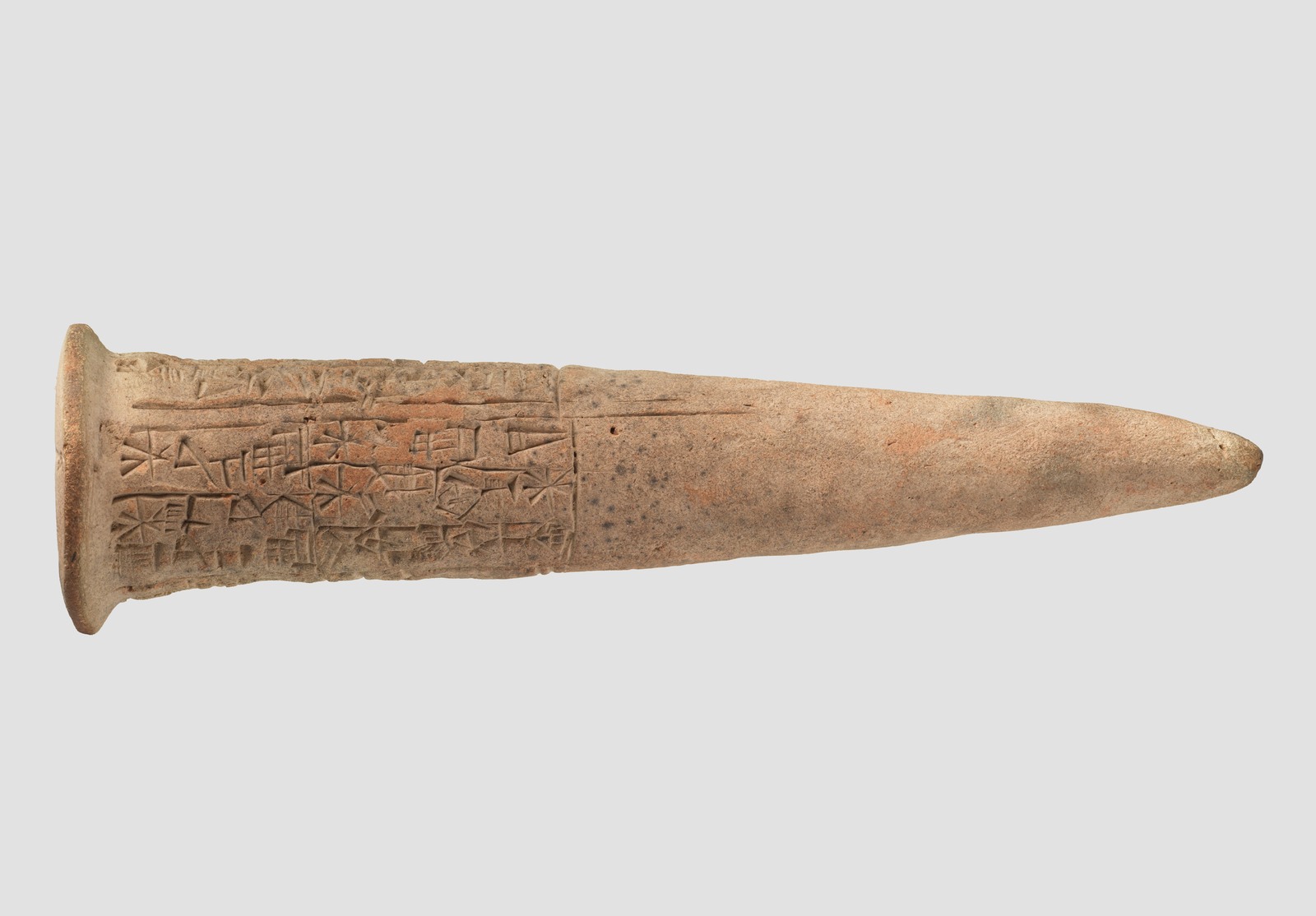
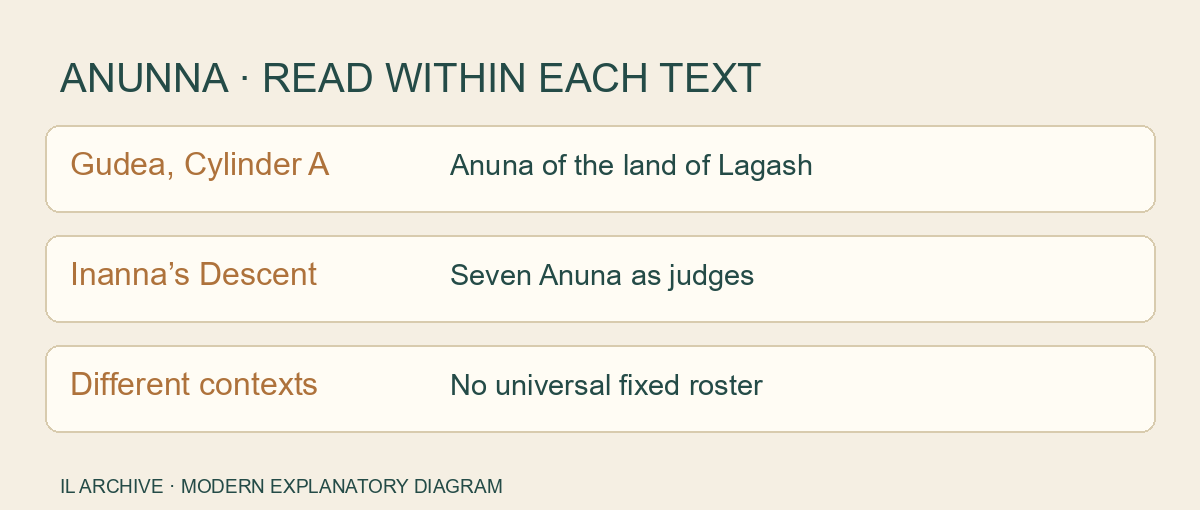
Gudea’s cylinders describing Ningirsu’s temple provide a direct example: the Anuna gods of the land of Lagash stand with the ruler in prayer during construction. The collective belongs to a local scene whose deity, temple, ruler and ritualsRitualAn organised or distinguished practice meaningful to a community; it may leave traces, but its form alone does not reveal an associated doctrine.Glossary · Click to read the explanation already exist.[11]
A name without one membership list
Anunna is Sumerian; Anunnaku and Anunnaki are related AkkadianAkkadianAn ancient East Semitic language written in cuneiform in Mesopotamia.Glossary · Click to read the explanation forms. The etymology is debated, with “those of princely seed” among the proposed translations. “Those who came from heaven to earth” is not the meaning adopted by the specialist reference.[1]
Texts do not invariably designate the same number or membership. The Lagash example shows that the term can identify gods in a local context, rather than a closed universal roster.[11]
The specialist entry identifies neither an independent sanctuary dedicated to the whole collective nor a securely known ancient image depicting them together. A relief containing several gods, or a winged figure from another period, should therefore not be labelled “the Anunnaki” without evidence.[1]
Seven judges in a text, not seven permanent members
In Inanna’s Descent to the Netherworld, seven Anuna act as judges and pass judgment against her. This identifies a group’s role in one composition, not a permanent membership count for all Mesopotamian literature.[12]
The name’s associations with the underworld vary across traditions. IgigiIgigiCollective divine name in Akkadian sources, attested from the Old Babylonian period; its relationship to Anunnaki varies by text.Glossary · Click to read the explanation are particularly attested in Akkadian sources from the Old Babylonian period. One rigid equation—Anunnaki below, Igigi above—cannot summarize every period.[13]
At the opening of AtrahasisAtrahasis: Epic and HeroAkkadian epic: humans created for divine labor, multiplication, noise and flood. Atrahasis, “exceedingly wise,” survives through Enki’s warning; human reproduction is regulated afterward.Glossary · Click to read the explanation, for example, the distinction concerns rank and labour: great gods impose work on the Igigi, whose revolt leads to the creation of humans to bear the burden. This differs from Inanna’s judges. Both contexts must be read within their compositions and the dates of their witnesses.[13]
What came before the Anunnaki?
Cities, gods, temples and connected traditions already existed. By the middle of the third millennium, scribes assembled hundreds of names, with An, Enlil, Inanna, Enki, Nanna and Utu at the beginning of a major witness.[6][8]
The surviving appearance of Anunna does not restart that world. It gives us a collective expression used within it, whose scope depends on the text. These sources do not describe a people preceding Sumer, or human or extraterrestrial founders of its gods.
We should not replace one origin story with another rigid progression: isolated gods, then lists, then families, councils and finally Anunna. Some relationships coexisted; some circulated orally before being written; others changed. We can order attestations more securely than first conceptions.
What can we say securely?
The Fara and Abu Salabikh lists precede the earliest known Anunna attestations. Their numerous names are not Anunna membership lists. Genealogies, ranks and collective designations vary among traditions. Belief before the earliest surviving document cannot be recovered in full from that document alone.
The question thus reveals a history wider than one name: cities with their gods, scribes collecting divine names, and traditions linking them through changing relationships. We see a shared divine world being shaped and interpreted, without knowing a day on which all heavens united or a single name that began it all.
References and notes
- Nicole Brisch. Anunna / Anunnaku (a group of gods). Ancient Mesopotamian Gods and Goddesses, ORACC (updated entry 2024). Indexed passages: Functions, Cult Places, Time Periods, Iconography and Name. Direct access failed; full direct page inspection is not claimed. Return to the text ↑
- Adam Stone. Enlil/Ellil (god). Ancient Mesopotamian Gods and Goddesses, ORACC (2019; updated entry 2024). Indexed genealogy/Sud, cult places and attestation passages. Relationship between deity and place names remains contested. Return to the text ↑
- Yağmur Heffron (2019). Inana/Ištar (goddess). Ancient Mesopotamian Gods and Goddesses, ORACC. Indexed genealogy and cult passages; alternative parentage belongs to different traditions. Return to the text ↑
- Adam Stone. Nanna/Suen/Sin (god). Ancient Mesopotamian Gods and Goddesses, ORACC. Indexed Cult Places and Time Periods: Ur and other centres; personal names from Late Uruk. Return to the text ↑
- Ruth Horry. Utu/Šamaš (god). Ancient Mesopotamian Gods and Goddesses, ORACC (updated entry). Indexed passage on principal cult centres at Larsa and Sippar. Return to the text ↑
- Cuneiform Digital Library Initiative. SF 001 (P010566), VAT 12760+, Shuruppak/Fara. Tablet metadata and opening transliteration, obverse column i, lines 1–6. Early Dynastic IIIa, ca. 2600–2500 BCE. Entire list not read. Return to the text ↑
- Cuneiform Digital Library Initiative. CDLI Lexical 000036 (Abu Salabikh God List) composite, P499260 / Q000036. Composite-text metadata and period; not a record of one physical tablet. Return to the text ↑
- Richard L. Litke (1998). A Reconstruction of the Assyro-Babylonian God-Lists, TBC 3. Reprint of 1958 dissertation. Introduction, p. 2 and note 9, text and visual inspection. “Over five hundred” is an estimate; older reservations about restoring An at the opening are noted. Current CDLI reading used for the sequence. Return to the text ↑
- W. G. Lambert & Ryan D. Winters (2023). An = Anum and Related Lists: God Lists of Ancient Mesopotamia, Vol. I. Edited by A. R. George & M. Krebernik. Mohr Siebeck. doi:10.1628/978-3-16-161383-8. Preview introduction pp. 3–4, especially §1.2; p. 4 visually inspected. Scribal/pedagogical organization and pockets of theology. Full book not read. Return to the text ↑
- Manfred Krebernik & Jan J. W. Lisman (2020). The Sumerian Zame Hymns from Tell Abū Ṣalābīḫ. Dubsar 12, Zaphon. Publisher description and contents: overlapping divine names, Enlil and cult centres. Complete edition and hymn translations not read. Return to the text ↑
- The Electronic Text Corpus of Sumerian Literature, University of Oxford. The building of Ningirsu’s temple (Gudea cylinders), ETCSL 2.1.7. Translation, Cylinder A lines 353–364: Anuna of the land of Lagash; also 551–561. Direct witness to the name in temple construction. Return to the text ↑
- The Electronic Text Corpus of Sumerian Literature, University of Oxford. Inana’s descent to the nether world, ETCSL 1.4.1. Translation lines 164–172: seven Anuna as judges. The story’s date is not inferred from its underworld setting. Return to the text ↑
- Nicole Brisch (2019). Igigi (a group of gods). Ancient Mesopotamian Gods and Goddesses, ORACC. Indexed entry passages on Atrahasis, attestation and variable group distinctions. Entry summary used; full Atrahasis edition not read. Return to the text ↑
Suggest a correction · Suggest a source for this record
Cite this record
IL Archive, «What Came Before the Anunnaki?», Edition 1, https://ilarchive.com/en/studies/before-anunnaki
Continue reading