Study
Clay, labor, and breath: ancient accounts of human creation
An extended study of a topic, with evidence and references.
- Timeline
- From 1900 BCE to 700 CE
From Enki and Ninmah and Atraḫasīs to Genesis and the Qur’an: earth, breath, divine labor, and the limits of borrowing claims.
Share article
Text
The question sounds simple: why do ancient accounts say that humans were made from earthly matter? Yet the word “clay” can bundle together texts that tell different stories. In the Sumerian Enki and NinmahEnki and NinmahA Sumerian composition preserved in Old Babylonian copies: human creation relieves divine labor, followed by scenes about bodies and fates.Glossary · Click to read the explanation, material from the top of the AbzuAbzuDeep fresh waters in historical Mesopotamian conceptions, associated with Enki/Ea. The name occurs in E-abzu, “House of the Abzu”. It cannot automatically identify an Ubaid platform or a water basin.Glossary · Click to read the explanation is kneaded so that humans can replace gods worn down by work. In the AkkadianAkkadianAn ancient East Semitic language written in cuneiform in Mesopotamia.Glossary · Click to read the explanation AtraḫasisAtrahasis: Epic and HeroAkkadian epic: humans created for divine labor, multiplication, noise and flood. Atrahasis, “exceedingly wise,” survives through Enki’s warning; human reproduction is regulated afterward.Glossary · Click to read the explanation, clay is mixed with the flesh and blood of a slain god for much the same purpose. Genesis, however, depicts a human formed by YHWHYahwehThe divine proper name written YHWH in the Hebrew Bible.Glossary · Click to read the explanation God from dust of the ground and given the breath of life, without a divine killing or a revolt of laboring gods. The Qur’an mentions clay and a divine breathing in several passages, but their language and purposes do not constitute an Atraḫasis recipe. [1][2][5][7]
This study compares material, animation, and the reason for creating humanity, then asks what historical relationships the evidence permits. Resemblance between stories is an observable textual fact. A claim that an author took a whole account from a particular tablet requires additional evidence for the path of transmission.
First: the gods’ work in the Sumerian text
Enki and Ninmah opens with a surprising scene for anyone who imagines the gods always at leisure. Senior gods oversee work; junior gods dig canals, pile up silt, and crush clay. The workers complain. NammaNammaA goddess who asks Enki to relieve the gods’ labor in Enki and Ninmah.Glossary · Click to read the explanation wakes her son EnkiEnkiMesopotamian deity associated with deep fresh water, wisdom and Eridu, known as Ea in Akkadian tradition. The earliest preserved written mention does not date his cult’s origin or identify Ubaid Eridu’s deity.Glossary · Click to read the explanation and asks him to provide a substitute who will lift their burden. He answers with a plan: clay from the upper part of the Abzu is to be kneaded; birth goddesses participate in shaping the human form, NinmahNinmahA major goddess involved in human making and in assigning fates to fashioned bodies in the Sumerian composition.Glossary · Click to read the explanation assists, and basket-carrying is assigned to the new creature. [1]
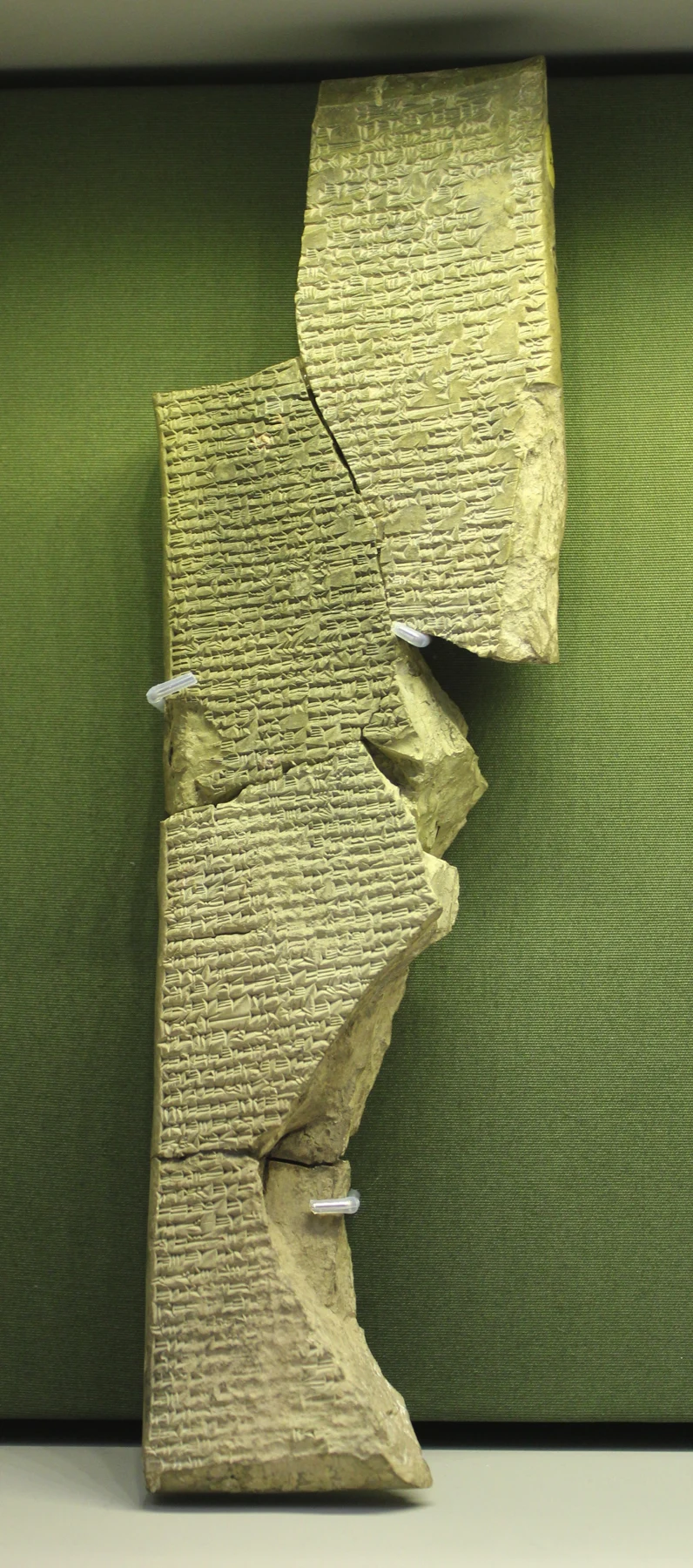
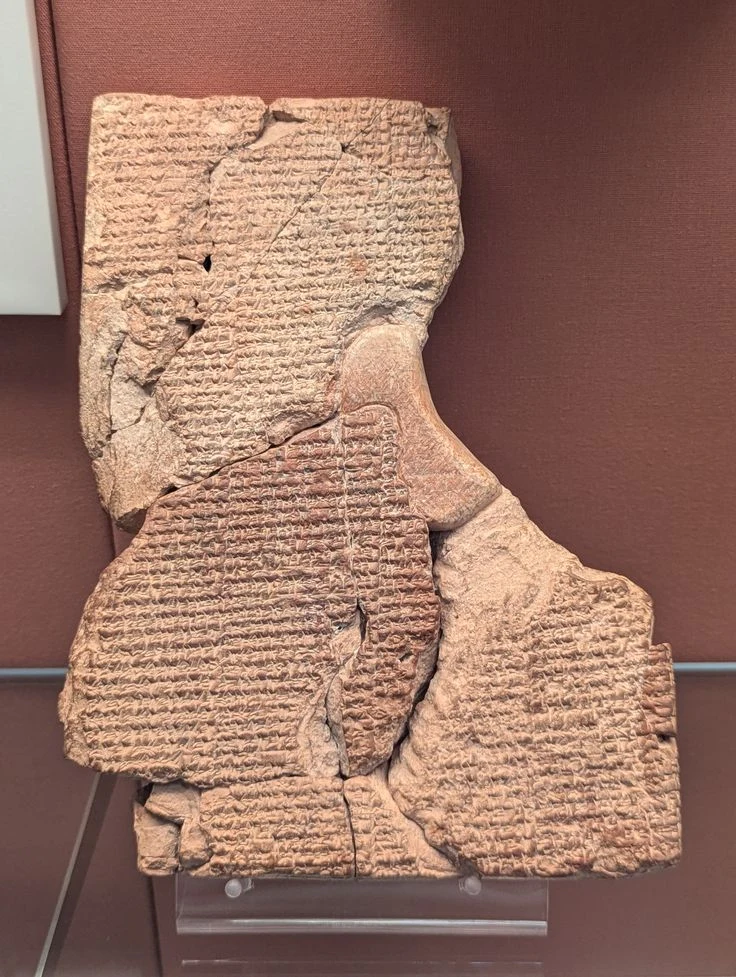
Clay is more than decoration here. The substanceOusia — essenceGreek term for essence or nature, with meanings changing between authors.Glossary · Click to read the explanation of making belongs to the working landscape with which the story began: canals, wet soil, and baskets. The account thus links the forming of a body to the social role assigned to humanity within its world. Old Babylonian copies preserve the composition. One witness is CBS2168 from NippurNippur / NuffarMesopotamian city and major Enlil cult centre, connected with kings’ legitimacy beyond the city.Glossary · Click to read the explanation; another tablet in the Louvre is dated approximately 1800–1700 BCE. A surviving copy's date is not automatically the date when the story was first composed. The cover photograph instead shows a different witness to Atraḫasīs, associated with its flood section; it does not show the creation passage examined here. [1][13][15][16]
The narrative then turns to a feast and a contest between Enki and Ninmah over fashioned bodies and the fates assigned to them. This section serves a different purpose from the initial solution to divine labor; it is damaged in places and has variant manuscript readings. It would be unsound to derive a fixed classification of people with disabilities from a broken translated phrase, or to compress every part of the composition into the making of one individual. [1]
Second: Atraḫasis tells the making differently
At the opening of Atraḫasis Tablet I, the IgigiIgigiCollective divine name in Akkadian sources, attested from the Old Babylonian period; its relationship to Anunnaki varies by text.Glossary · Click to read the explanation carry heavy work and dig waterways. Their distress leads them to burn their tools and baskets and gather at EnlilEnlilProminent Mesopotamian god associated with Nippur and Ekur, highly ranked in Early Dynastic texts before the earliest known Anunna attestation.Glossary · Click to read the explanation’s residence. When the senior gods meet, their solution is not to eliminate the need for canals but to make humans carry the burden. Ea/Enki proposes the participation of Mami, the birth goddess; she asks that clay be prepared for her. [2]
But this narrative adds an element absent from the preserved making scene of Enki and Ninmah: a god is killed, and his flesh and blood are mixed with the clay. The university edition reads his name as Wē and records witnesses with the variant Alla. The lines also speak of a “spirit” or trace through which the slain god is remembered, though their wording varies among manuscripts. Mami subsequently announces that she has removed hard toil from the gods and laid it on humanity. The story continues with divided portions of clay, birth goddesses, and the emergence of males and females. [2]
These details guard against inventing one composite “Mesopotamian version.” The Sumerian account names Abzu clay and the cooperation of Enki, Namma, and Ninmah, but does not mention the blood of a slain god in its extant creation scene. Atraḫasis does include flesh, blood, and clay, so reducing it to “Enki fashioned humans from clay” removes a central element. Even within Atraḫasis, the consulted edition combines tablets and fragments; it is not a complete, unbroken copy from a single scribe. [1][2]
At the end of Tablet I, a colophon names the copyist Ipiq-Aya and a year under King Ammī-ṣaduqa. This helps date a written witness from the Old Babylonian period. It does not establish the year in which an oral story or its earliest literary form first arose. [2]
A third account: Qingu’s blood in Enūma Eliš
In Tablet VI of Enūma ElišEnuma ElishBabylonian Akkadian composition celebrating Marduk’s elevation and cosmic/divine ordering. Human creation is in VI, Nibiru in VII; a Tablet I reference cannot document those passages.Glossary · Click to read the explanation, MardukMardukBabylon’s god, elevated with the city’s history. Enuma Elish celebrates his rise and cosmic ordering; sources associate him with Nibiru and Jupiter. Earliest origins and functions remain uncertain.Glossary · Click to read the explanation plans the creation of people for the service of the gods, and Ea carries it out using QinguQinguTiamat’s commander, whose blood forms humanity in Enuma Elish.Glossary · Click to read the explanation’s blood after Qingu is condemned in the divine conflict. A god's blood and divine service overlap with Atraḫasis, but this is not Mami’s scene retold with the same cast. In particular, the clay of Atraḫasis should not be inserted into an explanation of Tablet VI as though the relevant lines explicitly named both ingredients. [3]
Before reaching Genesis, then, we have three Mesopotamian scenes whose functions overlap in part, while their agents, substances, and sequences differ. Saying “the Babylonian myth says…” in the singular conceals that diversity.
Genesis: dust of the ground and the breath of life
Genesis 2:5–7 first describes conditions without a human to cultivate the ground. YHWH God then forms the human from dust of the ground, breathes the breath of life into the nostrils, and the human becomes a living being. The HebrewHebrewA Northwest Semitic language in the Canaanite group, with ancient and modern forms.Glossary · Click to read the explanation has *ʿāpār*, “dust,” alongside *ʾădāmāh*, “ground/soil”; it does not use the direct noun for potter’s clay in verse 7. A potter image may help interpret the forming verb and moist setting, but it remains an interpretation of the imagery, not a claim that the verse itself says “clay.” [5][11]
Here the difference matters. In Atraḫasis the flesh and blood of a killed god are part of the making; Genesis has no such episode. Life comes to the formed human through God's breath, not through the mixing of matter from a slain deity. Ed Noort notes a broad Near Eastern pattern in which an earth-made figure receives what makes it alive, while emphasizing that the second step and the meaning of divine material differ among accounts. That comparative observation cannot by itself demonstrate that Genesis reproduced a line from Atraḫasis. [2][5][11]
The two creation passages within Genesis must also be kept distinct. Genesis 1:26–28 presents humanity, male and female, made in the divine image, blessed to reproduce and given authority over animals. That unit does not say that a body was kneaded from clay or breath blown into nostrils. The final book contains both units, but historical comparison should not put every word of chapter 2 into chapter 1. Isaac Kikawada proposed, in an article available to us only as an extract, that a general account followed by a more concrete one may reflect an ancient literary convention. It is a scholarly proposal, not evidence for one author or an established route of borrowing. [4][5][12]
Is the Genesis human a worker serving God?
Before the transgression, the human is placed in the garden “to work it and keep it” in Genesis 2:15. Work is therefore present from the outset. Yet this is not the scene of exhausted gods who revolt against canal digging and demand substitutes. The narrative does not say that YHWH could no longer carry out agricultural labor and needed humans to take over his task. [2][5]
Later, Genesis 3:17–19 associates bread with difficult ground, thorns, and sweat after the eating of the forbidden fruit, and recalls the human’s return to dust. Tending the garden before the offense must be distinguished from arduous labor after expulsion. Human beings, earth, and work occur in both stories, but those elements do not perform the same narrative job as the transfer of the gods' labor in Atraḫasis. [5][6]
The Qur’an: clay and breathing, without a god’s blood
The Qur’an uses more than one expression for the material of human creation. Q 15:26–29 speaks of resonant clay from altered dark mud, followed by an address to the angels, fashioning, and breathing. Q 38:71–72 speaks of making a human from clay and then fashioning and breathing. Q 23:12–14 moves from an extract of clay to the stages of a drop and development. Q 32:7–9 distinguishes the beginning of human creation from clay from the offspring produced from fluid, and speaks of fashioning, breathing, hearing, sight, and hearts. [7][8][9][10]
These passages intersect with Genesis in the language of earthly material and breathing. They are not, however, one uninterrupted chapter whose parts must be forced into a single detailed material sequence. Nor does “of My spirit” in the Qur’an describe a god being slaughtered and his blood mixed into dough. Reading Atraḫasis into that expression would require linguistic and historical evidence beyond the recurrence of clay. The cited verses likewise do not say that human creation solved a revolt by other gods or transferred their labor to people. [7][8][9][10]
What could have been transmitted?
Some chronological priority is secure: Old Babylonian copies of Enki and Ninmah and Atraḫasis predate the surviving Genesis manuscripts, and much more clearly predate the Qur’an. Cultural contacts between MesopotamiaMesopotamiaA historical region associated with the Tigris and Euphrates, home to many societies and civilisations.Glossary · Click to read the explanation and the LevantThe LevantThe Levant is a regional name for lands along the eastern MediterraneanGlossary · Click to read the explanation are also well attested in broad terms. But priority and general contact do not identify a reader, copyist, or tablet from which a verse was taken. Biblical traditions passed through stages of composition and editing. The Qur’an emerged much later in a world where a variety of Jewish and Christian traditions circulated; resemblance does not establish that its direct route was a particular Akkadian tablet. [2][11][12]
The test becomes stronger when it concerns an unusual sequence of details rather than a widespread material alone. The Mesopotamian accounts discussed here include divine labor, complaint, and a human substitute; Atraḫasis adds a killed god’s blood. That entire sequence is absent from Genesis and the Qur’an. There is, however, a broader image shared across traditions: an earth-related creature is formed and given life and a role. This may point to a shared repertoire of images and their reworking, but it does not reduce each composition to a “version” of another. [1][2][3][5][7][11]
Partial literary transmission of some imagery into ancient Israelite settings remains a hypothesis worth testing. It needs more precise dating of textual layers, a plausible route, and comparison that takes divergent structures and aims seriously. In the Qur’anic case, later biblical and interpretive traditions also need to be tested as possible intermediaries before assuming a direct link with an Old Babylonian artifact. No textual chain presently establishes that direct link. [11][12]
Degrees of evidence
Confirmed: the Sumerian text connects Abzu clay and relief of divine labor; Atraḫasis combines a comparable purpose with clay, a god’s flesh, and blood; Genesis 2 says dust and breath; the cited Qur’anic passages use their own formulations for earthly material and breathing. [1][2][5][7][9]
Probable: these accounts belong to an ancient repertoire of images for human formation and purpose, while reconstructing the reason for human existence and status differently. [1][2][11]
Possible and debated: some Israelite formulations may have been shaped by Mesopotamian images through the connected ancient Near EastAncient Near EastA historical and geographical term covering Mesopotamia, the Levant and neighbouring ancient societies.Glossary · Click to read the explanation; neither a particular tablet nor one act of borrowing can yet be identified. [11][12]
Unproven: that Genesis copied its recipe verbatim from Atraḫasis; that the Qur’anic “spirit” means the blood of the slain god; or that every religious text mentioning clay tells the same story under different names. [1][2][5][7]
The tablet photograph at the top of this page reminds us where inquiry starts. It is a real witness to Atraḫasīs, but the photographed section belongs to the flood narrative rather than the human-creation lines of Tablet I; it cannot represent the beliefs of everyone in Mesopotamia. The specified textual witnesses permit a more exact comparison: earthly material recurs, while the reason for creation, the animation of the body, and humanity’s role are not identical. [2][16]
Extent of reading: The extant Enki and Ninmah translation, specified passages in the Atraḫasīs edition, and the cited Genesis and Qur’anic passages were read. Enūma Eliš Tablet VI was consulted for an earlier study and reused here. Selected pages of Ed Noort’s study were read; only Isaac Kikawada’s extract was accessible. Museum catalogue entries are not a line-by-line reading of every tablet. The notes specify each source’s actual extent.
Related reading
References and notes
- Full extant English translation read. Lines 1–37 and 44–51 govern the labor and human-creation comparison; lines 52–139 concern Ninmah's subsequent fashioned persons and their assigned fates and contain lacunae and manuscript variants. The translation is not an autograph of composition. Oxford ETCSL 1.1.2, Enki and Ninmaḫ, lines 1–51, 52–139 Return to the text ↑
- University edition's English translation and relevant variant notes for specified lines read, plus witness table and dated colophon. The entire transliteration/commentary and Tablets II–III were not read. This is a composite edition, not the transcription of a single tablet. Sources of Early Akkadian Literature, Atraḫasis I (all periods), composite text, lines 1–68, 174–270, colophon 416c–i; manuscript table Return to the text ↑
- Tablet VI 1–65 in recent translation previously consulted for the published Genesis-and-Enuma-Elish study; its source-review was checked for this dossier. The full volume has not been read anew. Reuse is restricted to Marduk's plan, Ea's execution, Qingu's blood and human service; do not import Atraḫasis clay into VI. Haubold, Helle, Jiménez, Wisnom, eds., Enuma Elish (2025 imprint), Tablet VI 1–65 Return to the text ↑
- Whole short chapter displayed and verses 26–28 read closely. The image of God, male and female, blessing and rule are explicit; clay and breath are absent from this unit. Genesis 1:26–28, JPS 1917 English Return to the text ↑
- Entire chapter displayed, verses 5–19 read closely. Verse 7 says dust from ground and divine breath; 2:5 anticipates human cultivation, and 2:15 assigns garden tending and keeping. This is not divine relief from exhausting labor. Genesis 2:5–19, JPS 1917 English; Hebrew terms checked separately against Sefaria/Noort Return to the text ↑
- Whole chapter displayed; 17–23 read closely. Hard agricultural toil follows the transgression; return to dust in 3:19; pre-fall garden work must be distinguished from post-fall hardship. Genesis 3:17–23, JPS 1917 English Return to the text ↑
- Arabic verses 26–29 read. Terms ṣalṣāl and ḥamaʾ masnūn and God's breathing from His spirit appear in adjacent verses. English translation checked but article paraphrases Arabic. Qur'an 15:26–29, Arabic original Return to the text ↑
- Arabic verses 12–14 read. Extract from clay is followed by embryonic development; later phrasing 'another creation' is not collapsed into a single Mesopotamian recipe. Qur'an 23:12–14, Arabic original Return to the text ↑
- All three Arabic verses read. Initial clay creation is distinguished from offspring made from fluid, followed by fashioning, breathing and hearing/sight/hearts. Qur'an 32:7–9, Arabic original Return to the text ↑
- Both Arabic verses read; the material and breathing motif cross-checks Q 15, not an independent dated creation manuscript. Qur'an 38:71–72, Arabic original Return to the text ↑
- Publisher PDF at Groningen: front matter and selected passages on pp. 1–3, 5–10 read, not all 15 article pages. Distinction between earth, breathing, labor, Mesopotamian blood and birth checked. His specific proposal that 'dust' was a later addition to Gen 2:7 is an attributed, contestable interpretation and will not be presented as a textual fact. Ed Noort, 'Taken from the Soil, Gifted with the Breath of Life' (2016), pp. 1–11 selected; especially 5–10 Return to the text ↑
- Accessible extract only, not the whole article. General-to-specific 'doublet' literary-convention hypothesis attributed to Kikawada and treated as a hypothesis, not a proved lineage. Isaac M. Kikawada, Iraq 45/1 (1983), 43–45 Return to the text ↑
- Full object catalogue metadata and image-list description read. Actual image 76961 inspected visually at 1600px; no claim that every sign was identified or that the image captures every witness. Penn Museum CBS2168, joined fragment of Enki and Ninmah, Old Babylonian 1900–1600 BCE, Nippur Return to the text ↑
- Image listing and educational-only permission statement read; research image inspected locally but excluded from publication because this is not one of the site’s accepted open-license categories. Penn Museum images for CBS2168, image 76961; rights statement Return to the text ↑
- Full object metadata and dates read as independent check that Old Babylonian witnesses of the Sumerian composition survive; Louvre image reuse terms were not used for the article cover. Louvre AO 7036, Enki and Ninmah tablet; catalogue only Return to the text ↑
- Full Commons file page and license checked; actual photograph visually inspected. Uploader links the object to Atraḫasīs and the flood; exact BM accession and human-creation lines not identified. SpeakingArch (10 July 2026), Atraḫasīs tablet photograph; Commons file description and CC BY-SA 4.0 license Return to the text ↑
Suggest a correction · Suggest a source for this record
Cite this record
IL Archive, «Clay, labor, and breath: ancient accounts of human creation», Edition 1, https://ilarchive.com/en/studies/humanity-clay-and-divine-labor
Continue reading