Study
Resemblance Does Not Establish Borrowing
An extended study of a topic, with evidence and references.
From Moses and Sargon to flood narratives and the heavenly council: historical comparison, dates of traditions and copies, relationship and direction, common origins, mediation and independent development.
Share article

Text
When resemblance looks like an answer
A child is placed in a basket near water and becomes a great figure. A flood destroys humanity while one man survives in a boat. A supreme deity sits among heavenly beings. Set these images side by side and quick verdicts follow: MosesMosesCentral figure in Exodus, Torah traditions and the Qur’an; childhood accounts differ in detail.Glossary · Click to read the explanation comes from Sargon, NoahNoahNoah is the flood-story figure in Genesis and a prophet in the Qur’anGlossary · Click to read the explanation from Gilgamesh, YahwehYahwehThe divine proper name written YHWH in the Hebrew Bible.Glossary · Click to read the explanation’s council from El’s.
Resemblance opens the question without answering it. A real historical connection may lie behind it, but so may shared traditionShared traditionInherited material reaching several texts without direct dependence between them.Glossary · Click to read the explanation or a widespread theme. The task is to explain the evidence with as few assumptions as possible, distinguishing what is known from what remains uncertain.
Similarity is an observation; transmission is an explanation
Saying that two texts resemble each other reports something that can be examined. Saying that one borrowed from the other adds a history: a source, a recipient, a direction and a route. These require a separate argument.
We distinguish literary borrowingLiterary borrowingUse of material from an earlier text or tradition in a new work.Glossary · Click to read the explanation from an earlier text or tradition from literary dependenceLiterary dependenceA relationship explaining a text’s composition through another text.Glossary · Click to read the explanation, where a text’s composition is best explained through another text. Even when a relationship is probable, direction or mediationIntercessionMediation subject in the cited Quranic texts to permission and approval, not divine independence.Glossary · Click to read the explanation may remain uncertain. Cooper Smith’s study explicitly separates the existence of a relationship from its direction. [3]
Sandmel’s warning
In “ParallelomaniaParallelomaniaExaggerating parallels into insufficiently supported dependence.Glossary · Click to read the explanation,” published in 1962, Samuel SandmelSamuel SandmelScholar whose influential “Parallelomania” appeared in 1962.Glossary · Click to read the explanation warned against exaggerating similarities and then inferring literary relationships and their direction. He should not be credited with inventing the word: he mentioned an earlier use. [1]
ParallelomaniaParallelomaniaExaggerating parallels into insufficiently supported dependence.Glossary · Click to read the explanation names that risk. The remedy is careful comparison, reading each text in context before assembling matching phrases. Extracted quotations can make two works appear closer than their complete structures warrant.
Which claim are we testing?
“Flood narratives are historically connected” differs from “the author of Genesis copied Gilgamesh Tablet XI.” The second identifies a particular work, agent and encounter.
The more specific the claim, the more specific its evidence must be. Transmission into a new setting may be defensible without identifying the copy received or the intermediary language. Gaps in the route do not license an imagined scene of a writer sitting before a particular tablet.
Five explanations to keep open
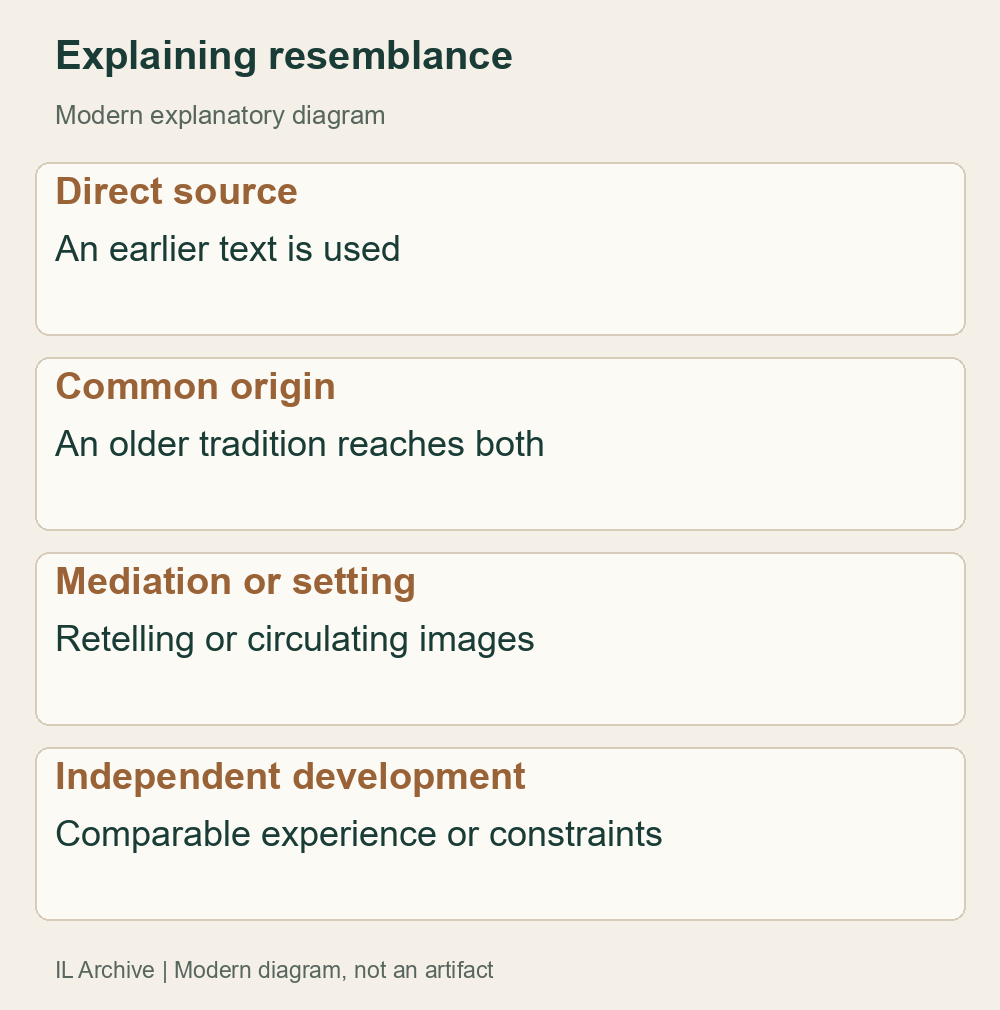
A text may use another directly. Both may inherit an older shared traditionShared traditionInherited material reaching several texts without direct dependence between them.Glossary · Click to read the explanation. Material may pass through intermediaries or retellings. A cultural setting may circulate similar images without a single written source. Independent developmentIndependent developmentSimilar elements arising without historical transmission between them.Glossary · Click to read the explanation may arise from comparable experiences or constraints.
These possibilities are not equally plausible in every case or always mutually exclusive. A tradition can have a common origin and later exchanges within it. Comparison asks which explanation best accounts for the full evidence, including differences.
Three dates, not one
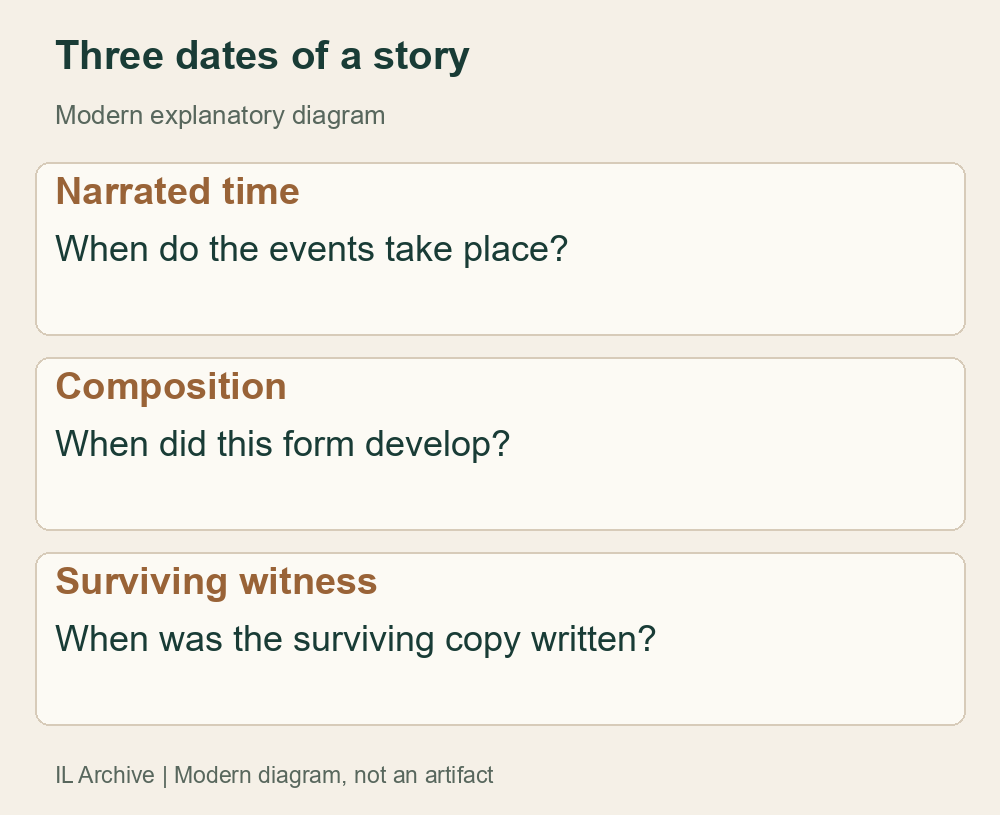
Dating textsDating textsDistinguishing narrated time, composition and surviving copy.Glossary · Click to read the explanation requires separating the time narrated, the formation or composition of the story, and the surviving copy. A story about an ancient king can be composed centuries later; a late tablet can reproduce an older tradition.
Archaeology dates a material witness. The age of the narrative requires further linguistic, textual and historical arguments. An early protagonist does not date every detail, and a late copy does not prove the story began when that copy was written.
Sargon: the king and the birth legend
Sargon of AkkadSargon of AkkadThird-millennium BCE king associated with later birth and ascent traditions.Glossary · Click to read the explanation was a third-millennium BCE king. The well-known witness to his birth legend, K 3401 and associated fragments, comes from Neo-Assyrian NinevehNineveh and KuyunjikNineveh is an ancient Assyrian city near Mosul in northern Iraq; Kuyunjik is one of its archaeological moundsGlossary · Click to read the explanation. A story about Sargon is not thereby a document from his lifetime. [4]
Proposals about the story’s composition or political use in Assyrian times differ from dating the tablet. Comparing it with Moses’ infancy requires dating witnesses and traditions, rather than contrasting the king’s lifetime with an assumed lifetime of Moses. [5]
Moses and Sargon: likeness and difference
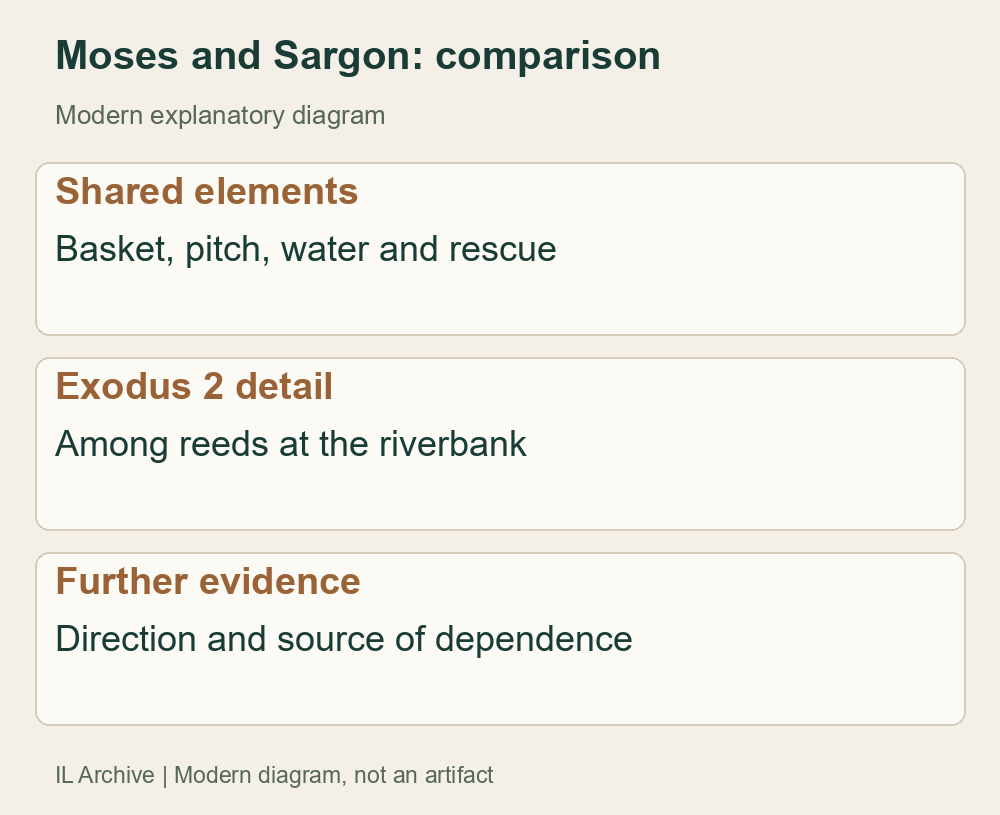
The plant basket, pitch, water, rescue and eventual prominence form a meaningful comparison. Exodus 2, however, does not say Moses’ mother launched the basket into the current. She placed it among reeds at the bank; his sister watched. Pharaoh’s daughter intervened, and the child returned to his mother for nursing before adoption. [5] [6]
Removing those details makes the comparison easier and weaker. The endangered-child tradition and its different uses deserve study, but direct dependence and direction require more evidence.
Priority permits transmission without proving it
For a particular textual form to supply another, it must have existed earlier or been available during that other form’s composition. This is a chronological requirement of the hypothesis, not proof that transmission occurred.
The earliest surviving witness may postdate the tradition’s origin. “An earlier witness,” “a probably earlier composition” and “a possible earlier tradition” are different claims. Confusing them can create a false directional arrow where the relative age of the compared passages remains uncertain.
Was there a route between the settings?
Trade, war, migration, exile, multilingualism and scribes provide possible routes. Geographic proximity alone is insufficient: who encountered whom, when, in which language, and what material could that encounter carry?
CuneiformCuneiformWriting with wedge-shaped signs, developed from Mesopotamian recording traditions and used for several languages from the third millennium BCE.Glossary · Click to read the explanation documents attest Judeans in Babylonia during the Neo-Babylonian and Persian periods. This matters for historical contact, but does not itself identify a carrier of the flood narrative or place every Mesopotamian parallel in the Exile. [7]
Contact is not the arrival of a text
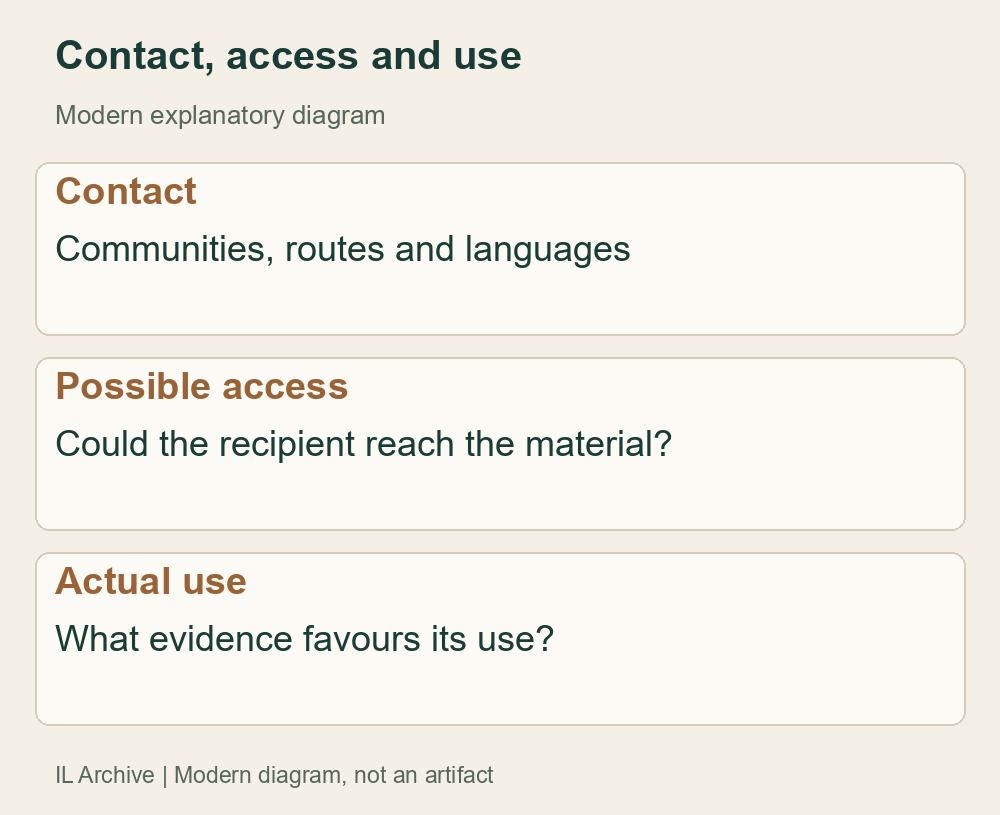
A community can live abroad without reading the local literature. A translated or oral story can reach someone unable to read its source script. Population contact, access to material and actual use therefore require separate consideration.
Evidence of language learning or a work’s circulation increases probable availability without proving use of a particular passage. Conversely, the lack of a written receipt cannot erase a relationship supported by strong evidence. We seek a plausible route without inventing its missing travellers.
A single motif and a complex pattern
A literary motifLiterary motifRecurring narrative element whose presence alone does not establish dependence.Glossary · Click to read the explanation is a recurring element such as an endangered child, dream or flood. Its presence in two texts may be unremarkable. An unusual cluster of details and specific relationships can make historical connection more probable.
Raw counts mislead. Boat, passengers and sailing are not three fully independent proofs: some imply others. Consider rarity, interdependence and distribution across other works. Emily West discusses such criteria while warning against treating them as an agreed automatic test. [2]
An invented example to clarify the difference
Imagine two kings dreaming in an invented teaching example, not an archaeological text. That likeness is weak. If both dreams contain a lion crossing a river against the current, followed by an interpreter rearranging three objects in the same unusual way, the question becomes more substantial.
Even then direct borrowing is not proved: both writers might know a third story. A detail matters because it helps distinguish explanations, rather than merely being strange or sharing many words.
Sequence and narrative function
Identical elements need not perform identical roles. A warning before catastrophe differs from an explanation afterwards; a sacrifice reconciling gods differs from a scene establishing a lasting human covenant.
The argument strengthens when relationships among elements correspond. Adaptation can nonetheless change sequence and function. Such changes require explanation within the receiving text; every difference is not automatically evidence of deliberate rewriting. Adaptation itself needs supporting evidence.
The flood: a group of witnesses
We have a Sumerian narrative about ZiusudraZiusudraKing and priest in the fragmentary Sumerian Flood Story, preserved in an Old Babylonian copy. Survives, sacrifices and receives divine life in Dilmun; historicity is unproven.Glossary · Click to read the explanation, AtrahasisAtrahasis: Epic and HeroAkkadian epic: humans created for divine labor, multiplication, noise and flood. Atrahasis, “exceedingly wise,” survives through Enki’s warning; human reproduction is regulated afterward.Glossary · Click to read the explanation with an Old Babylonian witness from Ammi-saduqa’s reign, UtnapishtimUtnapishtimGilgamesh’s flood hero narrates survival to a king seeking immortality. Ea warns him; life is preserved; hero and wife receive exceptional life. Literary character, not an archaeologically established person.Glossary · Click to read the explanation’s story in GilgameshEpic of GilgameshMesopotamian literary tradition with multiple versions, concerning Uruk’s king, Enkidu and mortality. Standard Tablet XI preserves Utnapishtim’s flood; manuscript date does not date the tradition’s origin.Glossary · Click to read the explanation Tablet XI, and Noah in Genesis. These are distinct works and copies, not a single “Sumerian text.” [8] [9] [11] [12]
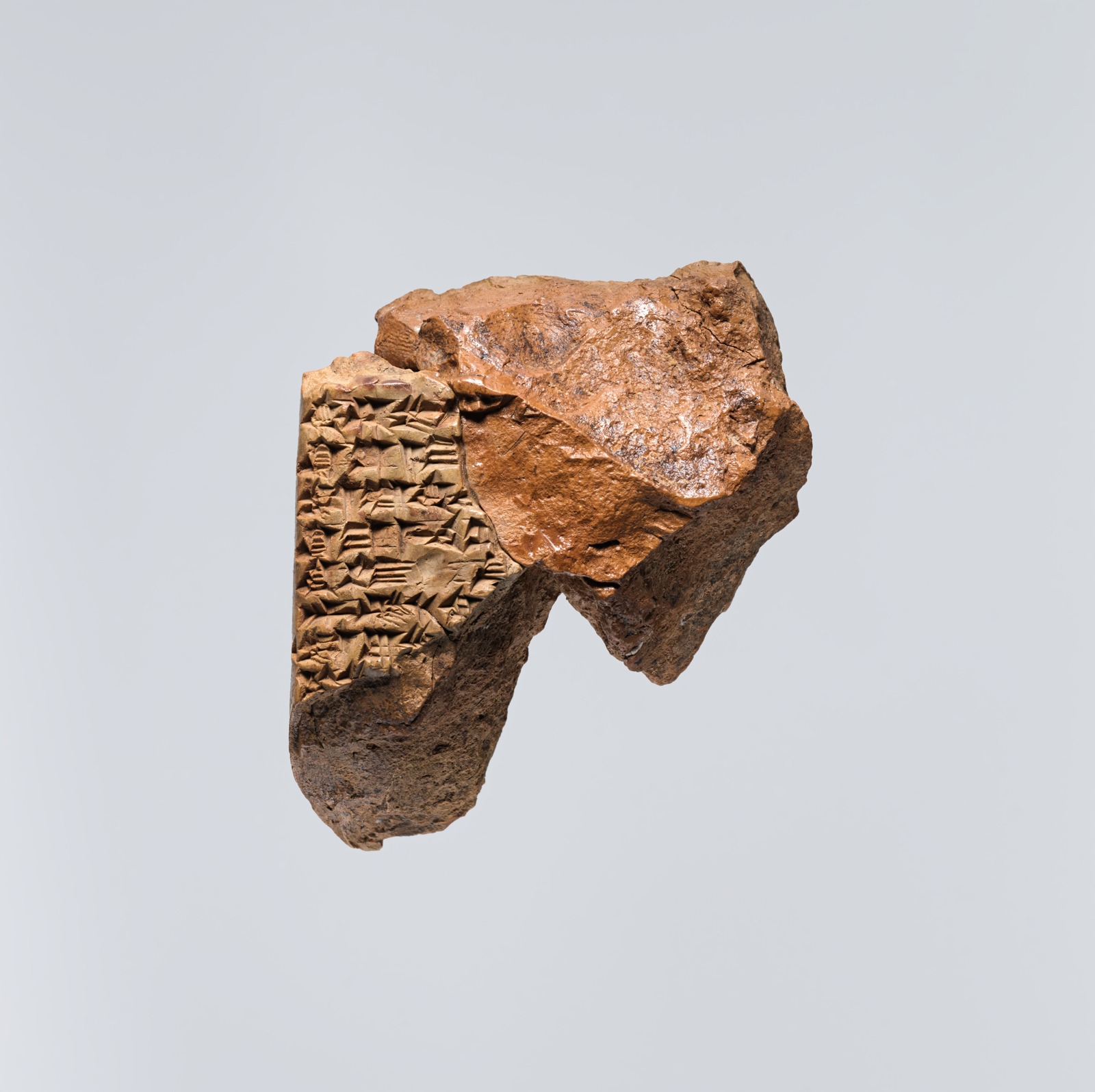
Mesopotamian witnesses preserve flood traditions long before Genesis’ final form. Dating each detail and identifying a direct source remain further questions. The photographed tablet dates approximately to the seventh–sixth centuries BCE: its age does not date the beginning of the Atrahasis tradition. [17]
![Atrahasis-tradition fragment, Met 86.11.378a, c. seventh–sixth centuries BCE. A later witness, not the tradition’s starting date. [17]](/media/1656)
Flood details: correspondence and difference
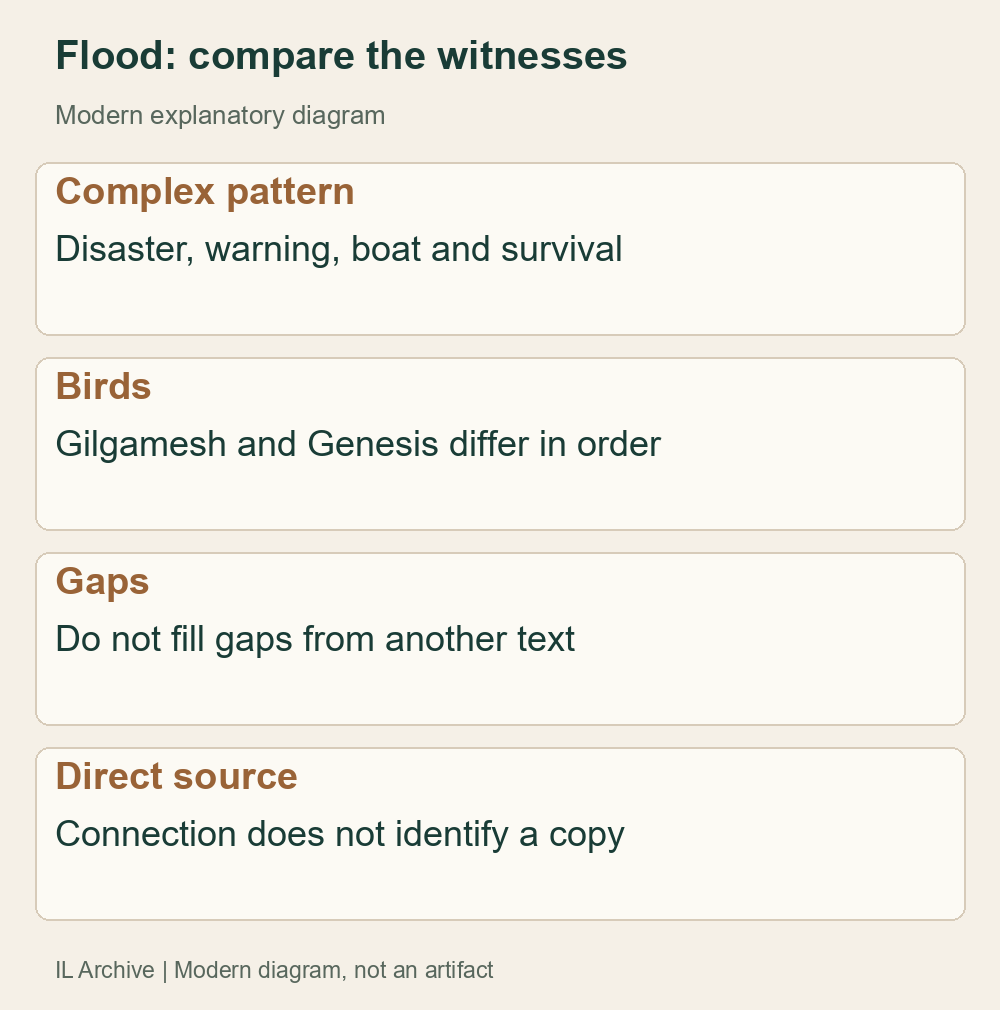
Divine catastrophe, warning a survivor, building a boat, preserving life, receding water and a sacrifice form a richer comparison than a flood alone. Every narrative does not preserve every element, and some tablets are damaged. [8] [11] [12] [13]
Bird release is clear in Gilgamesh and Genesis. Gilgamesh sends a dove, swallow and raven; Genesis sends a raven followed by repeated dove trials. The surviving Ziusudra passages do not attest this scene. Absence from preserved evidence cannot settle what missing portions contained. [8] [11] [13]
The catastrophe’s cause and the story’s ending
Atrahasis links its crises to human increase and, in the familiar interpretation, noise disturbing the deity; the flood is followed by measures governing humanity’s continuation. Genesis grounds judgment in wickedness and violence, then connects survival with a promise and covenant with NoahThe Noahic Covenant in GenesisGenesis 9’s covenant with Noah, descendants and all living creatures, marked by the bow in the clouds and a promise against another destroying flood.Glossary · Click to read the explanation, his descendants and living beings. [10] [12] [14]
Gilgamesh depicts conflicting divine attitudes towards disaster and the survivor. Genesis does not retain that division among divine persons, yet combines judgment, grief and promised continuity. Structural resemblance does not erase transformed meaning. [11] [12] [13]
Within Mesopotamia: closer literary relations
Comparing Atrahasis with the Gilgamesh flood does not rest on boat and catastrophe alone. Closely corresponding passages and expressions within an AkkadianAkkadianAn ancient East Semitic language written in cuneiform in Mesopotamia.Glossary · Click to read the explanation written tradition strengthen probable literary reuse. Alan Millard highlighted this relationship in his study of Atrahasis. [18]
This is stronger evidence than juxtaposing geographically distant flood stories. Even so, reuse does not necessarily identify the exact copy available to a writer or imply that the whole narrative passed unchanged.
El’s council and Yahweh’s council
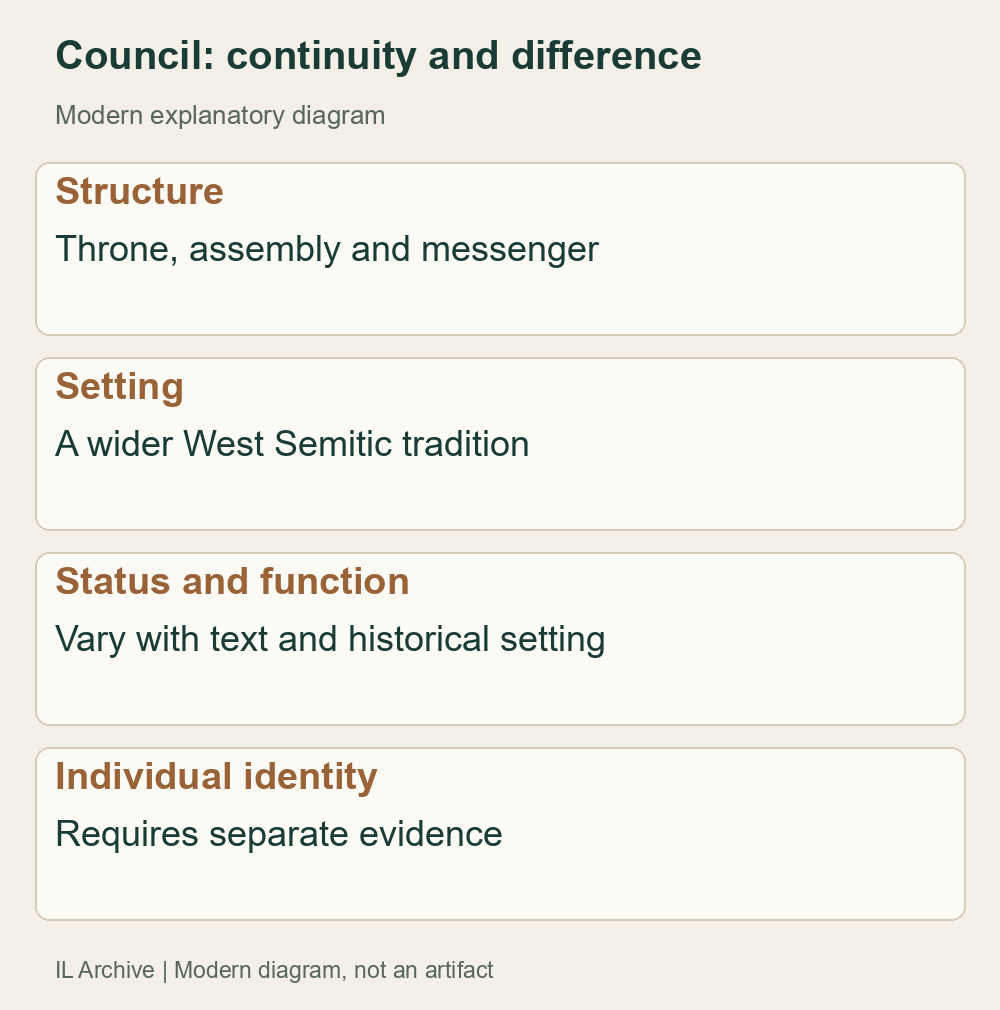
UgaritUgaritAncient city and kingdom at Ras Shamra on the Syrian coast, flourishing between the fourteenth and early twelfth centuries BCE and preserving multilingual archives.Glossary · Click to read the explanation presents ElEl at UgaritA deity prominent in West Semitic traditions, especially as head of the divine family in Ugaritic texts.Glossary · Click to read the explanation within a divine community described through family and council. HebrewHebrewA Northwest Semitic language in the Canaanite group, with ancient and modern forms.Glossary · Click to read the explanation texts contain heavenly groups and phrases such as sons of GodSons of GodA Hebrew expression for heavenly beings in texts such as Job; context determines its meaning, rather than biological descent or a fixed angelic roster.Glossary · Click to read the explanation and assembly of El, with YahwehYahwehThe divine proper name written YHWH in the Hebrew Bible.Glossary · Click to read the explanation presiding in several scenes. This is an important West Semitic comparison. [15] [16]
It does not establish an Israelite writer copying a Ugaritic tablet. The divine councilDivine councilA representation of divine beings acting as an assembly with authority and differentiated roles.Glossary · Click to read the explanation model extends beyond one city; the relationship may involve regional continuity. Ellen White cautions against imposing a ready-made Ugaritic scheme on every Hebrew scene before examining its particular features. [15]
Council members are not interchangeable
Throne, assembly and messenger can persist while surrounding beings change status. In a heavenly reading of Psalm 82, the presiding deity judges beings called gods and announces their death. That differs from a divine family simply gathering. A human-judges interpretation also exists and belongs in discussion of the psalm. [16]
Structural continuity cannot prove that each later angel was a particular Ugaritic deity. Every proposed identity requires separate evidence. Resembling councils do not provide a conversion table of their members.
Read the whole before extracting parallels
Two works can invoke a divine father while one discusses divine genealogy and the other protection of a people. A heavenly messenger can appear in both, yet serve worship in one scene and political disaster in another.
Ask about genre, speaker, audience, position and surrounding argument. Record differences beside correspondences. Comparison then becomes reviewable, instead of treating texts as containers from which to select whatever supports a desired conclusion.
When is independent development plausible?
Death, birth, sun, water, illness and power are widespread experiences. Two societies can imagine an animate sun or a king representing heaven without exchanging a specific story. Rescue from water also makes a boat an unsurprising narrative element.
This does not reduce every likeness to coincidence. It asks how much the subject and setting already predict. Unusual relationships and details not required by the experience make historical connection a more competitive explanation.
Lost texts and oral transmission
The earliest copy is not necessarily the first formulation. An earlier story may be lost, or oral transmissionOral transmissionCirculation through performance and hearing, potentially involving change.Glossary · Click to read the explanation may connect witnesses. These are reasonable possibilities given the limited survival of ancient literature.
Possible loss does not establish the specific missing source we need. We cannot invent a text and then use it as evidence, or answer every objection with an unattested intermediary. A good hypothesis identifies the gap, seeks nearby evidence and remains open to revision.
Could stories remember the same event?
Several narratives might preserve memories of a real event, such as a local flood, while interpreting it differently. Literary relationship and the event’s occurrence remain separate questions. Similar flood stories do not prove a worldwide inundation.
Identifying a common event requires independent evidence of deposits, location, date and geographic extent, followed by a cautious connection to the stories. One event can generate independent accounts; related accounts can move far from the event behind them.
Six practical questions for comparison
Six questions organize the inquiry: how are witnesses and compared forms dated? Was there contact and plausible access? Which distinctive details correspond? How are they related and ordered? What functions and differences do they have? Which alternative best explains the evidence with fewer assumptions?
This is a working tool for this study, not a universal academic rule with six equally necessary boxes. One line of evidence may be strong while another is unavailable. Weigh the combined arguments and state what they cannot settle. [2] [3]
Selecting examples after choosing the conclusion
Searching thousands of works and showing only the closest three hides how common supposedly rare elements are. Dividing one scene into ten overlapping points can also inflate the evidence.
Explain text selection, compare other examples of the same subject and report discordant details. This tests whether a pattern distinguishes this relationship or belongs broadly to literature. An invented probability is unnecessary; transparent description of comparisons and exclusions is essential.
Relationship and direction are different questions
Verbal or structural correspondence can make a relationship highly probable while its direction remains disputed. Choosing the better-known text or earliest manuscript automatically will not resolve that dispute.
Look for a passage presupposing what another explains, signs of adaptation to a new context and independent dating where possible. Evidence can conflict or fit a common source. Cooper Smith’s conclusion calls for weighing several arguments rather than allowing one criterion to decide every case. [3]
Certainty belongs to a specific claim
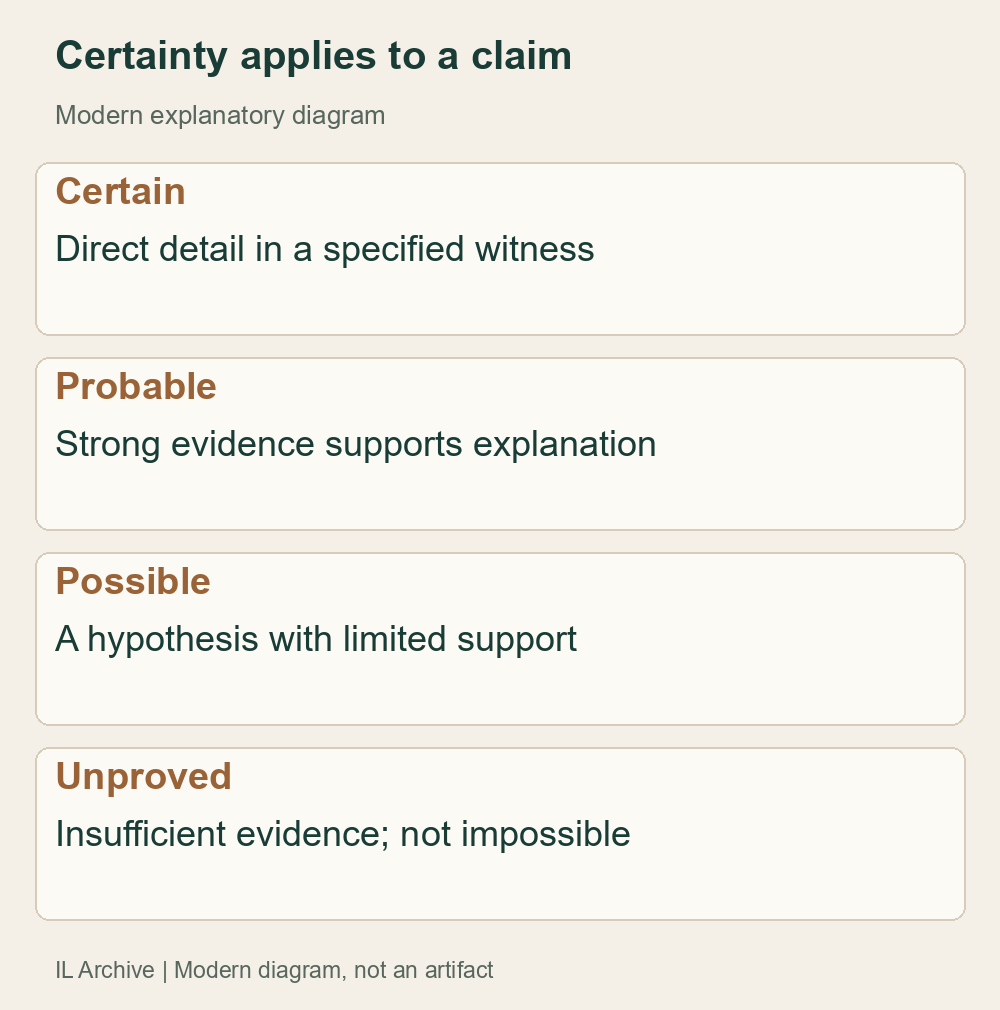
It can be certain that two texts preserve birds and a boat, probable that their traditions are related, possible that oral mediation connected them, and unproved that a writer copied a particular tablet. These judgments coexist because they concern different claims.
Use “certain” for specified direct evidence, “probable” for converging strong support, “possible” for limited support and “unproved” where evidence is insufficient. Unproved does not mean impossible. Each judgment should include its reasons and limits.
Borrowing, adaptation and moral judgment
Borrowing describes a historical relationship, not an automatic charge of plagiarism. A familiar subject can be retold for another theology, reversed or integrated into a new work. Inquiry concerns how that happened and what changed.
Demonstrating connection does not erase the receiving work’s distinctiveness, and distinctiveness does not exclude connection. Claims of polemical rewriting or deliberate reversal nevertheless require evidence of context and purpose, beyond finding a difference between stories.
Three examples with different judgments
Moses and Sargon offer a meaningful cluster of parallels, but a basket alone cannot settle direct dependence or direction. Flood witnesses and connected details strongly favour a relationship with Mesopotamian traditions, while the route into Genesis and exact source remain unproved. [5] [6] [8] [11] [12] [13]
For the heavenly council, continuity with the West Semitic world is a strong explanation; copying a particular Ugaritic tablet is unestablished. These are the comparative judgments of this study, rather than one verdict imposed on every pair of texts. [15] [16]
From parallels to a reviewable argument
Resemblance matters, but requires history, context and alternatives. A good argument identifies witnesses, separates their dates, presents likenesses and differences, and explains exactly which relationship it favours and why.
Establishing a tradition’s continuity can be a substantial result even without naming its carrier or reconstructing its entire route. A comparison need not become a story of direct copying to matter. Keeping evidence distinct from explanation makes intellectual history more precise and more responsive to new discoveries.
References and notes
- Samuel Sandmel, “Parallelomania”, JBL 81/1 (1962), pp. 1–13 Indexed opening and context passages read; full article not directly accessible. He did not claim to coin the word. Return to the text ↑
- Emily West, “The Transformation of Cyavana: A Case Study in Narrative Evolution”, Oral Tradition 31/1 (2017), pp. 77–122 pp. 77–81, especially p. 78: comparison criteria and their limits. Tigay 1993 is reported through West, not directly read. Return to the text ↑
- Cooper Smith, “Inner-Biblical Allusion and the Direction of Dependence”, Journal of Hebrew Scriptures 22, article 6 (issue 2022; online 2023) Introduction and conclusion, pp. 25–26: relationship before direction; criteria are neither equally strong nor universally applicable. Return to the text ↑
- CDLI, P365306, K 03401 + Sm 2118: Sargon birth legend Artifact metadata: Nineveh, Neo-Assyrian period; witness date differs from Sargon’s lifetime. Return to the text ↑
- James A. Loader, “The beautiful infant and Israel’s salvation”, HTS 67/1 (2011), article 913 Introduction and infant-Moses section: comparison and scholarly interpretations; direct dependence not presented as consensus. Return to the text ↑
- Exodus 2:1–10, Hebrew text and JPS English translation Verses 1–10: reed basket, pitch, reeds at the bank, sister, nursing and adoption; analytical paraphrase. Return to the text ↑
- Laurie E. Pearce, “Cuneiform Sources for Judeans in Babylonia …: An Overview”, Religion Compass 10/9 (2016), pp. 230–243 Author’s abstract and bibliography: Judeans in Babylonian society and economy; no specific narrative transfer established. Return to the text ↑
- ETCSL 1.7.4, The Flood Story, University of Oxford Published translation, segments A–E; Ziusudra witness is damaged and preserved passages do not attest bird release. Return to the text ↑
- CDLI, P285811: Old Babylonian Atrahasis witness Artifact record and Ammi-saduqa year 12; absolute date depends on chronology. Return to the text ↑
- A. R. George and F. N. H. Al-Rawi, “Tablets from the Sippar Library VI. Atra-ḫasīs”, Iraq 58 (1996), pp. 147–190 Available/indexed opening, p. 147: creation, reproduction, plagues, drought, famine and flood; full edition not read. Return to the text ↑
- Alexander Heidel, The Gilgamesh Epic and Old Testament Parallels, 2nd ed. (1949), Tablet XI translation Translation, pp. 81–87: warning, boat, survivors, birds and sacrifice; older academic translation, not endorsement of every interpretation. Return to the text ↑
- Genesis 6:5–22, Hebrew text and JPS English translation Wickedness, violence, ark and survival; not independent proof of a global event. Return to the text ↑
- Genesis 8, Hebrew text and JPS English translation Verses 4–12 and 20–22: landing, raven and dove, sacrifice and promise; bird sequence differs from Gilgamesh. Return to the text ↑
- Genesis 9:8–17, Hebrew text and JPS English translation Covenant with Noah, descendants and living beings; narrative function in Genesis. Return to the text ↑
- Ellen White, Yahweh’s Council: Its Structure and Membership (2014), publisher preview Chapter 1, pp. 1–4: Ugaritic comparison and risk of imposing its structure on Hebrew texts; not the complete book. Return to the text ↑
- Psalm 82, Hebrew text and JPS English translation Whole psalm; comparative reading of Hebrew terms distinguished from JPS’s “judges” interpretation in verse 1. Return to the text ↑
- The Metropolitan Museum of Art, 86.11.378a: Atrahasis-tradition fragment Catalogue, image and Open Access metadata: c. seventh–sixth centuries BCE; not Old Babylonian witness or the famous Gilgamesh tablet. Return to the text ↑
- A. R. Millard, The Atra-ḫasīs Epic and Its Place in Babylonian Literature (MPhil thesis, 1965), SOAS Indexed abstract, chapter VI: identical passages and probable reuse in Gilgamesh; full thesis not read. Return to the text ↑
Suggest a correction · Suggest a source for this record
Cite this record
IL Archive, «Resemblance Does Not Establish Borrowing», Edition 1, https://ilarchive.com/en/studies/similarity-and-borrowing
Continue reading


![Gold coin of Ptolemy II, Alexandria, ca. 261–246 BCE; the illustrated obverse bears Arsinoe II’s head. Context for Hellenistic Egypt, not a portrait of Philo or proof of a Torah translation commission. [24]](/media/1436)